

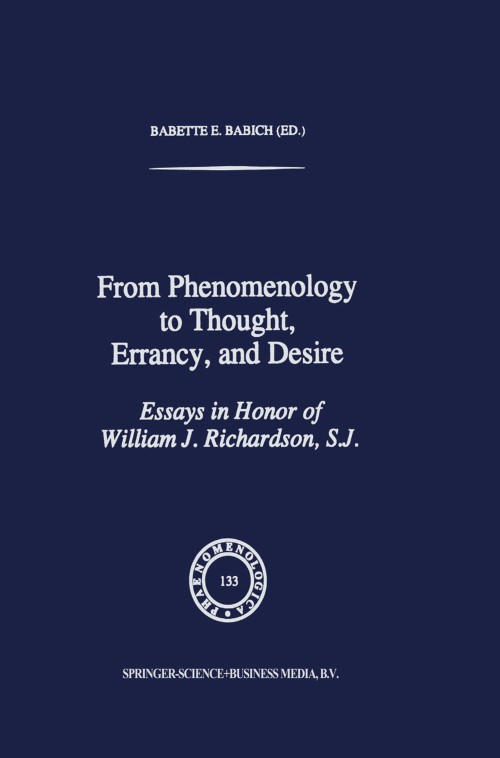
From Phenomenology to Thought, Errancy, and Desire [electronic resource] : Essays in Honor of William J. Richardson, S.J. / edited by B.E. Babich.
Erişim Adresi
ISBN
9789401716246
Dil Kodu
İngilizce
Yer Numarası
DK/15949
Basım Bildirimi
1st ed. 1995.
Yayın Bilgisi
Dordrecht : Springer Netherlands : Imprint: Springer, 1995.
Fiziksel Niteleme
XV, 640 p. online resource.
Dizi
Phaenomenologica, Series Founded by H. L. Van Breda and Published Under the Auspices of the Husserl-Archives, 2215-0331 ; 133
İçindekiler Notu
I: Essays on the Early Heidegger, the Late Heidegger, Heidegger I/II, the Beiträge -- Through Phenomenology to Concealment -- Authenticity, Poetry, God -- The Power of Essential Thinking in Heidegger’s Beiträge zur Philosophie (Vom Ereignis) -- Raising Atlantis: The Later Heidegger and Contemporary Philosophy -- Surplus Being: The Kantian Legacy -- Existenz in Incubation Underway Toward Being and Time -- „Gelassenheit“ bei Heidegger und Meister Eckhart -- “Heidegger I,” “Heidegger II,” and Beiträge zur Philosophie (Vom Ereignis) -- Reticence and Resonance in the Work of Translating -- Das Gewesen: Remembering the Fordham Years -- II: Through Phenomenology to Thinking: The Turning of the Existential Question -- Die existenzdialektische Grundvoraussetzung der Verzweiflungsanalyse Kierkegaards -- Profile -- The Turn -- The Call -- Letter to Bill Richardson -- Ein Versuch über Herkunft und Zukunft in der „Frömmigkeit des Denkens“ im Hinblick auf Martin Heidegger -- Desire — (The) Passion -- III: The Political and the Philosophical: Arrant Errancy -- Dark Hearts: Heidegger, Richardson, and Evil -- Heidegger’s Fall -- “I Will Tell You Who You Are.” Heidegger on Greco-German Destiny and Amerikanismus -- The Uses and Abuses of Aristotle’s Rhetoric in Heidegger’s Fundamental Ontology: The Lecture Course, Summer 1924 -- Power, Language, and Desire -- On Empty and Full Speech: Intelligibility and Change in the Public World -- Reading the Case of Christopher -- IV: The Ethics of Desire: Philosophy and Psychoanalysis -- Lacan and Heidegger: The Ethics of Desire and The Ethics of Authenticity -- “Now You See It ... :” The Dynamics of Presence and Absence in Psychoanalysis -- Myth, Ritual, Desire, and Gender -- Adaequatio Sexualis: Is There a Measure of Sexual Difference?.-Schreber and Hölderlin: The Concept of “A-Father” -- Hegel, Lacan, Deleuze: Three Strange Bedfellows -- Ontical Craving versus Ontological Desire -- V: Psychoanalysis, Science, and the World: Calculation, View, Transfiguration -- Reflections on the “Foundations” of Psychology and Psychoanalysis -- Heidegger and Freud -- The Science Thing -- Heidegger’s Longest Day: Twenty-Five Years Later -- Heidegger’s Philosophy of Science: Calculation, Thought, and Gelassenheit -- The World as a Whole -- Supplement -- Martin Heidegger (Full text of a reference article originally prepared for the Supplement to the Encyclopaedia of Philosophy) -- Contributors -- Index of Names.
Özet, vb.
For both continental and analytic styles of philosophy, the thought of Martin Heidegger must be counted as one of the most important influences in contemporary philosophy. In this book, essays by internationally noted scholars, ranging from David B. Allison to Slavoj Zizek, honour the interpretive contributions of William J. Richardson's pathbreaking Heidegger: Through Phenomenology to Thought. The essays move from traditional phenomenology to the idea of essential (another) thinking, the questions of translation and existential expressions of the turn of Heidegger's thought, the intersection of politics and language, the philosophic significance of Jacques Lacan, and several essays on science and technology. All show the influence of Richardson's first study. A valuable emphasis appears in Richardson's interpretation of Heidegger's conception of die Irre, interpreted as Errancy, set in its current locus in a discussion of Heidegger's debacle with the political in his involvement with National Socialism.
Konu
Phenomenology .
Philosophy, Modern.
Science __ Philosophy.
Public health.
Phenomenology.
Early Modern Philosophy.
Philosophy of Science.
Public Health.
Philosophy, Modern.
Science __ Philosophy.
Public health.
Phenomenology.
Early Modern Philosophy.
Philosophy of Science.
Public Health.
Diğer Yazarlar
Kurum Adı
Eseri Alıntıla
Referansları kullanmadan önce gözden geçirmeniz ve varsa gerekli düzeltmeleri yapmanız önerilir.
Dijital Kaynak
MARC Görünümü
LEADER 06394nam a22006015i 4500
001 814711
003 TR_AnAIT
005 20260130214514
007 cr nn 008mamaa
008 130321s1995 ne | s |||| 0|eng d
020 |a9789401716246|9978-94-017-1624-6
024 7 |a10.1007/978-94-017-1624-6|2doi
041 |aeng
049 |aTürk Tarih Kurumu Kütüphanesi
050 4|aB829.5.A-Z
072 7|aHPCF3|2bicssc
072 7|aPHI018000|2bisacsh
072 7|aQDHR5|2thema
082 04|a142.7|223
090 |aDK/15949
245 10|aFrom Phenomenology to Thought, Errancy, and Desire|h[electronic resource] :|bEssays in Honor of William J. Richardson, S.J. /|cedited by B.E. Babich.
250 |a1st ed. 1995.
264 1|aDordrecht :|bSpringer Netherlands :|bImprint: Springer,|c1995.
300 |aXV, 640 p.|bonline resource.
336 |atext|btxt|2rdacontent
337 |acomputer|bc|2rdamedia
338 |aonline resource|bcr|2rdacarrier
347 |atext file|bPDF|2rda
490 1 |aPhaenomenologica, Series Founded by H. L. Van Breda and Published Under the Auspices of the Husserl-Archives,|x2215-0331 ;|v133
505 0 |aI: Essays on the Early Heidegger, the Late Heidegger, Heidegger I/II, the Beiträge -- Through Phenomenology to Concealment -- Authenticity, Poetry, God -- The Power of Essential Thinking in Heidegger’s Beiträge zur Philosophie (Vom Ereignis) -- Raising Atlantis: The Later Heidegger and Contemporary Philosophy -- Surplus Being: The Kantian Legacy -- Existenz in Incubation Underway Toward Being and Time -- „Gelassenheit“ bei Heidegger und Meister Eckhart -- “Heidegger I,” “Heidegger II,” and Beiträge zur Philosophie (Vom Ereignis) -- Reticence and Resonance in the Work of Translating -- Das Gewesen: Remembering the Fordham Years -- II: Through Phenomenology to Thinking: The Turning of the Existential Question -- Die existenzdialektische Grundvoraussetzung der Verzweiflungsanalyse Kierkegaards -- Profile -- The Turn -- The Call -- Letter to Bill Richardson -- Ein Versuch über Herkunft und Zukunft in der „Frömmigkeit des Denkens“ im Hinblick auf Martin Heidegger -- Desire — (The) Passion -- III: The Political and the Philosophical: Arrant Errancy -- Dark Hearts: Heidegger, Richardson, and Evil -- Heidegger’s Fall -- “I Will Tell You Who You Are.” Heidegger on Greco-German Destiny and Amerikanismus -- The Uses and Abuses of Aristotle’s Rhetoric in Heidegger’s Fundamental Ontology: The Lecture Course, Summer 1924 -- Power, Language, and Desire -- On Empty and Full Speech: Intelligibility and Change in the Public World -- Reading the Case of Christopher -- IV: The Ethics of Desire: Philosophy and Psychoanalysis -- Lacan and Heidegger: The Ethics of Desire and The Ethics of Authenticity -- “Now You See It ... :” The Dynamics of Presence and Absence in Psychoanalysis -- Myth, Ritual, Desire, and Gender -- Adaequatio Sexualis: Is There a Measure of Sexual Difference?.-Schreber and Hölderlin: The Concept of “A-Father” -- Hegel, Lacan, Deleuze: Three Strange Bedfellows -- Ontical Craving versus Ontological Desire -- V: Psychoanalysis, Science, and the World: Calculation, View, Transfiguration -- Reflections on the “Foundations” of Psychology and Psychoanalysis -- Heidegger and Freud -- The Science Thing -- Heidegger’s Longest Day: Twenty-Five Years Later -- Heidegger’s Philosophy of Science: Calculation, Thought, and Gelassenheit -- The World as a Whole -- Supplement -- Martin Heidegger (Full text of a reference article originally prepared for the Supplement to the Encyclopaedia of Philosophy) -- Contributors -- Index of Names.
520 |aFor both continental and analytic styles of philosophy, the thought of Martin Heidegger must be counted as one of the most important influences in contemporary philosophy. In this book, essays by internationally noted scholars, ranging from David B. Allison to Slavoj Zizek, honour the interpretive contributions of William J. Richardson's pathbreaking Heidegger: Through Phenomenology to Thought. The essays move from traditional phenomenology to the idea of essential (another) thinking, the questions of translation and existential expressions of the turn of Heidegger's thought, the intersection of politics and language, the philosophic significance of Jacques Lacan, and several essays on science and technology. All show the influence of Richardson's first study. A valuable emphasis appears in Richardson's interpretation of Heidegger's conception of die Irre, interpreted as Errancy, set in its current locus in a discussion of Heidegger's debacle with the political in his involvement with National Socialism.
532 8 |aAccessibility summary: This PDF is not accessible. It is based on scanned pages and does not support features such as screen reader compatibility or described non-text content (images, graphs etc). However, it likely supports searchable and selectable text based on OCR (Optical Character Recognition). Users with accessibility needs may not be able to use this content effectively. Please contact us at accessibilitysupport@springernature.com if you require assistance or an alternative format.
532 8 |aInaccessible, or known limited accessibility
532 8 |aNo reading system accessibility options actively disabled
532 8 |aPublisher contact for further accessibility information: accessibilitysupport@springernature.com
650 0|aPhenomenology .
650 0|aPhilosophy, Modern.
650 0|aScience|xPhilosophy.
650 0|aPublic health.
650 14|aPhenomenology.
650 24|aEarly Modern Philosophy.
650 24|aPhilosophy of Science.
650 24|aPublic Health.
700 1 |aBabich, B.E.|eeditor.|4edt|4http://id.loc.gov/vocabulary/relators/edt
710 2 |aSpringerLink (Online service)
773 0 |tSpringer Nature eBook
776 08|iPrinted edition:|z9780792335672
776 08|iPrinted edition:|z9789048145768
776 08|iPrinted edition:|z9789401716253
830 0|aPhaenomenologica, Series Founded by H. L. Van Breda and Published Under the Auspices of the Husserl-Archives,|x2215-0331 ;|v133
856 40|uhttps://doi.org/10.1007/978-94-017-1624-6
912 |aZDB-2-SHU
912 |aZDB-2-SXPR
912 |aZDB-2-BAE
950 |aHumanities, Social Sciences and Law (SpringerNature-11648)
950 |aPhilosophy and Religion (R0) (SpringerNature-43725)
001 814711
003 TR_AnAIT
005 20260130214514
007 cr nn 008mamaa
008 130321s1995 ne | s |||| 0|eng d
020 |a9789401716246|9978-94-017-1624-6
024 7 |a10.1007/978-94-017-1624-6|2doi
041 |aeng
049 |aTürk Tarih Kurumu Kütüphanesi
050 4|aB829.5.A-Z
072 7|aHPCF3|2bicssc
072 7|aPHI018000|2bisacsh
072 7|aQDHR5|2thema
082 04|a142.7|223
090 |aDK/15949
245 10|aFrom Phenomenology to Thought, Errancy, and Desire|h[electronic resource] :|bEssays in Honor of William J. Richardson, S.J. /|cedited by B.E. Babich.
250 |a1st ed. 1995.
264 1|aDordrecht :|bSpringer Netherlands :|bImprint: Springer,|c1995.
300 |aXV, 640 p.|bonline resource.
336 |atext|btxt|2rdacontent
337 |acomputer|bc|2rdamedia
338 |aonline resource|bcr|2rdacarrier
347 |atext file|bPDF|2rda
490 1 |aPhaenomenologica, Series Founded by H. L. Van Breda and Published Under the Auspices of the Husserl-Archives,|x2215-0331 ;|v133
505 0 |aI: Essays on the Early Heidegger, the Late Heidegger, Heidegger I/II, the Beiträge -- Through Phenomenology to Concealment -- Authenticity, Poetry, God -- The Power of Essential Thinking in Heidegger’s Beiträge zur Philosophie (Vom Ereignis) -- Raising Atlantis: The Later Heidegger and Contemporary Philosophy -- Surplus Being: The Kantian Legacy -- Existenz in Incubation Underway Toward Being and Time -- „Gelassenheit“ bei Heidegger und Meister Eckhart -- “Heidegger I,” “Heidegger II,” and Beiträge zur Philosophie (Vom Ereignis) -- Reticence and Resonance in the Work of Translating -- Das Gewesen: Remembering the Fordham Years -- II: Through Phenomenology to Thinking: The Turning of the Existential Question -- Die existenzdialektische Grundvoraussetzung der Verzweiflungsanalyse Kierkegaards -- Profile -- The Turn -- The Call -- Letter to Bill Richardson -- Ein Versuch über Herkunft und Zukunft in der „Frömmigkeit des Denkens“ im Hinblick auf Martin Heidegger -- Desire — (The) Passion -- III: The Political and the Philosophical: Arrant Errancy -- Dark Hearts: Heidegger, Richardson, and Evil -- Heidegger’s Fall -- “I Will Tell You Who You Are.” Heidegger on Greco-German Destiny and Amerikanismus -- The Uses and Abuses of Aristotle’s Rhetoric in Heidegger’s Fundamental Ontology: The Lecture Course, Summer 1924 -- Power, Language, and Desire -- On Empty and Full Speech: Intelligibility and Change in the Public World -- Reading the Case of Christopher -- IV: The Ethics of Desire: Philosophy and Psychoanalysis -- Lacan and Heidegger: The Ethics of Desire and The Ethics of Authenticity -- “Now You See It ... :” The Dynamics of Presence and Absence in Psychoanalysis -- Myth, Ritual, Desire, and Gender -- Adaequatio Sexualis: Is There a Measure of Sexual Difference?.-Schreber and Hölderlin: The Concept of “A-Father” -- Hegel, Lacan, Deleuze: Three Strange Bedfellows -- Ontical Craving versus Ontological Desire -- V: Psychoanalysis, Science, and the World: Calculation, View, Transfiguration -- Reflections on the “Foundations” of Psychology and Psychoanalysis -- Heidegger and Freud -- The Science Thing -- Heidegger’s Longest Day: Twenty-Five Years Later -- Heidegger’s Philosophy of Science: Calculation, Thought, and Gelassenheit -- The World as a Whole -- Supplement -- Martin Heidegger (Full text of a reference article originally prepared for the Supplement to the Encyclopaedia of Philosophy) -- Contributors -- Index of Names.
520 |aFor both continental and analytic styles of philosophy, the thought of Martin Heidegger must be counted as one of the most important influences in contemporary philosophy. In this book, essays by internationally noted scholars, ranging from David B. Allison to Slavoj Zizek, honour the interpretive contributions of William J. Richardson's pathbreaking Heidegger: Through Phenomenology to Thought. The essays move from traditional phenomenology to the idea of essential (another) thinking, the questions of translation and existential expressions of the turn of Heidegger's thought, the intersection of politics and language, the philosophic significance of Jacques Lacan, and several essays on science and technology. All show the influence of Richardson's first study. A valuable emphasis appears in Richardson's interpretation of Heidegger's conception of die Irre, interpreted as Errancy, set in its current locus in a discussion of Heidegger's debacle with the political in his involvement with National Socialism.
532 8 |aAccessibility summary: This PDF is not accessible. It is based on scanned pages and does not support features such as screen reader compatibility or described non-text content (images, graphs etc). However, it likely supports searchable and selectable text based on OCR (Optical Character Recognition). Users with accessibility needs may not be able to use this content effectively. Please contact us at accessibilitysupport@springernature.com if you require assistance or an alternative format.
532 8 |aInaccessible, or known limited accessibility
532 8 |aNo reading system accessibility options actively disabled
532 8 |aPublisher contact for further accessibility information: accessibilitysupport@springernature.com
650 0|aPhenomenology .
650 0|aPhilosophy, Modern.
650 0|aScience|xPhilosophy.
650 0|aPublic health.
650 14|aPhenomenology.
650 24|aEarly Modern Philosophy.
650 24|aPhilosophy of Science.
650 24|aPublic Health.
700 1 |aBabich, B.E.|eeditor.|4edt|4http://id.loc.gov/vocabulary/relators/edt
710 2 |aSpringerLink (Online service)
773 0 |tSpringer Nature eBook
776 08|iPrinted edition:|z9780792335672
776 08|iPrinted edition:|z9789048145768
776 08|iPrinted edition:|z9789401716253
830 0|aPhaenomenologica, Series Founded by H. L. Van Breda and Published Under the Auspices of the Husserl-Archives,|x2215-0331 ;|v133
856 40|uhttps://doi.org/10.1007/978-94-017-1624-6
912 |aZDB-2-SHU
912 |aZDB-2-SXPR
912 |aZDB-2-BAE
950 |aHumanities, Social Sciences and Law (SpringerNature-11648)
950 |aPhilosophy and Religion (R0) (SpringerNature-43725)
Materyaller
Depodan talep edilen materyal sadece kütüphane içerisinde kullanılmaktadır.
Materyal dışarıya ödünç verilmemektedir.
Materyal dışarıya ödünç verilmemektedir.
