

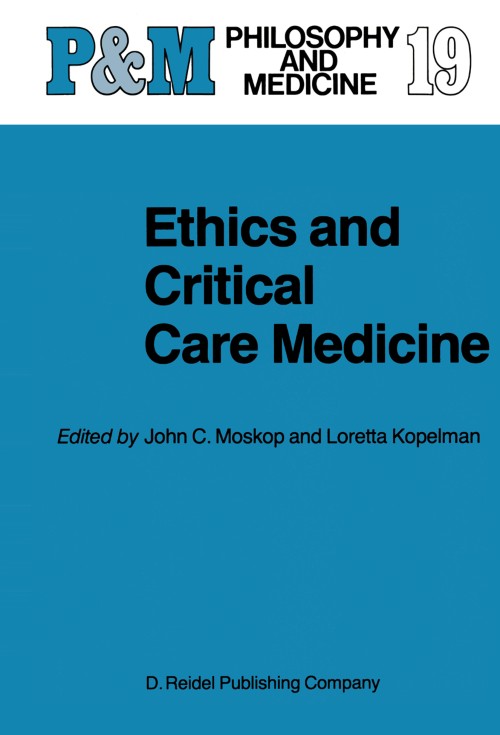
Ethics and Critical Care Medicine [electronic resource] / edited by J.C. Moskop, L.M. Kopelman.
Erişim Adresi
ISBN
9789400952331
Dil Kodu
İngilizce
Yer Numarası
DK/15993
Basım Bildirimi
1st ed. 1985.
Yayın Bilgisi
Dordrecht : Springer Netherlands : Imprint: Springer, 1985.
Fiziksel Niteleme
XX, 236 p. online resource.
Dizi
Philosophy and Medicine, 2215-0080 ; 19
İçindekiler Notu
A Movable Medical Crisis -- Moral Absurdities in Critical Care Medicine: Commentary on a Parable -- Moral Tensions in Critical Care Medicine: “Absurdities” as Indications of Finitude -- “Conceptual Construals” vs. Moral Experience: A Rejoinder -- Can Principles Survive in Situations of Critical Care? -- Coercion, Conversation and the Casuist: A Reply to Jay Katz -- Justice and the Hippocratic Tradition of Acting for the Good of the Sick -- Clinical Ethics and Resource Allocation: The Problem of Chronic Illness in Childhood -- Moral Choice, the Good of the Patient, and the Patient’s Good -- What Good is Another Paper on The Good? No Codes and Dr. Pellegrino -- Allocating Resources Within Health Care: Critical Care vs. Prevention -- Report of the President’s 2003 Commission on the Fall of Medicine -- Triage and Critical Care -- The Ethics of Critical Care in Cross-Cultural Perspective -- Triage: Philosophical and Cross-Cultural Perspectives -- Critical Care in an Historical Context -- Commentary on Stanley J. Reiser’s ‘Critical Care in an Historical Context’ -- Notes on Contributors.
Özet, vb.
The expense of critical care and emergency medicine, along with widespread expectations for good care when the need arises, pose hard moral and political problems. How should we spend our tax d'ollars, and who should get help? The purpose of this volume is to reflect upon our choices. The authors whose papers appear herein identify major difficulties and offer various solutions to them. Four topics are discussed throughout the volume: First, encounters between patients and health professionals in critical situations in general, and where scarcity makes rationing necessary; second, allocation and social policy, including how much to spend on preventive, chronic or critical care medicine, or for medicine in general compared to other important social projects; third, conflicts between or ranking of important goals and values; and fourth, conceptual issues affecting the choices we make. Since these topics are raised by the authors in almost every essay, we did not divide the papers into separate sections within the volume. Warren Reich begins the volume with a parable illustrating a key problem for contemporary medicine and two very different approaches to its solution. His story begins with the "delivery" of three indigent, critically ill, foreign patients to the emergency room of a large American private hospital. Although the hospital is legally bound to care for these patients, providing long term, high cost care for them and others soon becomes a major financial strain.
Konu
Medicine __ Philosophy.
Emergency medicine.
Public health.
Bioethics.
Philosophy of Medicine.
Emergency Medicine.
Public Health.
Bioethics.
Emergency medicine.
Public health.
Bioethics.
Philosophy of Medicine.
Emergency Medicine.
Public Health.
Bioethics.
Diğer Yazarlar
Kurum Adı
Eseri Alıntıla
Referansları kullanmadan önce gözden geçirmeniz ve varsa gerekli düzeltmeleri yapmanız önerilir.
Dijital Kaynak
MARC Görünümü
LEADER 05377nam a22006375i 4500
001 814756
003 TR_AnAIT
005 20260130214341
007 cr nn 008mamaa
008 121227s1985 ne | s |||| 0|eng d
020 |a9789400952331|9978-94-009-5233-1
024 7 |a10.1007/978-94-009-5233-1|2doi
041 |aeng
049 |aTürk Tarih Kurumu Kütüphanesi
050 4|aR723-723.7
072 7|aHP|2bicssc
072 7|aMBDC|2bicssc
072 7|aMED050000|2bisacsh
072 7|aQD|2thema
072 7|aMBDC|2thema
082 04|a610.1|223
090 |aDK/15993
245 10|aEthics and Critical Care Medicine|h[electronic resource] /|cedited by J.C. Moskop, L.M. Kopelman.
250 |a1st ed. 1985.
264 1|aDordrecht :|bSpringer Netherlands :|bImprint: Springer,|c1985.
300 |aXX, 236 p.|bonline resource.
336 |atext|btxt|2rdacontent
337 |acomputer|bc|2rdamedia
338 |aonline resource|bcr|2rdacarrier
347 |atext file|bPDF|2rda
490 1 |aPhilosophy and Medicine,|x2215-0080 ;|v19
505 0 |aA Movable Medical Crisis -- Moral Absurdities in Critical Care Medicine: Commentary on a Parable -- Moral Tensions in Critical Care Medicine: “Absurdities” as Indications of Finitude -- “Conceptual Construals” vs. Moral Experience: A Rejoinder -- Can Principles Survive in Situations of Critical Care? -- Coercion, Conversation and the Casuist: A Reply to Jay Katz -- Justice and the Hippocratic Tradition of Acting for the Good of the Sick -- Clinical Ethics and Resource Allocation: The Problem of Chronic Illness in Childhood -- Moral Choice, the Good of the Patient, and the Patient’s Good -- What Good is Another Paper on The Good? No Codes and Dr. Pellegrino -- Allocating Resources Within Health Care: Critical Care vs. Prevention -- Report of the President’s 2003 Commission on the Fall of Medicine -- Triage and Critical Care -- The Ethics of Critical Care in Cross-Cultural Perspective -- Triage: Philosophical and Cross-Cultural Perspectives -- Critical Care in an Historical Context -- Commentary on Stanley J. Reiser’s ‘Critical Care in an Historical Context’ -- Notes on Contributors.
520 |aThe expense of critical care and emergency medicine, along with widespread expectations for good care when the need arises, pose hard moral and political problems. How should we spend our tax d'ollars, and who should get help? The purpose of this volume is to reflect upon our choices. The authors whose papers appear herein identify major difficulties and offer various solutions to them. Four topics are discussed throughout the volume: First, encounters between patients and health professionals in critical situations in general, and where scarcity makes rationing necessary; second, allocation and social policy, including how much to spend on preventive, chronic or critical care medicine, or for medicine in general compared to other important social projects; third, conflicts between or ranking of important goals and values; and fourth, conceptual issues affecting the choices we make. Since these topics are raised by the authors in almost every essay, we did not divide the papers into separate sections within the volume. Warren Reich begins the volume with a parable illustrating a key problem for contemporary medicine and two very different approaches to its solution. His story begins with the "delivery" of three indigent, critically ill, foreign patients to the emergency room of a large American private hospital. Although the hospital is legally bound to care for these patients, providing long term, high cost care for them and others soon becomes a major financial strain.
532 8 |aAccessibility summary: This PDF is not accessible. It is based on scanned pages and does not support features such as screen reader compatibility or described non-text content (images, graphs etc). However, it likely supports searchable and selectable text based on OCR (Optical Character Recognition). Users with accessibility needs may not be able to use this content effectively. Please contact us at accessibilitysupport@springernature.com if you require assistance or an alternative format.
532 8 |aInaccessible, or known limited accessibility
532 8 |aNo reading system accessibility options actively disabled
532 8 |aPublisher contact for further accessibility information: accessibilitysupport@springernature.com
650 0|aMedicine|xPhilosophy.
650 0|aEmergency medicine.
650 0|aPublic health.
650 0|aBioethics.
650 14|aPhilosophy of Medicine.
650 24|aEmergency Medicine.
650 24|aPublic Health.
650 24|aBioethics.
700 1 |aMoskop, J.C.|eeditor.|4edt|4http://id.loc.gov/vocabulary/relators/edt
700 1 |aKopelman, L.M.|eeditor.|4edt|4http://id.loc.gov/vocabulary/relators/edt
710 2 |aSpringerLink (Online service)
773 0 |tSpringer Nature eBook
776 08|iPrinted edition:|z9789027718204
776 08|iPrinted edition:|z9789400952348
776 08|iPrinted edition:|z9789401088145
830 0|aPhilosophy and Medicine,|x2215-0080 ;|v19
856 40|uhttps://doi.org/10.1007/978-94-009-5233-1
912 |aZDB-2-SHU
912 |aZDB-2-SXPR
912 |aZDB-2-BAE
950 |aHumanities, Social Sciences and Law (SpringerNature-11648)
950 |aPhilosophy and Religion (R0) (SpringerNature-43725)
001 814756
003 TR_AnAIT
005 20260130214341
007 cr nn 008mamaa
008 121227s1985 ne | s |||| 0|eng d
020 |a9789400952331|9978-94-009-5233-1
024 7 |a10.1007/978-94-009-5233-1|2doi
041 |aeng
049 |aTürk Tarih Kurumu Kütüphanesi
050 4|aR723-723.7
072 7|aHP|2bicssc
072 7|aMBDC|2bicssc
072 7|aMED050000|2bisacsh
072 7|aQD|2thema
072 7|aMBDC|2thema
082 04|a610.1|223
090 |aDK/15993
245 10|aEthics and Critical Care Medicine|h[electronic resource] /|cedited by J.C. Moskop, L.M. Kopelman.
250 |a1st ed. 1985.
264 1|aDordrecht :|bSpringer Netherlands :|bImprint: Springer,|c1985.
300 |aXX, 236 p.|bonline resource.
336 |atext|btxt|2rdacontent
337 |acomputer|bc|2rdamedia
338 |aonline resource|bcr|2rdacarrier
347 |atext file|bPDF|2rda
490 1 |aPhilosophy and Medicine,|x2215-0080 ;|v19
505 0 |aA Movable Medical Crisis -- Moral Absurdities in Critical Care Medicine: Commentary on a Parable -- Moral Tensions in Critical Care Medicine: “Absurdities” as Indications of Finitude -- “Conceptual Construals” vs. Moral Experience: A Rejoinder -- Can Principles Survive in Situations of Critical Care? -- Coercion, Conversation and the Casuist: A Reply to Jay Katz -- Justice and the Hippocratic Tradition of Acting for the Good of the Sick -- Clinical Ethics and Resource Allocation: The Problem of Chronic Illness in Childhood -- Moral Choice, the Good of the Patient, and the Patient’s Good -- What Good is Another Paper on The Good? No Codes and Dr. Pellegrino -- Allocating Resources Within Health Care: Critical Care vs. Prevention -- Report of the President’s 2003 Commission on the Fall of Medicine -- Triage and Critical Care -- The Ethics of Critical Care in Cross-Cultural Perspective -- Triage: Philosophical and Cross-Cultural Perspectives -- Critical Care in an Historical Context -- Commentary on Stanley J. Reiser’s ‘Critical Care in an Historical Context’ -- Notes on Contributors.
520 |aThe expense of critical care and emergency medicine, along with widespread expectations for good care when the need arises, pose hard moral and political problems. How should we spend our tax d'ollars, and who should get help? The purpose of this volume is to reflect upon our choices. The authors whose papers appear herein identify major difficulties and offer various solutions to them. Four topics are discussed throughout the volume: First, encounters between patients and health professionals in critical situations in general, and where scarcity makes rationing necessary; second, allocation and social policy, including how much to spend on preventive, chronic or critical care medicine, or for medicine in general compared to other important social projects; third, conflicts between or ranking of important goals and values; and fourth, conceptual issues affecting the choices we make. Since these topics are raised by the authors in almost every essay, we did not divide the papers into separate sections within the volume. Warren Reich begins the volume with a parable illustrating a key problem for contemporary medicine and two very different approaches to its solution. His story begins with the "delivery" of three indigent, critically ill, foreign patients to the emergency room of a large American private hospital. Although the hospital is legally bound to care for these patients, providing long term, high cost care for them and others soon becomes a major financial strain.
532 8 |aAccessibility summary: This PDF is not accessible. It is based on scanned pages and does not support features such as screen reader compatibility or described non-text content (images, graphs etc). However, it likely supports searchable and selectable text based on OCR (Optical Character Recognition). Users with accessibility needs may not be able to use this content effectively. Please contact us at accessibilitysupport@springernature.com if you require assistance or an alternative format.
532 8 |aInaccessible, or known limited accessibility
532 8 |aNo reading system accessibility options actively disabled
532 8 |aPublisher contact for further accessibility information: accessibilitysupport@springernature.com
650 0|aMedicine|xPhilosophy.
650 0|aEmergency medicine.
650 0|aPublic health.
650 0|aBioethics.
650 14|aPhilosophy of Medicine.
650 24|aEmergency Medicine.
650 24|aPublic Health.
650 24|aBioethics.
700 1 |aMoskop, J.C.|eeditor.|4edt|4http://id.loc.gov/vocabulary/relators/edt
700 1 |aKopelman, L.M.|eeditor.|4edt|4http://id.loc.gov/vocabulary/relators/edt
710 2 |aSpringerLink (Online service)
773 0 |tSpringer Nature eBook
776 08|iPrinted edition:|z9789027718204
776 08|iPrinted edition:|z9789400952348
776 08|iPrinted edition:|z9789401088145
830 0|aPhilosophy and Medicine,|x2215-0080 ;|v19
856 40|uhttps://doi.org/10.1007/978-94-009-5233-1
912 |aZDB-2-SHU
912 |aZDB-2-SXPR
912 |aZDB-2-BAE
950 |aHumanities, Social Sciences and Law (SpringerNature-11648)
950 |aPhilosophy and Religion (R0) (SpringerNature-43725)
Materyaller
Depodan talep edilen materyal sadece kütüphane içerisinde kullanılmaktadır.
Materyal dışarıya ödünç verilmemektedir.
Materyal dışarıya ödünç verilmemektedir.
