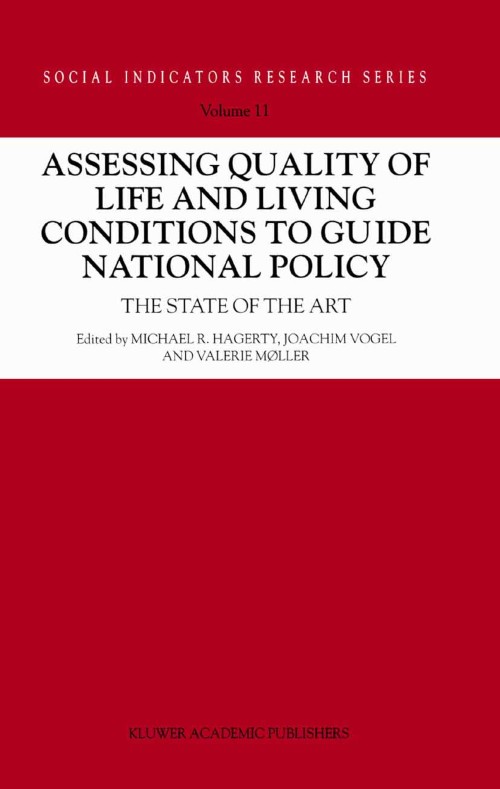
Assessing Quality of Life and Living Conditions to Guide National Policy [electronic resource] : The State of the Art / edited by Michael R. Hagerty, Joachim Vogel, Valerie Møller.
Erişim Adresi
ISBN
9780306475139
Dil Kodu
İngilizce
Yer Numarası
DK/15999
Basım Bildirimi
1st ed. 2002.
Yayın Bilgisi
Dordrecht : Springer Netherlands : Imprint: Springer, 2002.
Fiziksel Niteleme
VI, 450 p. online resource.
Dizi
Social Indicators Research Series, 2215-0099 ; 11
İçindekiler Notu
Concepts and Theory -- Conceptualizing and Measuring Quality of Life for National Policy -- Why Social Policy Needs Subjective Indicators -- Towards a European System of Social Indicators: Theoretical Framework and System Architecture -- Current Social Indicator and Social Reporting Programs: National and Comparative Experience -- Strategies and Traditions in Swedish Social Reporting: A 30-Year Experience -- Quality of Life and Living Conditions in the Netherlands -- “Quality of Life” Research at the Israel Central Bureau of Statistics: Social Indicators and Social Surveys -- Quality of Life in a European Perspective: The EUROMODULE as a New Instrument for Comparative Welfare Research -- The Norbalt Project: Comparative Studies of Living Conditions in the Three Baltic Countries -- Living Conditions in the Arctic -- Cross-National Comparison of the Quality of Life in Europe: Inventory of Surveys and Methods -- Applying Social Indicators to Effect Social Change -- Telesis: The Uses of Indicators to Set Goals and Develop Programs to Change Conditions -- The Role of Quality of Life Surveys in Managing Change in Democratic Transitions: The South African Case -- Monitoring the Impact of Land Reform on Quality of Life: A South African Case Study -- Toward a Social Development Index for Hong Kong: The Process of Community Engagement -- International Comparisons of Trends in Economic Well-Being -- Declining Quality of Life Costs Governments Elections: Review of 13 OECD Countries -- Considering Social Cohesion in Quality of Life Assessments: Concept and Measurement -- Do Income Surveys Overestimate Poverty in Western Europe? Evidence from a Comparison with Institutional Frameworks.
Özet, vb.
Our book is a useful "how to" book for researchers and government offices wanting to start or improve their own QOL survey, and contains "best practices" from all over the world. We discuss cutting-edge surveys that are being adopted by all countries in the European community as a standardized measure of each country's progress. We also discuss how developing countries can begin the measurement of Quality of Life in ways that will increase political credibility and require smaller budgets. Other chapters describe policy applications of the Quality of Life surveys, including nations' health goals, smoking cessation, child welfare, and poverty reduction. The authors of these chapters are the world's top experts on assessing Quality of Life. For example, the author of the first chapter is Sten Johansson, former Director of Statistics Sweden, responsible for creating the first comprehensive QOL assessment systems in the world, beginning in the 1960's. The author of the second chapter is Professor Ruut Veenhoven, known as the premier researcher on national happiness, having developed the largest database in the world on the subjective measures of well-being. Heinz-Herbert Noll is responsible for developing the unified Quality of Life measurement system for the new European Union, where up to 25 countries will be assessed using the same methodology and questionnaires.
Konu
Sociology.
Quality of life.
Political science.
Sociology.
Quality of Life Research.
Political Science.
Quality of life.
Political science.
Sociology.
Quality of Life Research.
Political Science.
Kurum Adı

Eseri Alıntıla
Referansları kullanmadan önce gözden geçirmeniz ve varsa gerekli düzeltmeleri yapmanız önerilir.
Dijital Kaynak
MARC Görünümü
LEADER 05273nam a22005775i 4500
001 814762
003 TR_AnAIT
005 20260130214307
007 cr nn 008mamaa
008 100301s2002 ne | s |||| 0|eng d
020 |a9780306475139|9978-0-306-47513-9
024 7 |a10.1007/0-306-47513-8|2doi
041 |aeng
049 |aTürk Tarih Kurumu Kütüphanesi
050 4|aHM
072 7|aJHB|2bicssc
072 7|aJHB|2bicssc
072 7|aSOC026000|2bisacsh
072 7|aJHB|2thema
072 7|aJHB|2thema
082 04|a301|223
090 |aDK/15999
245 10|aAssessing Quality of Life and Living Conditions to Guide National Policy|h[electronic resource] :|bThe State of the Art /|cedited by Michael R. Hagerty, Joachim Vogel, Valerie Møller.
250 |a1st ed. 2002.
264 1|aDordrecht :|bSpringer Netherlands :|bImprint: Springer,|c2002.
300 |aVI, 450 p.|bonline resource.
336 |atext|btxt|2rdacontent
337 |acomputer|bc|2rdamedia
338 |aonline resource|bcr|2rdacarrier
347 |atext file|bPDF|2rda
490 1 |aSocial Indicators Research Series,|x2215-0099 ;|v11
505 0 |aConcepts and Theory -- Conceptualizing and Measuring Quality of Life for National Policy -- Why Social Policy Needs Subjective Indicators -- Towards a European System of Social Indicators: Theoretical Framework and System Architecture -- Current Social Indicator and Social Reporting Programs: National and Comparative Experience -- Strategies and Traditions in Swedish Social Reporting: A 30-Year Experience -- Quality of Life and Living Conditions in the Netherlands -- “Quality of Life” Research at the Israel Central Bureau of Statistics: Social Indicators and Social Surveys -- Quality of Life in a European Perspective: The EUROMODULE as a New Instrument for Comparative Welfare Research -- The Norbalt Project: Comparative Studies of Living Conditions in the Three Baltic Countries -- Living Conditions in the Arctic -- Cross-National Comparison of the Quality of Life in Europe: Inventory of Surveys and Methods -- Applying Social Indicators to Effect Social Change -- Telesis: The Uses of Indicators to Set Goals and Develop Programs to Change Conditions -- The Role of Quality of Life Surveys in Managing Change in Democratic Transitions: The South African Case -- Monitoring the Impact of Land Reform on Quality of Life: A South African Case Study -- Toward a Social Development Index for Hong Kong: The Process of Community Engagement -- International Comparisons of Trends in Economic Well-Being -- Declining Quality of Life Costs Governments Elections: Review of 13 OECD Countries -- Considering Social Cohesion in Quality of Life Assessments: Concept and Measurement -- Do Income Surveys Overestimate Poverty in Western Europe? Evidence from a Comparison with Institutional Frameworks.
520 |aOur book is a useful "how to" book for researchers and government offices wanting to start or improve their own QOL survey, and contains "best practices" from all over the world. We discuss cutting-edge surveys that are being adopted by all countries in the European community as a standardized measure of each country's progress. We also discuss how developing countries can begin the measurement of Quality of Life in ways that will increase political credibility and require smaller budgets. Other chapters describe policy applications of the Quality of Life surveys, including nations' health goals, smoking cessation, child welfare, and poverty reduction. The authors of these chapters are the world's top experts on assessing Quality of Life. For example, the author of the first chapter is Sten Johansson, former Director of Statistics Sweden, responsible for creating the first comprehensive QOL assessment systems in the world, beginning in the 1960's. The author of the second chapter is Professor Ruut Veenhoven, known as the premier researcher on national happiness, having developed the largest database in the world on the subjective measures of well-being. Heinz-Herbert Noll is responsible for developing the unified Quality of Life measurement system for the new European Union, where up to 25 countries will be assessed using the same methodology and questionnaires.
650 0|aSociology.
650 0|aQuality of life.
650 0|aPolitical science.
650 14|aSociology.
650 24|aQuality of Life Research.
650 24|aPolitical Science.
700 1 |aHagerty, Michael R.|eeditor.|4edt|4http://id.loc.gov/vocabulary/relators/edt
700 1 |aVogel, Joachim.|eeditor.|4edt|4http://id.loc.gov/vocabulary/relators/edt
700 1 |aMøller, Valerie.|eeditor.|0(orcid)0000-0003-1463-1914|1https://orcid.org/0000-0003-1463-1914|4edt|4http://id.loc.gov/vocabulary/relators/edt
710 2 |aSpringerLink (Online service)
773 0 |tSpringer Nature eBook
776 08|iPrinted edition:|z9781402007279
776 08|iPrinted edition:|z9789048160648
776 08|iPrinted edition:|z9789401739399
830 0|aSocial Indicators Research Series,|x2215-0099 ;|v11
856 40|uhttps://doi.org/10.1007/0-306-47513-8
912 |aZDB-2-SHU
912 |aZDB-2-SXS
912 |aZDB-2-BAE
950 |aHumanities, Social Sciences and Law (SpringerNature-11648)
950 |aSocial Sciences (R0) (SpringerNature-43726)
001 814762
003 TR_AnAIT
005 20260130214307
007 cr nn 008mamaa
008 100301s2002 ne | s |||| 0|eng d
020 |a9780306475139|9978-0-306-47513-9
024 7 |a10.1007/0-306-47513-8|2doi
041 |aeng
049 |aTürk Tarih Kurumu Kütüphanesi
050 4|aHM
072 7|aJHB|2bicssc
072 7|aJHB|2bicssc
072 7|aSOC026000|2bisacsh
072 7|aJHB|2thema
072 7|aJHB|2thema
082 04|a301|223
090 |aDK/15999
245 10|aAssessing Quality of Life and Living Conditions to Guide National Policy|h[electronic resource] :|bThe State of the Art /|cedited by Michael R. Hagerty, Joachim Vogel, Valerie Møller.
250 |a1st ed. 2002.
264 1|aDordrecht :|bSpringer Netherlands :|bImprint: Springer,|c2002.
300 |aVI, 450 p.|bonline resource.
336 |atext|btxt|2rdacontent
337 |acomputer|bc|2rdamedia
338 |aonline resource|bcr|2rdacarrier
347 |atext file|bPDF|2rda
490 1 |aSocial Indicators Research Series,|x2215-0099 ;|v11
505 0 |aConcepts and Theory -- Conceptualizing and Measuring Quality of Life for National Policy -- Why Social Policy Needs Subjective Indicators -- Towards a European System of Social Indicators: Theoretical Framework and System Architecture -- Current Social Indicator and Social Reporting Programs: National and Comparative Experience -- Strategies and Traditions in Swedish Social Reporting: A 30-Year Experience -- Quality of Life and Living Conditions in the Netherlands -- “Quality of Life” Research at the Israel Central Bureau of Statistics: Social Indicators and Social Surveys -- Quality of Life in a European Perspective: The EUROMODULE as a New Instrument for Comparative Welfare Research -- The Norbalt Project: Comparative Studies of Living Conditions in the Three Baltic Countries -- Living Conditions in the Arctic -- Cross-National Comparison of the Quality of Life in Europe: Inventory of Surveys and Methods -- Applying Social Indicators to Effect Social Change -- Telesis: The Uses of Indicators to Set Goals and Develop Programs to Change Conditions -- The Role of Quality of Life Surveys in Managing Change in Democratic Transitions: The South African Case -- Monitoring the Impact of Land Reform on Quality of Life: A South African Case Study -- Toward a Social Development Index for Hong Kong: The Process of Community Engagement -- International Comparisons of Trends in Economic Well-Being -- Declining Quality of Life Costs Governments Elections: Review of 13 OECD Countries -- Considering Social Cohesion in Quality of Life Assessments: Concept and Measurement -- Do Income Surveys Overestimate Poverty in Western Europe? Evidence from a Comparison with Institutional Frameworks.
520 |aOur book is a useful "how to" book for researchers and government offices wanting to start or improve their own QOL survey, and contains "best practices" from all over the world. We discuss cutting-edge surveys that are being adopted by all countries in the European community as a standardized measure of each country's progress. We also discuss how developing countries can begin the measurement of Quality of Life in ways that will increase political credibility and require smaller budgets. Other chapters describe policy applications of the Quality of Life surveys, including nations' health goals, smoking cessation, child welfare, and poverty reduction. The authors of these chapters are the world's top experts on assessing Quality of Life. For example, the author of the first chapter is Sten Johansson, former Director of Statistics Sweden, responsible for creating the first comprehensive QOL assessment systems in the world, beginning in the 1960's. The author of the second chapter is Professor Ruut Veenhoven, known as the premier researcher on national happiness, having developed the largest database in the world on the subjective measures of well-being. Heinz-Herbert Noll is responsible for developing the unified Quality of Life measurement system for the new European Union, where up to 25 countries will be assessed using the same methodology and questionnaires.
650 0|aSociology.
650 0|aQuality of life.
650 0|aPolitical science.
650 14|aSociology.
650 24|aQuality of Life Research.
650 24|aPolitical Science.
700 1 |aHagerty, Michael R.|eeditor.|4edt|4http://id.loc.gov/vocabulary/relators/edt
700 1 |aVogel, Joachim.|eeditor.|4edt|4http://id.loc.gov/vocabulary/relators/edt
700 1 |aMøller, Valerie.|eeditor.|0(orcid)0000-0003-1463-1914|1https://orcid.org/0000-0003-1463-1914|4edt|4http://id.loc.gov/vocabulary/relators/edt
710 2 |aSpringerLink (Online service)
773 0 |tSpringer Nature eBook
776 08|iPrinted edition:|z9781402007279
776 08|iPrinted edition:|z9789048160648
776 08|iPrinted edition:|z9789401739399
830 0|aSocial Indicators Research Series,|x2215-0099 ;|v11
856 40|uhttps://doi.org/10.1007/0-306-47513-8
912 |aZDB-2-SHU
912 |aZDB-2-SXS
912 |aZDB-2-BAE
950 |aHumanities, Social Sciences and Law (SpringerNature-11648)
950 |aSocial Sciences (R0) (SpringerNature-43726)
Materyaller
Depodan talep edilen materyal sadece kütüphane içerisinde kullanılmaktadır.
Materyal dışarıya ödünç verilmemektedir.
