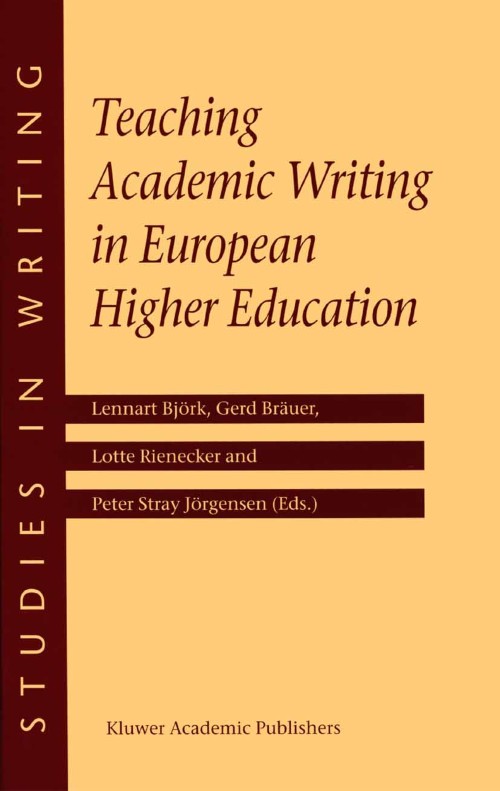
Teaching Academic Writing in European Higher Education [electronic resource] / edited by Lennart Björk, Gerd Bräuer, L. Rienecker, Peter Stray Jörgensen.
Erişim Adresi
ISBN
9780306481956
Dil Kodu
İngilizce
Yer Numarası
DK/16000
Basım Bildirimi
1st ed. 2003.
Yayın Bilgisi
Dordrecht : Springer Netherlands : Imprint: Springer, 2003.
Fiziksel Niteleme
VIII, 234 p. online resource.
Dizi
Studies in Writing ; 12
İçindekiler Notu
Teaching Academic Writing in European Higher Education: An Introduction -- Text and Writer -- Getting Started: Academic Writing in the First Year of a University Education -- Text Types, Textual Consciousness and Academic Writing Ability -- Teaching Academic Writing to International Students: Individual Tutoring as a Supplement to Workshops -- The Genre in Focus, not the Writer: Using Model Examples in Large-Class Workshops -- A Good Paper Makes a Case: Teaching Academic Writing the Macro-Toulmin Way -- Rethinking Feedback: Asymmetry in Disguise -- The (IM)Possibilities in Teaching University Writing in the Anglo-American Tradition When Dealing with Continential Student Writers -- Helping Doctoral Students to Finish Their Theses -- Teaching Academic Writing in Context -- Centres for Writing & Reading-Bridging the Gap between University and School Education -- Writing at Norwegian Universities in an International Perspective -- Contacts-Conflicts-Cooperation -- An Analysis of the Discourse of Study Support at the London Institute -- Creating a Basis for a Faculty-Oriented Writing Programme -- Implementation Issues for Study Support.
Özet, vb.
DAVID R. RUSSELL English Department of Iowa State University, U. S. A. I was fortunate to attend, as a visitor from the U. S. , the first European Association for the Teaching of Academic Writing (EATAW) conference in 2001 at Groningen. I was struck by the similarities in the challenges higher education faces on both sides of the Atlantic in terms of developing students’ academic writing, and students’ learning through writing. It is indeed an international ‘problem. ’ But I was equally struck by the profound differences in responding to these challenges – among - tions, institutions, disciplines, and even within disciplines. The essays in this - traordinary volume address a growing demand for help with academic writing, on the part of students and academic staff alike. And they do so in ways that bring fresh approaches, not only to Europeans, who have only recently begun to study academic writing, but also to researchers and academic staff in the U. S. , where we have a c- tury-old tradition of attention to the problem – but are much in need of these fresh approaches. Academic writing has become a ‘problem’ in higher education – all around the world – because higher education sits smack between two contradictory pressures. On one end, far more students (and far more diverse students) come streaming into higher education – bringing in a far greater diversity of linguistic resources (often interpreted as ‘standards are falling,’ as Frank, Haacke & Tente point out).
Konu
Learning, Psychology of.
Instructional Psychology.
Kurum Adı

Eseri Alıntıla
Referansları kullanmadan önce gözden geçirmeniz ve varsa gerekli düzeltmeleri yapmanız önerilir.
Dijital Kaynak
MARC Görünümü
LEADER 04629nam a22005175i 4500
001 814763
003 TR_AnAIT
005 20260130214302
007 cr nn 008mamaa
008 100301s2003 ne | s |||| 0|eng d
020 |a9780306481956|9978-0-306-48195-6
024 7 |a10.1007/0-306-48195-2|2doi
041 |aeng
049 |aTürk Tarih Kurumu Kütüphanesi
050 4|aLB1060-1077
072 7|aJNC|2bicssc
072 7|aEDU009000|2bisacsh
072 7|aJNC|2thema
082 04|a370.15|223
090 |aDK/16000
245 10|aTeaching Academic Writing in European Higher Education|h[electronic resource] /|cedited by Lennart Björk, Gerd Bräuer, L. Rienecker, Peter Stray Jörgensen.
250 |a1st ed. 2003.
264 1|aDordrecht :|bSpringer Netherlands :|bImprint: Springer,|c2003.
300 |aVIII, 234 p.|bonline resource.
336 |atext|btxt|2rdacontent
337 |acomputer|bc|2rdamedia
338 |aonline resource|bcr|2rdacarrier
347 |atext file|bPDF|2rda
490 1 |aStudies in Writing ;|v12
505 0 |aTeaching Academic Writing in European Higher Education: An Introduction -- Text and Writer -- Getting Started: Academic Writing in the First Year of a University Education -- Text Types, Textual Consciousness and Academic Writing Ability -- Teaching Academic Writing to International Students: Individual Tutoring as a Supplement to Workshops -- The Genre in Focus, not the Writer: Using Model Examples in Large-Class Workshops -- A Good Paper Makes a Case: Teaching Academic Writing the Macro-Toulmin Way -- Rethinking Feedback: Asymmetry in Disguise -- The (IM)Possibilities in Teaching University Writing in the Anglo-American Tradition When Dealing with Continential Student Writers -- Helping Doctoral Students to Finish Their Theses -- Teaching Academic Writing in Context -- Centres for Writing & Reading-Bridging the Gap between University and School Education -- Writing at Norwegian Universities in an International Perspective -- Contacts-Conflicts-Cooperation -- An Analysis of the Discourse of Study Support at the London Institute -- Creating a Basis for a Faculty-Oriented Writing Programme -- Implementation Issues for Study Support.
520 |aDAVID R. RUSSELL English Department of Iowa State University, U. S. A. I was fortunate to attend, as a visitor from the U. S. , the first European Association for the Teaching of Academic Writing (EATAW) conference in 2001 at Groningen. I was struck by the similarities in the challenges higher education faces on both sides of the Atlantic in terms of developing students’ academic writing, and students’ learning through writing. It is indeed an international ‘problem. ’ But I was equally struck by the profound differences in responding to these challenges – among - tions, institutions, disciplines, and even within disciplines. The essays in this - traordinary volume address a growing demand for help with academic writing, on the part of students and academic staff alike. And they do so in ways that bring fresh approaches, not only to Europeans, who have only recently begun to study academic writing, but also to researchers and academic staff in the U. S. , where we have a c- tury-old tradition of attention to the problem – but are much in need of these fresh approaches. Academic writing has become a ‘problem’ in higher education – all around the world – because higher education sits smack between two contradictory pressures. On one end, far more students (and far more diverse students) come streaming into higher education – bringing in a far greater diversity of linguistic resources (often interpreted as ‘standards are falling,’ as Frank, Haacke & Tente point out).
650 0|aLearning, Psychology of.
650 14|aInstructional Psychology.
700 1 |aBjörk, Lennart.|eeditor.|4edt|4http://id.loc.gov/vocabulary/relators/edt
700 1 |aBräuer, Gerd.|eeditor.|4edt|4http://id.loc.gov/vocabulary/relators/edt
700 1 |aRienecker, L.|eeditor.|4edt|4http://id.loc.gov/vocabulary/relators/edt
700 1 |aStray Jörgensen, Peter.|eeditor.|4edt|4http://id.loc.gov/vocabulary/relators/edt
710 2 |aSpringerLink (Online service)
773 0 |tSpringer Nature eBook
776 08|iPrinted edition:|z9781402012082
776 08|iPrinted edition:|z9781402012099
776 08|iPrinted edition:|z9789401742368
830 0|aStudies in Writing ;|v12
856 40|uhttps://doi.org/10.1007/0-306-48195-2
912 |aZDB-2-SHU
912 |aZDB-2-SXED
912 |aZDB-2-BAE
950 |aHumanities, Social Sciences and Law (SpringerNature-11648)
950 |aEducation (R0) (SpringerNature-43721)
001 814763
003 TR_AnAIT
005 20260130214302
007 cr nn 008mamaa
008 100301s2003 ne | s |||| 0|eng d
020 |a9780306481956|9978-0-306-48195-6
024 7 |a10.1007/0-306-48195-2|2doi
041 |aeng
049 |aTürk Tarih Kurumu Kütüphanesi
050 4|aLB1060-1077
072 7|aJNC|2bicssc
072 7|aEDU009000|2bisacsh
072 7|aJNC|2thema
082 04|a370.15|223
090 |aDK/16000
245 10|aTeaching Academic Writing in European Higher Education|h[electronic resource] /|cedited by Lennart Björk, Gerd Bräuer, L. Rienecker, Peter Stray Jörgensen.
250 |a1st ed. 2003.
264 1|aDordrecht :|bSpringer Netherlands :|bImprint: Springer,|c2003.
300 |aVIII, 234 p.|bonline resource.
336 |atext|btxt|2rdacontent
337 |acomputer|bc|2rdamedia
338 |aonline resource|bcr|2rdacarrier
347 |atext file|bPDF|2rda
490 1 |aStudies in Writing ;|v12
505 0 |aTeaching Academic Writing in European Higher Education: An Introduction -- Text and Writer -- Getting Started: Academic Writing in the First Year of a University Education -- Text Types, Textual Consciousness and Academic Writing Ability -- Teaching Academic Writing to International Students: Individual Tutoring as a Supplement to Workshops -- The Genre in Focus, not the Writer: Using Model Examples in Large-Class Workshops -- A Good Paper Makes a Case: Teaching Academic Writing the Macro-Toulmin Way -- Rethinking Feedback: Asymmetry in Disguise -- The (IM)Possibilities in Teaching University Writing in the Anglo-American Tradition When Dealing with Continential Student Writers -- Helping Doctoral Students to Finish Their Theses -- Teaching Academic Writing in Context -- Centres for Writing & Reading-Bridging the Gap between University and School Education -- Writing at Norwegian Universities in an International Perspective -- Contacts-Conflicts-Cooperation -- An Analysis of the Discourse of Study Support at the London Institute -- Creating a Basis for a Faculty-Oriented Writing Programme -- Implementation Issues for Study Support.
520 |aDAVID R. RUSSELL English Department of Iowa State University, U. S. A. I was fortunate to attend, as a visitor from the U. S. , the first European Association for the Teaching of Academic Writing (EATAW) conference in 2001 at Groningen. I was struck by the similarities in the challenges higher education faces on both sides of the Atlantic in terms of developing students’ academic writing, and students’ learning through writing. It is indeed an international ‘problem. ’ But I was equally struck by the profound differences in responding to these challenges – among - tions, institutions, disciplines, and even within disciplines. The essays in this - traordinary volume address a growing demand for help with academic writing, on the part of students and academic staff alike. And they do so in ways that bring fresh approaches, not only to Europeans, who have only recently begun to study academic writing, but also to researchers and academic staff in the U. S. , where we have a c- tury-old tradition of attention to the problem – but are much in need of these fresh approaches. Academic writing has become a ‘problem’ in higher education – all around the world – because higher education sits smack between two contradictory pressures. On one end, far more students (and far more diverse students) come streaming into higher education – bringing in a far greater diversity of linguistic resources (often interpreted as ‘standards are falling,’ as Frank, Haacke & Tente point out).
650 0|aLearning, Psychology of.
650 14|aInstructional Psychology.
700 1 |aBjörk, Lennart.|eeditor.|4edt|4http://id.loc.gov/vocabulary/relators/edt
700 1 |aBräuer, Gerd.|eeditor.|4edt|4http://id.loc.gov/vocabulary/relators/edt
700 1 |aRienecker, L.|eeditor.|4edt|4http://id.loc.gov/vocabulary/relators/edt
700 1 |aStray Jörgensen, Peter.|eeditor.|4edt|4http://id.loc.gov/vocabulary/relators/edt
710 2 |aSpringerLink (Online service)
773 0 |tSpringer Nature eBook
776 08|iPrinted edition:|z9781402012082
776 08|iPrinted edition:|z9781402012099
776 08|iPrinted edition:|z9789401742368
830 0|aStudies in Writing ;|v12
856 40|uhttps://doi.org/10.1007/0-306-48195-2
912 |aZDB-2-SHU
912 |aZDB-2-SXED
912 |aZDB-2-BAE
950 |aHumanities, Social Sciences and Law (SpringerNature-11648)
950 |aEducation (R0) (SpringerNature-43721)
Materyaller
Depodan talep edilen materyal sadece kütüphane içerisinde kullanılmaktadır.
Materyal dışarıya ödünç verilmemektedir.
