

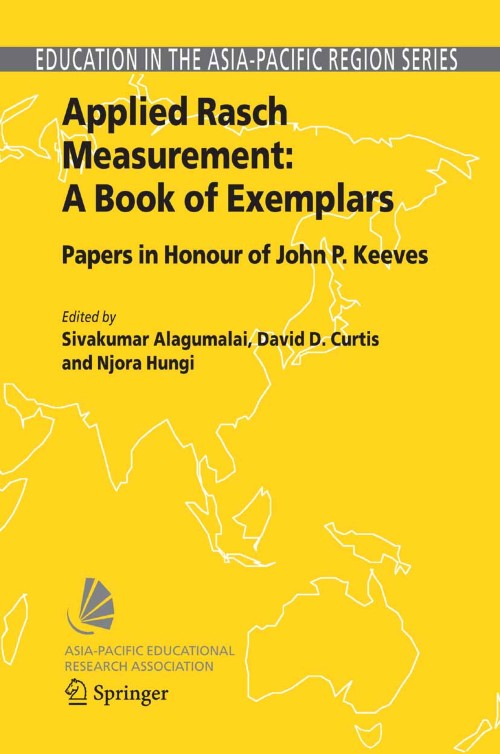
Applied Rasch Measurement: A Book of Exemplars [electronic resource] : Papers in Honour of John P. Keeves / edited by Sivakumar Alagumalai, David D. Curtis, Njora Hungi.
Erişim Adresi
ISBN
9781402030765
Dil Kodu
İngilizce
Yer Numarası
DK/16002
Basım Bildirimi
1st ed. 2005.
Yayın Bilgisi
Dordrecht : Springer Netherlands : Imprint: Springer, 2005.
Fiziksel Niteleme
XVIII, 360 p. online resource.
Dizi
Education in the Asia-Pacific Region: Issues, Concerns and Prospects, 2214-9791 ; 4
İçindekiler Notu
Measurement and the Rasch model -- Classical Test Theory -- Objective Measurement -- The Rasch Model Explained -- Applications of the Rasch Model — Tests and Competencies -- Monitoring Mathematics Achievement over Time -- Manual and Automatic Estimates of Growth and Gain Across Year Levels: How Close is Close? -- Japanese Language Learning and the Rasch Model -- Chinese Language Learning and the Rasch Model -- Employing the Rasch Model to Detect Biased Items -- Raters and Examinations -- Comparing Classical and Contemporary Analyses and Rasch Measurement -- Combining Rasch Scaling and Multi-Level Analysis -- Applications of the Rasch Model — Attitudes Scales and Views -- Rasch and Attitude Scales: Explanatory Style -- Science Teachers’ Views on Science, Technology and Society Issues -- Estimating the Complexity of Workplace Rehabilitation Tasks Using Rasch Analysis -- Creating a Scale as a General Measure of Satisfaction for Information and Communication Technology Users -- Extensions of the Rasch model -- Multidimensional Item Responses: Multimethod-Multitrait Perspectives -- Information Functions for the General Dichotomous Unfolding Model -- Past, Present and Future: An Idiosyncratic View of Rasch Measurement -- Epilogue -- Our Experiences and Conclusion.
Özet, vb.
While the primary purpose of the book is a celebration of John’s contributions to the field of measurement, a second and related purpose is to provide a useful resource. We believe that the combination of the developmental history and theory of the method, the examples of its use in practice, some possible future directions, and software and data files will make this book a valuable resource for teachers and scholars of the Rasch method. This book is a tribute to Professor John P Keeves for the advocacy of the Rasch model in Australia. Happy 80th birthday John! xii There are good introductory texts on Item Response Theory, Objective Measurement and the Rasch model. However, for a beginning researcher keen on utilising the potentials of the Rasch model, theoretical discussions of test theory and associated indices do not meet their pragmatic needs. Furthermore, many researchers in measurement still have little or no knowledge of the features of the Rasch model and its use in a variety of situations and disciplines. This book attempts to describe the underlying axioms of test theory, and, in particular, the concepts of objective measurement and the Rasch model, and then link theory to practice. We have been introduced to the various models of test theory during our graduate days. It was time for us to share with those keen in the field of measurement in education, psychology and the social sciences the theoretical and practical aspects of objective measurement.
Konu
Education.
International education .
Comparative education.
Probabilities.
Education.
International and Comparative Education.
Probability Theory.
International education .
Comparative education.
Probabilities.
Education.
International and Comparative Education.
Probability Theory.
Diğer Yazarlar
Kurum Adı
Eseri Alıntıla
Referansları kullanmadan önce gözden geçirmeniz ve varsa gerekli düzeltmeleri yapmanız önerilir.
Dijital Kaynak
MARC Görünümü
LEADER 04923nam a22005535i 4500
001 814765
003 TR_AnAIT
005 20260130214300
007 cr nn 008mamaa
008 100301s2005 ne | s |||| 0|eng d
020 |a9781402030765|9978-1-4020-3076-5
024 7 |a10.1007/1-4020-3076-2|2doi
041 |aeng
049 |aTürk Tarih Kurumu Kütüphanesi
050 4|aL1-991
072 7|aJN|2bicssc
072 7|aEDU000000|2bisacsh
072 7|aJN|2thema
082 04|a370|223
090 |aDK/16002
245 10|aApplied Rasch Measurement: A Book of Exemplars|h[electronic resource] :|bPapers in Honour of John P. Keeves /|cedited by Sivakumar Alagumalai, David D. Curtis, Njora Hungi.
250 |a1st ed. 2005.
264 1|aDordrecht :|bSpringer Netherlands :|bImprint: Springer,|c2005.
300 |aXVIII, 360 p.|bonline resource.
336 |atext|btxt|2rdacontent
337 |acomputer|bc|2rdamedia
338 |aonline resource|bcr|2rdacarrier
347 |atext file|bPDF|2rda
490 1 |aEducation in the Asia-Pacific Region: Issues, Concerns and Prospects,|x2214-9791 ;|v4
505 0 |aMeasurement and the Rasch model -- Classical Test Theory -- Objective Measurement -- The Rasch Model Explained -- Applications of the Rasch Model — Tests and Competencies -- Monitoring Mathematics Achievement over Time -- Manual and Automatic Estimates of Growth and Gain Across Year Levels: How Close is Close? -- Japanese Language Learning and the Rasch Model -- Chinese Language Learning and the Rasch Model -- Employing the Rasch Model to Detect Biased Items -- Raters and Examinations -- Comparing Classical and Contemporary Analyses and Rasch Measurement -- Combining Rasch Scaling and Multi-Level Analysis -- Applications of the Rasch Model — Attitudes Scales and Views -- Rasch and Attitude Scales: Explanatory Style -- Science Teachers’ Views on Science, Technology and Society Issues -- Estimating the Complexity of Workplace Rehabilitation Tasks Using Rasch Analysis -- Creating a Scale as a General Measure of Satisfaction for Information and Communication Technology Users -- Extensions of the Rasch model -- Multidimensional Item Responses: Multimethod-Multitrait Perspectives -- Information Functions for the General Dichotomous Unfolding Model -- Past, Present and Future: An Idiosyncratic View of Rasch Measurement -- Epilogue -- Our Experiences and Conclusion.
520 |aWhile the primary purpose of the book is a celebration of John’s contributions to the field of measurement, a second and related purpose is to provide a useful resource. We believe that the combination of the developmental history and theory of the method, the examples of its use in practice, some possible future directions, and software and data files will make this book a valuable resource for teachers and scholars of the Rasch method. This book is a tribute to Professor John P Keeves for the advocacy of the Rasch model in Australia. Happy 80th birthday John! xii There are good introductory texts on Item Response Theory, Objective Measurement and the Rasch model. However, for a beginning researcher keen on utilising the potentials of the Rasch model, theoretical discussions of test theory and associated indices do not meet their pragmatic needs. Furthermore, many researchers in measurement still have little or no knowledge of the features of the Rasch model and its use in a variety of situations and disciplines. This book attempts to describe the underlying axioms of test theory, and, in particular, the concepts of objective measurement and the Rasch model, and then link theory to practice. We have been introduced to the various models of test theory during our graduate days. It was time for us to share with those keen in the field of measurement in education, psychology and the social sciences the theoretical and practical aspects of objective measurement.
650 0|aEducation.
650 0|aInternational education .
650 0|aComparative education.
650 0|aProbabilities.
650 14|aEducation.
650 24|aInternational and Comparative Education.
650 24|aProbability Theory.
700 1 |aAlagumalai, Sivakumar.|eeditor.|4edt|4http://id.loc.gov/vocabulary/relators/edt
700 1 |aCurtis, David D.|eeditor.|4edt|4http://id.loc.gov/vocabulary/relators/edt
700 1 |aHungi, Njora.|eeditor.|4edt|4http://id.loc.gov/vocabulary/relators/edt
710 2 |aSpringerLink (Online service)
773 0 |tSpringer Nature eBook
776 08|iPrinted edition:|z9781402030727
776 08|iPrinted edition:|z9789048101757
776 08|iPrinted edition:|z9789048167852
830 0|aEducation in the Asia-Pacific Region: Issues, Concerns and Prospects,|x2214-9791 ;|v4
856 40|uhttps://doi.org/10.1007/1-4020-3076-2
912 |aZDB-2-SHU
912 |aZDB-2-SXED
950 |aHumanities, Social Sciences and Law (SpringerNature-11648)
950 |aEducation (R0) (SpringerNature-43721)
001 814765
003 TR_AnAIT
005 20260130214300
007 cr nn 008mamaa
008 100301s2005 ne | s |||| 0|eng d
020 |a9781402030765|9978-1-4020-3076-5
024 7 |a10.1007/1-4020-3076-2|2doi
041 |aeng
049 |aTürk Tarih Kurumu Kütüphanesi
050 4|aL1-991
072 7|aJN|2bicssc
072 7|aEDU000000|2bisacsh
072 7|aJN|2thema
082 04|a370|223
090 |aDK/16002
245 10|aApplied Rasch Measurement: A Book of Exemplars|h[electronic resource] :|bPapers in Honour of John P. Keeves /|cedited by Sivakumar Alagumalai, David D. Curtis, Njora Hungi.
250 |a1st ed. 2005.
264 1|aDordrecht :|bSpringer Netherlands :|bImprint: Springer,|c2005.
300 |aXVIII, 360 p.|bonline resource.
336 |atext|btxt|2rdacontent
337 |acomputer|bc|2rdamedia
338 |aonline resource|bcr|2rdacarrier
347 |atext file|bPDF|2rda
490 1 |aEducation in the Asia-Pacific Region: Issues, Concerns and Prospects,|x2214-9791 ;|v4
505 0 |aMeasurement and the Rasch model -- Classical Test Theory -- Objective Measurement -- The Rasch Model Explained -- Applications of the Rasch Model — Tests and Competencies -- Monitoring Mathematics Achievement over Time -- Manual and Automatic Estimates of Growth and Gain Across Year Levels: How Close is Close? -- Japanese Language Learning and the Rasch Model -- Chinese Language Learning and the Rasch Model -- Employing the Rasch Model to Detect Biased Items -- Raters and Examinations -- Comparing Classical and Contemporary Analyses and Rasch Measurement -- Combining Rasch Scaling and Multi-Level Analysis -- Applications of the Rasch Model — Attitudes Scales and Views -- Rasch and Attitude Scales: Explanatory Style -- Science Teachers’ Views on Science, Technology and Society Issues -- Estimating the Complexity of Workplace Rehabilitation Tasks Using Rasch Analysis -- Creating a Scale as a General Measure of Satisfaction for Information and Communication Technology Users -- Extensions of the Rasch model -- Multidimensional Item Responses: Multimethod-Multitrait Perspectives -- Information Functions for the General Dichotomous Unfolding Model -- Past, Present and Future: An Idiosyncratic View of Rasch Measurement -- Epilogue -- Our Experiences and Conclusion.
520 |aWhile the primary purpose of the book is a celebration of John’s contributions to the field of measurement, a second and related purpose is to provide a useful resource. We believe that the combination of the developmental history and theory of the method, the examples of its use in practice, some possible future directions, and software and data files will make this book a valuable resource for teachers and scholars of the Rasch method. This book is a tribute to Professor John P Keeves for the advocacy of the Rasch model in Australia. Happy 80th birthday John! xii There are good introductory texts on Item Response Theory, Objective Measurement and the Rasch model. However, for a beginning researcher keen on utilising the potentials of the Rasch model, theoretical discussions of test theory and associated indices do not meet their pragmatic needs. Furthermore, many researchers in measurement still have little or no knowledge of the features of the Rasch model and its use in a variety of situations and disciplines. This book attempts to describe the underlying axioms of test theory, and, in particular, the concepts of objective measurement and the Rasch model, and then link theory to practice. We have been introduced to the various models of test theory during our graduate days. It was time for us to share with those keen in the field of measurement in education, psychology and the social sciences the theoretical and practical aspects of objective measurement.
650 0|aEducation.
650 0|aInternational education .
650 0|aComparative education.
650 0|aProbabilities.
650 14|aEducation.
650 24|aInternational and Comparative Education.
650 24|aProbability Theory.
700 1 |aAlagumalai, Sivakumar.|eeditor.|4edt|4http://id.loc.gov/vocabulary/relators/edt
700 1 |aCurtis, David D.|eeditor.|4edt|4http://id.loc.gov/vocabulary/relators/edt
700 1 |aHungi, Njora.|eeditor.|4edt|4http://id.loc.gov/vocabulary/relators/edt
710 2 |aSpringerLink (Online service)
773 0 |tSpringer Nature eBook
776 08|iPrinted edition:|z9781402030727
776 08|iPrinted edition:|z9789048101757
776 08|iPrinted edition:|z9789048167852
830 0|aEducation in the Asia-Pacific Region: Issues, Concerns and Prospects,|x2214-9791 ;|v4
856 40|uhttps://doi.org/10.1007/1-4020-3076-2
912 |aZDB-2-SHU
912 |aZDB-2-SXED
950 |aHumanities, Social Sciences and Law (SpringerNature-11648)
950 |aEducation (R0) (SpringerNature-43721)
Materyaller
Depodan talep edilen materyal sadece kütüphane içerisinde kullanılmaktadır.
Materyal dışarıya ödünç verilmemektedir.
Materyal dışarıya ödünç verilmemektedir.
