

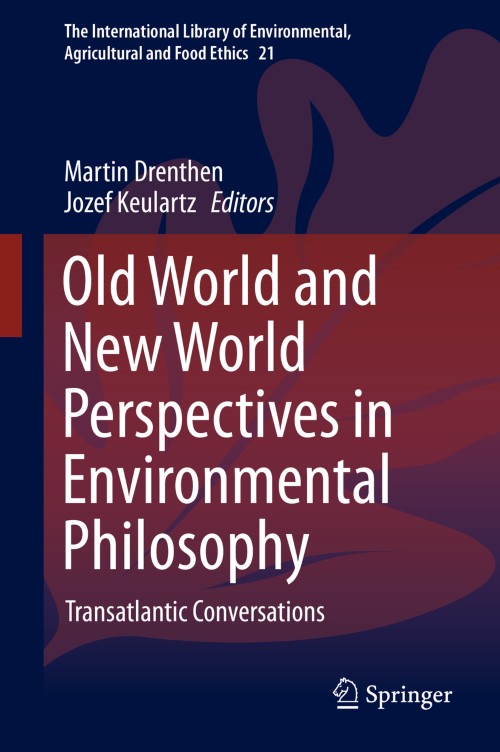
Old World and New World Perspectives in Environmental Philosophy [electronic resource] : Transatlantic Conversations / edited by Martin Drenthen, Jozef Keulartz.
Erişim Adresi
ISBN
9783319076836
Dil Kodu
İngilizce
Yer Numarası
DK/16036
Basım Bildirimi
1st ed. 2014.
Yayın Bilgisi
Cham : Springer International Publishing : Imprint: Springer, 2014.
Fiziksel Niteleme
XII, 233 p. 19 illus. online resource.
Dizi
The International Library of Environmental, Agricultural and Food Ethics, 2215-1737 ; 21
İçindekiler Notu
Contributors -- Preface -- 1. Introduction; Martin Drenthen & Jozef Keulartz: Introduction -- Part One: Wilderness and Cultural Landscapes -- 2. Extracting Culture or Injecting Nature? Rewilding in Transatlantic Perspective; Marcus Hall -- 3. Restoration and Authenticity Revisited; Marion Hourdequin & David Havlick -- 4. Conceiving the Earth itself as our Garden; W.S.K. Cameron 5. Wilderness Recognized. Environments Free From Human Control; Robert Scotney -- Part Two: Restoration of Value and Meaning to Cultural Ecosystems -- 6. Cultural Landscapes, Ecological Restoration and the Intergenerational Narrative; Paul Knights -- 7. Enduring Nature; Glenn Deliège 8. Seeking Nature's Permission; Alan Holland -- 9. Green Managerialism And The Erosion Of Meaning; Simon P. James -- Part Three: Wolves and Wildness -- 10. The wolf is coming! Emplacing a predator that is not (yet) there; Martin Drenthen -- 11. Eating Wolves; Thomas Thorp -- 12. Blurring Boundaries: Freedom, Enclosure, and Death; Brian Seitz -- 13. The Hero, the Wolf, and the Hybrid. Overcoming the Overcoming of Uncultured Landscapes; Nathan Kowalsky -- Index.
Özet, vb.
This is the first collection of essays in which European and American philosophers explicitly think out their respective contributions and identities as environmental thinkers in the analytic and continental traditions. The American/European, as well as Analytic/Continental collaboration here bears fruit helpful for further theorizing and research. The essays group around three well-defined areas of questioning all focusing on the amelioration/management of environmentally, historically and traditionally diminished landscapes. The first part deals with differences between New World and the Old World perspectives on nature and landscape restoration in general, the second focuses on the meaning of ecological restoration of cultural landscapes, and the third on the meaning of the wolf and of wildness. It does so in a way that the strengths of each philosophical school—continental and analytic—comes to the fore in order to supplement the other’s approach. This text is open to educated readers across all disciplines, particularly those interested in restoration/adaptation ecology, the cultural construction of place and landscape, the ongoing conversation about wilderness, the challenges posed to global environmental change. The text may also be a gold mine for doctoral students looking for dissertation projects in environmental philosophy that are inclusive of continental and analytic traditions. This text is rich in innovative approaches to the questions they raise that are reasonably well thought out. The fact that the essays in each section really do resonate with one another directly is also intellectually exciting and very helpful in working out the full dimensions of each question raised in the volume.
Konu
Ethics.
Conservation biology.
Ecology .
Landscape ecology.
Human geography.
Moral Philosophy and Applied Ethics.
Conservation Biology.
Landscape Ecology.
Human Geography.
Conservation biology.
Ecology .
Landscape ecology.
Human geography.
Moral Philosophy and Applied Ethics.
Conservation Biology.
Landscape Ecology.
Human Geography.
Diğer Yazarlar
Kurum Adı
Eseri Alıntıla
Referansları kullanmadan önce gözden geçirmeniz ve varsa gerekli düzeltmeleri yapmanız önerilir.
Dijital Kaynak
MARC Görünümü
LEADER 05032nam a22005655i 4500
001 814799
003 TR_AnAIT
005 20260130214028
007 cr nn 008mamaa
008 140728s2014 sz | s |||| 0|eng d
020 |a9783319076836|9978-3-319-07683-6
024 7 |a10.1007/978-3-319-07683-6|2doi
041 |aeng
049 |aTürk Tarih Kurumu Kütüphanesi
050 4|aBJ1-1725
072 7|aHPQ|2bicssc
072 7|aPHI005000|2bisacsh
072 7|aQDTQ|2thema
082 04|a170|223
090 |aDK/16036
245 10|aOld World and New World Perspectives in Environmental Philosophy|h[electronic resource] :|bTransatlantic Conversations /|cedited by Martin Drenthen, Jozef Keulartz.
250 |a1st ed. 2014.
264 1|aCham :|bSpringer International Publishing :|bImprint: Springer,|c2014.
300 |aXII, 233 p. 19 illus.|bonline resource.
336 |atext|btxt|2rdacontent
337 |acomputer|bc|2rdamedia
338 |aonline resource|bcr|2rdacarrier
347 |atext file|bPDF|2rda
490 1 |aThe International Library of Environmental, Agricultural and Food Ethics,|x2215-1737 ;|v21
505 0 |aContributors -- Preface -- 1. Introduction; Martin Drenthen & Jozef Keulartz: Introduction -- Part One: Wilderness and Cultural Landscapes -- 2. Extracting Culture or Injecting Nature? Rewilding in Transatlantic Perspective; Marcus Hall -- 3. Restoration and Authenticity Revisited; Marion Hourdequin & David Havlick -- 4. Conceiving the Earth itself as our Garden; W.S.K. Cameron 5. Wilderness Recognized. Environments Free From Human Control; Robert Scotney -- Part Two: Restoration of Value and Meaning to Cultural Ecosystems -- 6. Cultural Landscapes, Ecological Restoration and the Intergenerational Narrative; Paul Knights -- 7. Enduring Nature; Glenn Deliège 8. Seeking Nature's Permission; Alan Holland -- 9. Green Managerialism And The Erosion Of Meaning; Simon P. James -- Part Three: Wolves and Wildness -- 10. The wolf is coming! Emplacing a predator that is not (yet) there; Martin Drenthen -- 11. Eating Wolves; Thomas Thorp -- 12. Blurring Boundaries: Freedom, Enclosure, and Death; Brian Seitz -- 13. The Hero, the Wolf, and the Hybrid. Overcoming the Overcoming of Uncultured Landscapes; Nathan Kowalsky -- Index.
520 |aThis is the first collection of essays in which European and American philosophers explicitly think out their respective contributions and identities as environmental thinkers in the analytic and continental traditions. The American/European, as well as Analytic/Continental collaboration here bears fruit helpful for further theorizing and research. The essays group around three well-defined areas of questioning all focusing on the amelioration/management of environmentally, historically and traditionally diminished landscapes. The first part deals with differences between New World and the Old World perspectives on nature and landscape restoration in general, the second focuses on the meaning of ecological restoration of cultural landscapes, and the third on the meaning of the wolf and of wildness. It does so in a way that the strengths of each philosophical school—continental and analytic—comes to the fore in order to supplement the other’s approach. This text is open to educated readers across all disciplines, particularly those interested in restoration/adaptation ecology, the cultural construction of place and landscape, the ongoing conversation about wilderness, the challenges posed to global environmental change. The text may also be a gold mine for doctoral students looking for dissertation projects in environmental philosophy that are inclusive of continental and analytic traditions. This text is rich in innovative approaches to the questions they raise that are reasonably well thought out. The fact that the essays in each section really do resonate with one another directly is also intellectually exciting and very helpful in working out the full dimensions of each question raised in the volume.
650 0|aEthics.
650 0|aConservation biology.
650 0|aEcology .
650 0|aLandscape ecology.
650 0|aHuman geography.
650 14|aMoral Philosophy and Applied Ethics.
650 24|aConservation Biology.
650 24|aLandscape Ecology.
650 24|aHuman Geography.
700 1 |aDrenthen, Martin.|eeditor.|4edt|4http://id.loc.gov/vocabulary/relators/edt
700 1 |aKeulartz, Jozef.|eeditor.|4edt|4http://id.loc.gov/vocabulary/relators/edt
710 2 |aSpringerLink (Online service)
773 0 |tSpringer Nature eBook
776 08|iPrinted edition:|z9783319076829
776 08|iPrinted edition:|z9783319076843
776 08|iPrinted edition:|z9783319381961
830 0|aThe International Library of Environmental, Agricultural and Food Ethics,|x2215-1737 ;|v21
856 40|uhttps://doi.org/10.1007/978-3-319-07683-6
912 |aZDB-2-SHU
912 |aZDB-2-SXPR
950 |aHumanities, Social Sciences and Law (SpringerNature-11648)
950 |aPhilosophy and Religion (R0) (SpringerNature-43725)
001 814799
003 TR_AnAIT
005 20260130214028
007 cr nn 008mamaa
008 140728s2014 sz | s |||| 0|eng d
020 |a9783319076836|9978-3-319-07683-6
024 7 |a10.1007/978-3-319-07683-6|2doi
041 |aeng
049 |aTürk Tarih Kurumu Kütüphanesi
050 4|aBJ1-1725
072 7|aHPQ|2bicssc
072 7|aPHI005000|2bisacsh
072 7|aQDTQ|2thema
082 04|a170|223
090 |aDK/16036
245 10|aOld World and New World Perspectives in Environmental Philosophy|h[electronic resource] :|bTransatlantic Conversations /|cedited by Martin Drenthen, Jozef Keulartz.
250 |a1st ed. 2014.
264 1|aCham :|bSpringer International Publishing :|bImprint: Springer,|c2014.
300 |aXII, 233 p. 19 illus.|bonline resource.
336 |atext|btxt|2rdacontent
337 |acomputer|bc|2rdamedia
338 |aonline resource|bcr|2rdacarrier
347 |atext file|bPDF|2rda
490 1 |aThe International Library of Environmental, Agricultural and Food Ethics,|x2215-1737 ;|v21
505 0 |aContributors -- Preface -- 1. Introduction; Martin Drenthen & Jozef Keulartz: Introduction -- Part One: Wilderness and Cultural Landscapes -- 2. Extracting Culture or Injecting Nature? Rewilding in Transatlantic Perspective; Marcus Hall -- 3. Restoration and Authenticity Revisited; Marion Hourdequin & David Havlick -- 4. Conceiving the Earth itself as our Garden; W.S.K. Cameron 5. Wilderness Recognized. Environments Free From Human Control; Robert Scotney -- Part Two: Restoration of Value and Meaning to Cultural Ecosystems -- 6. Cultural Landscapes, Ecological Restoration and the Intergenerational Narrative; Paul Knights -- 7. Enduring Nature; Glenn Deliège 8. Seeking Nature's Permission; Alan Holland -- 9. Green Managerialism And The Erosion Of Meaning; Simon P. James -- Part Three: Wolves and Wildness -- 10. The wolf is coming! Emplacing a predator that is not (yet) there; Martin Drenthen -- 11. Eating Wolves; Thomas Thorp -- 12. Blurring Boundaries: Freedom, Enclosure, and Death; Brian Seitz -- 13. The Hero, the Wolf, and the Hybrid. Overcoming the Overcoming of Uncultured Landscapes; Nathan Kowalsky -- Index.
520 |aThis is the first collection of essays in which European and American philosophers explicitly think out their respective contributions and identities as environmental thinkers in the analytic and continental traditions. The American/European, as well as Analytic/Continental collaboration here bears fruit helpful for further theorizing and research. The essays group around three well-defined areas of questioning all focusing on the amelioration/management of environmentally, historically and traditionally diminished landscapes. The first part deals with differences between New World and the Old World perspectives on nature and landscape restoration in general, the second focuses on the meaning of ecological restoration of cultural landscapes, and the third on the meaning of the wolf and of wildness. It does so in a way that the strengths of each philosophical school—continental and analytic—comes to the fore in order to supplement the other’s approach. This text is open to educated readers across all disciplines, particularly those interested in restoration/adaptation ecology, the cultural construction of place and landscape, the ongoing conversation about wilderness, the challenges posed to global environmental change. The text may also be a gold mine for doctoral students looking for dissertation projects in environmental philosophy that are inclusive of continental and analytic traditions. This text is rich in innovative approaches to the questions they raise that are reasonably well thought out. The fact that the essays in each section really do resonate with one another directly is also intellectually exciting and very helpful in working out the full dimensions of each question raised in the volume.
650 0|aEthics.
650 0|aConservation biology.
650 0|aEcology .
650 0|aLandscape ecology.
650 0|aHuman geography.
650 14|aMoral Philosophy and Applied Ethics.
650 24|aConservation Biology.
650 24|aLandscape Ecology.
650 24|aHuman Geography.
700 1 |aDrenthen, Martin.|eeditor.|4edt|4http://id.loc.gov/vocabulary/relators/edt
700 1 |aKeulartz, Jozef.|eeditor.|4edt|4http://id.loc.gov/vocabulary/relators/edt
710 2 |aSpringerLink (Online service)
773 0 |tSpringer Nature eBook
776 08|iPrinted edition:|z9783319076829
776 08|iPrinted edition:|z9783319076843
776 08|iPrinted edition:|z9783319381961
830 0|aThe International Library of Environmental, Agricultural and Food Ethics,|x2215-1737 ;|v21
856 40|uhttps://doi.org/10.1007/978-3-319-07683-6
912 |aZDB-2-SHU
912 |aZDB-2-SXPR
950 |aHumanities, Social Sciences and Law (SpringerNature-11648)
950 |aPhilosophy and Religion (R0) (SpringerNature-43725)
Materyaller
Depodan talep edilen materyal sadece kütüphane içerisinde kullanılmaktadır.
Materyal dışarıya ödünç verilmemektedir.
Materyal dışarıya ödünç verilmemektedir.
