

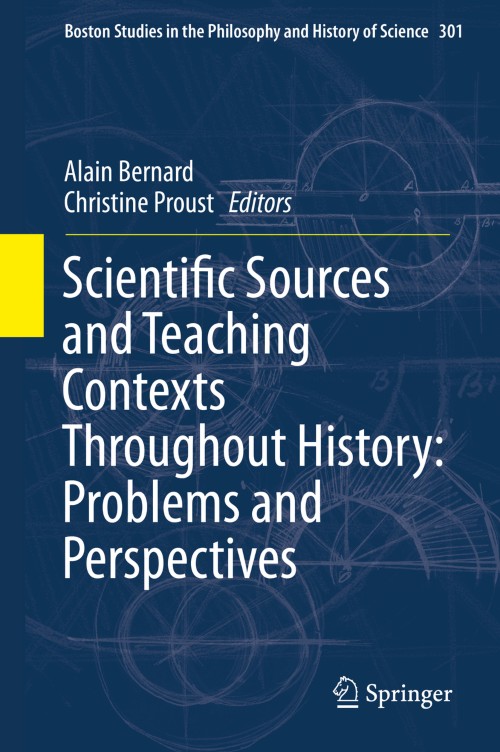
Scientific Sources and Teaching Contexts Throughout History: Problems and Perspectives [electronic resource] / edited by Alain Bernard, Christine Proust.
Erişim Adresi
ISBN
9789400751224
Dil Kodu
İngilizce
Yer Numarası
DK/16058
Basım Bildirimi
1st ed. 2014.
Yayın Bilgisi
Dordrecht : Springer Netherlands : Imprint: Springer, 2014.
Fiziksel Niteleme
IX, 334 p. 227 illus. online resource.
Dizi
Boston Studies in the Philosophy and History of Science, 2214-7942 ; 301
İçindekiler Notu
Contributors -- General Introduction; Alain Bernard and Christine Proust -- Part I: Holistic Approach -- The teaching context and reading from the 16th to the 19th centuries: The role of the memorization of texts in learning; Anne-Marie Chartier -- Teaching and learning medicine and exorcism at Uruk during the Hellenistic period; Philippe Clancier -- Part II: Critical Approach -- Does a master always write for his students? Some evidence from Old Babylonian scribal schools; Christine Proust -- In what sense did Theon’s commentary on the Almagest have a didactic purpose?; Alain Bernard -- Part III: Comparative Approach -- Relationships between French “practical arithmetics” and teaching?; Stéphane Lamassé -- On the transmission of mathematical knowledge in versified form in China; Andrea Bréard -- Mathematical Progress or Mathematical Teaching? Bilingualism and Printing In European Renaissance Mathematics; Giovanna C. Cifoletti -- Part IV: Zooming Approach.- Leonardo of Pisa and the Liber Abaci.Biographical elements and the project of the work; Eva Caianiello -- Didactical Dimensions of Mathematical Problems: Weighted Distribution in a Vietnamese Mathematical Treatise; Alexei Volkov -- Learning and Teaching Medicine in Late Imperial China; Florence Bretelle-Establet -- Post Face -- On the sources of the historian of science from the perspective of a history of education; Karine Chemla -- Index.
Özet, vb.
This book examines the textual, social, cultural, practical and institutional environments to which the expression “teaching and learning contexts” refers. It reflects on the extent to which studying such environments helps us to better understand ancient or modern sources, and how notions of “teaching” and “learning” are to be understood. Tackling two problems: the first, is that of certain sources of scientific knowledge being studied without taking into account the various “contexts” of transmission that gave this knowledge a long-lasting meaning. The second is that other sources are related to teaching and learning activities, but without being too precise and demonstrative about the existence and nature of this “teaching context”. In other words, this book makes clear what is meant by “context” and highlights the complexity of the practice hidden by the words “teaching” and “learning”. Divided into three parts, the book makes accessible teaching and learning situations, presents comparatist approaches, and emphasizes the notion of teaching as projects embedded in coherent treatises or productions. .
Konu
Science __ History.
Knowledge, Theory of.
Education __ Philosophy.
Science __ Philosophy.
History of Science.
Epistemology.
Philosophy of Education.
Philosophy of Science.
Knowledge, Theory of.
Education __ Philosophy.
Science __ Philosophy.
History of Science.
Epistemology.
Philosophy of Education.
Philosophy of Science.
Diğer Yazarlar
Kurum Adı
Eseri Alıntıla
Referansları kullanmadan önce gözden geçirmeniz ve varsa gerekli düzeltmeleri yapmanız önerilir.
Dijital Kaynak
MARC Görünümü
LEADER 04664nam a22005535i 4500
001 814821
003 TR_AnAIT
005 20260130213840
007 cr nn 008mamaa
008 131125s2014 ne | s |||| 0|eng d
020 |a9789400751224|9978-94-007-5122-4
024 7 |a10.1007/978-94-007-5122-4|2doi
041 |aeng
049 |aTürk Tarih Kurumu Kütüphanesi
050 4|aQ124.6-127.2
072 7|aPDX|2bicssc
072 7|aSCI034000|2bisacsh
072 7|aPDX|2thema
082 04|a509|223
090 |aDK/16058
245 10|aScientific Sources and Teaching Contexts Throughout History: Problems and Perspectives|h[electronic resource] /|cedited by Alain Bernard, Christine Proust.
250 |a1st ed. 2014.
264 1|aDordrecht :|bSpringer Netherlands :|bImprint: Springer,|c2014.
300 |aIX, 334 p. 227 illus.|bonline resource.
336 |atext|btxt|2rdacontent
337 |acomputer|bc|2rdamedia
338 |aonline resource|bcr|2rdacarrier
347 |atext file|bPDF|2rda
490 1 |aBoston Studies in the Philosophy and History of Science,|x2214-7942 ;|v301
505 0 |aContributors -- General Introduction; Alain Bernard and Christine Proust -- Part I: Holistic Approach -- The teaching context and reading from the 16th to the 19th centuries: The role of the memorization of texts in learning; Anne-Marie Chartier -- Teaching and learning medicine and exorcism at Uruk during the Hellenistic period; Philippe Clancier -- Part II: Critical Approach -- Does a master always write for his students? Some evidence from Old Babylonian scribal schools; Christine Proust -- In what sense did Theon’s commentary on the Almagest have a didactic purpose?; Alain Bernard -- Part III: Comparative Approach -- Relationships between French “practical arithmetics” and teaching?; Stéphane Lamassé -- On the transmission of mathematical knowledge in versified form in China; Andrea Bréard -- Mathematical Progress or Mathematical Teaching? Bilingualism and Printing In European Renaissance Mathematics; Giovanna C. Cifoletti -- Part IV: Zooming Approach.- Leonardo of Pisa and the Liber Abaci.Biographical elements and the project of the work; Eva Caianiello -- Didactical Dimensions of Mathematical Problems: Weighted Distribution in a Vietnamese Mathematical Treatise; Alexei Volkov -- Learning and Teaching Medicine in Late Imperial China; Florence Bretelle-Establet -- Post Face -- On the sources of the historian of science from the perspective of a history of education; Karine Chemla -- Index.
520 |aThis book examines the textual, social, cultural, practical and institutional environments to which the expression “teaching and learning contexts” refers. It reflects on the extent to which studying such environments helps us to better understand ancient or modern sources, and how notions of “teaching” and “learning” are to be understood. Tackling two problems: the first, is that of certain sources of scientific knowledge being studied without taking into account the various “contexts” of transmission that gave this knowledge a long-lasting meaning. The second is that other sources are related to teaching and learning activities, but without being too precise and demonstrative about the existence and nature of this “teaching context”. In other words, this book makes clear what is meant by “context” and highlights the complexity of the practice hidden by the words “teaching” and “learning”. Divided into three parts, the book makes accessible teaching and learning situations, presents comparatist approaches, and emphasizes the notion of teaching as projects embedded in coherent treatises or productions. .
650 0|aScience|xHistory.
650 0|aKnowledge, Theory of.
650 0|aEducation|xPhilosophy.
650 0|aScience|xPhilosophy.
650 14|aHistory of Science.
650 24|aEpistemology.
650 24|aPhilosophy of Education.
650 24|aPhilosophy of Science.
700 1 |aBernard, Alain.|eeditor.|4edt|4http://id.loc.gov/vocabulary/relators/edt
700 1 |aProust, Christine.|eeditor.|4edt|4http://id.loc.gov/vocabulary/relators/edt
710 2 |aSpringerLink (Online service)
773 0 |tSpringer Nature eBook
776 08|iPrinted edition:|z9789400751217
776 08|iPrinted edition:|z9789400751231
776 08|iPrinted edition:|z9789401778060
830 0|aBoston Studies in the Philosophy and History of Science,|x2214-7942 ;|v301
856 40|uhttps://doi.org/10.1007/978-94-007-5122-4
912 |aZDB-2-SHU
912 |aZDB-2-SXH
950 |aHumanities, Social Sciences and Law (SpringerNature-11648)
950 |aHistory (R0) (SpringerNature-43722)
001 814821
003 TR_AnAIT
005 20260130213840
007 cr nn 008mamaa
008 131125s2014 ne | s |||| 0|eng d
020 |a9789400751224|9978-94-007-5122-4
024 7 |a10.1007/978-94-007-5122-4|2doi
041 |aeng
049 |aTürk Tarih Kurumu Kütüphanesi
050 4|aQ124.6-127.2
072 7|aPDX|2bicssc
072 7|aSCI034000|2bisacsh
072 7|aPDX|2thema
082 04|a509|223
090 |aDK/16058
245 10|aScientific Sources and Teaching Contexts Throughout History: Problems and Perspectives|h[electronic resource] /|cedited by Alain Bernard, Christine Proust.
250 |a1st ed. 2014.
264 1|aDordrecht :|bSpringer Netherlands :|bImprint: Springer,|c2014.
300 |aIX, 334 p. 227 illus.|bonline resource.
336 |atext|btxt|2rdacontent
337 |acomputer|bc|2rdamedia
338 |aonline resource|bcr|2rdacarrier
347 |atext file|bPDF|2rda
490 1 |aBoston Studies in the Philosophy and History of Science,|x2214-7942 ;|v301
505 0 |aContributors -- General Introduction; Alain Bernard and Christine Proust -- Part I: Holistic Approach -- The teaching context and reading from the 16th to the 19th centuries: The role of the memorization of texts in learning; Anne-Marie Chartier -- Teaching and learning medicine and exorcism at Uruk during the Hellenistic period; Philippe Clancier -- Part II: Critical Approach -- Does a master always write for his students? Some evidence from Old Babylonian scribal schools; Christine Proust -- In what sense did Theon’s commentary on the Almagest have a didactic purpose?; Alain Bernard -- Part III: Comparative Approach -- Relationships between French “practical arithmetics” and teaching?; Stéphane Lamassé -- On the transmission of mathematical knowledge in versified form in China; Andrea Bréard -- Mathematical Progress or Mathematical Teaching? Bilingualism and Printing In European Renaissance Mathematics; Giovanna C. Cifoletti -- Part IV: Zooming Approach.- Leonardo of Pisa and the Liber Abaci.Biographical elements and the project of the work; Eva Caianiello -- Didactical Dimensions of Mathematical Problems: Weighted Distribution in a Vietnamese Mathematical Treatise; Alexei Volkov -- Learning and Teaching Medicine in Late Imperial China; Florence Bretelle-Establet -- Post Face -- On the sources of the historian of science from the perspective of a history of education; Karine Chemla -- Index.
520 |aThis book examines the textual, social, cultural, practical and institutional environments to which the expression “teaching and learning contexts” refers. It reflects on the extent to which studying such environments helps us to better understand ancient or modern sources, and how notions of “teaching” and “learning” are to be understood. Tackling two problems: the first, is that of certain sources of scientific knowledge being studied without taking into account the various “contexts” of transmission that gave this knowledge a long-lasting meaning. The second is that other sources are related to teaching and learning activities, but without being too precise and demonstrative about the existence and nature of this “teaching context”. In other words, this book makes clear what is meant by “context” and highlights the complexity of the practice hidden by the words “teaching” and “learning”. Divided into three parts, the book makes accessible teaching and learning situations, presents comparatist approaches, and emphasizes the notion of teaching as projects embedded in coherent treatises or productions. .
650 0|aScience|xHistory.
650 0|aKnowledge, Theory of.
650 0|aEducation|xPhilosophy.
650 0|aScience|xPhilosophy.
650 14|aHistory of Science.
650 24|aEpistemology.
650 24|aPhilosophy of Education.
650 24|aPhilosophy of Science.
700 1 |aBernard, Alain.|eeditor.|4edt|4http://id.loc.gov/vocabulary/relators/edt
700 1 |aProust, Christine.|eeditor.|4edt|4http://id.loc.gov/vocabulary/relators/edt
710 2 |aSpringerLink (Online service)
773 0 |tSpringer Nature eBook
776 08|iPrinted edition:|z9789400751217
776 08|iPrinted edition:|z9789400751231
776 08|iPrinted edition:|z9789401778060
830 0|aBoston Studies in the Philosophy and History of Science,|x2214-7942 ;|v301
856 40|uhttps://doi.org/10.1007/978-94-007-5122-4
912 |aZDB-2-SHU
912 |aZDB-2-SXH
950 |aHumanities, Social Sciences and Law (SpringerNature-11648)
950 |aHistory (R0) (SpringerNature-43722)
Materyaller
Depodan talep edilen materyal sadece kütüphane içerisinde kullanılmaktadır.
Materyal dışarıya ödünç verilmemektedir.
Materyal dışarıya ödünç verilmemektedir.
