

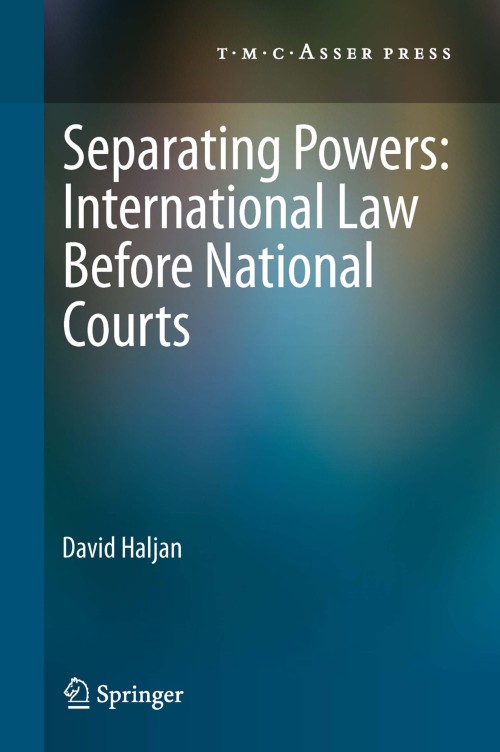
Separating Powers: International Law before National Courts [electronic resource] / by David Haljan.
Erişim Adresi
ISBN
9789067048583
Dil Kodu
İngilizce
Yer Numarası
DK/16062
Yazar
Basım Bildirimi
1st ed. 2013.
Yayın Bilgisi
The Hague : T.M.C. Asser Press : Imprint: T.M.C. Asser Press, 2013.
Fiziksel Niteleme
XIV, 326 p. online resource.
İçindekiler Notu
Making Introductions -- International Law and the Separation of Powers -- Treaties and Law-Making Power -- Customary International Law and Judicial Power -- Separating Powers?.
Özet, vb.
The more international law, taken as a global answer to global problems, intrudes into domestic legal systems, the more it takes on the role and function of domestic law. This raises a separation of powers question regarding law-making powers. In this book the author considers that specific issue. In contrast to other studies on domestic courts applying international law, the author’s constitutional orientation focusses on the presumptions concerning the distribution of state power. He collects and examines relevant decisions regarding treaties and customary international law from four leading legal systems, the US, the UK, France, and the Netherlands. Those decisions reveal that institutional and conceptual allegiances to constitutional structures render it difficult for courts to see their mandates and powers in terms other than exclusively national. What follows is a constitutional asymmetry between international law and national law generating an inevitable dualism which cannot necessarily be overcome by express constitutional provisions accommodating international law. The separation of powers thus frames the two principal horizons for any future, practicable attempts at integrating of the two legal orders. Either established concepts of constitutional law and constitutionalism will have to be revised, or what international law may do within a municipal legal system will have to be recalculated. This book offers new insight and new approaches in dealing with international law questions before domestic courts. It is an interesting work of reference and a basis for further debate on this topic among academics and practitioners in the fields of international and constitutional law. David Haljan is a Senior Research Fellow with the Institute of Constitutional Law, University of Leuven.
Konu
Mediation.
Dispute resolution (Law).
Arbitration (Administrative law).
Constitutional law.
Dispute Resolution, Mediation, Arbitration.
Constitutional Law.
Dispute resolution (Law).
Arbitration (Administrative law).
Constitutional law.
Dispute Resolution, Mediation, Arbitration.
Constitutional Law.
Kurum Adı
Eseri Alıntıla
Referansları kullanmadan önce gözden geçirmeniz ve varsa gerekli düzeltmeleri yapmanız önerilir.
Dijital Kaynak
MARC Görünümü
LEADER 04468nam a22005175i 4500
001 814825
003 TR_AnAIT
005 20260130213825
007 cr nn 008mamaa
008 121031s2013 ne | s |||| 0|eng d
020 |a9789067048583|9978-90-6704-858-3
024 7 |a10.1007/978-90-6704-858-3|2doi
041 |aeng
049 |aTürk Tarih Kurumu Kütüphanesi
050 4|aK5459
072 7|aLNAC5|2bicssc
072 7|aLAW006000|2bisacsh
072 7|aLNAC5|2thema
082 04|a347.09|223
090 |aDK/16062
100 1 |aHaljan, David.|eauthor.|4aut|4http://id.loc.gov/vocabulary/relators/aut
245 10|aSeparating Powers: International Law before National Courts|h[electronic resource] /|cby David Haljan.
250 |a1st ed. 2013.
264 1|aThe Hague :|bT.M.C. Asser Press :|bImprint: T.M.C. Asser Press,|c2013.
300 |aXIV, 326 p.|bonline resource.
336 |atext|btxt|2rdacontent
337 |acomputer|bc|2rdamedia
338 |aonline resource|bcr|2rdacarrier
347 |atext file|bPDF|2rda
505 0 |aMaking Introductions -- International Law and the Separation of Powers -- Treaties and Law-Making Power -- Customary International Law and Judicial Power -- Separating Powers?.
520 |aThe more international law, taken as a global answer to global problems, intrudes into domestic legal systems, the more it takes on the role and function of domestic law. This raises a separation of powers question regarding law-making powers. In this book the author considers that specific issue. In contrast to other studies on domestic courts applying international law, the author’s constitutional orientation focusses on the presumptions concerning the distribution of state power. He collects and examines relevant decisions regarding treaties and customary international law from four leading legal systems, the US, the UK, France, and the Netherlands. Those decisions reveal that institutional and conceptual allegiances to constitutional structures render it difficult for courts to see their mandates and powers in terms other than exclusively national. What follows is a constitutional asymmetry between international law and national law generating an inevitable dualism which cannot necessarily be overcome by express constitutional provisions accommodating international law. The separation of powers thus frames the two principal horizons for any future, practicable attempts at integrating of the two legal orders. Either established concepts of constitutional law and constitutionalism will have to be revised, or what international law may do within a municipal legal system will have to be recalculated. This book offers new insight and new approaches in dealing with international law questions before domestic courts. It is an interesting work of reference and a basis for further debate on this topic among academics and practitioners in the fields of international and constitutional law. David Haljan is a Senior Research Fellow with the Institute of Constitutional Law, University of Leuven.
532 8 |aAccessibility summary: This PDF eBook is produced by a third-party. We have requested that the file be made accessible and compliant with the European Accessibility Act (EAA). However, we have not been able to fully verify its compliance with recognized accessibility standards (such as PDF/UA or WCAG). For detailed accessibility information, please refer to the original publisher’s website. If you require an accessible version of this content, please contact accessibilitysupport@springernature.com. We are committed to improving accessibility and will work with the publisher to meet your needs wherever possible.
532 8 |aPublisher contact for further accessibility information: accessibilitysupport@springernature.com
650 0|aMediation.
650 0|aDispute resolution (Law).
650 0|aArbitration (Administrative law).
650 0|aConstitutional law.
650 14|aDispute Resolution, Mediation, Arbitration.
650 24|aConstitutional Law.
710 2 |aSpringerLink (Online service)
773 0 |tSpringer Nature eBook
776 08|iPrinted edition:|z9789067048576
776 08|iPrinted edition:|z9789067048590
776 08|iPrinted edition:|z9789067049580
856 40|uhttps://doi.org/10.1007/978-90-6704-858-3
912 |aZDB-2-SHU
912 |aZDB-2-SXLC
950 |aHumanities, Social Sciences and Law (SpringerNature-11648)
950 |aLaw and Criminology (R0) (SpringerNature-43727)
001 814825
003 TR_AnAIT
005 20260130213825
007 cr nn 008mamaa
008 121031s2013 ne | s |||| 0|eng d
020 |a9789067048583|9978-90-6704-858-3
024 7 |a10.1007/978-90-6704-858-3|2doi
041 |aeng
049 |aTürk Tarih Kurumu Kütüphanesi
050 4|aK5459
072 7|aLNAC5|2bicssc
072 7|aLAW006000|2bisacsh
072 7|aLNAC5|2thema
082 04|a347.09|223
090 |aDK/16062
100 1 |aHaljan, David.|eauthor.|4aut|4http://id.loc.gov/vocabulary/relators/aut
245 10|aSeparating Powers: International Law before National Courts|h[electronic resource] /|cby David Haljan.
250 |a1st ed. 2013.
264 1|aThe Hague :|bT.M.C. Asser Press :|bImprint: T.M.C. Asser Press,|c2013.
300 |aXIV, 326 p.|bonline resource.
336 |atext|btxt|2rdacontent
337 |acomputer|bc|2rdamedia
338 |aonline resource|bcr|2rdacarrier
347 |atext file|bPDF|2rda
505 0 |aMaking Introductions -- International Law and the Separation of Powers -- Treaties and Law-Making Power -- Customary International Law and Judicial Power -- Separating Powers?.
520 |aThe more international law, taken as a global answer to global problems, intrudes into domestic legal systems, the more it takes on the role and function of domestic law. This raises a separation of powers question regarding law-making powers. In this book the author considers that specific issue. In contrast to other studies on domestic courts applying international law, the author’s constitutional orientation focusses on the presumptions concerning the distribution of state power. He collects and examines relevant decisions regarding treaties and customary international law from four leading legal systems, the US, the UK, France, and the Netherlands. Those decisions reveal that institutional and conceptual allegiances to constitutional structures render it difficult for courts to see their mandates and powers in terms other than exclusively national. What follows is a constitutional asymmetry between international law and national law generating an inevitable dualism which cannot necessarily be overcome by express constitutional provisions accommodating international law. The separation of powers thus frames the two principal horizons for any future, practicable attempts at integrating of the two legal orders. Either established concepts of constitutional law and constitutionalism will have to be revised, or what international law may do within a municipal legal system will have to be recalculated. This book offers new insight and new approaches in dealing with international law questions before domestic courts. It is an interesting work of reference and a basis for further debate on this topic among academics and practitioners in the fields of international and constitutional law. David Haljan is a Senior Research Fellow with the Institute of Constitutional Law, University of Leuven.
532 8 |aAccessibility summary: This PDF eBook is produced by a third-party. We have requested that the file be made accessible and compliant with the European Accessibility Act (EAA). However, we have not been able to fully verify its compliance with recognized accessibility standards (such as PDF/UA or WCAG). For detailed accessibility information, please refer to the original publisher’s website. If you require an accessible version of this content, please contact accessibilitysupport@springernature.com. We are committed to improving accessibility and will work with the publisher to meet your needs wherever possible.
532 8 |aPublisher contact for further accessibility information: accessibilitysupport@springernature.com
650 0|aMediation.
650 0|aDispute resolution (Law).
650 0|aArbitration (Administrative law).
650 0|aConstitutional law.
650 14|aDispute Resolution, Mediation, Arbitration.
650 24|aConstitutional Law.
710 2 |aSpringerLink (Online service)
773 0 |tSpringer Nature eBook
776 08|iPrinted edition:|z9789067048576
776 08|iPrinted edition:|z9789067048590
776 08|iPrinted edition:|z9789067049580
856 40|uhttps://doi.org/10.1007/978-90-6704-858-3
912 |aZDB-2-SHU
912 |aZDB-2-SXLC
950 |aHumanities, Social Sciences and Law (SpringerNature-11648)
950 |aLaw and Criminology (R0) (SpringerNature-43727)
Materyaller
Depodan talep edilen materyal sadece kütüphane içerisinde kullanılmaktadır.
Materyal dışarıya ödünç verilmemektedir.
Materyal dışarıya ödünç verilmemektedir.
