

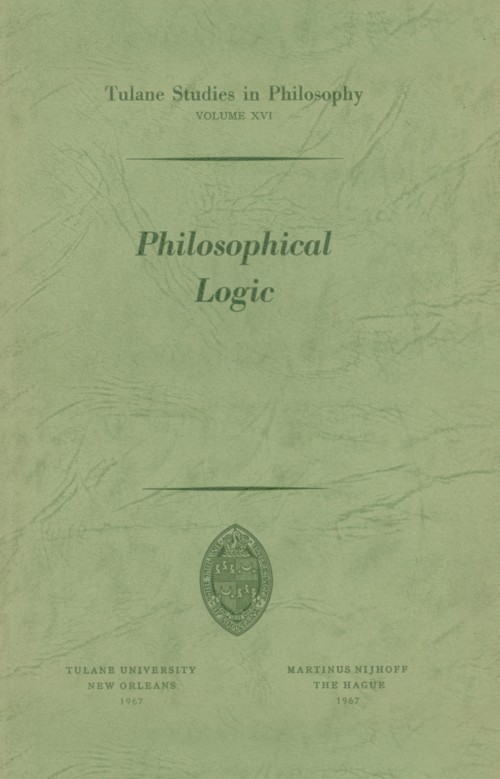
Philosophical Logic [electronic resource] / by Robert L. Arrington, Peter M. Burkholder, Shannon Dubose, James W. Dye, James K. Feibleman, Bertrand P. Helm, Max Hocutt, Harold N. Lee, Louise N. Roberts, John C. Sallis, Donald H. Weiss.
Erişim Adresi
ISBN
9789401034975
Dil Kodu
İngilizce
Yer Numarası
DK/16063
Yazar
Basım Bildirimi
1st ed. 1967.
Yayın Bilgisi
Dordrecht : Springer Netherlands : Imprint: Springer, 1967.
Fiziksel Niteleme
VIII, 162 p. online resource.
Dizi
Tulane Studies in Philosophy ; 16
İçindekiler Notu
The Logic of our Language -- Petitio in the Strife of Systems -- Observations on the Uses of Order -- Cultural Relativity and the Logic of Philosophy -- A Material Theory of Reference -- On Letting -- On the Illogic of the Mental -- On the Uses and Interpretation of Logical Symbols -- Notes on a Past Logic of Time -- The Problem of Judgment in Husserl’s Later Thought -- Philosophical Logic and Psychological Satisfaction.
Özet, vb.
With this issue we initiate the policy of expanding the scope of Tulane Studies in Philosophy to include, in addition to the work of members of the department, contributions from philosophers who have earned advanced degrees from Tulane and who are now teaching in other colleges and universities. The Editor THE LOGIC OF OUR LANGUAGE ROBERT L. ARRINGTON Wittgenstein wrote in the Tractatus that "logic is not a body of doctrine, but a mirror-image of the world. " 1 In line with his suggestion that a proposition is a 'picture', Wittgenstein argued that propositions 'show' the logical structure of the real. He was insistent, however, that "the apparent logical form of a proposition need not be its real one. " 2 As a result of this we can misunderstand the structure of fact. Philosophical problems arise just when "the logic of our language is mis understood. " 3 It is common knowledge that much of this view of logic was rejected by Wittgenstein himself in the Philosophical Investi gations. There we are told that language has no ideal or sublime 4 logic which mirrors the structure of the extra-linguistic world. Consequently, inferences from the structure of language to the structure of that extra-linguistic world are invalid. Reality can be 'cut up' in any of a number of ways by language. Wittgenstein adopted a view of philosophy which would render that discipline a non-explanatory, non-critical study of the multiple ways in which language can be used.
Konu
Philosophy.
Logic.
Philosophy.
Logic.
Logic.
Philosophy.
Logic.
Diğer Yazarlar
Kurum Adı
Eseri Alıntıla
Referansları kullanmadan önce gözden geçirmeniz ve varsa gerekli düzeltmeleri yapmanız önerilir.
Dijital Kaynak
MARC Görünümü
LEADER 05339nam a22006615i 4500
001 814826
003 TR_AnAIT
005 20260130213811
007 cr nn 008mamaa
008 121227s1967 ne | s |||| 0|eng d
020 |a9789401034975|9978-94-010-3497-5
024 7 |a10.1007/978-94-010-3497-5|2doi
041 |aeng
049 |aTürk Tarih Kurumu Kütüphanesi
050 4|aB1-5802
072 7|aHP|2bicssc
072 7|aPHI000000|2bisacsh
072 7|aQD|2thema
082 04|a100|223
090 |aDK/16063
100 1 |aArrington, Robert L.|eauthor.|4aut|4http://id.loc.gov/vocabulary/relators/aut
245 10|aPhilosophical Logic|h[electronic resource] /|cby Robert L. Arrington, Peter M. Burkholder, Shannon Dubose, James W. Dye, James K. Feibleman, Bertrand P. Helm, Max Hocutt, Harold N. Lee, Louise N. Roberts, John C. Sallis, Donald H. Weiss.
250 |a1st ed. 1967.
264 1|aDordrecht :|bSpringer Netherlands :|bImprint: Springer,|c1967.
300 |aVIII, 162 p.|bonline resource.
336 |atext|btxt|2rdacontent
337 |acomputer|bc|2rdamedia
338 |aonline resource|bcr|2rdacarrier
347 |atext file|bPDF|2rda
490 1 |aTulane Studies in Philosophy ;|v16
505 0 |aThe Logic of our Language -- Petitio in the Strife of Systems -- Observations on the Uses of Order -- Cultural Relativity and the Logic of Philosophy -- A Material Theory of Reference -- On Letting -- On the Illogic of the Mental -- On the Uses and Interpretation of Logical Symbols -- Notes on a Past Logic of Time -- The Problem of Judgment in Husserl’s Later Thought -- Philosophical Logic and Psychological Satisfaction.
520 |aWith this issue we initiate the policy of expanding the scope of Tulane Studies in Philosophy to include, in addition to the work of members of the department, contributions from philosophers who have earned advanced degrees from Tulane and who are now teaching in other colleges and universities. The Editor THE LOGIC OF OUR LANGUAGE ROBERT L. ARRINGTON Wittgenstein wrote in the Tractatus that "logic is not a body of doctrine, but a mirror-image of the world. " 1 In line with his suggestion that a proposition is a 'picture', Wittgenstein argued that propositions 'show' the logical structure of the real. He was insistent, however, that "the apparent logical form of a proposition need not be its real one. " 2 As a result of this we can misunderstand the structure of fact. Philosophical problems arise just when "the logic of our language is mis understood. " 3 It is common knowledge that much of this view of logic was rejected by Wittgenstein himself in the Philosophical Investi gations. There we are told that language has no ideal or sublime 4 logic which mirrors the structure of the extra-linguistic world. Consequently, inferences from the structure of language to the structure of that extra-linguistic world are invalid. Reality can be 'cut up' in any of a number of ways by language. Wittgenstein adopted a view of philosophy which would render that discipline a non-explanatory, non-critical study of the multiple ways in which language can be used.
532 8 |aAccessibility summary: This PDF is not accessible. It is based on scanned pages and does not support features such as screen reader compatibility or described non-text content (images, graphs etc). However, it likely supports searchable and selectable text based on OCR (Optical Character Recognition). Users with accessibility needs may not be able to use this content effectively. Please contact us at accessibilitysupport@springernature.com if you require assistance or an alternative format.
532 8 |aInaccessible, or known limited accessibility
532 8 |aNo reading system accessibility options actively disabled
532 8 |aPublisher contact for further accessibility information: accessibilitysupport@springernature.com
650 0|aPhilosophy.
650 0|aLogic.
650 14|aPhilosophy.
650 24|aLogic.
700 1 |aBurkholder, Peter M.|eauthor.|4aut|4http://id.loc.gov/vocabulary/relators/aut
700 1 |aDubose, Shannon.|eauthor.|4aut|4http://id.loc.gov/vocabulary/relators/aut
700 1 |aDye, James W.|eauthor.|4aut|4http://id.loc.gov/vocabulary/relators/aut
700 1 |aFeibleman, James K.|eauthor.|4aut|4http://id.loc.gov/vocabulary/relators/aut
700 1 |aHelm, Bertrand P.|eauthor.|4aut|4http://id.loc.gov/vocabulary/relators/aut
700 1 |aHocutt, Max.|eauthor.|4aut|4http://id.loc.gov/vocabulary/relators/aut
700 1 |aLee, Harold N.|eauthor.|4aut|4http://id.loc.gov/vocabulary/relators/aut
700 1 |aRoberts, Louise N.|eauthor.|4aut|4http://id.loc.gov/vocabulary/relators/aut
700 1 |aSallis, John C.|eauthor.|4aut|4http://id.loc.gov/vocabulary/relators/aut
700 1 |aWeiss, Donald H.|eauthor.|4aut|4http://id.loc.gov/vocabulary/relators/aut
710 2 |aSpringerLink (Online service)
773 0 |tSpringer Nature eBook
776 08|iPrinted edition:|z9789024702909
776 08|iPrinted edition:|z9789401034982
830 0|aTulane Studies in Philosophy ;|v16
856 40|uhttps://doi.org/10.1007/978-94-010-3497-5
912 |aZDB-2-SHU
912 |aZDB-2-SXPR
912 |aZDB-2-BAE
950 |aHumanities, Social Sciences and Law (SpringerNature-11648)
950 |aPhilosophy and Religion (R0) (SpringerNature-43725)
001 814826
003 TR_AnAIT
005 20260130213811
007 cr nn 008mamaa
008 121227s1967 ne | s |||| 0|eng d
020 |a9789401034975|9978-94-010-3497-5
024 7 |a10.1007/978-94-010-3497-5|2doi
041 |aeng
049 |aTürk Tarih Kurumu Kütüphanesi
050 4|aB1-5802
072 7|aHP|2bicssc
072 7|aPHI000000|2bisacsh
072 7|aQD|2thema
082 04|a100|223
090 |aDK/16063
100 1 |aArrington, Robert L.|eauthor.|4aut|4http://id.loc.gov/vocabulary/relators/aut
245 10|aPhilosophical Logic|h[electronic resource] /|cby Robert L. Arrington, Peter M. Burkholder, Shannon Dubose, James W. Dye, James K. Feibleman, Bertrand P. Helm, Max Hocutt, Harold N. Lee, Louise N. Roberts, John C. Sallis, Donald H. Weiss.
250 |a1st ed. 1967.
264 1|aDordrecht :|bSpringer Netherlands :|bImprint: Springer,|c1967.
300 |aVIII, 162 p.|bonline resource.
336 |atext|btxt|2rdacontent
337 |acomputer|bc|2rdamedia
338 |aonline resource|bcr|2rdacarrier
347 |atext file|bPDF|2rda
490 1 |aTulane Studies in Philosophy ;|v16
505 0 |aThe Logic of our Language -- Petitio in the Strife of Systems -- Observations on the Uses of Order -- Cultural Relativity and the Logic of Philosophy -- A Material Theory of Reference -- On Letting -- On the Illogic of the Mental -- On the Uses and Interpretation of Logical Symbols -- Notes on a Past Logic of Time -- The Problem of Judgment in Husserl’s Later Thought -- Philosophical Logic and Psychological Satisfaction.
520 |aWith this issue we initiate the policy of expanding the scope of Tulane Studies in Philosophy to include, in addition to the work of members of the department, contributions from philosophers who have earned advanced degrees from Tulane and who are now teaching in other colleges and universities. The Editor THE LOGIC OF OUR LANGUAGE ROBERT L. ARRINGTON Wittgenstein wrote in the Tractatus that "logic is not a body of doctrine, but a mirror-image of the world. " 1 In line with his suggestion that a proposition is a 'picture', Wittgenstein argued that propositions 'show' the logical structure of the real. He was insistent, however, that "the apparent logical form of a proposition need not be its real one. " 2 As a result of this we can misunderstand the structure of fact. Philosophical problems arise just when "the logic of our language is mis understood. " 3 It is common knowledge that much of this view of logic was rejected by Wittgenstein himself in the Philosophical Investi gations. There we are told that language has no ideal or sublime 4 logic which mirrors the structure of the extra-linguistic world. Consequently, inferences from the structure of language to the structure of that extra-linguistic world are invalid. Reality can be 'cut up' in any of a number of ways by language. Wittgenstein adopted a view of philosophy which would render that discipline a non-explanatory, non-critical study of the multiple ways in which language can be used.
532 8 |aAccessibility summary: This PDF is not accessible. It is based on scanned pages and does not support features such as screen reader compatibility or described non-text content (images, graphs etc). However, it likely supports searchable and selectable text based on OCR (Optical Character Recognition). Users with accessibility needs may not be able to use this content effectively. Please contact us at accessibilitysupport@springernature.com if you require assistance or an alternative format.
532 8 |aInaccessible, or known limited accessibility
532 8 |aNo reading system accessibility options actively disabled
532 8 |aPublisher contact for further accessibility information: accessibilitysupport@springernature.com
650 0|aPhilosophy.
650 0|aLogic.
650 14|aPhilosophy.
650 24|aLogic.
700 1 |aBurkholder, Peter M.|eauthor.|4aut|4http://id.loc.gov/vocabulary/relators/aut
700 1 |aDubose, Shannon.|eauthor.|4aut|4http://id.loc.gov/vocabulary/relators/aut
700 1 |aDye, James W.|eauthor.|4aut|4http://id.loc.gov/vocabulary/relators/aut
700 1 |aFeibleman, James K.|eauthor.|4aut|4http://id.loc.gov/vocabulary/relators/aut
700 1 |aHelm, Bertrand P.|eauthor.|4aut|4http://id.loc.gov/vocabulary/relators/aut
700 1 |aHocutt, Max.|eauthor.|4aut|4http://id.loc.gov/vocabulary/relators/aut
700 1 |aLee, Harold N.|eauthor.|4aut|4http://id.loc.gov/vocabulary/relators/aut
700 1 |aRoberts, Louise N.|eauthor.|4aut|4http://id.loc.gov/vocabulary/relators/aut
700 1 |aSallis, John C.|eauthor.|4aut|4http://id.loc.gov/vocabulary/relators/aut
700 1 |aWeiss, Donald H.|eauthor.|4aut|4http://id.loc.gov/vocabulary/relators/aut
710 2 |aSpringerLink (Online service)
773 0 |tSpringer Nature eBook
776 08|iPrinted edition:|z9789024702909
776 08|iPrinted edition:|z9789401034982
830 0|aTulane Studies in Philosophy ;|v16
856 40|uhttps://doi.org/10.1007/978-94-010-3497-5
912 |aZDB-2-SHU
912 |aZDB-2-SXPR
912 |aZDB-2-BAE
950 |aHumanities, Social Sciences and Law (SpringerNature-11648)
950 |aPhilosophy and Religion (R0) (SpringerNature-43725)
Materyaller
Depodan talep edilen materyal sadece kütüphane içerisinde kullanılmaktadır.
Materyal dışarıya ödünç verilmemektedir.
Materyal dışarıya ödünç verilmemektedir.
