

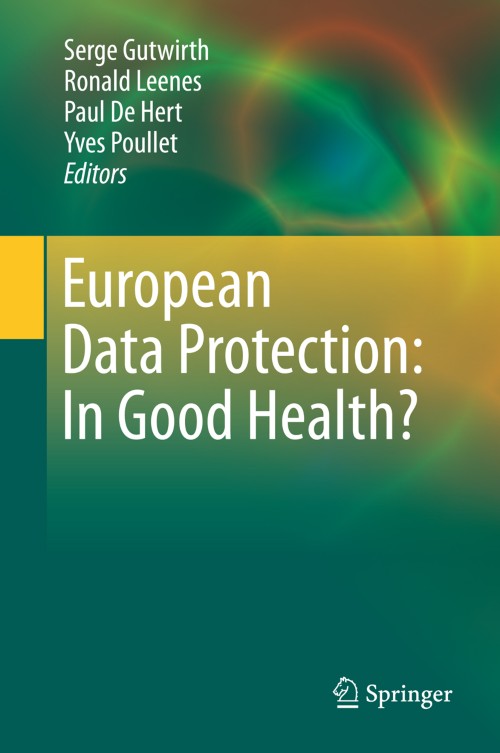
European Data Protection: In Good Health? [electronic resource] / edited by Serge Gutwirth, Ronald Leenes, Paul De Hert, Yves Poullet.
Erişim Adresi
ISBN
9789400729032
Dil Kodu
İngilizce
Yer Numarası
DK/16066
Basım Bildirimi
1st ed. 2012.
Yayın Bilgisi
Dordrecht : Springer Netherlands : Imprint: Springer, 2012.
Fiziksel Niteleme
XVIII, 363 p. 20 illus., 10 illus. in color. online resource.
İçindekiler Notu
Preface: Serge Gutwirth, Ronald Leenes, Paul De Hert & Yves Poullet -- Chapter 1: Surveillance, profiling and prediction -- 1. We are all connected to Facebook...by Facebook: Arnold Roosendaal -- 2. Behavioural tracking on the Internet: Claude Castelluccia -- 3. Privacy for loan applicants versus predictive ower for Loan Providers: is it possible to bridge the gap?: Charlene Jennett, Miguel Malheiros, Sacha Brostoff and M. Angela Sasse -- 4. Cookie wars: how new data profiling and targeting techniques threaten citizens and consumers in the “Big Data” era: Jeffrey Chester -- 5. Examining governmental data mining and its alternatives – A methodology for policy responses: Tal Zarsky -- 6. Managing suspicion and privacy in police information systems: Vlad Niculescu-Dinca -- Chapter 2: Regulation, enforcement and security: 7. The set up of data protection authorities as a new regulatory approach.: Philip Schuetz -- 8. Information sharing in the Area of Freedom, Security and Justice: Franziska Boehm -- 9. The Adequacy of an EU-US Partnership: Els De Busser -- 10. Law Enforcement in the Clouds: is the Data Protection Legal Framework up to the task?: Maria Grazia Porcedda -- 11. Privacy self-regulation through awareness? A critical investigation into the market structure of the security field.: Carla Ilten, Daniel Guagnin and Leon Hempel -- Chapter 3 Concepts and prospection: 12. Privacy penetration testing— how to establish trust in your cloud provider: Christian W. Probst, M. Angela Sasse, Wolter Pieters, Trajce Dimkov, Erik Luysterborg and Michel Arnaud 18 -- 13. Review of the Data Protection Directive: is there need (and room) for a new concept of personal data?: Mario Viola De Azevedo Cunha -- 14. Towards a European eID regulatory framework. Challenges in constructing a legal framework for the protection and management of electronic identities: Norberto Nuno Gomes De Andrade -- 15. From the protection of data to the protection of individuals : extending the application ofnon discrimination principles: Daniel Le Métayer and Julien Le Clainche -- 16. On the principle of privacy by design and its limits: technology, ethics and the rule of law: Ugo Pagallo -- 17. The right to forget, the right to be forgotten. Personal reflections on the fate of personal data in the information society: Ivan Szekely.
Özet, vb.
Although Europe has a significant legal data protection framework, built up around EU Directive 95/46/EC and the Charter of Fundamental Rights, the question of whether data protection and its legal framework are ‘in good health’ is increasingly being posed. Advanced technologies raise fundamental issues regarding key concepts of data protection. Falling storage prices, increasing chips performance, the fact that technology is becoming increasingly embedded and ubiquitous, the convergence of technologies and other technological developments are broadening the scope and possibilities of applications rapidly. Society however, is also changing, affecting the privacy and data protection landscape. The ‘demand’ for free services, security, convenience, governance, etc, changes the mindsets of all the stakeholders involved. Privacy is being proclaimed dead or at least worthy of dying by the captains of industry; governments and policy makers are having to manoeuvre between competing and incompatible aims; and citizens and customers are considered to be indifferent. In the year in which the plans for the revision of the Data Protection Directive will be revealed, the current volume brings together a number of chapters highlighting issues, describing and discussing practices, and offering conceptual analysis of core concepts within the domain of privacy and data protection. The book’s first part focuses on surveillance, profiling and prediction; the second on regulation, enforcement, and security; and the third on some of the fundamental concepts in the area of privacy and data protection. Reading the various chapters it appears that the ‘patient’ needs to be cured of quite some weak spots, illnesses and malformations. European data protection is at a turning point and the new challenges are not only accentuating the existing flaws and the anticipated difficulties, but also, more positively, the merits and the need for strong and accurate data protection practices and rules in Europe, and elsewhere.
Konu
International law.
Computers __ Law and legislation.
Information technology __ Law and legislation.
Law __ Philosophy.
Technology __ Philosophy.
Public International Law.
Legal Aspects of Computing.
Philosophy of Law.
Philosophy of Technology.
Computers __ Law and legislation.
Information technology __ Law and legislation.
Law __ Philosophy.
Technology __ Philosophy.
Public International Law.
Legal Aspects of Computing.
Philosophy of Law.
Philosophy of Technology.
Diğer Yazarlar
Kurum Adı
Eseri Alıntıla
Referansları kullanmadan önce gözden geçirmeniz ve varsa gerekli düzeltmeleri yapmanız önerilir.
Dijital Kaynak
MARC Görünümü
LEADER 06545nam a22005655i 4500
001 814829
003 TR_AnAIT
005 20260130213746
007 cr nn 008mamaa
008 120221s2012 ne | s |||| 0|eng d
020 |a9789400729032|9978-94-007-2903-2
024 7 |a10.1007/978-94-007-2903-2|2doi
041 |aeng
049 |aTürk Tarih Kurumu Kütüphanesi
050 4|aKZ
072 7|aLBB|2bicssc
072 7|aLAW051000|2bisacsh
072 7|aLBB|2thema
082 04|a341|223
090 |aDK/16066
245 10|aEuropean Data Protection: In Good Health?|h[electronic resource] /|cedited by Serge Gutwirth, Ronald Leenes, Paul De Hert, Yves Poullet.
250 |a1st ed. 2012.
264 1|aDordrecht :|bSpringer Netherlands :|bImprint: Springer,|c2012.
300 |aXVIII, 363 p. 20 illus., 10 illus. in color.|bonline resource.
336 |atext|btxt|2rdacontent
337 |acomputer|bc|2rdamedia
338 |aonline resource|bcr|2rdacarrier
347 |atext file|bPDF|2rda
505 0 |aPreface: Serge Gutwirth, Ronald Leenes, Paul De Hert & Yves Poullet -- Chapter 1: Surveillance, profiling and prediction -- 1. We are all connected to Facebook...by Facebook: Arnold Roosendaal -- 2. Behavioural tracking on the Internet: Claude Castelluccia -- 3. Privacy for loan applicants versus predictive ower for Loan Providers: is it possible to bridge the gap?: Charlene Jennett, Miguel Malheiros, Sacha Brostoff and M. Angela Sasse -- 4. Cookie wars: how new data profiling and targeting techniques threaten citizens and consumers in the “Big Data” era: Jeffrey Chester -- 5. Examining governmental data mining and its alternatives – A methodology for policy responses: Tal Zarsky -- 6. Managing suspicion and privacy in police information systems: Vlad Niculescu-Dinca -- Chapter 2: Regulation, enforcement and security: 7. The set up of data protection authorities as a new regulatory approach.: Philip Schuetz -- 8. Information sharing in the Area of Freedom, Security and Justice: Franziska Boehm -- 9. The Adequacy of an EU-US Partnership: Els De Busser -- 10. Law Enforcement in the Clouds: is the Data Protection Legal Framework up to the task?: Maria Grazia Porcedda -- 11. Privacy self-regulation through awareness? A critical investigation into the market structure of the security field.: Carla Ilten, Daniel Guagnin and Leon Hempel -- Chapter 3 Concepts and prospection: 12. Privacy penetration testing— how to establish trust in your cloud provider: Christian W. Probst, M. Angela Sasse, Wolter Pieters, Trajce Dimkov, Erik Luysterborg and Michel Arnaud 18 -- 13. Review of the Data Protection Directive: is there need (and room) for a new concept of personal data?: Mario Viola De Azevedo Cunha -- 14. Towards a European eID regulatory framework. Challenges in constructing a legal framework for the protection and management of electronic identities: Norberto Nuno Gomes De Andrade -- 15. From the protection of data to the protection of individuals : extending the application ofnon discrimination principles: Daniel Le Métayer and Julien Le Clainche -- 16. On the principle of privacy by design and its limits: technology, ethics and the rule of law: Ugo Pagallo -- 17. The right to forget, the right to be forgotten. Personal reflections on the fate of personal data in the information society: Ivan Szekely.
520 |aAlthough Europe has a significant legal data protection framework, built up around EU Directive 95/46/EC and the Charter of Fundamental Rights, the question of whether data protection and its legal framework are ‘in good health’ is increasingly being posed. Advanced technologies raise fundamental issues regarding key concepts of data protection. Falling storage prices, increasing chips performance, the fact that technology is becoming increasingly embedded and ubiquitous, the convergence of technologies and other technological developments are broadening the scope and possibilities of applications rapidly. Society however, is also changing, affecting the privacy and data protection landscape. The ‘demand’ for free services, security, convenience, governance, etc, changes the mindsets of all the stakeholders involved. Privacy is being proclaimed dead or at least worthy of dying by the captains of industry; governments and policy makers are having to manoeuvre between competing and incompatible aims; and citizens and customers are considered to be indifferent. In the year in which the plans for the revision of the Data Protection Directive will be revealed, the current volume brings together a number of chapters highlighting issues, describing and discussing practices, and offering conceptual analysis of core concepts within the domain of privacy and data protection. The book’s first part focuses on surveillance, profiling and prediction; the second on regulation, enforcement, and security; and the third on some of the fundamental concepts in the area of privacy and data protection. Reading the various chapters it appears that the ‘patient’ needs to be cured of quite some weak spots, illnesses and malformations. European data protection is at a turning point and the new challenges are not only accentuating the existing flaws and the anticipated difficulties, but also, more positively, the merits and the need for strong and accurate data protection practices and rules in Europe, and elsewhere.
650 0|aInternational law.
650 0|aComputers|xLaw and legislation.
650 0|aInformation technology|xLaw and legislation.
650 0|aLaw|xPhilosophy.
650 0|aTechnology|xPhilosophy.
650 14|aPublic International Law.
650 24|aLegal Aspects of Computing.
650 24|aPhilosophy of Law.
650 24|aPhilosophy of Technology.
700 1 |aGutwirth, Serge.|eeditor.|4edt|4http://id.loc.gov/vocabulary/relators/edt
700 1 |aLeenes, Ronald.|eeditor.|4edt|4http://id.loc.gov/vocabulary/relators/edt
700 1 |aDe Hert, Paul.|eeditor.|4edt|4http://id.loc.gov/vocabulary/relators/edt
700 1 |aPoullet, Yves.|eeditor.|4edt|4http://id.loc.gov/vocabulary/relators/edt
710 2 |aSpringerLink (Online service)
773 0 |tSpringer Nature eBook
776 08|iPrinted edition:|z9789400729025
776 08|iPrinted edition:|z9789400729049
776 08|iPrinted edition:|z9789400729056
856 40|uhttps://doi.org/10.1007/978-94-007-2903-2
912 |aZDB-2-SHU
912 |aZDB-2-SXLC
950 |aHumanities, Social Sciences and Law (SpringerNature-11648)
950 |aLaw and Criminology (R0) (SpringerNature-43727)
001 814829
003 TR_AnAIT
005 20260130213746
007 cr nn 008mamaa
008 120221s2012 ne | s |||| 0|eng d
020 |a9789400729032|9978-94-007-2903-2
024 7 |a10.1007/978-94-007-2903-2|2doi
041 |aeng
049 |aTürk Tarih Kurumu Kütüphanesi
050 4|aKZ
072 7|aLBB|2bicssc
072 7|aLAW051000|2bisacsh
072 7|aLBB|2thema
082 04|a341|223
090 |aDK/16066
245 10|aEuropean Data Protection: In Good Health?|h[electronic resource] /|cedited by Serge Gutwirth, Ronald Leenes, Paul De Hert, Yves Poullet.
250 |a1st ed. 2012.
264 1|aDordrecht :|bSpringer Netherlands :|bImprint: Springer,|c2012.
300 |aXVIII, 363 p. 20 illus., 10 illus. in color.|bonline resource.
336 |atext|btxt|2rdacontent
337 |acomputer|bc|2rdamedia
338 |aonline resource|bcr|2rdacarrier
347 |atext file|bPDF|2rda
505 0 |aPreface: Serge Gutwirth, Ronald Leenes, Paul De Hert & Yves Poullet -- Chapter 1: Surveillance, profiling and prediction -- 1. We are all connected to Facebook...by Facebook: Arnold Roosendaal -- 2. Behavioural tracking on the Internet: Claude Castelluccia -- 3. Privacy for loan applicants versus predictive ower for Loan Providers: is it possible to bridge the gap?: Charlene Jennett, Miguel Malheiros, Sacha Brostoff and M. Angela Sasse -- 4. Cookie wars: how new data profiling and targeting techniques threaten citizens and consumers in the “Big Data” era: Jeffrey Chester -- 5. Examining governmental data mining and its alternatives – A methodology for policy responses: Tal Zarsky -- 6. Managing suspicion and privacy in police information systems: Vlad Niculescu-Dinca -- Chapter 2: Regulation, enforcement and security: 7. The set up of data protection authorities as a new regulatory approach.: Philip Schuetz -- 8. Information sharing in the Area of Freedom, Security and Justice: Franziska Boehm -- 9. The Adequacy of an EU-US Partnership: Els De Busser -- 10. Law Enforcement in the Clouds: is the Data Protection Legal Framework up to the task?: Maria Grazia Porcedda -- 11. Privacy self-regulation through awareness? A critical investigation into the market structure of the security field.: Carla Ilten, Daniel Guagnin and Leon Hempel -- Chapter 3 Concepts and prospection: 12. Privacy penetration testing— how to establish trust in your cloud provider: Christian W. Probst, M. Angela Sasse, Wolter Pieters, Trajce Dimkov, Erik Luysterborg and Michel Arnaud 18 -- 13. Review of the Data Protection Directive: is there need (and room) for a new concept of personal data?: Mario Viola De Azevedo Cunha -- 14. Towards a European eID regulatory framework. Challenges in constructing a legal framework for the protection and management of electronic identities: Norberto Nuno Gomes De Andrade -- 15. From the protection of data to the protection of individuals : extending the application ofnon discrimination principles: Daniel Le Métayer and Julien Le Clainche -- 16. On the principle of privacy by design and its limits: technology, ethics and the rule of law: Ugo Pagallo -- 17. The right to forget, the right to be forgotten. Personal reflections on the fate of personal data in the information society: Ivan Szekely.
520 |aAlthough Europe has a significant legal data protection framework, built up around EU Directive 95/46/EC and the Charter of Fundamental Rights, the question of whether data protection and its legal framework are ‘in good health’ is increasingly being posed. Advanced technologies raise fundamental issues regarding key concepts of data protection. Falling storage prices, increasing chips performance, the fact that technology is becoming increasingly embedded and ubiquitous, the convergence of technologies and other technological developments are broadening the scope and possibilities of applications rapidly. Society however, is also changing, affecting the privacy and data protection landscape. The ‘demand’ for free services, security, convenience, governance, etc, changes the mindsets of all the stakeholders involved. Privacy is being proclaimed dead or at least worthy of dying by the captains of industry; governments and policy makers are having to manoeuvre between competing and incompatible aims; and citizens and customers are considered to be indifferent. In the year in which the plans for the revision of the Data Protection Directive will be revealed, the current volume brings together a number of chapters highlighting issues, describing and discussing practices, and offering conceptual analysis of core concepts within the domain of privacy and data protection. The book’s first part focuses on surveillance, profiling and prediction; the second on regulation, enforcement, and security; and the third on some of the fundamental concepts in the area of privacy and data protection. Reading the various chapters it appears that the ‘patient’ needs to be cured of quite some weak spots, illnesses and malformations. European data protection is at a turning point and the new challenges are not only accentuating the existing flaws and the anticipated difficulties, but also, more positively, the merits and the need for strong and accurate data protection practices and rules in Europe, and elsewhere.
650 0|aInternational law.
650 0|aComputers|xLaw and legislation.
650 0|aInformation technology|xLaw and legislation.
650 0|aLaw|xPhilosophy.
650 0|aTechnology|xPhilosophy.
650 14|aPublic International Law.
650 24|aLegal Aspects of Computing.
650 24|aPhilosophy of Law.
650 24|aPhilosophy of Technology.
700 1 |aGutwirth, Serge.|eeditor.|4edt|4http://id.loc.gov/vocabulary/relators/edt
700 1 |aLeenes, Ronald.|eeditor.|4edt|4http://id.loc.gov/vocabulary/relators/edt
700 1 |aDe Hert, Paul.|eeditor.|4edt|4http://id.loc.gov/vocabulary/relators/edt
700 1 |aPoullet, Yves.|eeditor.|4edt|4http://id.loc.gov/vocabulary/relators/edt
710 2 |aSpringerLink (Online service)
773 0 |tSpringer Nature eBook
776 08|iPrinted edition:|z9789400729025
776 08|iPrinted edition:|z9789400729049
776 08|iPrinted edition:|z9789400729056
856 40|uhttps://doi.org/10.1007/978-94-007-2903-2
912 |aZDB-2-SHU
912 |aZDB-2-SXLC
950 |aHumanities, Social Sciences and Law (SpringerNature-11648)
950 |aLaw and Criminology (R0) (SpringerNature-43727)
Materyaller
Depodan talep edilen materyal sadece kütüphane içerisinde kullanılmaktadır.
Materyal dışarıya ödünç verilmemektedir.
Materyal dışarıya ödünç verilmemektedir.
