

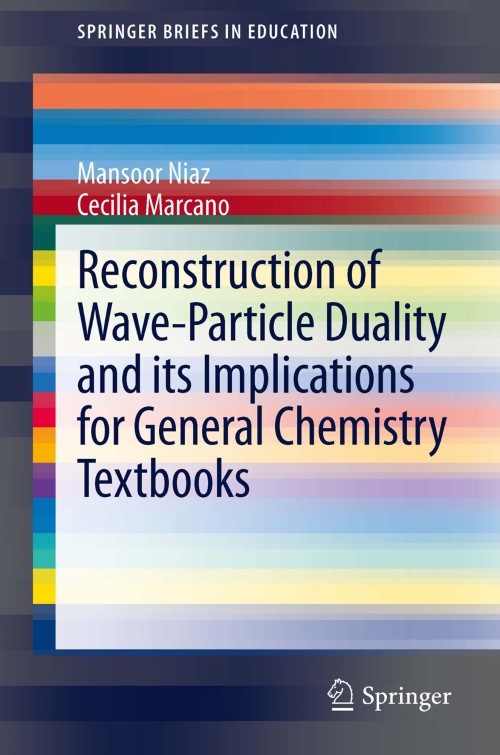
Reconstruction of Wave-Particle Duality and its Implications for General Chemistry Textbooks [electronic resource] / by Mansoor Niaz, Cecilia Marcano.
Erişim Adresi
ISBN
9789400743960
Dil Kodu
İngilizce
Yer Numarası
DK/16086
Yazar
Basım Bildirimi
1st ed. 2012.
Yayın Bilgisi
Dordrecht : Springer Netherlands : Imprint: Springer, 2012.
Fiziksel Niteleme
VIII, 46 p. online resource.
Dizi
SpringerBriefs in Education, 2211-193X
İçindekiler Notu
Introduction: A Brief Review of Textbook Analyses based on a History and Philosoph of Science Perspective -- Historical Reconstruction of Wave-Particle Duality -- Criteria for Evaluation of General Chemistry Textbooks -- Evaluation of General Chemistry Textbooks: Results and Discussion -- Conclusions and Educational Implications -- References -- Appendix A List of General Chemistry Textbooks Analyzed in this Study (n=128) -- Appendix B Reliability of Evaluation of General Chemistry Textbooks based on Inter-Rater Agreement.
Özet, vb.
It goes without saying that atomic structure, including its dual wave-particle nature, cannot be demonstrated in the classroom. Thus, for most science teachers, especially those in physics and chemistry, the textbook is their key resource and their students’ core source of information. Science education historiography recognizes the role played by the history and philosophy of science in developing the content of our textbooks, and with this in mind, the authors analyze more than 120 general chemistry textbooks published in the USA, based on criteria derived from a historical reconstruction of wave-particle duality. They come to some revealing conclusions, including the fact that very few textbooks discussed issues such as the suggestion, by both Einstein and de Broglie, and before conclusive experimental evidence was available, that wave-particle duality existed. Other large-scale omissions included de Broglie’s prescription for observing this duality, and the importance of the Davisson-Germer experiments, as well as the struggle to interpret the experimental data they were collecting. Also untouched was the background to the role played by Schrödinger in developing de Broglie’s ideas. The authors argue that rectifying these deficiencies will arouse students’ curiosity by giving them the opportunity to engage creatively with the content of science curricula. They also assert that it isn’t just the experimental data in science that matters, but the theoretical insights and unwonted inspirations, too. In addition, the controversies and discrepancies in the theoretical and experimental record are key drivers in understanding the development of science as we know it today.
Konu
Science __ Study and teaching.
Teachers __ Training of.
Learning, Psychology of.
Science __ History.
Science __ Philosophy.
Science Education.
Teaching and Teacher Education.
Instructional Psychology.
History of Science.
Philosophy of Science.
Teachers __ Training of.
Learning, Psychology of.
Science __ History.
Science __ Philosophy.
Science Education.
Teaching and Teacher Education.
Instructional Psychology.
History of Science.
Philosophy of Science.
Diğer Yazarlar
Kurum Adı
Eseri Alıntıla
Referansları kullanmadan önce gözden geçirmeniz ve varsa gerekli düzeltmeleri yapmanız önerilir.
Dijital Kaynak
MARC Görünümü
LEADER 04340nam a22005895i 4500
001 814849
003 TR_AnAIT
005 20260130213652
007 cr nn 008mamaa
008 120425s2012 ne | s |||| 0|eng d
020 |a9789400743960|9978-94-007-4396-0
024 7 |a10.1007/978-94-007-4396-0|2doi
041 |aeng
049 |aTürk Tarih Kurumu Kütüphanesi
050 4|aQ181-183.4
072 7|aJNU|2bicssc
072 7|aPD|2bicssc
072 7|aSCI063000|2bisacsh
072 7|aJNU|2thema
072 7|aPD|2thema
082 04|a507.1|223
090 |aDK/16086
100 1 |aNiaz, Mansoor.|eauthor.|4aut|4http://id.loc.gov/vocabulary/relators/aut
245 10|aReconstruction of Wave-Particle Duality and its Implications for General Chemistry Textbooks|h[electronic resource] /|cby Mansoor Niaz, Cecilia Marcano.
250 |a1st ed. 2012.
264 1|aDordrecht :|bSpringer Netherlands :|bImprint: Springer,|c2012.
300 |aVIII, 46 p.|bonline resource.
336 |atext|btxt|2rdacontent
337 |acomputer|bc|2rdamedia
338 |aonline resource|bcr|2rdacarrier
347 |atext file|bPDF|2rda
490 1 |aSpringerBriefs in Education,|x2211-193X
505 0 |aIntroduction: A Brief Review of Textbook Analyses based on a History and Philosoph of Science Perspective -- Historical Reconstruction of Wave-Particle Duality -- Criteria for Evaluation of General Chemistry Textbooks -- Evaluation of General Chemistry Textbooks: Results and Discussion -- Conclusions and Educational Implications -- References -- Appendix A List of General Chemistry Textbooks Analyzed in this Study (n=128) -- Appendix B Reliability of Evaluation of General Chemistry Textbooks based on Inter-Rater Agreement.
520 |aIt goes without saying that atomic structure, including its dual wave-particle nature, cannot be demonstrated in the classroom. Thus, for most science teachers, especially those in physics and chemistry, the textbook is their key resource and their students’ core source of information. Science education historiography recognizes the role played by the history and philosophy of science in developing the content of our textbooks, and with this in mind, the authors analyze more than 120 general chemistry textbooks published in the USA, based on criteria derived from a historical reconstruction of wave-particle duality. They come to some revealing conclusions, including the fact that very few textbooks discussed issues such as the suggestion, by both Einstein and de Broglie, and before conclusive experimental evidence was available, that wave-particle duality existed. Other large-scale omissions included de Broglie’s prescription for observing this duality, and the importance of the Davisson-Germer experiments, as well as the struggle to interpret the experimental data they were collecting. Also untouched was the background to the role played by Schrödinger in developing de Broglie’s ideas. The authors argue that rectifying these deficiencies will arouse students’ curiosity by giving them the opportunity to engage creatively with the content of science curricula. They also assert that it isn’t just the experimental data in science that matters, but the theoretical insights and unwonted inspirations, too. In addition, the controversies and discrepancies in the theoretical and experimental record are key drivers in understanding the development of science as we know it today.
650 0|aScience|xStudy and teaching.
650 0|aTeachers|xTraining of.
650 0|aLearning, Psychology of.
650 0|aScience|xHistory.
650 0|aScience|xPhilosophy.
650 14|aScience Education.
650 24|aTeaching and Teacher Education.
650 24|aInstructional Psychology.
650 24|aHistory of Science.
650 24|aPhilosophy of Science.
700 1 |aMarcano, Cecilia.|eauthor.|4aut|4http://id.loc.gov/vocabulary/relators/aut
710 2 |aSpringerLink (Online service)
773 0 |tSpringer Nature eBook
776 08|iPrinted edition:|z9789400743953
776 08|iPrinted edition:|z9789400743977
830 0|aSpringerBriefs in Education,|x2211-193X
856 40|uhttps://doi.org/10.1007/978-94-007-4396-0
912 |aZDB-2-SHU
912 |aZDB-2-SXED
950 |aHumanities, Social Sciences and Law (SpringerNature-11648)
950 |aEducation (R0) (SpringerNature-43721)
001 814849
003 TR_AnAIT
005 20260130213652
007 cr nn 008mamaa
008 120425s2012 ne | s |||| 0|eng d
020 |a9789400743960|9978-94-007-4396-0
024 7 |a10.1007/978-94-007-4396-0|2doi
041 |aeng
049 |aTürk Tarih Kurumu Kütüphanesi
050 4|aQ181-183.4
072 7|aJNU|2bicssc
072 7|aPD|2bicssc
072 7|aSCI063000|2bisacsh
072 7|aJNU|2thema
072 7|aPD|2thema
082 04|a507.1|223
090 |aDK/16086
100 1 |aNiaz, Mansoor.|eauthor.|4aut|4http://id.loc.gov/vocabulary/relators/aut
245 10|aReconstruction of Wave-Particle Duality and its Implications for General Chemistry Textbooks|h[electronic resource] /|cby Mansoor Niaz, Cecilia Marcano.
250 |a1st ed. 2012.
264 1|aDordrecht :|bSpringer Netherlands :|bImprint: Springer,|c2012.
300 |aVIII, 46 p.|bonline resource.
336 |atext|btxt|2rdacontent
337 |acomputer|bc|2rdamedia
338 |aonline resource|bcr|2rdacarrier
347 |atext file|bPDF|2rda
490 1 |aSpringerBriefs in Education,|x2211-193X
505 0 |aIntroduction: A Brief Review of Textbook Analyses based on a History and Philosoph of Science Perspective -- Historical Reconstruction of Wave-Particle Duality -- Criteria for Evaluation of General Chemistry Textbooks -- Evaluation of General Chemistry Textbooks: Results and Discussion -- Conclusions and Educational Implications -- References -- Appendix A List of General Chemistry Textbooks Analyzed in this Study (n=128) -- Appendix B Reliability of Evaluation of General Chemistry Textbooks based on Inter-Rater Agreement.
520 |aIt goes without saying that atomic structure, including its dual wave-particle nature, cannot be demonstrated in the classroom. Thus, for most science teachers, especially those in physics and chemistry, the textbook is their key resource and their students’ core source of information. Science education historiography recognizes the role played by the history and philosophy of science in developing the content of our textbooks, and with this in mind, the authors analyze more than 120 general chemistry textbooks published in the USA, based on criteria derived from a historical reconstruction of wave-particle duality. They come to some revealing conclusions, including the fact that very few textbooks discussed issues such as the suggestion, by both Einstein and de Broglie, and before conclusive experimental evidence was available, that wave-particle duality existed. Other large-scale omissions included de Broglie’s prescription for observing this duality, and the importance of the Davisson-Germer experiments, as well as the struggle to interpret the experimental data they were collecting. Also untouched was the background to the role played by Schrödinger in developing de Broglie’s ideas. The authors argue that rectifying these deficiencies will arouse students’ curiosity by giving them the opportunity to engage creatively with the content of science curricula. They also assert that it isn’t just the experimental data in science that matters, but the theoretical insights and unwonted inspirations, too. In addition, the controversies and discrepancies in the theoretical and experimental record are key drivers in understanding the development of science as we know it today.
650 0|aScience|xStudy and teaching.
650 0|aTeachers|xTraining of.
650 0|aLearning, Psychology of.
650 0|aScience|xHistory.
650 0|aScience|xPhilosophy.
650 14|aScience Education.
650 24|aTeaching and Teacher Education.
650 24|aInstructional Psychology.
650 24|aHistory of Science.
650 24|aPhilosophy of Science.
700 1 |aMarcano, Cecilia.|eauthor.|4aut|4http://id.loc.gov/vocabulary/relators/aut
710 2 |aSpringerLink (Online service)
773 0 |tSpringer Nature eBook
776 08|iPrinted edition:|z9789400743953
776 08|iPrinted edition:|z9789400743977
830 0|aSpringerBriefs in Education,|x2211-193X
856 40|uhttps://doi.org/10.1007/978-94-007-4396-0
912 |aZDB-2-SHU
912 |aZDB-2-SXED
950 |aHumanities, Social Sciences and Law (SpringerNature-11648)
950 |aEducation (R0) (SpringerNature-43721)
Materyaller
Depodan talep edilen materyal sadece kütüphane içerisinde kullanılmaktadır.
Materyal dışarıya ödünç verilmemektedir.
Materyal dışarıya ödünç verilmemektedir.
