LEADER 03567nam a22005175i 4500
001 814867
003 TR_AnAIT
005 20260130213610
007 cr nn 008mamaa
008 100301s2008 ne | s |||| 0|eng d
020 |a9781402088667|9978-1-4020-8866-7
024 7 |a10.1007/978-1-4020-8866-7|2doi
041 |aeng
049 |aTürk Tarih Kurumu Kütüphanesi
050 4|aQ174-175.3
050 4|aB67
072 7|aPDA|2bicssc
072 7|aSCI075000|2bisacsh
072 7|aPDA|2thema
082 04|a501|223
090 |aDK/16104
100 1 |aAgutter, Paul S.|eauthor.|4aut|4http://id.loc.gov/vocabulary/relators/aut
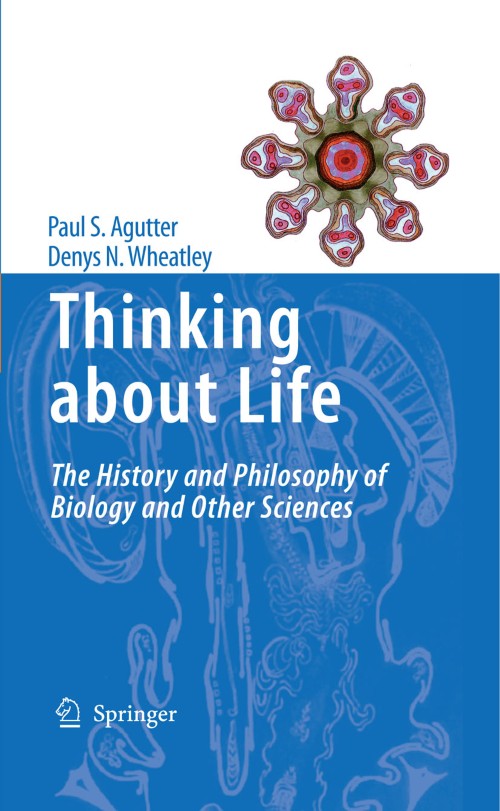
245 10|aThinking about Life|h[electronic resource] :|bThe history and philosophy of biology and other sciences /|cby Paul S. Agutter, Denys N. Wheatley.
250 |a1st ed. 2008.
264 1|aDordrecht :|bSpringer Netherlands :|bImprint: Springer,|c2008.
300 |aXIV, 267 p.|bonline resource.
336 |atext|btxt|2rdacontent
337 |acomputer|bc|2rdamedia
338 |aonline resource|bcr|2rdacarrier
347 |atext file|bPDF|2rda
505 0 |aWhat is Science? -- Culture, Technology and Knowledge -- Classical Roots -- Mediaeval Views of the World -- The Scientific Revolution -- The ‘Scientific Revolution’ in Biology -- Aristotle's Biology -- How Different Are Organisms from Inanimate Objects? -- Cell Theory and Experimental Physiology: New Ideas in a Changing Society -- Embryos and Entelechy -- Spontaneous Generation -- The Evolution of Darwinism -- The Great Heredity Debate -- Evolutionary Theory Attains Maturity -- The Problem of Purpose -- The Scientific Status of Biology.
520 |aOur previous book, About Life, concerned modern biology. We used our present-day understanding of cells to ‘define’ the living state, providing a basis for exploring several general-interest topics: the origin of life, extraterrestrial life, intelligence, and the possibility that humans are unique. The ideas we proposed in About Life were intended as starting-points for debate – we did not claim them as ‘truth’ – but the information on which they were based is currently accepted as ‘scientific fact’. What does that mean? What is ‘scientific fact’ and why is it accepted? What is science – and is biology like other sciences such as physics (except in subject m- ter)? The book you are now reading investigates these questions – and some related ones. Like About Life, it may particularly interest a reader who wishes to change career to biology and its related subdisciplines. In line with a recommendation by the British Association for the Advancement of Science – that the public should be given fuller information about the nature of science – we present the concepts underpinning biology and a survey of its historical and philosophical basis.
650 0|aScience|xPhilosophy.
650 0|aScience|xHistory.
650 0|aBiology|xPhilosophy.
650 14|aPhilosophy of Science.
650 24|aHistory of Science.
650 24|aPhilosophy of Biology.
700 1 |aWheatley, Denys N.|eauthor.|4aut|4http://id.loc.gov/vocabulary/relators/aut
710 2 |aSpringerLink (Online service)
773 0 |tSpringer Nature eBook
776 08|iPrinted edition:|z9781402088650
776 08|iPrinted edition:|z9789048121854
776 08|iPrinted edition:|z9789048180103
856 40|uhttps://doi.org/10.1007/978-1-4020-8866-7
912 |aZDB-2-SHU
912 |aZDB-2-SXPR
950 |aHumanities, Social Sciences and Law (SpringerNature-11648)
950 |aPhilosophy and Religion (R0) (SpringerNature-43725)