

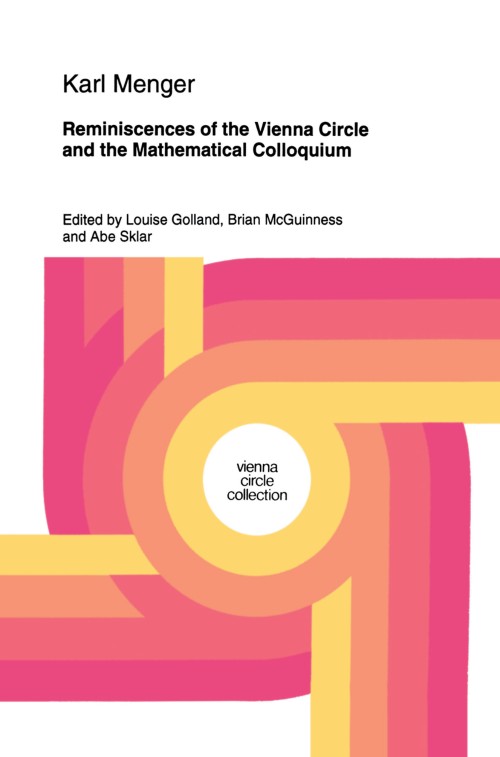
Reminiscences of the Vienna Circle and the Mathematical Colloquium [electronic resource] / by Karl Menger ; edited by L. Golland, B.F. McGuinness, Abe Sklar.
Erişim Adresi
ISBN
9789401111027
Dil Kodu
İngilizce
Yer Numarası
DK/16124
Yazar
Basım Bildirimi
1st ed. 1994.
Yayın Bilgisi
Dordrecht : Springer Netherlands : Imprint: Springer, 1994.
Fiziksel Niteleme
XXVI, 244 p. online resource.
Dizi
Vienna Circle Collection ; 20
İçindekiler Notu
I The Historical Background -- II The Cultural Background -- III The Philosophical Atmosphere in Vienna -- IV Why the Circle invited me. The Theory of Curves and Dimension Theory -- V Vignettes of the Members of the Circle in 1927 -- VI Reminiscences of the Wittgenstein Family -- VII Ludwig Wittgenstein’s Austrian Dictionary -- VIII Wittgenstein’s Tractatus and the Early Circle -- IX On the Communication of Metaphysical Ideas. Wittgenstein’s Ontology -- X Wittgenstein, Brower, and the Circle -- XI Discussions in the Circle 1927–30 -- XII Poland and the Vienna Circle -- XIII The United States 1930–31 -- XIV Discussions in the Circle 1931–34 -- XV The Circle on Ethics -- XVI Moritz Schlick’s Final Years -- Memories of Kurt Gödel -- Index of Names.
Özet, vb.
Karl Menger was born in Vienna on January 13, 1902, the only child of two gifted parents. His mother Hermione, nee Andermann (1870-1922), in addition to her musical abilities, wrote and published short stories and novelettes, while his father Carl (1840-1921) was the noted Austrian economist, one of the founders of marginal utility theory. A highly cultured man, and a liberal rationalist in the nine teenth century sense, the elder Menger had witnessed the defeat and humiliation of the old Austrian empire by Bismarck's Prussia, and the subsequent establishment under Prussian leadership of a militaristic, mystically nationalistic, state-capitalist German empire - in effect, the first modern "military-industrial complex. " These events helped frame in him a set of attitudes that he later transmitted to his son, and which included an appreciation of cultural attainments and tolerance and respect for cultural differences, com bined with a deep suspicion of rabid nationalism, particularly the German variety. Also a fascination with structure, whether artistic, scientific, philosophical, or theological, but a rejection of any aura of mysticism or mumbo-jumbo accompanying such structure. Thus the son remarked at least once that the archangels' chant that begins the Prolog im Himmel in Goethe's Faust was perhaps the most viii INTRODUCTION beautiful thing in the German language "but of course it doesn't mean anything.
Konu
History.
Philosophy and social sciences.
Mathematical logic.
Science __ Philosophy.
History.
Philosophy of the Social Sciences.
Mathematical Logic and Foundations.
Philosophy of Science.
Philosophy and social sciences.
Mathematical logic.
Science __ Philosophy.
History.
Philosophy of the Social Sciences.
Mathematical Logic and Foundations.
Philosophy of Science.
Diğer Yazarlar
Kurum Adı
Eseri Alıntıla
Referansları kullanmadan önce gözden geçirmeniz ve varsa gerekli düzeltmeleri yapmanız önerilir.
Dijital Kaynak
MARC Görünümü
LEADER 05211nam a22006615i 4500
001 814887
003 TR_AnAIT
005 20260130213440
007 cr nn 008mamaa
008 110719s1994 ne | s |||| 0|eng d
020 |a9789401111027|9978-94-011-1102-7
024 7 |a10.1007/978-94-011-1102-7|2doi
041 |aeng
049 |aTürk Tarih Kurumu Kütüphanesi
050 4|aD1-2027
072 7|aHB|2bicssc
072 7|aHBAH|2bicssc
072 7|aHIS000000|2bisacsh
072 7|aNH|2thema
072 7|aNHAH|2thema
082 04|a900|223
090 |aDK/16124
100 1 |aMenger, Karl.|eauthor.|4aut|4http://id.loc.gov/vocabulary/relators/aut
245 10|aReminiscences of the Vienna Circle and the Mathematical Colloquium|h[electronic resource] /|cby Karl Menger ; edited by L. Golland, B.F. McGuinness, Abe Sklar.
250 |a1st ed. 1994.
264 1|aDordrecht :|bSpringer Netherlands :|bImprint: Springer,|c1994.
300 |aXXVI, 244 p.|bonline resource.
336 |atext|btxt|2rdacontent
337 |acomputer|bc|2rdamedia
338 |aonline resource|bcr|2rdacarrier
347 |atext file|bPDF|2rda
490 1 |aVienna Circle Collection ;|v20
505 0 |aI The Historical Background -- II The Cultural Background -- III The Philosophical Atmosphere in Vienna -- IV Why the Circle invited me. The Theory of Curves and Dimension Theory -- V Vignettes of the Members of the Circle in 1927 -- VI Reminiscences of the Wittgenstein Family -- VII Ludwig Wittgenstein’s Austrian Dictionary -- VIII Wittgenstein’s Tractatus and the Early Circle -- IX On the Communication of Metaphysical Ideas. Wittgenstein’s Ontology -- X Wittgenstein, Brower, and the Circle -- XI Discussions in the Circle 1927–30 -- XII Poland and the Vienna Circle -- XIII The United States 1930–31 -- XIV Discussions in the Circle 1931–34 -- XV The Circle on Ethics -- XVI Moritz Schlick’s Final Years -- Memories of Kurt Gödel -- Index of Names.
520 |aKarl Menger was born in Vienna on January 13, 1902, the only child of two gifted parents. His mother Hermione, nee Andermann (1870-1922), in addition to her musical abilities, wrote and published short stories and novelettes, while his father Carl (1840-1921) was the noted Austrian economist, one of the founders of marginal utility theory. A highly cultured man, and a liberal rationalist in the nine teenth century sense, the elder Menger had witnessed the defeat and humiliation of the old Austrian empire by Bismarck's Prussia, and the subsequent establishment under Prussian leadership of a militaristic, mystically nationalistic, state-capitalist German empire - in effect, the first modern "military-industrial complex. " These events helped frame in him a set of attitudes that he later transmitted to his son, and which included an appreciation of cultural attainments and tolerance and respect for cultural differences, com bined with a deep suspicion of rabid nationalism, particularly the German variety. Also a fascination with structure, whether artistic, scientific, philosophical, or theological, but a rejection of any aura of mysticism or mumbo-jumbo accompanying such structure. Thus the son remarked at least once that the archangels' chant that begins the Prolog im Himmel in Goethe's Faust was perhaps the most viii INTRODUCTION beautiful thing in the German language "but of course it doesn't mean anything.
532 8 |aAccessibility summary: This PDF is not accessible. It is based on scanned pages and does not support features such as screen reader compatibility or described non-text content (images, graphs etc). However, it likely supports searchable and selectable text based on OCR (Optical Character Recognition). Users with accessibility needs may not be able to use this content effectively. Please contact us at accessibilitysupport@springernature.com if you require assistance or an alternative format.
532 8 |aInaccessible, or known limited accessibility
532 8 |aNo reading system accessibility options actively disabled
532 8 |aPublisher contact for further accessibility information: accessibilitysupport@springernature.com
650 0|aHistory.
650 0|aPhilosophy and social sciences.
650 0|aMathematical logic.
650 0|aScience|xPhilosophy.
650 14|aHistory.
650 24|aPhilosophy of the Social Sciences.
650 24|aMathematical Logic and Foundations.
650 24|aPhilosophy of Science.
700 1 |aGolland, L.|eeditor.|4edt|4http://id.loc.gov/vocabulary/relators/edt
700 1 |aMcGuinness, B.F.|eeditor.|4edt|4http://id.loc.gov/vocabulary/relators/edt
700 1 |aSklar, Abe.|eeditor.|4edt|4http://id.loc.gov/vocabulary/relators/edt
710 2 |aSpringerLink (Online service)
773 0 |tSpringer Nature eBook
776 08|iPrinted edition:|z9780792327110
776 08|iPrinted edition:|z9780792328735
776 08|iPrinted edition:|z9789401111034
830 0|aVienna Circle Collection ;|v20
856 40|uhttps://doi.org/10.1007/978-94-011-1102-7
912 |aZDB-2-SHU
912 |aZDB-2-SXH
912 |aZDB-2-BAE
950 |aHumanities, Social Sciences and Law (SpringerNature-11648)
950 |aHistory (R0) (SpringerNature-43722)
001 814887
003 TR_AnAIT
005 20260130213440
007 cr nn 008mamaa
008 110719s1994 ne | s |||| 0|eng d
020 |a9789401111027|9978-94-011-1102-7
024 7 |a10.1007/978-94-011-1102-7|2doi
041 |aeng
049 |aTürk Tarih Kurumu Kütüphanesi
050 4|aD1-2027
072 7|aHB|2bicssc
072 7|aHBAH|2bicssc
072 7|aHIS000000|2bisacsh
072 7|aNH|2thema
072 7|aNHAH|2thema
082 04|a900|223
090 |aDK/16124
100 1 |aMenger, Karl.|eauthor.|4aut|4http://id.loc.gov/vocabulary/relators/aut
245 10|aReminiscences of the Vienna Circle and the Mathematical Colloquium|h[electronic resource] /|cby Karl Menger ; edited by L. Golland, B.F. McGuinness, Abe Sklar.
250 |a1st ed. 1994.
264 1|aDordrecht :|bSpringer Netherlands :|bImprint: Springer,|c1994.
300 |aXXVI, 244 p.|bonline resource.
336 |atext|btxt|2rdacontent
337 |acomputer|bc|2rdamedia
338 |aonline resource|bcr|2rdacarrier
347 |atext file|bPDF|2rda
490 1 |aVienna Circle Collection ;|v20
505 0 |aI The Historical Background -- II The Cultural Background -- III The Philosophical Atmosphere in Vienna -- IV Why the Circle invited me. The Theory of Curves and Dimension Theory -- V Vignettes of the Members of the Circle in 1927 -- VI Reminiscences of the Wittgenstein Family -- VII Ludwig Wittgenstein’s Austrian Dictionary -- VIII Wittgenstein’s Tractatus and the Early Circle -- IX On the Communication of Metaphysical Ideas. Wittgenstein’s Ontology -- X Wittgenstein, Brower, and the Circle -- XI Discussions in the Circle 1927–30 -- XII Poland and the Vienna Circle -- XIII The United States 1930–31 -- XIV Discussions in the Circle 1931–34 -- XV The Circle on Ethics -- XVI Moritz Schlick’s Final Years -- Memories of Kurt Gödel -- Index of Names.
520 |aKarl Menger was born in Vienna on January 13, 1902, the only child of two gifted parents. His mother Hermione, nee Andermann (1870-1922), in addition to her musical abilities, wrote and published short stories and novelettes, while his father Carl (1840-1921) was the noted Austrian economist, one of the founders of marginal utility theory. A highly cultured man, and a liberal rationalist in the nine teenth century sense, the elder Menger had witnessed the defeat and humiliation of the old Austrian empire by Bismarck's Prussia, and the subsequent establishment under Prussian leadership of a militaristic, mystically nationalistic, state-capitalist German empire - in effect, the first modern "military-industrial complex. " These events helped frame in him a set of attitudes that he later transmitted to his son, and which included an appreciation of cultural attainments and tolerance and respect for cultural differences, com bined with a deep suspicion of rabid nationalism, particularly the German variety. Also a fascination with structure, whether artistic, scientific, philosophical, or theological, but a rejection of any aura of mysticism or mumbo-jumbo accompanying such structure. Thus the son remarked at least once that the archangels' chant that begins the Prolog im Himmel in Goethe's Faust was perhaps the most viii INTRODUCTION beautiful thing in the German language "but of course it doesn't mean anything.
532 8 |aAccessibility summary: This PDF is not accessible. It is based on scanned pages and does not support features such as screen reader compatibility or described non-text content (images, graphs etc). However, it likely supports searchable and selectable text based on OCR (Optical Character Recognition). Users with accessibility needs may not be able to use this content effectively. Please contact us at accessibilitysupport@springernature.com if you require assistance or an alternative format.
532 8 |aInaccessible, or known limited accessibility
532 8 |aNo reading system accessibility options actively disabled
532 8 |aPublisher contact for further accessibility information: accessibilitysupport@springernature.com
650 0|aHistory.
650 0|aPhilosophy and social sciences.
650 0|aMathematical logic.
650 0|aScience|xPhilosophy.
650 14|aHistory.
650 24|aPhilosophy of the Social Sciences.
650 24|aMathematical Logic and Foundations.
650 24|aPhilosophy of Science.
700 1 |aGolland, L.|eeditor.|4edt|4http://id.loc.gov/vocabulary/relators/edt
700 1 |aMcGuinness, B.F.|eeditor.|4edt|4http://id.loc.gov/vocabulary/relators/edt
700 1 |aSklar, Abe.|eeditor.|4edt|4http://id.loc.gov/vocabulary/relators/edt
710 2 |aSpringerLink (Online service)
773 0 |tSpringer Nature eBook
776 08|iPrinted edition:|z9780792327110
776 08|iPrinted edition:|z9780792328735
776 08|iPrinted edition:|z9789401111034
830 0|aVienna Circle Collection ;|v20
856 40|uhttps://doi.org/10.1007/978-94-011-1102-7
912 |aZDB-2-SHU
912 |aZDB-2-SXH
912 |aZDB-2-BAE
950 |aHumanities, Social Sciences and Law (SpringerNature-11648)
950 |aHistory (R0) (SpringerNature-43722)
Materyaller
Depodan talep edilen materyal sadece kütüphane içerisinde kullanılmaktadır.
Materyal dışarıya ödünç verilmemektedir.
Materyal dışarıya ödünç verilmemektedir.
