

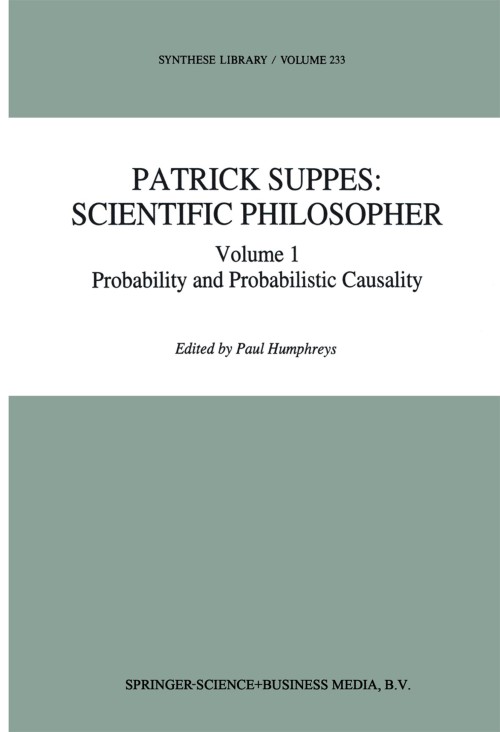
Patrick Suppes: Scientific Philosopher [electronic resource] : Volume 1. Probability and Probabilistic Causality / edited by P. Humphreys.
Erişim Adresi
ISBN
9789401107747
Dil Kodu
İngilizce
Yer Numarası
DK/16134
Basım Bildirimi
1st ed. 1994.
Yayın Bilgisi
Dordrecht : Springer Netherlands : Imprint: Springer, 1994.
Fiziksel Niteleme
XIX, 420 p. online resource.
Dizi
Synthese Library, Studies in Epistemology, Logic, Methodology, and Philosophy of Science, 2542-8292 ; 234
İçindekiler Notu
I: Probability -- Some Contributions to Formal Theory of Probability / Comments by Patrick Suppes -- Elementary Non-Archimedean Representations of Probability for Decision Theory and Games / Comments by Patrick Suppes -- Random Sequences and Hypotheses Tests / Comments by Patrick Suppes -- Changing Probability Judgements / Comments by Patrick Suppes -- Upper and Lower Probability / Comments by Patrick Suppes -- Some Connections between Epistemic Logic and the Theory of Nonadditive Probability / Comments by Patrick Suppes -- On the Properties of Conditional Independence / Comments by Patrick Suppes -- Qualitative Probabilities Revisited / Comments by Patrick Suppes -- The Monks’ Vote: A Dialogue on Unidimensional Probabilistic Geometry / Comments by Patrick Suppes -- II: Probabilistic Causality -- Probabilistic Causation Without Probability / Comments by Patrick Suppes -- Causal Tendency, Necessitivity and Sufficientivity: An Updated Review / Comments by Patrick Suppes -- Practical Causal Generalizations / Comments by Patrick Suppes -- In Place of Regression / Comments by Patrick Suppes -- Testing Probabilistic Causality / Comments by Patrick Suppes -- Psychologistic Aspects of Suppes’s Definition of Causality / Comments by Patrick Suppes -- Name Index -- Table of Contents to Volumes 2 and 3.
Özet, vb.
Patrick Suppes is a philosopher and scientist whose contributions range over probability and statistics, mathematical and experimental psychology, the foundations of physics, education theory, the philosophy of language, measurement theory, and the philosophy of science. He has also been a pioneer in the area of computer assisted instruction. In each of these areas, Suppes has provided seminal ideas that in some cases led to shaping the direction of research in the field. The papers contained in this collection were commissioned with the mandate of advancing research in their respective fields rather than retrospectively surveying the contributions that Suppes himself has made. The authors form an interesting mixture of researchers in both formal philosophy of science and science itself all of whom have been inspired by his ideas. To maintain the spirit of constructive dialogue that characterizes Suppes's intellectual style, he has written individual responses to each article. In Volume 1: Probability and Probabilistic Causality, nineteen distinguished philosophers and scientists focus their attention on probabilistic issues. In Part I the contributors explore axiomatic representations of probability theory including qualitative and interval valued probabilities as well as traditional point valued probabilities. Belief structures and the dynamics of belief are also treated in detail. In Part II the rapidly growing field of probabilistic causation is assessed from both formal and empirical viewpoints. For probability theorists, statisticians, economists, philosophers of science, psychologists and those interested in the foundations of mathematical social science. In Volume 2: Philosophy of Physics, Theory Structure, and Measurement Theory, fifteen distinguished philosophers and scientists cover a wide variety of topics. Part III covers issues in quantum theory, geometry, classical mechanics, and computational physics. Part IV explores Suppes's well known set-theoretic account of scientific theories which has served him well throughout his career. Suppes's contributions to measurement theory have been widely used in mathematical psychology and elsewhere, and this material is the subject of Part V. For physicists, logicians, workers in mathematical social sicence, and philosophers of science. In Volume 3: Philosophy of Language and Logic, Learning and Action Theory, fourteen distinguished philosophers and scientists explore issues in the philosophy of language, logic, and philosophical psychology. Suppes's suggestions that quantum theory requires a rethinking of classical logic form a particularly sharp account of that controversial thesis, and Part VI deals with this issue together with topics in the philosophy of language and logic, including relational grammars and anaphora. Part VII deals with issues in psychology, action theory, and robotics, while Part VIII concludes with a general survey of Suppes's views in the philosophy of science. A comprehensive chronological and topical bibliography of Suppes's writings is included in this volume. For philosophers of language, theoretical linguists, logicians, workers in mathematical social sciences, and philosophers of science.
Konu
Science __ Philosophy.
Statistics .
Language and languages __ Philosophy.
Philosophy of Science.
Statistics.
Philosophy of Language.
Statistics .
Language and languages __ Philosophy.
Philosophy of Science.
Statistics.
Philosophy of Language.
Diğer Yazarlar
Kurum Adı
Eseri Alıntıla
Referansları kullanmadan önce gözden geçirmeniz ve varsa gerekli düzeltmeleri yapmanız önerilir.
Dijital Kaynak
MARC Görünümü
LEADER 07325nam a22005895i 4500
001 814897
003 TR_AnAIT
005 20260130213353
007 cr nn 008mamaa
008 121227s1994 ne | s |||| 0|eng d
020 |a9789401107747|9978-94-011-0774-7
024 7 |a10.1007/978-94-011-0774-7|2doi
041 |aeng
049 |aTürk Tarih Kurumu Kütüphanesi
050 4|aQ174-175.3
050 4|aB67
072 7|aPDA|2bicssc
072 7|aSCI075000|2bisacsh
072 7|aPDA|2thema
082 04|a501|223
090 |aDK/16134
245 10|aPatrick Suppes: Scientific Philosopher|h[electronic resource] :|bVolume 1. Probability and Probabilistic Causality /|cedited by P. Humphreys.
250 |a1st ed. 1994.
264 1|aDordrecht :|bSpringer Netherlands :|bImprint: Springer,|c1994.
300 |aXIX, 420 p.|bonline resource.
336 |atext|btxt|2rdacontent
337 |acomputer|bc|2rdamedia
338 |aonline resource|bcr|2rdacarrier
347 |atext file|bPDF|2rda
490 1 |aSynthese Library, Studies in Epistemology, Logic, Methodology, and Philosophy of Science,|x2542-8292 ;|v234
505 0 |aI: Probability -- Some Contributions to Formal Theory of Probability / Comments by Patrick Suppes -- Elementary Non-Archimedean Representations of Probability for Decision Theory and Games / Comments by Patrick Suppes -- Random Sequences and Hypotheses Tests / Comments by Patrick Suppes -- Changing Probability Judgements / Comments by Patrick Suppes -- Upper and Lower Probability / Comments by Patrick Suppes -- Some Connections between Epistemic Logic and the Theory of Nonadditive Probability / Comments by Patrick Suppes -- On the Properties of Conditional Independence / Comments by Patrick Suppes -- Qualitative Probabilities Revisited / Comments by Patrick Suppes -- The Monks’ Vote: A Dialogue on Unidimensional Probabilistic Geometry / Comments by Patrick Suppes -- II: Probabilistic Causality -- Probabilistic Causation Without Probability / Comments by Patrick Suppes -- Causal Tendency, Necessitivity and Sufficientivity: An Updated Review / Comments by Patrick Suppes -- Practical Causal Generalizations / Comments by Patrick Suppes -- In Place of Regression / Comments by Patrick Suppes -- Testing Probabilistic Causality / Comments by Patrick Suppes -- Psychologistic Aspects of Suppes’s Definition of Causality / Comments by Patrick Suppes -- Name Index -- Table of Contents to Volumes 2 and 3.
520 |aPatrick Suppes is a philosopher and scientist whose contributions range over probability and statistics, mathematical and experimental psychology, the foundations of physics, education theory, the philosophy of language, measurement theory, and the philosophy of science. He has also been a pioneer in the area of computer assisted instruction. In each of these areas, Suppes has provided seminal ideas that in some cases led to shaping the direction of research in the field. The papers contained in this collection were commissioned with the mandate of advancing research in their respective fields rather than retrospectively surveying the contributions that Suppes himself has made. The authors form an interesting mixture of researchers in both formal philosophy of science and science itself all of whom have been inspired by his ideas. To maintain the spirit of constructive dialogue that characterizes Suppes's intellectual style, he has written individual responses to each article. In Volume 1: Probability and Probabilistic Causality, nineteen distinguished philosophers and scientists focus their attention on probabilistic issues. In Part I the contributors explore axiomatic representations of probability theory including qualitative and interval valued probabilities as well as traditional point valued probabilities. Belief structures and the dynamics of belief are also treated in detail. In Part II the rapidly growing field of probabilistic causation is assessed from both formal and empirical viewpoints. For probability theorists, statisticians, economists, philosophers of science, psychologists and those interested in the foundations of mathematical social science. In Volume 2: Philosophy of Physics, Theory Structure, and Measurement Theory, fifteen distinguished philosophers and scientists cover a wide variety of topics. Part III covers issues in quantum theory, geometry, classical mechanics, and computational physics. Part IV explores Suppes's well known set-theoretic account of scientific theories which has served him well throughout his career. Suppes's contributions to measurement theory have been widely used in mathematical psychology and elsewhere, and this material is the subject of Part V. For physicists, logicians, workers in mathematical social sicence, and philosophers of science. In Volume 3: Philosophy of Language and Logic, Learning and Action Theory, fourteen distinguished philosophers and scientists explore issues in the philosophy of language, logic, and philosophical psychology. Suppes's suggestions that quantum theory requires a rethinking of classical logic form a particularly sharp account of that controversial thesis, and Part VI deals with this issue together with topics in the philosophy of language and logic, including relational grammars and anaphora. Part VII deals with issues in psychology, action theory, and robotics, while Part VIII concludes with a general survey of Suppes's views in the philosophy of science. A comprehensive chronological and topical bibliography of Suppes's writings is included in this volume. For philosophers of language, theoretical linguists, logicians, workers in mathematical social sciences, and philosophers of science.
532 8 |aAccessibility summary: This PDF is not accessible. It is based on scanned pages and does not support features such as screen reader compatibility or described non-text content (images, graphs etc). However, it likely supports searchable and selectable text based on OCR (Optical Character Recognition). Users with accessibility needs may not be able to use this content effectively. Please contact us at accessibilitysupport@springernature.com if you require assistance or an alternative format.
532 8 |aInaccessible, or known limited accessibility
532 8 |aNo reading system accessibility options actively disabled
532 8 |aPublisher contact for further accessibility information: accessibilitysupport@springernature.com
650 0|aScience|xPhilosophy.
650 0|aStatistics .
650 0|aLanguage and languages|xPhilosophy.
650 14|aPhilosophy of Science.
650 24|aStatistics.
650 24|aPhilosophy of Language.
700 1 |aHumphreys, P.|eeditor.|4edt|4http://id.loc.gov/vocabulary/relators/edt
710 2 |aSpringerLink (Online service)
773 0 |tSpringer Nature eBook
776 08|iPrinted edition:|z9780792325529
776 08|iPrinted edition:|z9789401107754
776 08|iPrinted edition:|z9789401043311
830 0|aSynthese Library, Studies in Epistemology, Logic, Methodology, and Philosophy of Science,|x2542-8292 ;|v234
856 40|uhttps://doi.org/10.1007/978-94-011-0774-7
912 |aZDB-2-SHU
912 |aZDB-2-SXPR
912 |aZDB-2-BAE
950 |aHumanities, Social Sciences and Law (SpringerNature-11648)
950 |aPhilosophy and Religion (R0) (SpringerNature-43725)
001 814897
003 TR_AnAIT
005 20260130213353
007 cr nn 008mamaa
008 121227s1994 ne | s |||| 0|eng d
020 |a9789401107747|9978-94-011-0774-7
024 7 |a10.1007/978-94-011-0774-7|2doi
041 |aeng
049 |aTürk Tarih Kurumu Kütüphanesi
050 4|aQ174-175.3
050 4|aB67
072 7|aPDA|2bicssc
072 7|aSCI075000|2bisacsh
072 7|aPDA|2thema
082 04|a501|223
090 |aDK/16134
245 10|aPatrick Suppes: Scientific Philosopher|h[electronic resource] :|bVolume 1. Probability and Probabilistic Causality /|cedited by P. Humphreys.
250 |a1st ed. 1994.
264 1|aDordrecht :|bSpringer Netherlands :|bImprint: Springer,|c1994.
300 |aXIX, 420 p.|bonline resource.
336 |atext|btxt|2rdacontent
337 |acomputer|bc|2rdamedia
338 |aonline resource|bcr|2rdacarrier
347 |atext file|bPDF|2rda
490 1 |aSynthese Library, Studies in Epistemology, Logic, Methodology, and Philosophy of Science,|x2542-8292 ;|v234
505 0 |aI: Probability -- Some Contributions to Formal Theory of Probability / Comments by Patrick Suppes -- Elementary Non-Archimedean Representations of Probability for Decision Theory and Games / Comments by Patrick Suppes -- Random Sequences and Hypotheses Tests / Comments by Patrick Suppes -- Changing Probability Judgements / Comments by Patrick Suppes -- Upper and Lower Probability / Comments by Patrick Suppes -- Some Connections between Epistemic Logic and the Theory of Nonadditive Probability / Comments by Patrick Suppes -- On the Properties of Conditional Independence / Comments by Patrick Suppes -- Qualitative Probabilities Revisited / Comments by Patrick Suppes -- The Monks’ Vote: A Dialogue on Unidimensional Probabilistic Geometry / Comments by Patrick Suppes -- II: Probabilistic Causality -- Probabilistic Causation Without Probability / Comments by Patrick Suppes -- Causal Tendency, Necessitivity and Sufficientivity: An Updated Review / Comments by Patrick Suppes -- Practical Causal Generalizations / Comments by Patrick Suppes -- In Place of Regression / Comments by Patrick Suppes -- Testing Probabilistic Causality / Comments by Patrick Suppes -- Psychologistic Aspects of Suppes’s Definition of Causality / Comments by Patrick Suppes -- Name Index -- Table of Contents to Volumes 2 and 3.
520 |aPatrick Suppes is a philosopher and scientist whose contributions range over probability and statistics, mathematical and experimental psychology, the foundations of physics, education theory, the philosophy of language, measurement theory, and the philosophy of science. He has also been a pioneer in the area of computer assisted instruction. In each of these areas, Suppes has provided seminal ideas that in some cases led to shaping the direction of research in the field. The papers contained in this collection were commissioned with the mandate of advancing research in their respective fields rather than retrospectively surveying the contributions that Suppes himself has made. The authors form an interesting mixture of researchers in both formal philosophy of science and science itself all of whom have been inspired by his ideas. To maintain the spirit of constructive dialogue that characterizes Suppes's intellectual style, he has written individual responses to each article. In Volume 1: Probability and Probabilistic Causality, nineteen distinguished philosophers and scientists focus their attention on probabilistic issues. In Part I the contributors explore axiomatic representations of probability theory including qualitative and interval valued probabilities as well as traditional point valued probabilities. Belief structures and the dynamics of belief are also treated in detail. In Part II the rapidly growing field of probabilistic causation is assessed from both formal and empirical viewpoints. For probability theorists, statisticians, economists, philosophers of science, psychologists and those interested in the foundations of mathematical social science. In Volume 2: Philosophy of Physics, Theory Structure, and Measurement Theory, fifteen distinguished philosophers and scientists cover a wide variety of topics. Part III covers issues in quantum theory, geometry, classical mechanics, and computational physics. Part IV explores Suppes's well known set-theoretic account of scientific theories which has served him well throughout his career. Suppes's contributions to measurement theory have been widely used in mathematical psychology and elsewhere, and this material is the subject of Part V. For physicists, logicians, workers in mathematical social sicence, and philosophers of science. In Volume 3: Philosophy of Language and Logic, Learning and Action Theory, fourteen distinguished philosophers and scientists explore issues in the philosophy of language, logic, and philosophical psychology. Suppes's suggestions that quantum theory requires a rethinking of classical logic form a particularly sharp account of that controversial thesis, and Part VI deals with this issue together with topics in the philosophy of language and logic, including relational grammars and anaphora. Part VII deals with issues in psychology, action theory, and robotics, while Part VIII concludes with a general survey of Suppes's views in the philosophy of science. A comprehensive chronological and topical bibliography of Suppes's writings is included in this volume. For philosophers of language, theoretical linguists, logicians, workers in mathematical social sciences, and philosophers of science.
532 8 |aAccessibility summary: This PDF is not accessible. It is based on scanned pages and does not support features such as screen reader compatibility or described non-text content (images, graphs etc). However, it likely supports searchable and selectable text based on OCR (Optical Character Recognition). Users with accessibility needs may not be able to use this content effectively. Please contact us at accessibilitysupport@springernature.com if you require assistance or an alternative format.
532 8 |aInaccessible, or known limited accessibility
532 8 |aNo reading system accessibility options actively disabled
532 8 |aPublisher contact for further accessibility information: accessibilitysupport@springernature.com
650 0|aScience|xPhilosophy.
650 0|aStatistics .
650 0|aLanguage and languages|xPhilosophy.
650 14|aPhilosophy of Science.
650 24|aStatistics.
650 24|aPhilosophy of Language.
700 1 |aHumphreys, P.|eeditor.|4edt|4http://id.loc.gov/vocabulary/relators/edt
710 2 |aSpringerLink (Online service)
773 0 |tSpringer Nature eBook
776 08|iPrinted edition:|z9780792325529
776 08|iPrinted edition:|z9789401107754
776 08|iPrinted edition:|z9789401043311
830 0|aSynthese Library, Studies in Epistemology, Logic, Methodology, and Philosophy of Science,|x2542-8292 ;|v234
856 40|uhttps://doi.org/10.1007/978-94-011-0774-7
912 |aZDB-2-SHU
912 |aZDB-2-SXPR
912 |aZDB-2-BAE
950 |aHumanities, Social Sciences and Law (SpringerNature-11648)
950 |aPhilosophy and Religion (R0) (SpringerNature-43725)
Materyaller
Depodan talep edilen materyal sadece kütüphane içerisinde kullanılmaktadır.
Materyal dışarıya ödünç verilmemektedir.
Materyal dışarıya ödünç verilmemektedir.
