

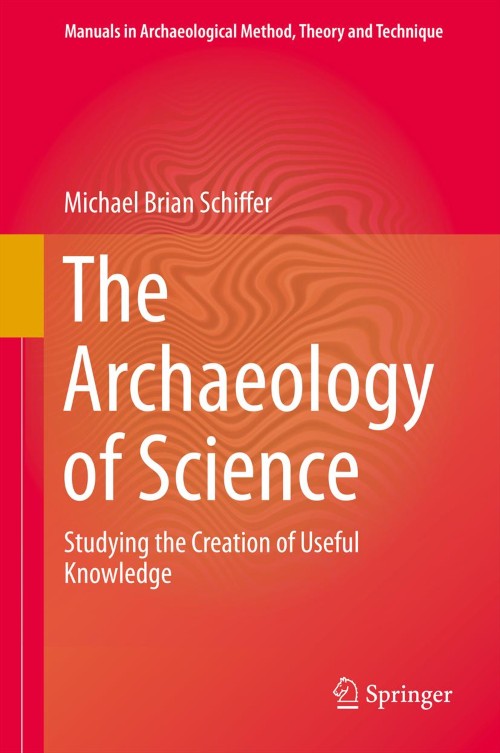
The Archaeology of Science [electronic resource] : Studying the Creation of Useful Knowledge / by Michael Brian Schiffer.
Erişim Adresi
ISBN
9783319000770
Dil Kodu
İngilizce
Yer Numarası
DK/16166
Yazar
Basım Bildirimi
1st ed. 2013.
Yayın Bilgisi
Cham : Springer International Publishing : Imprint: Springer, 2013.
Fiziksel Niteleme
XVI, 204 p. online resource.
Dizi
Manuals in Archaeological Method, Theory and Technique ; 9
İçindekiler Notu
PART I.- 1 Introduction.-2 Science: A Behavioral Perspective -- 3 The Varieties of Scientific Knowledge.-PART II -- 4 Experimental Archaeology -- 5 Ethnoarchaeology -- 6 Archaeometry -- PART III -- 7 The Artifacts of Modern and Early Modern Science -- 8 Thomas Edison’s Science -- 9 Colonization and Exploration -- 10 Scientific Expeditions to Antarctica.-11 The U.S. Nuclear Establishment.-12 Archaeology of the Space Age -- 13 Discovery Processes.
Özet, vb.
This manual pulls together—and illustrates with interesting case studies—the variety of specialized and generalized archaeological research strategies that yield new insights into science. Throughout the book there are templates, consisting of questions, to help readers visualize and design their own projects. The manual seeks to be as general as possible, applicable to any society, and so science is defined as the creation of useful knowledge—the kinds of knowledge that enable people to make predictions. The chapters in Part I discuss the scope of the archaeology of science and furnish a conceptual foundation for the remainder of the book. Included are basic principles of behavioral archaeology that, because they privilege people-artifact interactions, can be employed to frame new research on science. The varieties of scientific knowledge—from observations to theories and everything in between—are defined in behavioral terms. Next, Part II presents several specialized, but widely practiced, research strategies that contribute to the archaeology of science. These chapters contain fascinating case studies from the archaeological literature that illustrate how these strategies can be employed to formulate and answer research questions. In order to thoroughly ground the manual in real-life applications, Part III presents lengthy case studies that feature the use of historical and archaeological evidence in the study of scientific activities. Many of these chapters draw on unpublished archaeological reports that bring to light the material dimension of intriguing—sometimes once secret—science and technology projects, such as the Manhattan Project, Project Rover, and Thomas Edison’s “invention factories”, to name a few. The Archaeology of Science: Studying theCreation of Useful Knowledge stimulates readers because it calls attention to a great many archaeological projects already accomplished and shows readers how they can contribute to expanding and enriching the archaeology of science. This original concept provides both advanced undergraduates and graduates, as well as professional archaeologists, with a cornucopia of strategies and tactics for conducting original—indeed, exciting—research leading to term papers, theses, dissertations, and eventually publications. .
Konu
Archaeology.
Anthropology.
Science __ Philosophy.
Archaeology.
Anthropology.
Philosophy of Science.
Anthropology.
Science __ Philosophy.
Archaeology.
Anthropology.
Philosophy of Science.
Kurum Adı
Eseri Alıntıla
Referansları kullanmadan önce gözden geçirmeniz ve varsa gerekli düzeltmeleri yapmanız önerilir.
Dijital Kaynak
MARC Görünümü
LEADER 04741nam a22005295i 4500
001 814929
003 TR_AnAIT
005 20260130213204
007 cr nn 008mamaa
008 130419s2013 sz | s |||| 0|eng d
020 |a9783319000770|9978-3-319-00077-0
024 7 |a10.1007/978-3-319-00077-0|2doi
041 |aeng
049 |aTürk Tarih Kurumu Kütüphanesi
050 4|aCC1-960
072 7|aHD|2bicssc
072 7|aSOC003000|2bisacsh
072 7|aNK|2thema
082 04|a930.1|223
090 |aDK/16166
100 1 |aSchiffer, Michael Brian.|eauthor.|4aut|4http://id.loc.gov/vocabulary/relators/aut
245 14|aThe Archaeology of Science|h[electronic resource] :|bStudying the Creation of Useful Knowledge /|cby Michael Brian Schiffer.
250 |a1st ed. 2013.
264 1|aCham :|bSpringer International Publishing :|bImprint: Springer,|c2013.
300 |aXVI, 204 p.|bonline resource.
336 |atext|btxt|2rdacontent
337 |acomputer|bc|2rdamedia
338 |aonline resource|bcr|2rdacarrier
347 |atext file|bPDF|2rda
490 1 |aManuals in Archaeological Method, Theory and Technique ;|v9
505 0 |aPART I.- 1 Introduction.-2 Science: A Behavioral Perspective -- 3 The Varieties of Scientific Knowledge.-PART II -- 4 Experimental Archaeology -- 5 Ethnoarchaeology -- 6 Archaeometry -- PART III -- 7 The Artifacts of Modern and Early Modern Science -- 8 Thomas Edison’s Science -- 9 Colonization and Exploration -- 10 Scientific Expeditions to Antarctica.-11 The U.S. Nuclear Establishment.-12 Archaeology of the Space Age -- 13 Discovery Processes.
520 |aThis manual pulls together—and illustrates with interesting case studies—the variety of specialized and generalized archaeological research strategies that yield new insights into science. Throughout the book there are templates, consisting of questions, to help readers visualize and design their own projects. The manual seeks to be as general as possible, applicable to any society, and so science is defined as the creation of useful knowledge—the kinds of knowledge that enable people to make predictions. The chapters in Part I discuss the scope of the archaeology of science and furnish a conceptual foundation for the remainder of the book. Included are basic principles of behavioral archaeology that, because they privilege people-artifact interactions, can be employed to frame new research on science. The varieties of scientific knowledge—from observations to theories and everything in between—are defined in behavioral terms. Next, Part II presents several specialized, but widely practiced, research strategies that contribute to the archaeology of science. These chapters contain fascinating case studies from the archaeological literature that illustrate how these strategies can be employed to formulate and answer research questions. In order to thoroughly ground the manual in real-life applications, Part III presents lengthy case studies that feature the use of historical and archaeological evidence in the study of scientific activities. Many of these chapters draw on unpublished archaeological reports that bring to light the material dimension of intriguing—sometimes once secret—science and technology projects, such as the Manhattan Project, Project Rover, and Thomas Edison’s “invention factories”, to name a few. The Archaeology of Science: Studying theCreation of Useful Knowledge stimulates readers because it calls attention to a great many archaeological projects already accomplished and shows readers how they can contribute to expanding and enriching the archaeology of science. This original concept provides both advanced undergraduates and graduates, as well as professional archaeologists, with a cornucopia of strategies and tactics for conducting original—indeed, exciting—research leading to term papers, theses, dissertations, and eventually publications. .
650 0|aArchaeology.
650 0|aAnthropology.
650 0|aScience|xPhilosophy.
650 14|aArchaeology.
650 24|aAnthropology.
650 24|aPhilosophy of Science.
710 2 |aSpringerLink (Online service)
773 0 |tSpringer Nature eBook
776 08|iPrinted edition:|z9783319000763
776 08|iPrinted edition:|z9783319000787
776 08|iPrinted edition:|z9783319032740
776 08|iPrinted edition:|z9783319118680
830 0|aManuals in Archaeological Method, Theory and Technique ;|v9
856 40|uhttps://doi.org/10.1007/978-3-319-00077-0
912 |aZDB-2-SHU
912 |aZDB-2-SXS
950 |aHumanities, Social Sciences and Law (SpringerNature-11648)
950 |aSocial Sciences (R0) (SpringerNature-43726)
001 814929
003 TR_AnAIT
005 20260130213204
007 cr nn 008mamaa
008 130419s2013 sz | s |||| 0|eng d
020 |a9783319000770|9978-3-319-00077-0
024 7 |a10.1007/978-3-319-00077-0|2doi
041 |aeng
049 |aTürk Tarih Kurumu Kütüphanesi
050 4|aCC1-960
072 7|aHD|2bicssc
072 7|aSOC003000|2bisacsh
072 7|aNK|2thema
082 04|a930.1|223
090 |aDK/16166
100 1 |aSchiffer, Michael Brian.|eauthor.|4aut|4http://id.loc.gov/vocabulary/relators/aut
245 14|aThe Archaeology of Science|h[electronic resource] :|bStudying the Creation of Useful Knowledge /|cby Michael Brian Schiffer.
250 |a1st ed. 2013.
264 1|aCham :|bSpringer International Publishing :|bImprint: Springer,|c2013.
300 |aXVI, 204 p.|bonline resource.
336 |atext|btxt|2rdacontent
337 |acomputer|bc|2rdamedia
338 |aonline resource|bcr|2rdacarrier
347 |atext file|bPDF|2rda
490 1 |aManuals in Archaeological Method, Theory and Technique ;|v9
505 0 |aPART I.- 1 Introduction.-2 Science: A Behavioral Perspective -- 3 The Varieties of Scientific Knowledge.-PART II -- 4 Experimental Archaeology -- 5 Ethnoarchaeology -- 6 Archaeometry -- PART III -- 7 The Artifacts of Modern and Early Modern Science -- 8 Thomas Edison’s Science -- 9 Colonization and Exploration -- 10 Scientific Expeditions to Antarctica.-11 The U.S. Nuclear Establishment.-12 Archaeology of the Space Age -- 13 Discovery Processes.
520 |aThis manual pulls together—and illustrates with interesting case studies—the variety of specialized and generalized archaeological research strategies that yield new insights into science. Throughout the book there are templates, consisting of questions, to help readers visualize and design their own projects. The manual seeks to be as general as possible, applicable to any society, and so science is defined as the creation of useful knowledge—the kinds of knowledge that enable people to make predictions. The chapters in Part I discuss the scope of the archaeology of science and furnish a conceptual foundation for the remainder of the book. Included are basic principles of behavioral archaeology that, because they privilege people-artifact interactions, can be employed to frame new research on science. The varieties of scientific knowledge—from observations to theories and everything in between—are defined in behavioral terms. Next, Part II presents several specialized, but widely practiced, research strategies that contribute to the archaeology of science. These chapters contain fascinating case studies from the archaeological literature that illustrate how these strategies can be employed to formulate and answer research questions. In order to thoroughly ground the manual in real-life applications, Part III presents lengthy case studies that feature the use of historical and archaeological evidence in the study of scientific activities. Many of these chapters draw on unpublished archaeological reports that bring to light the material dimension of intriguing—sometimes once secret—science and technology projects, such as the Manhattan Project, Project Rover, and Thomas Edison’s “invention factories”, to name a few. The Archaeology of Science: Studying theCreation of Useful Knowledge stimulates readers because it calls attention to a great many archaeological projects already accomplished and shows readers how they can contribute to expanding and enriching the archaeology of science. This original concept provides both advanced undergraduates and graduates, as well as professional archaeologists, with a cornucopia of strategies and tactics for conducting original—indeed, exciting—research leading to term papers, theses, dissertations, and eventually publications. .
650 0|aArchaeology.
650 0|aAnthropology.
650 0|aScience|xPhilosophy.
650 14|aArchaeology.
650 24|aAnthropology.
650 24|aPhilosophy of Science.
710 2 |aSpringerLink (Online service)
773 0 |tSpringer Nature eBook
776 08|iPrinted edition:|z9783319000763
776 08|iPrinted edition:|z9783319000787
776 08|iPrinted edition:|z9783319032740
776 08|iPrinted edition:|z9783319118680
830 0|aManuals in Archaeological Method, Theory and Technique ;|v9
856 40|uhttps://doi.org/10.1007/978-3-319-00077-0
912 |aZDB-2-SHU
912 |aZDB-2-SXS
950 |aHumanities, Social Sciences and Law (SpringerNature-11648)
950 |aSocial Sciences (R0) (SpringerNature-43726)
Materyaller
Depodan talep edilen materyal sadece kütüphane içerisinde kullanılmaktadır.
Materyal dışarıya ödünç verilmemektedir.
Materyal dışarıya ödünç verilmemektedir.
