

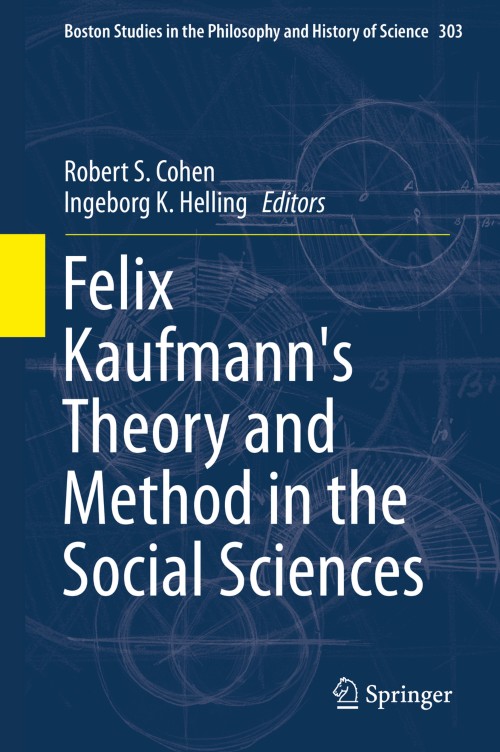
Felix Kaufmann's Theory and Method in the Social Sciences [electronic resource] / edited by Robert S. Cohen, Ingeborg K. Helling.
Erişim Adresi
ISBN
9783319028453
Dil Kodu
İngilizce
Yer Numarası
DK/16224
Basım Bildirimi
1st ed. 2014.
Yayın Bilgisi
Cham : Springer International Publishing : Imprint: Springer, 2014.
Fiziksel Niteleme
X, 357 p. 2 illus. online resource.
Dizi
Boston Studies in the Philosophy and History of Science, 2214-7942 ; 303
İçindekiler Notu
Editorial Note -- Introductory Essay - Felix Kaufmann in Perspective; Ingeborg K. Helling -- Theory and Method in the Social Sciences; Felix Kaufmann -- Preface -- Introduction On the Problematic and Structure of the Book -- Part One Elements of the General Theory of Science.- 1. Basic Philosophical Considerations -- 2. Logical-mathematical Thought -- 3. Fact and Law -- 4. Life and Consciousness -- 5. The Concept of Value -- 6. Metaphysics and the Theory of Science -- 7. Proposal for a Universal Methodological Schema -- Part Two The Dispute over Method in the Social Sciences (Methodenstreit).- 1. The Social Sciences and the Natural Sciences -- 2. The Social Sciences and Psychology -- 3. Value Problem in the Social Sciences -- 4. The ‘Historical’ in the Social Sciences -- 5. Fundamental Concepts of the Social Sciences -- 6. Social Laws and Ideal Types -- 7. The Way to Overcome the Methodenstreit -- 8. Remarks on the Methodological Controversy [Methodenstreit] over the Theory of Marginal Utility -- 9. The Concept of Positive Law and the Pure Theory of Law -- Annotations -- Index of Names -- Editorial Note -- Introductory Essay Felix Kaufmann in Perspective; Ingeborg K. Helling -- 1. Introduction -- 2. Biographical Dates -- 3. Kaufmann’s Milieus of Social Science in Vienna between the Wars -- 4. Kaufmann's Positions in Methodology -- 5. A Selection from Interviews and a letter on Kaufmann -- 6. Felix Kaufmann ‘Der Nationalökonom im Paradies’: a Poem with translation -- 7. Bibliography of Works Cited in the Introductory Essay Felix Kaufmann Theory and Method in the Social Sciences.- Preface -- Introduction On the Problematic and Structure of the Book -- Part One Elements of the General Theory of Science.- 1. Basic Philosophical Considerations -- 2. Logical-mathematical Thought -- 3. Fact and Law -- 4. Life and Consciousness -- 5. The Concept of Value -- 6. Metaphysics and the Theory of Science -- 7. Proposal for a Universal Methodological Schema -- Part Two The Dispute overMethod in the Social Sciences (Methodenstreit).- Preparatory Remarks -- 1. The Social Sciences and the Natural Sciences -- 2. The Social Sciences and Psychology -- 3. Value Problem in the Social Sciences -- 4. The ‘Historical’ in the Social Sciences -- 5. Fundamental Concepts of the Social Sciences -- 6. Social Laws and Ideal Types -- 7. The Way to Overcome the Methodenstreit -- 8. Remarks on the Methodological Controversy [Methodenstreit] over the Theory of Marginal Utility -- 9. The Concept of Positive Law and the Pure Theory of Law -- Annotations -- Index of Names.
Özet, vb.
This volume contains the English translation of Felix Kaufmann's (1895-1945) main work Methodenlehre der Sozialwissenschaften (1936). In this book, Kaufmann develops a general theory of knowledge of the social sciences in his role as a cross-border commuter between Husserl's phenomenology, Kelsen's pure theory of law and the logical positivism of the Vienna Circle. This multilayered inquiry connects the value-oriented reflections of a general philosophy of science with the specificity of the methods and theories of the social sciences, as opposed to abstract natural science and psychology. The core focus of the study is the attempt to elucidate how and under what conditions scientific knowledge about social facts, empirically justified and theoretically embedded, can be obtained. The empirical basis of knowledge within the social sciences forms a phenomenological concept of experience. According to Kaufmann, this concept of experience exhibits a complex structure. Within the meaning-interpretation of human action as the core of knowledge in the social sciences, this structure reaches out across the isolated act of verification toward the synthesis of external and internal experiences. The book opens with a detailed and useful introduction by Ingeborg K. Helling, which introduces the historical and theoretical background of Kaufmann's study and specifically illuminates his relation to Alfred Schütz and John Dewey. Finally, it contains interviews with and letters to members of his family, colleagues and students.
Konu
Science __ Philosophy.
Philosophy and social sciences.
Philosophy of Science.
Philosophy of the Social Sciences.
Philosophy and social sciences.
Philosophy of Science.
Philosophy of the Social Sciences.
Diğer Yazarlar
Kurum Adı
Eseri Alıntıla
Referansları kullanmadan önce gözden geçirmeniz ve varsa gerekli düzeltmeleri yapmanız önerilir.
Dijital Kaynak
MARC Görünümü
LEADER 06123nam a22005175i 4500
001 814987
003 TR_AnAIT
005 20260130212727
007 cr nn 008mamaa
008 140519s2014 sz | s |||| 0|eng d
020 |a9783319028453|9978-3-319-02845-3
024 7 |a10.1007/978-3-319-02845-3|2doi
041 |aeng
049 |aTürk Tarih Kurumu Kütüphanesi
050 4|aQ174-175.3
050 4|aB67
072 7|aPDA|2bicssc
072 7|aSCI075000|2bisacsh
072 7|aPDA|2thema
082 04|a501|223
090 |aDK/16224
245 10|aFelix Kaufmann's Theory and Method in the Social Sciences|h[electronic resource] /|cedited by Robert S. Cohen, Ingeborg K. Helling.
250 |a1st ed. 2014.
264 1|aCham :|bSpringer International Publishing :|bImprint: Springer,|c2014.
300 |aX, 357 p. 2 illus.|bonline resource.
336 |atext|btxt|2rdacontent
337 |acomputer|bc|2rdamedia
338 |aonline resource|bcr|2rdacarrier
347 |atext file|bPDF|2rda
490 1 |aBoston Studies in the Philosophy and History of Science,|x2214-7942 ;|v303
505 0 |aEditorial Note -- Introductory Essay - Felix Kaufmann in Perspective; Ingeborg K. Helling -- Theory and Method in the Social Sciences; Felix Kaufmann -- Preface -- Introduction On the Problematic and Structure of the Book -- Part One Elements of the General Theory of Science.- 1. Basic Philosophical Considerations -- 2. Logical-mathematical Thought -- 3. Fact and Law -- 4. Life and Consciousness -- 5. The Concept of Value -- 6. Metaphysics and the Theory of Science -- 7. Proposal for a Universal Methodological Schema -- Part Two The Dispute over Method in the Social Sciences (Methodenstreit).- 1. The Social Sciences and the Natural Sciences -- 2. The Social Sciences and Psychology -- 3. Value Problem in the Social Sciences -- 4. The ‘Historical’ in the Social Sciences -- 5. Fundamental Concepts of the Social Sciences -- 6. Social Laws and Ideal Types -- 7. The Way to Overcome the Methodenstreit -- 8. Remarks on the Methodological Controversy [Methodenstreit] over the Theory of Marginal Utility -- 9. The Concept of Positive Law and the Pure Theory of Law -- Annotations -- Index of Names -- Editorial Note -- Introductory Essay Felix Kaufmann in Perspective; Ingeborg K. Helling -- 1. Introduction -- 2. Biographical Dates -- 3. Kaufmann’s Milieus of Social Science in Vienna between the Wars -- 4. Kaufmann's Positions in Methodology -- 5. A Selection from Interviews and a letter on Kaufmann -- 6. Felix Kaufmann ‘Der Nationalökonom im Paradies’: a Poem with translation -- 7. Bibliography of Works Cited in the Introductory Essay Felix Kaufmann Theory and Method in the Social Sciences.- Preface -- Introduction On the Problematic and Structure of the Book -- Part One Elements of the General Theory of Science.- 1. Basic Philosophical Considerations -- 2. Logical-mathematical Thought -- 3. Fact and Law -- 4. Life and Consciousness -- 5. The Concept of Value -- 6. Metaphysics and the Theory of Science -- 7. Proposal for a Universal Methodological Schema -- Part Two The Dispute overMethod in the Social Sciences (Methodenstreit).- Preparatory Remarks -- 1. The Social Sciences and the Natural Sciences -- 2. The Social Sciences and Psychology -- 3. Value Problem in the Social Sciences -- 4. The ‘Historical’ in the Social Sciences -- 5. Fundamental Concepts of the Social Sciences -- 6. Social Laws and Ideal Types -- 7. The Way to Overcome the Methodenstreit -- 8. Remarks on the Methodological Controversy [Methodenstreit] over the Theory of Marginal Utility -- 9. The Concept of Positive Law and the Pure Theory of Law -- Annotations -- Index of Names.
520 |aThis volume contains the English translation of Felix Kaufmann's (1895-1945) main work Methodenlehre der Sozialwissenschaften (1936). In this book, Kaufmann develops a general theory of knowledge of the social sciences in his role as a cross-border commuter between Husserl's phenomenology, Kelsen's pure theory of law and the logical positivism of the Vienna Circle. This multilayered inquiry connects the value-oriented reflections of a general philosophy of science with the specificity of the methods and theories of the social sciences, as opposed to abstract natural science and psychology. The core focus of the study is the attempt to elucidate how and under what conditions scientific knowledge about social facts, empirically justified and theoretically embedded, can be obtained. The empirical basis of knowledge within the social sciences forms a phenomenological concept of experience. According to Kaufmann, this concept of experience exhibits a complex structure. Within the meaning-interpretation of human action as the core of knowledge in the social sciences, this structure reaches out across the isolated act of verification toward the synthesis of external and internal experiences. The book opens with a detailed and useful introduction by Ingeborg K. Helling, which introduces the historical and theoretical background of Kaufmann's study and specifically illuminates his relation to Alfred Schütz and John Dewey. Finally, it contains interviews with and letters to members of his family, colleagues and students.
650 0|aScience|xPhilosophy.
650 0|aPhilosophy and social sciences.
650 14|aPhilosophy of Science.
650 24|aPhilosophy of the Social Sciences.
700 1 |aCohen, Robert S.|eeditor.|4edt|4http://id.loc.gov/vocabulary/relators/edt
700 1 |aHelling, Ingeborg K.|eeditor.|4edt|4http://id.loc.gov/vocabulary/relators/edt
710 2 |aSpringerLink (Online service)
773 0 |tSpringer Nature eBook
776 08|iPrinted edition:|z9783319028446
776 08|iPrinted edition:|z9783319028460
776 08|iPrinted edition:|z9783319375540
830 0|aBoston Studies in the Philosophy and History of Science,|x2214-7942 ;|v303
856 40|uhttps://doi.org/10.1007/978-3-319-02845-3
912 |aZDB-2-SHU
912 |aZDB-2-SXPR
950 |aHumanities, Social Sciences and Law (SpringerNature-11648)
950 |aPhilosophy and Religion (R0) (SpringerNature-43725)
001 814987
003 TR_AnAIT
005 20260130212727
007 cr nn 008mamaa
008 140519s2014 sz | s |||| 0|eng d
020 |a9783319028453|9978-3-319-02845-3
024 7 |a10.1007/978-3-319-02845-3|2doi
041 |aeng
049 |aTürk Tarih Kurumu Kütüphanesi
050 4|aQ174-175.3
050 4|aB67
072 7|aPDA|2bicssc
072 7|aSCI075000|2bisacsh
072 7|aPDA|2thema
082 04|a501|223
090 |aDK/16224
245 10|aFelix Kaufmann's Theory and Method in the Social Sciences|h[electronic resource] /|cedited by Robert S. Cohen, Ingeborg K. Helling.
250 |a1st ed. 2014.
264 1|aCham :|bSpringer International Publishing :|bImprint: Springer,|c2014.
300 |aX, 357 p. 2 illus.|bonline resource.
336 |atext|btxt|2rdacontent
337 |acomputer|bc|2rdamedia
338 |aonline resource|bcr|2rdacarrier
347 |atext file|bPDF|2rda
490 1 |aBoston Studies in the Philosophy and History of Science,|x2214-7942 ;|v303
505 0 |aEditorial Note -- Introductory Essay - Felix Kaufmann in Perspective; Ingeborg K. Helling -- Theory and Method in the Social Sciences; Felix Kaufmann -- Preface -- Introduction On the Problematic and Structure of the Book -- Part One Elements of the General Theory of Science.- 1. Basic Philosophical Considerations -- 2. Logical-mathematical Thought -- 3. Fact and Law -- 4. Life and Consciousness -- 5. The Concept of Value -- 6. Metaphysics and the Theory of Science -- 7. Proposal for a Universal Methodological Schema -- Part Two The Dispute over Method in the Social Sciences (Methodenstreit).- 1. The Social Sciences and the Natural Sciences -- 2. The Social Sciences and Psychology -- 3. Value Problem in the Social Sciences -- 4. The ‘Historical’ in the Social Sciences -- 5. Fundamental Concepts of the Social Sciences -- 6. Social Laws and Ideal Types -- 7. The Way to Overcome the Methodenstreit -- 8. Remarks on the Methodological Controversy [Methodenstreit] over the Theory of Marginal Utility -- 9. The Concept of Positive Law and the Pure Theory of Law -- Annotations -- Index of Names -- Editorial Note -- Introductory Essay Felix Kaufmann in Perspective; Ingeborg K. Helling -- 1. Introduction -- 2. Biographical Dates -- 3. Kaufmann’s Milieus of Social Science in Vienna between the Wars -- 4. Kaufmann's Positions in Methodology -- 5. A Selection from Interviews and a letter on Kaufmann -- 6. Felix Kaufmann ‘Der Nationalökonom im Paradies’: a Poem with translation -- 7. Bibliography of Works Cited in the Introductory Essay Felix Kaufmann Theory and Method in the Social Sciences.- Preface -- Introduction On the Problematic and Structure of the Book -- Part One Elements of the General Theory of Science.- 1. Basic Philosophical Considerations -- 2. Logical-mathematical Thought -- 3. Fact and Law -- 4. Life and Consciousness -- 5. The Concept of Value -- 6. Metaphysics and the Theory of Science -- 7. Proposal for a Universal Methodological Schema -- Part Two The Dispute overMethod in the Social Sciences (Methodenstreit).- Preparatory Remarks -- 1. The Social Sciences and the Natural Sciences -- 2. The Social Sciences and Psychology -- 3. Value Problem in the Social Sciences -- 4. The ‘Historical’ in the Social Sciences -- 5. Fundamental Concepts of the Social Sciences -- 6. Social Laws and Ideal Types -- 7. The Way to Overcome the Methodenstreit -- 8. Remarks on the Methodological Controversy [Methodenstreit] over the Theory of Marginal Utility -- 9. The Concept of Positive Law and the Pure Theory of Law -- Annotations -- Index of Names.
520 |aThis volume contains the English translation of Felix Kaufmann's (1895-1945) main work Methodenlehre der Sozialwissenschaften (1936). In this book, Kaufmann develops a general theory of knowledge of the social sciences in his role as a cross-border commuter between Husserl's phenomenology, Kelsen's pure theory of law and the logical positivism of the Vienna Circle. This multilayered inquiry connects the value-oriented reflections of a general philosophy of science with the specificity of the methods and theories of the social sciences, as opposed to abstract natural science and psychology. The core focus of the study is the attempt to elucidate how and under what conditions scientific knowledge about social facts, empirically justified and theoretically embedded, can be obtained. The empirical basis of knowledge within the social sciences forms a phenomenological concept of experience. According to Kaufmann, this concept of experience exhibits a complex structure. Within the meaning-interpretation of human action as the core of knowledge in the social sciences, this structure reaches out across the isolated act of verification toward the synthesis of external and internal experiences. The book opens with a detailed and useful introduction by Ingeborg K. Helling, which introduces the historical and theoretical background of Kaufmann's study and specifically illuminates his relation to Alfred Schütz and John Dewey. Finally, it contains interviews with and letters to members of his family, colleagues and students.
650 0|aScience|xPhilosophy.
650 0|aPhilosophy and social sciences.
650 14|aPhilosophy of Science.
650 24|aPhilosophy of the Social Sciences.
700 1 |aCohen, Robert S.|eeditor.|4edt|4http://id.loc.gov/vocabulary/relators/edt
700 1 |aHelling, Ingeborg K.|eeditor.|4edt|4http://id.loc.gov/vocabulary/relators/edt
710 2 |aSpringerLink (Online service)
773 0 |tSpringer Nature eBook
776 08|iPrinted edition:|z9783319028446
776 08|iPrinted edition:|z9783319028460
776 08|iPrinted edition:|z9783319375540
830 0|aBoston Studies in the Philosophy and History of Science,|x2214-7942 ;|v303
856 40|uhttps://doi.org/10.1007/978-3-319-02845-3
912 |aZDB-2-SHU
912 |aZDB-2-SXPR
950 |aHumanities, Social Sciences and Law (SpringerNature-11648)
950 |aPhilosophy and Religion (R0) (SpringerNature-43725)
Materyaller
Depodan talep edilen materyal sadece kütüphane içerisinde kullanılmaktadır.
Materyal dışarıya ödünç verilmemektedir.
Materyal dışarıya ödünç verilmemektedir.
