

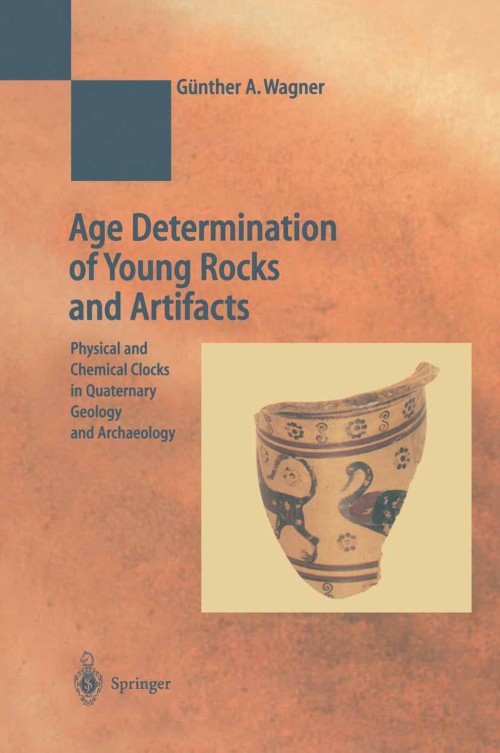
Age Determination of Young Rocks and Artifacts [electronic resource] : Physical and Chemical Clocks in Quaternary Geology and Archaeology / by Günther A. Wagner.
Erişim Adresi
ISBN
9783662036761
Dil Kodu
İngilizce
Yer Numarası
DK/16229
Yazar
Basım Bildirimi
1st ed. 1998.
Yayın Bilgisi
Berlin, Heidelberg : Springer Berlin Heidelberg : Imprint: Springer, 1998.
Fiziksel Niteleme
XVIII, 466 p. online resource.
Dizi
Natural Science in Archaeology
İçindekiler Notu
1 Introduction -- 2 Materials -- 3 Radiogenic Noble Gases -- 4 Uranium Series (Radioactive Equilibrium, Disequilibrium as Clock, Detection Techniques, Thermo-Ionization Mass Spectrometry, Gamma Spectrometry) -- 5 Cosmogenic Nuclides (Atmospheric Production, In Situ Production, Accelerator Mass Spectrometry) -- 6 Particle Tracks (Track Accumulation Age) -- 7 Radiation Dosimetry (Radiation Damage, Natural Dose, Resetting, Fading, Dose Rate, Dose Rate Evaluation) -- 8 Chemical Reactions (Reaction Kinetics, Diffusion) -- 9 Paleomagnetism -- 10 Earth’s Orbit, Climate and Age -- References.
Özet, vb.
The Quaternary, which spans approximately the last 2 million years, is characterized by dramatic environmental changes, commonly known as the "ice age". During this period, man with his manifold cultures evolved. Attempts at dating these events as accurately as possible have made great progress. The broad spectrum of physical and chemical dating methods, now available for dating human artifacts and Quaternary rocks, is becoming increasingly difficult to grasp. In this book the various chronometric techniques are comprehensively and intelligibly treated. By means of numerous case studies, taken from archaeology and Quaternary geology, the potential and limitation of these techniques are demonstrated. The book is intended mainly for scientists and students of these fields, but the interested layman may also find its rewarding.
Konu
Geochemistry.
Geology.
Geography.
Anthropology.
Geochemistry.
Geology.
Geography.
Anthropology.
Geology.
Geography.
Anthropology.
Geochemistry.
Geology.
Geography.
Anthropology.
Kurum Adı
