

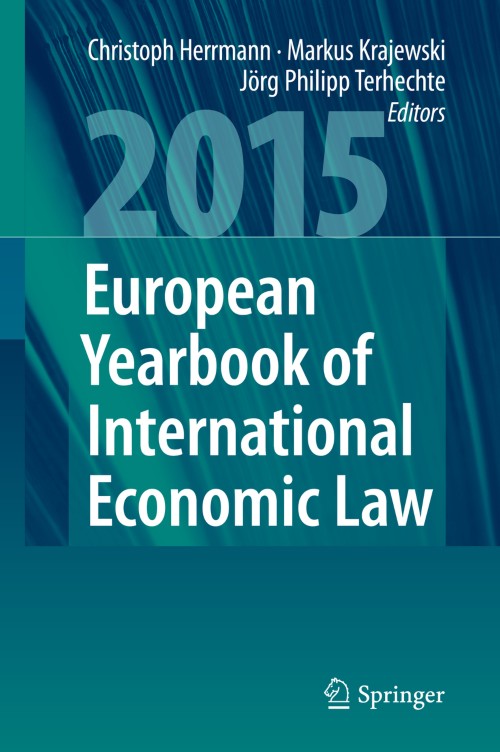
European Yearbook of International Economic Law 2015 [electronic resource] / edited by Christoph Herrmann, Markus Krajewski, Jörg Philipp Terhechte.
Erişim Adresi
ISBN
9783662467480
Dil Kodu
İngilizce
Yer Numarası
DK/16241
Basım Bildirimi
1st ed. 2015.
Yayın Bilgisi
Berlin, Heidelberg : Springer Berlin Heidelberg : Imprint: Springer, 2015.
Fiziksel Niteleme
XVIII, 448 p. 11 illus., 10 illus. in color. online resource.
Dizi
European Yearbook of International Economic Law, 2364-8406 ; 6
İçindekiler Notu
Part I Topics -- Part II Regional integration: Trade and investment relations between the EU and East Asia - The next frontier? -- Part III International economic institutions -- Part IV Book reviews -- Part V Publications on international economic law 2013-2014. .
Özet, vb.
This sixth volume (2015) of the European Yearbook of International Economic Law puts a particular emphasis on non-tariff barriers (NTBs) to trade and the world trade order. With the steady reduction of tariff rates since the GATT 47 came into force, focus in recent years has been on the vast and complex landscape of non-tariff barriers to trade. States as well as scholars seemingly struggle with the multitude of measures pooled under this expression as there is no single, acknowledged definition of the term, and its relation to the term “non-tariff measures” remains equally blurred. Particularly in practice and on a multilateral level, there appears to be some awkwardness when it comes to coping with NTBs since multilateral trade rules seem to be in conflict with national regulatory autonomy in the pursuit of policy objectives. In part one, this volume sheds light on the problems of non-tariff barriers to trade that arise in various fields. Part two focuses on regional integration with an emphasis on relations between East Asia and the European Union. In this regard, the authors outline the trade and investment relations between the European Union and East Asia, including Japan, Korea and Singapore. Part three offers an overview of recent institutional developments in WIPO, ICSID, WTO and WTO jurisprudence. Part four includes book reviews of recent works in the field of international economic law, and part five introduces a new section on publications in the field of international economic law that were released in 2013 and 2014.
Konu
International law.
Trade regulation.
International economic relations.
International Economic Law, Trade Law.
International Economics.
Trade regulation.
International economic relations.
International Economic Law, Trade Law.
International Economics.
Diğer Yazarlar
Kurum Adı
