

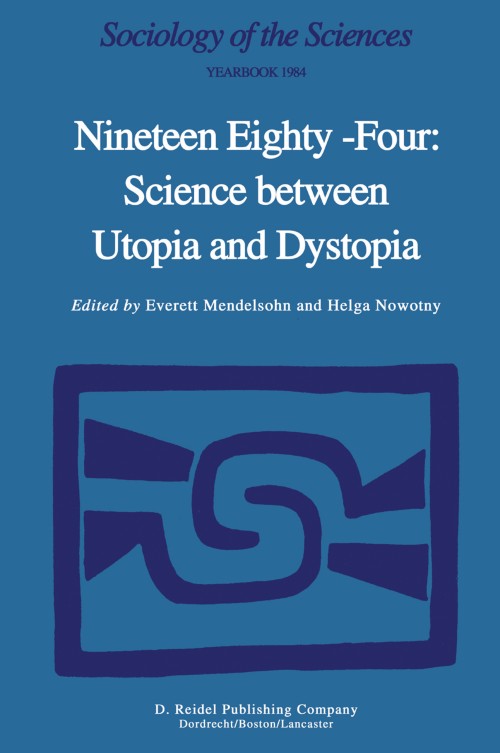
Nineteen Eighty-Four: Science Between Utopia and Dystopia [electronic resource] / edited by E. Mendelsohn, H. Nowotny.
Erişim Adresi
ISBN
9789400963405
Dil Kodu
İngilizce
Yer Numarası
DK/16260
Basım Bildirimi
1st ed. 1984.
Yayın Bilgisi
Dordrecht : Springer Netherlands : Imprint: Springer, 1984.
Fiziksel Niteleme
XV, 303 p. online resource.
Dizi
Sociology of the Sciences Yearbook, 2215-1796 ; 8
İçindekiler Notu
I Introduction -- Science and Utopia: On the Social Ordering of the Future -- II Science and Utopia in History -- Science and Utopia: The History of a Dilemma -- Elias Artista: A Precursor of the Messiah in Natural Science -- The Explosion of the Circle: Science and Negative Utopia -- III Socialism, Science and Utopia -- From Utopia to Science? The Development of Socialist Theory between Utopia and Science -- Bogdanov’s Red Star: An Early Bolshevik Science Utopia -- IV Utopias in Practice -- Automata: A Masculine Utopia -- Making Dreams Come True — An Essay on the Role of Practical Utopias in Science -- Eugenic Utopias: Blueprints for the Rationalization of Human Evolution -- Artificial Intelligence and Industrial Robots: An Automatic End for Utopian Thought? -- V Utopian Modes -- Meddling with ‘Politicks’ — Some Conjectures about the Relationship between Science and Utopia -- Science and Power for What? -- Science and Utopia in Late 20th Century Pluralist Democracy, with a Special Reference to the U.S.A. -- Epilogue -- Vespers -- Name Index.
Özet, vb.
Just fifty years ago Julian Huxley, the biologist grandson of Thomas Henry Huxley, published a book which easily could be seen to represent the prevail ing outlook among young scientists of the day: If I were a Dictator (1934). The outlook is optimistic, the tone playfully rational, the intent clear - allow science a free hand and through rational planning it could bring order out of the surrounding social chaos. He complained, however: At the moment, science is for most part either an intellectual luxury or the paid servant of capitalist industry or the nationalist state. When it and its results cannot be fitted into the existing framework, it and they are ignored; and furthermore the structure of scientific research is grossly lopsided, with over-emphasis on some kinds of science and partial or entire neglect of others. (pp. 83-84) All this the scientist dictator would set right. A new era of scientific human ism would provide alternative visions to the traditional religions with their Gods and the civic religions such as Nazism and fascism. Science in Huxley's version carries in it the twin impulses of the utopian imagination - Power and Order. Of course, it was exactly this vision of science which led that other grand son of Thomas Henry Huxley, the writer Aldous Huxley, to portray scientific discovery as potentially subversive and scientific practice as ultimately en slaving.
Konu
History.
History.
History.
Diğer Yazarlar
Kurum Adı
Eseri Alıntıla
Referansları kullanmadan önce gözden geçirmeniz ve varsa gerekli düzeltmeleri yapmanız önerilir.
Dijital Kaynak
MARC Görünümü
LEADER 05049nam a22005655i 4500
001 815023
003 TR_AnAIT
005 20260130212548
007 cr nn 008mamaa
008 121227s1984 ne | s |||| 0|eng d
020 |a9789400963405|9978-94-009-6340-5
024 7 |a10.1007/978-94-009-6340-5|2doi
041 |aeng
049 |aTürk Tarih Kurumu Kütüphanesi
050 4|aD1-2027
072 7|aHB|2bicssc
072 7|aHBAH|2bicssc
072 7|aHIS000000|2bisacsh
072 7|aNH|2thema
072 7|aNHAH|2thema
082 04|a900|223
090 |aDK/16260
245 10|aNineteen Eighty-Four: Science Between Utopia and Dystopia|h[electronic resource] /|cedited by E. Mendelsohn, H. Nowotny.
250 |a1st ed. 1984.
264 1|aDordrecht :|bSpringer Netherlands :|bImprint: Springer,|c1984.
300 |aXV, 303 p.|bonline resource.
336 |atext|btxt|2rdacontent
337 |acomputer|bc|2rdamedia
338 |aonline resource|bcr|2rdacarrier
347 |atext file|bPDF|2rda
490 1 |aSociology of the Sciences Yearbook,|x2215-1796 ;|v8
505 0 |aI Introduction -- Science and Utopia: On the Social Ordering of the Future -- II Science and Utopia in History -- Science and Utopia: The History of a Dilemma -- Elias Artista: A Precursor of the Messiah in Natural Science -- The Explosion of the Circle: Science and Negative Utopia -- III Socialism, Science and Utopia -- From Utopia to Science? The Development of Socialist Theory between Utopia and Science -- Bogdanov’s Red Star: An Early Bolshevik Science Utopia -- IV Utopias in Practice -- Automata: A Masculine Utopia -- Making Dreams Come True — An Essay on the Role of Practical Utopias in Science -- Eugenic Utopias: Blueprints for the Rationalization of Human Evolution -- Artificial Intelligence and Industrial Robots: An Automatic End for Utopian Thought? -- V Utopian Modes -- Meddling with ‘Politicks’ — Some Conjectures about the Relationship between Science and Utopia -- Science and Power for What? -- Science and Utopia in Late 20th Century Pluralist Democracy, with a Special Reference to the U.S.A. -- Epilogue -- Vespers -- Name Index.
520 |aJust fifty years ago Julian Huxley, the biologist grandson of Thomas Henry Huxley, published a book which easily could be seen to represent the prevail ing outlook among young scientists of the day: If I were a Dictator (1934). The outlook is optimistic, the tone playfully rational, the intent clear - allow science a free hand and through rational planning it could bring order out of the surrounding social chaos. He complained, however: At the moment, science is for most part either an intellectual luxury or the paid servant of capitalist industry or the nationalist state. When it and its results cannot be fitted into the existing framework, it and they are ignored; and furthermore the structure of scientific research is grossly lopsided, with over-emphasis on some kinds of science and partial or entire neglect of others. (pp. 83-84) All this the scientist dictator would set right. A new era of scientific human ism would provide alternative visions to the traditional religions with their Gods and the civic religions such as Nazism and fascism. Science in Huxley's version carries in it the twin impulses of the utopian imagination - Power and Order. Of course, it was exactly this vision of science which led that other grand son of Thomas Henry Huxley, the writer Aldous Huxley, to portray scientific discovery as potentially subversive and scientific practice as ultimately en slaving.
532 8 |aAccessibility summary: This PDF is not accessible. It is based on scanned pages and does not support features such as screen reader compatibility or described non-text content (images, graphs etc). However, it likely supports searchable and selectable text based on OCR (Optical Character Recognition). Users with accessibility needs may not be able to use this content effectively. Please contact us at accessibilitysupport@springernature.com if you require assistance or an alternative format.
532 8 |aInaccessible, or known limited accessibility
532 8 |aNo reading system accessibility options actively disabled
532 8 |aPublisher contact for further accessibility information: accessibilitysupport@springernature.com
650 0|aHistory.
650 14|aHistory.
700 1 |aMendelsohn, E.|eeditor.|4edt|4http://id.loc.gov/vocabulary/relators/edt
700 1 |aNowotny, H.|eeditor.|4edt|4http://id.loc.gov/vocabulary/relators/edt
710 2 |aSpringerLink (Online service)
773 0 |tSpringer Nature eBook
776 08|iPrinted edition:|z9789027717191
776 08|iPrinted edition:|z9789027717214
776 08|iPrinted edition:|z9789400963412
830 0|aSociology of the Sciences Yearbook,|x2215-1796 ;|v8
856 40|uhttps://doi.org/10.1007/978-94-009-6340-5
912 |aZDB-2-SHU
912 |aZDB-2-SXH
912 |aZDB-2-BAE
950 |aHumanities, Social Sciences and Law (SpringerNature-11648)
950 |aHistory (R0) (SpringerNature-43722)
001 815023
003 TR_AnAIT
005 20260130212548
007 cr nn 008mamaa
008 121227s1984 ne | s |||| 0|eng d
020 |a9789400963405|9978-94-009-6340-5
024 7 |a10.1007/978-94-009-6340-5|2doi
041 |aeng
049 |aTürk Tarih Kurumu Kütüphanesi
050 4|aD1-2027
072 7|aHB|2bicssc
072 7|aHBAH|2bicssc
072 7|aHIS000000|2bisacsh
072 7|aNH|2thema
072 7|aNHAH|2thema
082 04|a900|223
090 |aDK/16260
245 10|aNineteen Eighty-Four: Science Between Utopia and Dystopia|h[electronic resource] /|cedited by E. Mendelsohn, H. Nowotny.
250 |a1st ed. 1984.
264 1|aDordrecht :|bSpringer Netherlands :|bImprint: Springer,|c1984.
300 |aXV, 303 p.|bonline resource.
336 |atext|btxt|2rdacontent
337 |acomputer|bc|2rdamedia
338 |aonline resource|bcr|2rdacarrier
347 |atext file|bPDF|2rda
490 1 |aSociology of the Sciences Yearbook,|x2215-1796 ;|v8
505 0 |aI Introduction -- Science and Utopia: On the Social Ordering of the Future -- II Science and Utopia in History -- Science and Utopia: The History of a Dilemma -- Elias Artista: A Precursor of the Messiah in Natural Science -- The Explosion of the Circle: Science and Negative Utopia -- III Socialism, Science and Utopia -- From Utopia to Science? The Development of Socialist Theory between Utopia and Science -- Bogdanov’s Red Star: An Early Bolshevik Science Utopia -- IV Utopias in Practice -- Automata: A Masculine Utopia -- Making Dreams Come True — An Essay on the Role of Practical Utopias in Science -- Eugenic Utopias: Blueprints for the Rationalization of Human Evolution -- Artificial Intelligence and Industrial Robots: An Automatic End for Utopian Thought? -- V Utopian Modes -- Meddling with ‘Politicks’ — Some Conjectures about the Relationship between Science and Utopia -- Science and Power for What? -- Science and Utopia in Late 20th Century Pluralist Democracy, with a Special Reference to the U.S.A. -- Epilogue -- Vespers -- Name Index.
520 |aJust fifty years ago Julian Huxley, the biologist grandson of Thomas Henry Huxley, published a book which easily could be seen to represent the prevail ing outlook among young scientists of the day: If I were a Dictator (1934). The outlook is optimistic, the tone playfully rational, the intent clear - allow science a free hand and through rational planning it could bring order out of the surrounding social chaos. He complained, however: At the moment, science is for most part either an intellectual luxury or the paid servant of capitalist industry or the nationalist state. When it and its results cannot be fitted into the existing framework, it and they are ignored; and furthermore the structure of scientific research is grossly lopsided, with over-emphasis on some kinds of science and partial or entire neglect of others. (pp. 83-84) All this the scientist dictator would set right. A new era of scientific human ism would provide alternative visions to the traditional religions with their Gods and the civic religions such as Nazism and fascism. Science in Huxley's version carries in it the twin impulses of the utopian imagination - Power and Order. Of course, it was exactly this vision of science which led that other grand son of Thomas Henry Huxley, the writer Aldous Huxley, to portray scientific discovery as potentially subversive and scientific practice as ultimately en slaving.
532 8 |aAccessibility summary: This PDF is not accessible. It is based on scanned pages and does not support features such as screen reader compatibility or described non-text content (images, graphs etc). However, it likely supports searchable and selectable text based on OCR (Optical Character Recognition). Users with accessibility needs may not be able to use this content effectively. Please contact us at accessibilitysupport@springernature.com if you require assistance or an alternative format.
532 8 |aInaccessible, or known limited accessibility
532 8 |aNo reading system accessibility options actively disabled
532 8 |aPublisher contact for further accessibility information: accessibilitysupport@springernature.com
650 0|aHistory.
650 14|aHistory.
700 1 |aMendelsohn, E.|eeditor.|4edt|4http://id.loc.gov/vocabulary/relators/edt
700 1 |aNowotny, H.|eeditor.|4edt|4http://id.loc.gov/vocabulary/relators/edt
710 2 |aSpringerLink (Online service)
773 0 |tSpringer Nature eBook
776 08|iPrinted edition:|z9789027717191
776 08|iPrinted edition:|z9789027717214
776 08|iPrinted edition:|z9789400963412
830 0|aSociology of the Sciences Yearbook,|x2215-1796 ;|v8
856 40|uhttps://doi.org/10.1007/978-94-009-6340-5
912 |aZDB-2-SHU
912 |aZDB-2-SXH
912 |aZDB-2-BAE
950 |aHumanities, Social Sciences and Law (SpringerNature-11648)
950 |aHistory (R0) (SpringerNature-43722)
Materyaller
Depodan talep edilen materyal sadece kütüphane içerisinde kullanılmaktadır.
Materyal dışarıya ödünç verilmemektedir.
Materyal dışarıya ödünç verilmemektedir.
