LEADER 04216nam a22004575i 4500
001 815037
003 TR_AnAIT
005 20260130212455
007 cr nn 008mamaa
008 150617s2015 ne | s |||| 0|eng d
020 |a9789463000109|9978-94-6300-010-9
024 7 |a10.1007/978-94-6300-010-9|2doi
041 |aeng
049 |aTürk Tarih Kurumu Kütüphanesi
050 4|aL1-991
072 7|aJN|2bicssc
072 7|aEDU000000|2bisacsh
072 7|aJN|2thema
082 04|a370|223
090 |aDK/16273
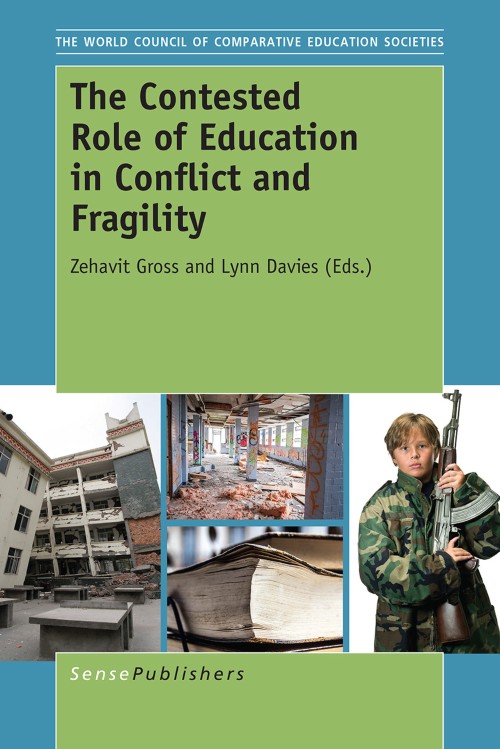
245 14|aThe Contested Role of Education in Conflict and Fragility|h[electronic resource] /|cedited by Zehavit Gross, Lynn Davies.
250 |a1st ed. 2015.
264 1|aRotterdam :|bSensePublishers :|bImprint: SensePublishers,|c2015.
300 |aVIII, 266 p.|bonline resource.
336 |atext|btxt|2rdacontent
337 |acomputer|bc|2rdamedia
338 |aonline resource|bcr|2rdacarrier
347 |atext file|bPDF|2rda
490 1 |aThe World Council of Comparative Education Societies
520 |a"This book brings together new thinking on education’s complex and evolving role in conflict and fragility. The changing nature of conflict, from inter- to intra-state, and with shifting geopolitical power balances, demands a reconceptualization of where education is positioned. Claims that education on its own can be an agent of conflict transformation are disputed. Deliberate attempts at peace education are not without critics and controversies. This collection aims to generate new realism from empirical and reflective accounts in a variety of countries and political contexts, as well as provide innovative methodological approaches to the study of education and conflict. The particular distinctiveness of the volume is the emphasis on ‘contested’ – it includes the debates and disagreements on the many faces of education in conflict, as well as material on teaching controversial issues in fragile contexts. Crucially, it underscores how education itself exists within highly contested projects of state, nation and region building. As well as overview comparative chapters, the collection encompasses a range of specific contexts, geographically and educationally – Algeria, Canada, El Salvador, Israel, Kenya, Mexico, Morocco, Nepal, Tunisia, UK and US, with settings that include schools, higher education and refugee camps. Focuses range from analyses of education in historical conflicts to contemporary issues such as post Arab Spring transformations. Perennial concerns about religion, colonialism, protest, integration, cohesion, emergencies, globalization and narrative are given new slants. Yet in spite of the debates, a cross-cutting consensus emerges as the crucial need for critical pedagogy and critical theory if education is to make any mark at all on conflict and fragility. ".
532 8 |aAccessibility summary: This PDF eBook is produced by a third-party. We have requested that the file be made accessible and compliant with the European Accessibility Act (EAA). However, we have not been able to fully verify its compliance with recognized accessibility standards (such as PDF/UA or WCAG). For detailed accessibility information, please refer to the original publisher’s website. If you require an accessible version of this content, please contact accessibilitysupport@springernature.com. We are committed to improving accessibility and will work with the publisher to meet your needs wherever possible.
532 8 |aPublisher contact for further accessibility information: accessibilitysupport@springernature.com
650 0|aEducation.
650 14|aEducation.
700 1 |aGross, Zehavit.|eeditor.|0(orcid)0000-0002-8758-2036|1https://orcid.org/0000-0002-8758-2036|4edt|4http://id.loc.gov/vocabulary/relators/edt
700 1 |aDavies, Lynn.|eeditor.|4edt|4http://id.loc.gov/vocabulary/relators/edt
710 2 |aSpringerLink (Online service)
773 0 |tSpringer Nature eBook
830 0|aThe World Council of Comparative Education Societies
856 40|uhttps://doi.org/10.1007/978-94-6300-010-9
912 |aZDB-2-SHU
912 |aZDB-2-SXED
950 |aHumanities, Social Sciences and Law (SpringerNature-11648)
950 |aEducation (R0) (SpringerNature-43721)