

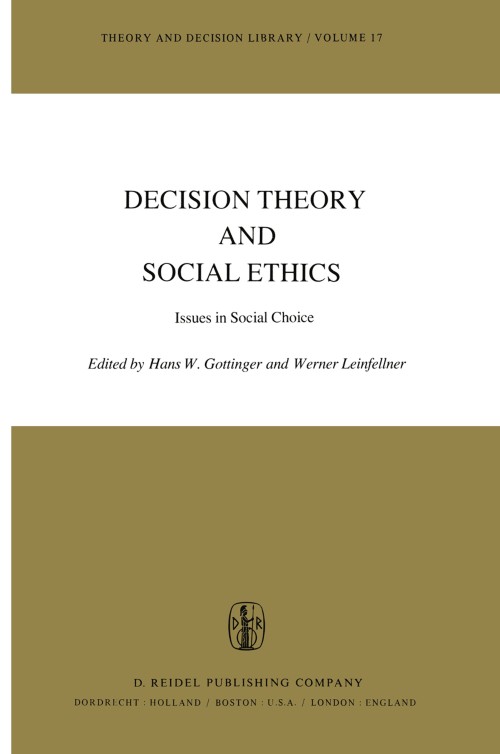
Decision Theory and Social Ethics [electronic resource] : Issues in Social Choice / edited by H.W. Gottinger, W. Leinfellner.
Erişim Adresi
ISBN
9789400998384
Dil Kodu
İngilizce
Yer Numarası
DK/16287
Basım Bildirimi
1st ed. 1978.
Yayın Bilgisi
Dordrecht : Springer Netherlands : Imprint: Springer, 1978.
Fiziksel Niteleme
351 p. online resource.
Dizi
Theory and Decision Library ; 17
İçindekiler Notu
1 / Philosophy and Ethical Principles -- Rule Utilitarianism and Decision Theory -- Marx and the Utility Approach to the Ethical Foundation of Microeconomics -- Endogenous Changes in Tastes: A Philosophical Discussion -- 2 / Social and Collective Choice Theory -- Nice Decision Schemes -- The Distribution of Rights in Society -- Acceptable Social Choice Lotteries -- Social Decision, Strategic Behavior, and Best Outcomes -- Cyclically Mixed Preferences—A Necessary and Sufficient Condition for Transitivity of the Social Preference Relation -- Comparative Distributive Ethics: An Extension of Sen’s Examination of the Pure Distribution Problem -- Rawls’s Theory of Justice: An Impossibility Result -- Arrow’s Impossibility Theorem: Some New Aspects -- Two Proofs of the Gibbard-Satterthwaite Theorem on the Possibility of a Strategy-Proof Social Choice Function -- 3 / Special Topics in Social Choice -- Ethics, Institutions and Optimality -- Complexity and Social Decision Rules -- Discrete Optimization and Social Decision Methods -- The Equity Principle in Economic Behavior -- The Distributive Justice of Income Inequality -- Index of Names -- Index of Subjects.
Özet, vb.
Ethics, as one of the most respectable disciplines of philosophy, has undergone a drastic and revolutionary change in recent time. There are three main trends of this development. The first trend can be described as a tendency towards a rigorous formal and analytical language. This means simply that ethics has created beside its own formalized set theoretical language a variety of new formalized, logical and mathemati cal methods and concepts. Thus ethics has become a formalized meta or epidiscipline which is going to replace the traditional concepts, principles and ethical methods in the realm of social sciences. It is clear that a formalized form of ethics can be used more easily in social, economic and political theories if there are ethical conflicts to be solved. This first trend can be regarded as a conditio sine qua non for application in, and imposing ethical solutions on, social scientific theories. The second trend may be characterized as an association- or unification-tendency of a formalized and analytical ethics with decision theory. Decision theory as a new interdiscipline of social sciences is actually an assemblage of a variety of subtheories such as value-utility theory, game theory, collective decision theory, etc. Harsanyi has called this complex of subtheories a general theory of human behavior. Analytical or formal ethics is actually using this general theory of human behavior as a vehicle simply because this theory deals from the beginning with conflict solution, i. e.
Konu
Sociology __ Methodology.
Sociological Methods.
Sociological Methods.
Diğer Yazarlar
Kurum Adı
Eseri Alıntıla
Referansları kullanmadan önce gözden geçirmeniz ve varsa gerekli düzeltmeleri yapmanız önerilir.
Dijital Kaynak
MARC Görünümü
LEADER 05226nam a22005415i 4500
001 815051
003 TR_AnAIT
005 20260130212350
007 cr nn 008mamaa
008 121227s1978 ne | s |||| 0|eng d
020 |a9789400998384|9978-94-009-9838-4
024 7 |a10.1007/978-94-009-9838-4|2doi
041 |aeng
049 |aTürk Tarih Kurumu Kütüphanesi
050 4|aHM511-538
072 7|aJHB|2bicssc
072 7|aSOC026000|2bisacsh
072 7|aJHB|2thema
082 04|a301.01|223
090 |aDK/16287
245 10|aDecision Theory and Social Ethics|h[electronic resource] :|bIssues in Social Choice /|cedited by H.W. Gottinger, W. Leinfellner.
250 |a1st ed. 1978.
264 1|aDordrecht :|bSpringer Netherlands :|bImprint: Springer,|c1978.
300 |a351 p.|bonline resource.
336 |atext|btxt|2rdacontent
337 |acomputer|bc|2rdamedia
338 |aonline resource|bcr|2rdacarrier
347 |atext file|bPDF|2rda
490 1 |aTheory and Decision Library ;|v17
505 0 |a1 / Philosophy and Ethical Principles -- Rule Utilitarianism and Decision Theory -- Marx and the Utility Approach to the Ethical Foundation of Microeconomics -- Endogenous Changes in Tastes: A Philosophical Discussion -- 2 / Social and Collective Choice Theory -- Nice Decision Schemes -- The Distribution of Rights in Society -- Acceptable Social Choice Lotteries -- Social Decision, Strategic Behavior, and Best Outcomes -- Cyclically Mixed Preferences—A Necessary and Sufficient Condition for Transitivity of the Social Preference Relation -- Comparative Distributive Ethics: An Extension of Sen’s Examination of the Pure Distribution Problem -- Rawls’s Theory of Justice: An Impossibility Result -- Arrow’s Impossibility Theorem: Some New Aspects -- Two Proofs of the Gibbard-Satterthwaite Theorem on the Possibility of a Strategy-Proof Social Choice Function -- 3 / Special Topics in Social Choice -- Ethics, Institutions and Optimality -- Complexity and Social Decision Rules -- Discrete Optimization and Social Decision Methods -- The Equity Principle in Economic Behavior -- The Distributive Justice of Income Inequality -- Index of Names -- Index of Subjects.
520 |aEthics, as one of the most respectable disciplines of philosophy, has undergone a drastic and revolutionary change in recent time. There are three main trends of this development. The first trend can be described as a tendency towards a rigorous formal and analytical language. This means simply that ethics has created beside its own formalized set theoretical language a variety of new formalized, logical and mathemati cal methods and concepts. Thus ethics has become a formalized meta or epidiscipline which is going to replace the traditional concepts, principles and ethical methods in the realm of social sciences. It is clear that a formalized form of ethics can be used more easily in social, economic and political theories if there are ethical conflicts to be solved. This first trend can be regarded as a conditio sine qua non for application in, and imposing ethical solutions on, social scientific theories. The second trend may be characterized as an association- or unification-tendency of a formalized and analytical ethics with decision theory. Decision theory as a new interdiscipline of social sciences is actually an assemblage of a variety of subtheories such as value-utility theory, game theory, collective decision theory, etc. Harsanyi has called this complex of subtheories a general theory of human behavior. Analytical or formal ethics is actually using this general theory of human behavior as a vehicle simply because this theory deals from the beginning with conflict solution, i. e.
532 8 |aAccessibility summary: This PDF is not accessible. It is based on scanned pages and does not support features such as screen reader compatibility or described non-text content (images, graphs etc). However, it likely supports searchable and selectable text based on OCR (Optical Character Recognition). Users with accessibility needs may not be able to use this content effectively. Please contact us at accessibilitysupport@springernature.com if you require assistance or an alternative format.
532 8 |aInaccessible, or known limited accessibility
532 8 |aNo reading system accessibility options actively disabled
532 8 |aPublisher contact for further accessibility information: accessibilitysupport@springernature.com
650 0|aSociology|xMethodology.
650 14|aSociological Methods.
700 1 |aGottinger, H.W.|eeditor.|4edt|4http://id.loc.gov/vocabulary/relators/edt
700 1 |aLeinfellner, W.|eeditor.|4edt|4http://id.loc.gov/vocabulary/relators/edt
710 2 |aSpringerLink (Online service)
773 0 |tSpringer Nature eBook
776 08|iPrinted edition:|z9789027708878
776 08|iPrinted edition:|z9789027709370
776 08|iPrinted edition:|z9789400998391
830 0|aTheory and Decision Library ;|v17
856 40|uhttps://doi.org/10.1007/978-94-009-9838-4
912 |aZDB-2-SHU
912 |aZDB-2-SXS
912 |aZDB-2-BAE
950 |aHumanities, Social Sciences and Law (SpringerNature-11648)
950 |aSocial Sciences (R0) (SpringerNature-43726)
001 815051
003 TR_AnAIT
005 20260130212350
007 cr nn 008mamaa
008 121227s1978 ne | s |||| 0|eng d
020 |a9789400998384|9978-94-009-9838-4
024 7 |a10.1007/978-94-009-9838-4|2doi
041 |aeng
049 |aTürk Tarih Kurumu Kütüphanesi
050 4|aHM511-538
072 7|aJHB|2bicssc
072 7|aSOC026000|2bisacsh
072 7|aJHB|2thema
082 04|a301.01|223
090 |aDK/16287
245 10|aDecision Theory and Social Ethics|h[electronic resource] :|bIssues in Social Choice /|cedited by H.W. Gottinger, W. Leinfellner.
250 |a1st ed. 1978.
264 1|aDordrecht :|bSpringer Netherlands :|bImprint: Springer,|c1978.
300 |a351 p.|bonline resource.
336 |atext|btxt|2rdacontent
337 |acomputer|bc|2rdamedia
338 |aonline resource|bcr|2rdacarrier
347 |atext file|bPDF|2rda
490 1 |aTheory and Decision Library ;|v17
505 0 |a1 / Philosophy and Ethical Principles -- Rule Utilitarianism and Decision Theory -- Marx and the Utility Approach to the Ethical Foundation of Microeconomics -- Endogenous Changes in Tastes: A Philosophical Discussion -- 2 / Social and Collective Choice Theory -- Nice Decision Schemes -- The Distribution of Rights in Society -- Acceptable Social Choice Lotteries -- Social Decision, Strategic Behavior, and Best Outcomes -- Cyclically Mixed Preferences—A Necessary and Sufficient Condition for Transitivity of the Social Preference Relation -- Comparative Distributive Ethics: An Extension of Sen’s Examination of the Pure Distribution Problem -- Rawls’s Theory of Justice: An Impossibility Result -- Arrow’s Impossibility Theorem: Some New Aspects -- Two Proofs of the Gibbard-Satterthwaite Theorem on the Possibility of a Strategy-Proof Social Choice Function -- 3 / Special Topics in Social Choice -- Ethics, Institutions and Optimality -- Complexity and Social Decision Rules -- Discrete Optimization and Social Decision Methods -- The Equity Principle in Economic Behavior -- The Distributive Justice of Income Inequality -- Index of Names -- Index of Subjects.
520 |aEthics, as one of the most respectable disciplines of philosophy, has undergone a drastic and revolutionary change in recent time. There are three main trends of this development. The first trend can be described as a tendency towards a rigorous formal and analytical language. This means simply that ethics has created beside its own formalized set theoretical language a variety of new formalized, logical and mathemati cal methods and concepts. Thus ethics has become a formalized meta or epidiscipline which is going to replace the traditional concepts, principles and ethical methods in the realm of social sciences. It is clear that a formalized form of ethics can be used more easily in social, economic and political theories if there are ethical conflicts to be solved. This first trend can be regarded as a conditio sine qua non for application in, and imposing ethical solutions on, social scientific theories. The second trend may be characterized as an association- or unification-tendency of a formalized and analytical ethics with decision theory. Decision theory as a new interdiscipline of social sciences is actually an assemblage of a variety of subtheories such as value-utility theory, game theory, collective decision theory, etc. Harsanyi has called this complex of subtheories a general theory of human behavior. Analytical or formal ethics is actually using this general theory of human behavior as a vehicle simply because this theory deals from the beginning with conflict solution, i. e.
532 8 |aAccessibility summary: This PDF is not accessible. It is based on scanned pages and does not support features such as screen reader compatibility or described non-text content (images, graphs etc). However, it likely supports searchable and selectable text based on OCR (Optical Character Recognition). Users with accessibility needs may not be able to use this content effectively. Please contact us at accessibilitysupport@springernature.com if you require assistance or an alternative format.
532 8 |aInaccessible, or known limited accessibility
532 8 |aNo reading system accessibility options actively disabled
532 8 |aPublisher contact for further accessibility information: accessibilitysupport@springernature.com
650 0|aSociology|xMethodology.
650 14|aSociological Methods.
700 1 |aGottinger, H.W.|eeditor.|4edt|4http://id.loc.gov/vocabulary/relators/edt
700 1 |aLeinfellner, W.|eeditor.|4edt|4http://id.loc.gov/vocabulary/relators/edt
710 2 |aSpringerLink (Online service)
773 0 |tSpringer Nature eBook
776 08|iPrinted edition:|z9789027708878
776 08|iPrinted edition:|z9789027709370
776 08|iPrinted edition:|z9789400998391
830 0|aTheory and Decision Library ;|v17
856 40|uhttps://doi.org/10.1007/978-94-009-9838-4
912 |aZDB-2-SHU
912 |aZDB-2-SXS
912 |aZDB-2-BAE
950 |aHumanities, Social Sciences and Law (SpringerNature-11648)
950 |aSocial Sciences (R0) (SpringerNature-43726)
Materyaller
Depodan talep edilen materyal sadece kütüphane içerisinde kullanılmaktadır.
Materyal dışarıya ödünç verilmemektedir.
Materyal dışarıya ödünç verilmemektedir.
