

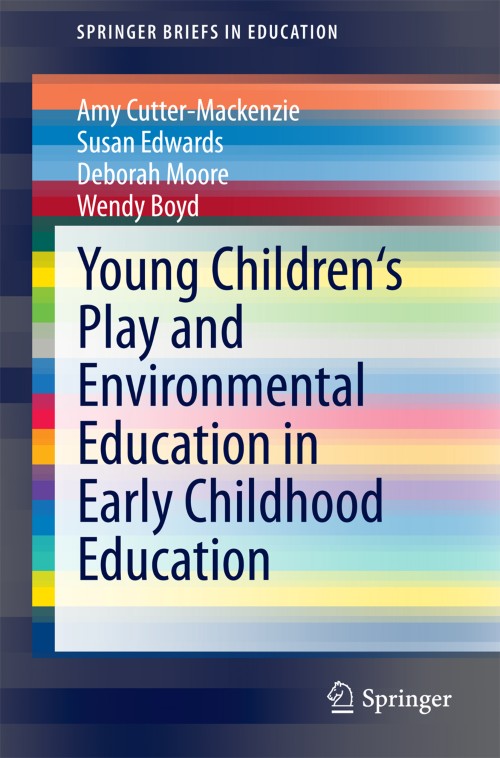
Young Children's Play and Environmental Education in Early Childhood Education [electronic resource] / by Amy Cutter-Mackenzie, Susan Edwards, Deborah Moore, Wendy Boyd.
Erişim Adresi
ISBN
9783319037400
Dil Kodu
İngilizce
Yer Numarası
DK/16310
Yazar
Basım Bildirimi
1st ed. 2014.
Yayın Bilgisi
Cham : Springer International Publishing : Imprint: Springer, 2014.
Fiziksel Niteleme
XI, 88 p. 16 illus. online resource.
Dizi
SpringerBriefs in Education, 2211-193X
İçindekiler Notu
1. A Challenge for Early Childhood Environmental Education?; Amy Cutter-Mackenzie & Susan Edwards -- 2. Play-based Learning in Early Childhood Education; Deborah Moore & Susan Edwards -- 3. Environmental Education and Pedagogical Play in Early Childhood Education; Susan Edwards & Amy Cutter-Mackenzie -- 4. Jeanette: Pond Life; Amy Cutter-Mackenzie & Wendy Boyd -- 5. Josh: Small is Beautiful; Wendy Boyd & Amy Cutter-Mackenzie -- 6. Robyn: Worms Underground; Deborah Moore & Susan Edwards -- 7. A Challenge Reconsidered: Play-based Learning in Early Childhood Environmental Education; Susan Edwards & Amy Cutter-Mackenzie.
Özet, vb.
In an era in which environmental education has been described as one of the most pressing educational concerns of our time, further insights are needed to understand how best to approach the learning and teaching of environmental education in early childhood education. In this book we address this concern by identifying two principles for using play-based learning early childhood environmental education. The principles we identify are the result of research conducted with teachers and children using different types of play-based learning whilst engaged in environmental education. Such play-types connect with the historical use of play-based learning in early childhood education as a basis for pedagogy. In the book ‘Beyond Quality in ECE and Care’ authors Dahlberg, Moss and Pence implore readers to ask critical questions about commonly held images of how young children come to construct themselves within social institutions. In similar fashion, this little book problematizes the taken-for-grantedness of the childhood development project in service to the certain cultural narratives. Cutter-Mackenzie, Edwards, Moore and Boyd challenge traditional conceptions of play-based learning through the medium of environmental education. This book signals a turning point in social thought grounded in a relational view of (environmental) education as experiential, intergenerational, interspecies, embodied learning in the third space. As Barad says, such work is based in inter-actions that can account for the tangled spaces of agencies. Through the deceptive simplicity of children’s play, the book stimulates deliberation of the real purposes of pedagogy and of schooling. Paul Hart, University of Regina, Canada.
Konu
Early childhood education.
Sustainability.
Early Childhood Education.
Sustainability.
Sustainability.
Early Childhood Education.
Sustainability.
Kurum Adı
Eseri Alıntıla
Referansları kullanmadan önce gözden geçirmeniz ve varsa gerekli düzeltmeleri yapmanız önerilir.
Dijital Kaynak
MARC Görünümü
LEADER 04447nam a22005175i 4500
001 815074
003 TR_AnAIT
005 20260130212306
007 cr nn 008mamaa
008 140117s2014 sz | s |||| 0|eng d
020 |a9783319037400|9978-3-319-03740-0
024 7 |a10.1007/978-3-319-03740-0|2doi
041 |aeng
049 |aTürk Tarih Kurumu Kütüphanesi
050 4|aLB1139.2-.5
072 7|aJNLA|2bicssc
072 7|aEDU023000|2bisacsh
072 7|aJNG|2thema
082 04|a372.21|223
090 |aDK/16310
100 1 |aCutter-Mackenzie, Amy.|eauthor.|4aut|4http://id.loc.gov/vocabulary/relators/aut
245 10|aYoung Children's Play and Environmental Education in Early Childhood Education|h[electronic resource] /|cby Amy Cutter-Mackenzie, Susan Edwards, Deborah Moore, Wendy Boyd.
250 |a1st ed. 2014.
264 1|aCham :|bSpringer International Publishing :|bImprint: Springer,|c2014.
300 |aXI, 88 p. 16 illus.|bonline resource.
336 |atext|btxt|2rdacontent
337 |acomputer|bc|2rdamedia
338 |aonline resource|bcr|2rdacarrier
347 |atext file|bPDF|2rda
490 1 |aSpringerBriefs in Education,|x2211-193X
505 0 |a1. A Challenge for Early Childhood Environmental Education?; Amy Cutter-Mackenzie & Susan Edwards -- 2. Play-based Learning in Early Childhood Education; Deborah Moore & Susan Edwards -- 3. Environmental Education and Pedagogical Play in Early Childhood Education; Susan Edwards & Amy Cutter-Mackenzie -- 4. Jeanette: Pond Life; Amy Cutter-Mackenzie & Wendy Boyd -- 5. Josh: Small is Beautiful; Wendy Boyd & Amy Cutter-Mackenzie -- 6. Robyn: Worms Underground; Deborah Moore & Susan Edwards -- 7. A Challenge Reconsidered: Play-based Learning in Early Childhood Environmental Education; Susan Edwards & Amy Cutter-Mackenzie.
520 |aIn an era in which environmental education has been described as one of the most pressing educational concerns of our time, further insights are needed to understand how best to approach the learning and teaching of environmental education in early childhood education. In this book we address this concern by identifying two principles for using play-based learning early childhood environmental education. The principles we identify are the result of research conducted with teachers and children using different types of play-based learning whilst engaged in environmental education. Such play-types connect with the historical use of play-based learning in early childhood education as a basis for pedagogy. In the book ‘Beyond Quality in ECE and Care’ authors Dahlberg, Moss and Pence implore readers to ask critical questions about commonly held images of how young children come to construct themselves within social institutions. In similar fashion, this little book problematizes the taken-for-grantedness of the childhood development project in service to the certain cultural narratives. Cutter-Mackenzie, Edwards, Moore and Boyd challenge traditional conceptions of play-based learning through the medium of environmental education. This book signals a turning point in social thought grounded in a relational view of (environmental) education as experiential, intergenerational, interspecies, embodied learning in the third space. As Barad says, such work is based in inter-actions that can account for the tangled spaces of agencies. Through the deceptive simplicity of children’s play, the book stimulates deliberation of the real purposes of pedagogy and of schooling. Paul Hart, University of Regina, Canada.
650 0|aEarly childhood education.
650 0|aSustainability.
650 14|aEarly Childhood Education.
650 24|aSustainability.
700 1 |aEdwards, Susan.|eauthor.|4aut|4http://id.loc.gov/vocabulary/relators/aut
700 1 |aMoore, Deborah.|eauthor.|4aut|4http://id.loc.gov/vocabulary/relators/aut
700 1 |aBoyd, Wendy.|eauthor.|0(orcid)0000-0001-5435-6617|1https://orcid.org/0000-0001-5435-6617|4aut|4http://id.loc.gov/vocabulary/relators/aut
710 2 |aSpringerLink (Online service)
773 0 |tSpringer Nature eBook
776 08|iPrinted edition:|z9783319037394
776 08|iPrinted edition:|z9783319037417
830 0|aSpringerBriefs in Education,|x2211-193X
856 40|uhttps://doi.org/10.1007/978-3-319-03740-0
912 |aZDB-2-SHU
912 |aZDB-2-SXED
950 |aHumanities, Social Sciences and Law (SpringerNature-11648)
950 |aEducation (R0) (SpringerNature-43721)
001 815074
003 TR_AnAIT
005 20260130212306
007 cr nn 008mamaa
008 140117s2014 sz | s |||| 0|eng d
020 |a9783319037400|9978-3-319-03740-0
024 7 |a10.1007/978-3-319-03740-0|2doi
041 |aeng
049 |aTürk Tarih Kurumu Kütüphanesi
050 4|aLB1139.2-.5
072 7|aJNLA|2bicssc
072 7|aEDU023000|2bisacsh
072 7|aJNG|2thema
082 04|a372.21|223
090 |aDK/16310
100 1 |aCutter-Mackenzie, Amy.|eauthor.|4aut|4http://id.loc.gov/vocabulary/relators/aut
245 10|aYoung Children's Play and Environmental Education in Early Childhood Education|h[electronic resource] /|cby Amy Cutter-Mackenzie, Susan Edwards, Deborah Moore, Wendy Boyd.
250 |a1st ed. 2014.
264 1|aCham :|bSpringer International Publishing :|bImprint: Springer,|c2014.
300 |aXI, 88 p. 16 illus.|bonline resource.
336 |atext|btxt|2rdacontent
337 |acomputer|bc|2rdamedia
338 |aonline resource|bcr|2rdacarrier
347 |atext file|bPDF|2rda
490 1 |aSpringerBriefs in Education,|x2211-193X
505 0 |a1. A Challenge for Early Childhood Environmental Education?; Amy Cutter-Mackenzie & Susan Edwards -- 2. Play-based Learning in Early Childhood Education; Deborah Moore & Susan Edwards -- 3. Environmental Education and Pedagogical Play in Early Childhood Education; Susan Edwards & Amy Cutter-Mackenzie -- 4. Jeanette: Pond Life; Amy Cutter-Mackenzie & Wendy Boyd -- 5. Josh: Small is Beautiful; Wendy Boyd & Amy Cutter-Mackenzie -- 6. Robyn: Worms Underground; Deborah Moore & Susan Edwards -- 7. A Challenge Reconsidered: Play-based Learning in Early Childhood Environmental Education; Susan Edwards & Amy Cutter-Mackenzie.
520 |aIn an era in which environmental education has been described as one of the most pressing educational concerns of our time, further insights are needed to understand how best to approach the learning and teaching of environmental education in early childhood education. In this book we address this concern by identifying two principles for using play-based learning early childhood environmental education. The principles we identify are the result of research conducted with teachers and children using different types of play-based learning whilst engaged in environmental education. Such play-types connect with the historical use of play-based learning in early childhood education as a basis for pedagogy. In the book ‘Beyond Quality in ECE and Care’ authors Dahlberg, Moss and Pence implore readers to ask critical questions about commonly held images of how young children come to construct themselves within social institutions. In similar fashion, this little book problematizes the taken-for-grantedness of the childhood development project in service to the certain cultural narratives. Cutter-Mackenzie, Edwards, Moore and Boyd challenge traditional conceptions of play-based learning through the medium of environmental education. This book signals a turning point in social thought grounded in a relational view of (environmental) education as experiential, intergenerational, interspecies, embodied learning in the third space. As Barad says, such work is based in inter-actions that can account for the tangled spaces of agencies. Through the deceptive simplicity of children’s play, the book stimulates deliberation of the real purposes of pedagogy and of schooling. Paul Hart, University of Regina, Canada.
650 0|aEarly childhood education.
650 0|aSustainability.
650 14|aEarly Childhood Education.
650 24|aSustainability.
700 1 |aEdwards, Susan.|eauthor.|4aut|4http://id.loc.gov/vocabulary/relators/aut
700 1 |aMoore, Deborah.|eauthor.|4aut|4http://id.loc.gov/vocabulary/relators/aut
700 1 |aBoyd, Wendy.|eauthor.|0(orcid)0000-0001-5435-6617|1https://orcid.org/0000-0001-5435-6617|4aut|4http://id.loc.gov/vocabulary/relators/aut
710 2 |aSpringerLink (Online service)
773 0 |tSpringer Nature eBook
776 08|iPrinted edition:|z9783319037394
776 08|iPrinted edition:|z9783319037417
830 0|aSpringerBriefs in Education,|x2211-193X
856 40|uhttps://doi.org/10.1007/978-3-319-03740-0
912 |aZDB-2-SHU
912 |aZDB-2-SXED
950 |aHumanities, Social Sciences and Law (SpringerNature-11648)
950 |aEducation (R0) (SpringerNature-43721)
Materyaller
Depodan talep edilen materyal sadece kütüphane içerisinde kullanılmaktadır.
Materyal dışarıya ödünç verilmemektedir.
Materyal dışarıya ödünç verilmemektedir.
