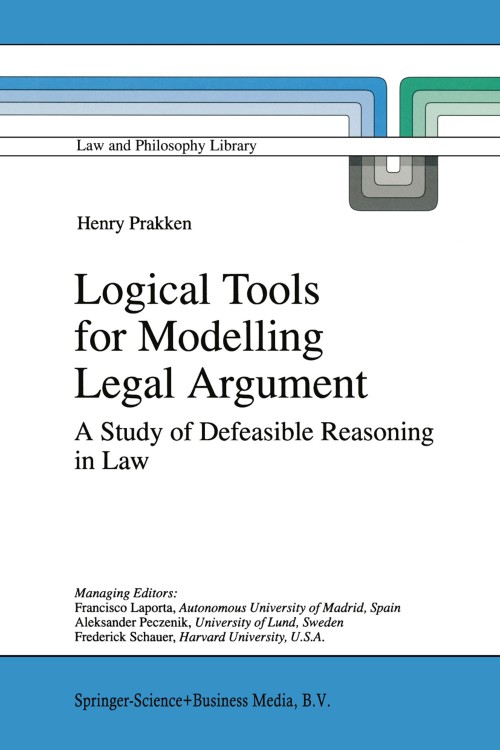
Logical Tools for Modelling Legal Argument [electronic resource] : A Study of Defeasible Reasoning in Law / by H. Prakken.
Erişim Adresi
ISBN
9789401589758
Dil Kodu
İngilizce
Yer Numarası
DK/16314
Yazar
Basım Bildirimi
1st ed. 1997.
Yayın Bilgisi
Dordrecht : Springer Netherlands : Imprint: Springer, 1997.
Fiziksel Niteleme
XIII, 314 p. online resource.
Dizi
Law and Philosophy Library, 2215-0315 ; 32
İçindekiler Notu
1 Introduction -- 2 The Role of Logic in Legal Reasoning -- 3 The Need for New Logical Tools -- 4 Logics for Nonmonotonic Reasoning -- 5 Representing Explicit Exceptions -- 6 Preferring the Most Specific Argument -- 7 Reasoning with Inconsistent Information -- 8 Reasoning about Priority Relations -- 9 Systems for Defeasible Argumentation -- 10 Using the Argumentation System -- 11 Conclusion -- A Notations, Orderings and Glossary -- A1 General Symbols and Notations -- A2 Ordering Relations -- A3 Notions of the Argumentation System of Chapters 6–8 -- A4 Glossary -- References.
Özet, vb.
This book is a revised and extended version of my PhD Thesis 'Logical Tools for Modelling Legal Argument', which I defended on 14 January 1993 at the Free University Amsterdam. The first five chapters of the thesis have remained almost completely unchanged but the other chapters have undergone considerable revision and expansion. Most importantly, I have replaced the formal argument-based system of the old Chapters 6, 7 and 8 with a revised and extended system, whieh I have developed during the last three years in collaboration with Giovanni Sartor. Apart from some technical improvements, the main additions to the old system are the enriehment of its language with a nonprovability operator, and the ability to formalise reasoning about preference criteria. Moreover, the new system has a very intuitive dialectieal form, as opposed to the rather unintuitive fixed-point appearance of the old system. Another important revision is the split of the old Chapter 9 into two new chapters. The oldSection 9. 1 on related research has been updated and expanded into a whole chapter, while the rest of the old chapter is now in revised form in Chapter 10. This chapter also contains two new contributions, a detailed discussion of Gordon's Pleadings Game, and a general description of a multi-Iayered overall view on the structure of argu mentation, comprising a logieal, dialectical, procedural and strategie layer. Finally, in the revised conclusion I have paid more attention to the relevance of my investigations for legal philosophy and argumentation theory.
Konu
Law __ Philosophy.
Law __ History.
Artificial intelligence.
Logic.
Philosophy of Law.
Theories of Law, Philosophy of Law, Legal History.
Artificial Intelligence.
Logic.
Law __ History.
Artificial intelligence.
Logic.
Philosophy of Law.
Theories of Law, Philosophy of Law, Legal History.
Artificial Intelligence.
Logic.
Kurum Adı

Eseri Alıntıla
Referansları kullanmadan önce gözden geçirmeniz ve varsa gerekli düzeltmeleri yapmanız önerilir.
Dijital Kaynak
MARC Görünümü
LEADER 04832nam a22006015i 4500
001 815078
003 TR_AnAIT
005 20260130212254
007 cr nn 008mamaa
008 130327s1997 ne | s |||| 0|eng d
020 |a9789401589758|9978-94-015-8975-8
024 7 |a10.1007/978-94-015-8975-8|2doi
041 |aeng
049 |aTürk Tarih Kurumu Kütüphanesi
050 4|aK201-487
072 7|aLAB|2bicssc
072 7|aPHI000000|2bisacsh
072 7|aLAB|2thema
082 04|a340.1|223
090 |aDK/16314
100 1 |aPrakken, H.|eauthor.|4aut|4http://id.loc.gov/vocabulary/relators/aut
245 10|aLogical Tools for Modelling Legal Argument|h[electronic resource] :|bA Study of Defeasible Reasoning in Law /|cby H. Prakken.
250 |a1st ed. 1997.
264 1|aDordrecht :|bSpringer Netherlands :|bImprint: Springer,|c1997.
300 |aXIII, 314 p.|bonline resource.
336 |atext|btxt|2rdacontent
337 |acomputer|bc|2rdamedia
338 |aonline resource|bcr|2rdacarrier
347 |atext file|bPDF|2rda
490 1 |aLaw and Philosophy Library,|x2215-0315 ;|v32
505 0 |a1 Introduction -- 2 The Role of Logic in Legal Reasoning -- 3 The Need for New Logical Tools -- 4 Logics for Nonmonotonic Reasoning -- 5 Representing Explicit Exceptions -- 6 Preferring the Most Specific Argument -- 7 Reasoning with Inconsistent Information -- 8 Reasoning about Priority Relations -- 9 Systems for Defeasible Argumentation -- 10 Using the Argumentation System -- 11 Conclusion -- A Notations, Orderings and Glossary -- A1 General Symbols and Notations -- A2 Ordering Relations -- A3 Notions of the Argumentation System of Chapters 6–8 -- A4 Glossary -- References.
520 |aThis book is a revised and extended version of my PhD Thesis 'Logical Tools for Modelling Legal Argument', which I defended on 14 January 1993 at the Free University Amsterdam. The first five chapters of the thesis have remained almost completely unchanged but the other chapters have undergone considerable revision and expansion. Most importantly, I have replaced the formal argument-based system of the old Chapters 6, 7 and 8 with a revised and extended system, whieh I have developed during the last three years in collaboration with Giovanni Sartor. Apart from some technical improvements, the main additions to the old system are the enriehment of its language with a nonprovability operator, and the ability to formalise reasoning about preference criteria. Moreover, the new system has a very intuitive dialectieal form, as opposed to the rather unintuitive fixed-point appearance of the old system. Another important revision is the split of the old Chapter 9 into two new chapters. The oldSection 9. 1 on related research has been updated and expanded into a whole chapter, while the rest of the old chapter is now in revised form in Chapter 10. This chapter also contains two new contributions, a detailed discussion of Gordon's Pleadings Game, and a general description of a multi-Iayered overall view on the structure of argu mentation, comprising a logieal, dialectical, procedural and strategie layer. Finally, in the revised conclusion I have paid more attention to the relevance of my investigations for legal philosophy and argumentation theory.
532 8 |aAccessibility summary: This PDF is not accessible. It is based on scanned pages and does not support features such as screen reader compatibility or described non-text content (images, graphs etc). However, it likely supports searchable and selectable text based on OCR (Optical Character Recognition). Users with accessibility needs may not be able to use this content effectively. Please contact us at accessibilitysupport@springernature.com if you require assistance or an alternative format.
532 8 |aInaccessible, or known limited accessibility
532 8 |aNo reading system accessibility options actively disabled
532 8 |aPublisher contact for further accessibility information: accessibilitysupport@springernature.com
650 0|aLaw|xPhilosophy.
650 0|aLaw|xHistory.
650 0|aArtificial intelligence.
650 0|aLogic.
650 14|aPhilosophy of Law.
650 24|aTheories of Law, Philosophy of Law, Legal History.
650 24|aArtificial Intelligence.
650 24|aLogic.
710 2 |aSpringerLink (Online service)
773 0 |tSpringer Nature eBook
776 08|iPrinted edition:|z9780792347767
776 08|iPrinted edition:|z9789048149285
776 08|iPrinted edition:|z9789401589765
830 0|aLaw and Philosophy Library,|x2215-0315 ;|v32
856 40|uhttps://doi.org/10.1007/978-94-015-8975-8
912 |aZDB-2-SHU
912 |aZDB-2-SXPR
912 |aZDB-2-BAE
950 |aHumanities, Social Sciences and Law (SpringerNature-11648)
950 |aPhilosophy and Religion (R0) (SpringerNature-43725)
001 815078
003 TR_AnAIT
005 20260130212254
007 cr nn 008mamaa
008 130327s1997 ne | s |||| 0|eng d
020 |a9789401589758|9978-94-015-8975-8
024 7 |a10.1007/978-94-015-8975-8|2doi
041 |aeng
049 |aTürk Tarih Kurumu Kütüphanesi
050 4|aK201-487
072 7|aLAB|2bicssc
072 7|aPHI000000|2bisacsh
072 7|aLAB|2thema
082 04|a340.1|223
090 |aDK/16314
100 1 |aPrakken, H.|eauthor.|4aut|4http://id.loc.gov/vocabulary/relators/aut
245 10|aLogical Tools for Modelling Legal Argument|h[electronic resource] :|bA Study of Defeasible Reasoning in Law /|cby H. Prakken.
250 |a1st ed. 1997.
264 1|aDordrecht :|bSpringer Netherlands :|bImprint: Springer,|c1997.
300 |aXIII, 314 p.|bonline resource.
336 |atext|btxt|2rdacontent
337 |acomputer|bc|2rdamedia
338 |aonline resource|bcr|2rdacarrier
347 |atext file|bPDF|2rda
490 1 |aLaw and Philosophy Library,|x2215-0315 ;|v32
505 0 |a1 Introduction -- 2 The Role of Logic in Legal Reasoning -- 3 The Need for New Logical Tools -- 4 Logics for Nonmonotonic Reasoning -- 5 Representing Explicit Exceptions -- 6 Preferring the Most Specific Argument -- 7 Reasoning with Inconsistent Information -- 8 Reasoning about Priority Relations -- 9 Systems for Defeasible Argumentation -- 10 Using the Argumentation System -- 11 Conclusion -- A Notations, Orderings and Glossary -- A1 General Symbols and Notations -- A2 Ordering Relations -- A3 Notions of the Argumentation System of Chapters 6–8 -- A4 Glossary -- References.
520 |aThis book is a revised and extended version of my PhD Thesis 'Logical Tools for Modelling Legal Argument', which I defended on 14 January 1993 at the Free University Amsterdam. The first five chapters of the thesis have remained almost completely unchanged but the other chapters have undergone considerable revision and expansion. Most importantly, I have replaced the formal argument-based system of the old Chapters 6, 7 and 8 with a revised and extended system, whieh I have developed during the last three years in collaboration with Giovanni Sartor. Apart from some technical improvements, the main additions to the old system are the enriehment of its language with a nonprovability operator, and the ability to formalise reasoning about preference criteria. Moreover, the new system has a very intuitive dialectieal form, as opposed to the rather unintuitive fixed-point appearance of the old system. Another important revision is the split of the old Chapter 9 into two new chapters. The oldSection 9. 1 on related research has been updated and expanded into a whole chapter, while the rest of the old chapter is now in revised form in Chapter 10. This chapter also contains two new contributions, a detailed discussion of Gordon's Pleadings Game, and a general description of a multi-Iayered overall view on the structure of argu mentation, comprising a logieal, dialectical, procedural and strategie layer. Finally, in the revised conclusion I have paid more attention to the relevance of my investigations for legal philosophy and argumentation theory.
532 8 |aAccessibility summary: This PDF is not accessible. It is based on scanned pages and does not support features such as screen reader compatibility or described non-text content (images, graphs etc). However, it likely supports searchable and selectable text based on OCR (Optical Character Recognition). Users with accessibility needs may not be able to use this content effectively. Please contact us at accessibilitysupport@springernature.com if you require assistance or an alternative format.
532 8 |aInaccessible, or known limited accessibility
532 8 |aNo reading system accessibility options actively disabled
532 8 |aPublisher contact for further accessibility information: accessibilitysupport@springernature.com
650 0|aLaw|xPhilosophy.
650 0|aLaw|xHistory.
650 0|aArtificial intelligence.
650 0|aLogic.
650 14|aPhilosophy of Law.
650 24|aTheories of Law, Philosophy of Law, Legal History.
650 24|aArtificial Intelligence.
650 24|aLogic.
710 2 |aSpringerLink (Online service)
773 0 |tSpringer Nature eBook
776 08|iPrinted edition:|z9780792347767
776 08|iPrinted edition:|z9789048149285
776 08|iPrinted edition:|z9789401589765
830 0|aLaw and Philosophy Library,|x2215-0315 ;|v32
856 40|uhttps://doi.org/10.1007/978-94-015-8975-8
912 |aZDB-2-SHU
912 |aZDB-2-SXPR
912 |aZDB-2-BAE
950 |aHumanities, Social Sciences and Law (SpringerNature-11648)
950 |aPhilosophy and Religion (R0) (SpringerNature-43725)
Materyaller
Depodan talep edilen materyal sadece kütüphane içerisinde kullanılmaktadır.
Materyal dışarıya ödünç verilmemektedir.
