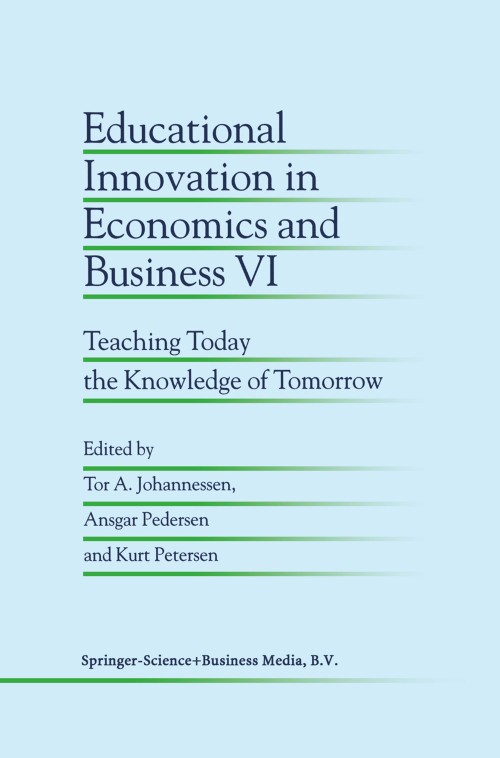
Educational Innovation in Economics and Business VI [electronic resource] : Teaching Today the Knowledge of Tomorrow / edited by Tor A. Johannessen, Ansgar Pedersen, Kurt Petersen.
Erişim Adresi
ISBN
9789401713900
Dil Kodu
İngilizce
Yer Numarası
DK/16338
Basım Bildirimi
1st ed. 2002.
Yayın Bilgisi
Dordrecht : Springer Netherlands : Imprint: Springer, 2002.
Fiziksel Niteleme
XVIII, 334 p. online resource.
Dizi
Educational Innovation in Economics and Business ; 6
İçindekiler Notu
Focusing on Capabilities Development to Reduce Knowledge and Skills Obsolescence -- Goals and Critical Success Factors in a PBL Marketing Course -- The Use of the Action-Research Methodology in the Development of Business Education a Case Study -- Managing Teams of Teams: Lessons Learned -- Issues in Team Teaching: Point and Counterpoint -- Project Seminars: One Way of Developing Reflected Practical Competence -- Mindfulness Theory, Technology and the Transfer of New Learning -- Collaborative Learning and New Learning Technologies: Coordination of Pedagogy -- Interactive Case Studies — Enablers For Innovative Learning -- The Role of Problem Based Learning and Technology Support in a ‘Spoon-Fed’ Undergraduate Environment -- From Information to Knowledge: Teaching and Learning Online -- Learning Methods and the Use of ICT -- Learning by Sharing: a Model for Life-Long Learning -- Student-Focused Learning: the Goal of Learning to Learn -- Enterprise Development: Strategic Collaboration for Economics and Business -- Teaching Introductory OB as Propaedeutic -- Is the Fragmentation of Strategic Management Theory a Handicap for Business? -- Trainer, Mentor, Educator: What Role for the Business Faculty in the 21st Century -- Leadership Development as a Means of Organizational Change -- Aspects of Learning Style and Labour Market Entry: an Explorative Study.
Özet, vb.
Business education and business research has often been criticized by the business community, which claims that much of it is mainly directed at the establishment of teachers and researchers themselves, instead of distributing their knowledge to the business community. It may seem that many universities and other research institutions have turned into mere `knowledge manufacturers', where the emphasis is more on the output volume than on quality of relevance, with little or no consideration for the end users. As universities and corporations attempt to prepare management to be alert to future changes, improved and even brand new teaching methodologies are required. The main focus of the present volume is on the distribution and selection of new knowledge. How can business educators deliver new knowledge to students and the business community more rapidly than before? How should we define the core business curriculum when new knowledge becomes old knowledge?
Konu
Education.
Learning, Psychology of.
Education __ Curricula.
Education.
Instructional Psychology.
Curriculum Studies.
Learning, Psychology of.
Education __ Curricula.
Education.
Instructional Psychology.
Curriculum Studies.
Diğer Yazarlar
Kurum Adı

Eseri Alıntıla
Referansları kullanmadan önce gözden geçirmeniz ve varsa gerekli düzeltmeleri yapmanız önerilir.
Dijital Kaynak
MARC Görünümü
LEADER 05193nam a22006015i 4500
001 815102
003 TR_AnAIT
005 20260130212217
007 cr nn 008mamaa
008 130321s2002 ne | s |||| 0|eng d
020 |a9789401713900|9978-94-017-1390-0
024 7 |a10.1007/978-94-017-1390-0|2doi
041 |aeng
049 |aTürk Tarih Kurumu Kütüphanesi
050 4|aL1-991
072 7|aJN|2bicssc
072 7|aEDU000000|2bisacsh
072 7|aJN|2thema
082 04|a370|223
090 |aDK/16338
245 10|aEducational Innovation in Economics and Business VI|h[electronic resource] :|bTeaching Today the Knowledge of Tomorrow /|cedited by Tor A. Johannessen, Ansgar Pedersen, Kurt Petersen.
250 |a1st ed. 2002.
264 1|aDordrecht :|bSpringer Netherlands :|bImprint: Springer,|c2002.
300 |aXVIII, 334 p.|bonline resource.
336 |atext|btxt|2rdacontent
337 |acomputer|bc|2rdamedia
338 |aonline resource|bcr|2rdacarrier
347 |atext file|bPDF|2rda
490 1 |aEducational Innovation in Economics and Business ;|v6
505 0 |aFocusing on Capabilities Development to Reduce Knowledge and Skills Obsolescence -- Goals and Critical Success Factors in a PBL Marketing Course -- The Use of the Action-Research Methodology in the Development of Business Education a Case Study -- Managing Teams of Teams: Lessons Learned -- Issues in Team Teaching: Point and Counterpoint -- Project Seminars: One Way of Developing Reflected Practical Competence -- Mindfulness Theory, Technology and the Transfer of New Learning -- Collaborative Learning and New Learning Technologies: Coordination of Pedagogy -- Interactive Case Studies — Enablers For Innovative Learning -- The Role of Problem Based Learning and Technology Support in a ‘Spoon-Fed’ Undergraduate Environment -- From Information to Knowledge: Teaching and Learning Online -- Learning Methods and the Use of ICT -- Learning by Sharing: a Model for Life-Long Learning -- Student-Focused Learning: the Goal of Learning to Learn -- Enterprise Development: Strategic Collaboration for Economics and Business -- Teaching Introductory OB as Propaedeutic -- Is the Fragmentation of Strategic Management Theory a Handicap for Business? -- Trainer, Mentor, Educator: What Role for the Business Faculty in the 21st Century -- Leadership Development as a Means of Organizational Change -- Aspects of Learning Style and Labour Market Entry: an Explorative Study.
520 |aBusiness education and business research has often been criticized by the business community, which claims that much of it is mainly directed at the establishment of teachers and researchers themselves, instead of distributing their knowledge to the business community. It may seem that many universities and other research institutions have turned into mere `knowledge manufacturers', where the emphasis is more on the output volume than on quality of relevance, with little or no consideration for the end users. As universities and corporations attempt to prepare management to be alert to future changes, improved and even brand new teaching methodologies are required. The main focus of the present volume is on the distribution and selection of new knowledge. How can business educators deliver new knowledge to students and the business community more rapidly than before? How should we define the core business curriculum when new knowledge becomes old knowledge?
532 8 |aAccessibility summary: This PDF is not accessible. It is based on scanned pages and does not support features such as screen reader compatibility or described non-text content (images, graphs etc). However, it likely supports searchable and selectable text based on OCR (Optical Character Recognition). Users with accessibility needs may not be able to use this content effectively. Please contact us at accessibilitysupport@springernature.com if you require assistance or an alternative format.
532 8 |aInaccessible, or known limited accessibility
532 8 |aNo reading system accessibility options actively disabled
532 8 |aPublisher contact for further accessibility information: accessibilitysupport@springernature.com
650 0|aEducation.
650 0|aLearning, Psychology of.
650 0|aEducation|xCurricula.
650 14|aEducation.
650 24|aInstructional Psychology.
650 24|aCurriculum Studies.
700 1 |aJohannessen, Tor A.|eeditor.|4edt|4http://id.loc.gov/vocabulary/relators/edt
700 1 |aPedersen, Ansgar.|eeditor.|4edt|4http://id.loc.gov/vocabulary/relators/edt
700 1 |aPetersen, Kurt.|eeditor.|4edt|4http://id.loc.gov/vocabulary/relators/edt
710 2 |aSpringerLink (Online service)
773 0 |tSpringer Nature eBook
776 08|iPrinted edition:|z9781402004780
776 08|iPrinted edition:|z9789048159598
776 08|iPrinted edition:|z9789401713917
830 0|aEducational Innovation in Economics and Business ;|v6
856 40|uhttps://doi.org/10.1007/978-94-017-1390-0
912 |aZDB-2-SHU
912 |aZDB-2-SXED
912 |aZDB-2-BAE
950 |aHumanities, Social Sciences and Law (SpringerNature-11648)
950 |aEducation (R0) (SpringerNature-43721)
001 815102
003 TR_AnAIT
005 20260130212217
007 cr nn 008mamaa
008 130321s2002 ne | s |||| 0|eng d
020 |a9789401713900|9978-94-017-1390-0
024 7 |a10.1007/978-94-017-1390-0|2doi
041 |aeng
049 |aTürk Tarih Kurumu Kütüphanesi
050 4|aL1-991
072 7|aJN|2bicssc
072 7|aEDU000000|2bisacsh
072 7|aJN|2thema
082 04|a370|223
090 |aDK/16338
245 10|aEducational Innovation in Economics and Business VI|h[electronic resource] :|bTeaching Today the Knowledge of Tomorrow /|cedited by Tor A. Johannessen, Ansgar Pedersen, Kurt Petersen.
250 |a1st ed. 2002.
264 1|aDordrecht :|bSpringer Netherlands :|bImprint: Springer,|c2002.
300 |aXVIII, 334 p.|bonline resource.
336 |atext|btxt|2rdacontent
337 |acomputer|bc|2rdamedia
338 |aonline resource|bcr|2rdacarrier
347 |atext file|bPDF|2rda
490 1 |aEducational Innovation in Economics and Business ;|v6
505 0 |aFocusing on Capabilities Development to Reduce Knowledge and Skills Obsolescence -- Goals and Critical Success Factors in a PBL Marketing Course -- The Use of the Action-Research Methodology in the Development of Business Education a Case Study -- Managing Teams of Teams: Lessons Learned -- Issues in Team Teaching: Point and Counterpoint -- Project Seminars: One Way of Developing Reflected Practical Competence -- Mindfulness Theory, Technology and the Transfer of New Learning -- Collaborative Learning and New Learning Technologies: Coordination of Pedagogy -- Interactive Case Studies — Enablers For Innovative Learning -- The Role of Problem Based Learning and Technology Support in a ‘Spoon-Fed’ Undergraduate Environment -- From Information to Knowledge: Teaching and Learning Online -- Learning Methods and the Use of ICT -- Learning by Sharing: a Model for Life-Long Learning -- Student-Focused Learning: the Goal of Learning to Learn -- Enterprise Development: Strategic Collaboration for Economics and Business -- Teaching Introductory OB as Propaedeutic -- Is the Fragmentation of Strategic Management Theory a Handicap for Business? -- Trainer, Mentor, Educator: What Role for the Business Faculty in the 21st Century -- Leadership Development as a Means of Organizational Change -- Aspects of Learning Style and Labour Market Entry: an Explorative Study.
520 |aBusiness education and business research has often been criticized by the business community, which claims that much of it is mainly directed at the establishment of teachers and researchers themselves, instead of distributing their knowledge to the business community. It may seem that many universities and other research institutions have turned into mere `knowledge manufacturers', where the emphasis is more on the output volume than on quality of relevance, with little or no consideration for the end users. As universities and corporations attempt to prepare management to be alert to future changes, improved and even brand new teaching methodologies are required. The main focus of the present volume is on the distribution and selection of new knowledge. How can business educators deliver new knowledge to students and the business community more rapidly than before? How should we define the core business curriculum when new knowledge becomes old knowledge?
532 8 |aAccessibility summary: This PDF is not accessible. It is based on scanned pages and does not support features such as screen reader compatibility or described non-text content (images, graphs etc). However, it likely supports searchable and selectable text based on OCR (Optical Character Recognition). Users with accessibility needs may not be able to use this content effectively. Please contact us at accessibilitysupport@springernature.com if you require assistance or an alternative format.
532 8 |aInaccessible, or known limited accessibility
532 8 |aNo reading system accessibility options actively disabled
532 8 |aPublisher contact for further accessibility information: accessibilitysupport@springernature.com
650 0|aEducation.
650 0|aLearning, Psychology of.
650 0|aEducation|xCurricula.
650 14|aEducation.
650 24|aInstructional Psychology.
650 24|aCurriculum Studies.
700 1 |aJohannessen, Tor A.|eeditor.|4edt|4http://id.loc.gov/vocabulary/relators/edt
700 1 |aPedersen, Ansgar.|eeditor.|4edt|4http://id.loc.gov/vocabulary/relators/edt
700 1 |aPetersen, Kurt.|eeditor.|4edt|4http://id.loc.gov/vocabulary/relators/edt
710 2 |aSpringerLink (Online service)
773 0 |tSpringer Nature eBook
776 08|iPrinted edition:|z9781402004780
776 08|iPrinted edition:|z9789048159598
776 08|iPrinted edition:|z9789401713917
830 0|aEducational Innovation in Economics and Business ;|v6
856 40|uhttps://doi.org/10.1007/978-94-017-1390-0
912 |aZDB-2-SHU
912 |aZDB-2-SXED
912 |aZDB-2-BAE
950 |aHumanities, Social Sciences and Law (SpringerNature-11648)
950 |aEducation (R0) (SpringerNature-43721)
Materyaller
Depodan talep edilen materyal sadece kütüphane içerisinde kullanılmaktadır.
Materyal dışarıya ödünç verilmemektedir.
