

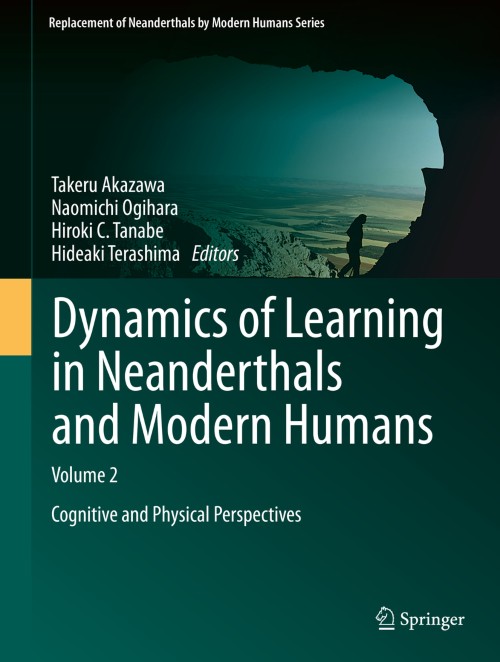
Dynamics of Learning in Neanderthals and Modern Humans Volume 2 [electronic resource] : Cognitive and Physical Perspectives / edited by Takeru Akazawa, Naomichi Ogihara, Hiroki C Tanabe, Hideaki Terashima.
Erişim Adresi
ISBN
9784431545538
Dil Kodu
İngilizce
Yer Numarası
DK/16359
Basım Bildirimi
1st ed. 2014.
Yayın Bilgisi
Tokyo : Springer Japan : Imprint: Springer, 2014.
Fiziksel Niteleme
XIII, 243 p. 161 illus., 75 illus. in color. online resource.
Dizi
Replacement of Neanderthals by Modern Humans Series, 2365-0648
İçindekiler Notu
Introduction -- The Cognition of Homo neanderthalensis and H. Sapiens: Does the Use of Pigment Necessarily Imply Symbolic Thought? -- Comparisons between Individual, Imitative and Instructed Learning -- The Ability to Objectify Conventional Styles of Problem-Solving: A Hypothesis on the Difference in Learning Ability between Modern Humans and Neanderthals -- Cognitive Flexibility and Object-making in Baka Pygmy Children -- The Demonstration of Resilience in the Drawings of Baka Pygmy Children -- Social Learning, Trial-and-Error, and Creativity -- Experimental Studies of Modern Human Social and Individual Learning in an Archaeological Context: People Behave Adaptively, But within Limits -- Motion Analysis for Stone-Knapping of the Skilled Levallois Technique -- Daily Physical Activity and Time-Space Using of Pygmy Hunter-Gatherers' Children in Southeast Cameroon -- Estimation of the Period of Childhood and Child Growth Characteristics of Pygmy Hunter-Gatherers in Southeast Cameroon -- Interpretations of Practical Population Genetics Analyses of Genome-Wide SNP Data on Human Demography -- Functional Craniology, Human Evolution, and Anatomical Constraints in the Neanderthal Braincase -- Cerebral Sulci and Gyri Observed on Macaque Endocasts -- The Coronal Suture as an Indicator of the Caudal Border of the Monkey Prefrontal Cortex -- Application of Sliding Landmark Method for Morphological Analysis of Modern Japanese Neurocranial Shape -- A Geometric Morphometric Study of Neurocranial Shape Variations in the Crania of Modern Japanese -- Statistical Interpolation of Missing Parts in Human Crania Using Regularized Multivariate Linear Regression Analysis -- Transferring Semi-Landmarks by Minimizing Bending Energy on Surfaces -- CT Image Segmentation for Bone Structures Using Image-Based FEM -- Virtual Endocast of Qafzeh 9: A Preliminary Assessment of Right-Left Asymmetry -- Reconstruction of the Brain from Skull Fossils Using Computational Anatomy -- Integrated Analytical Scheme for Comparing Neanderthal’s Brain to Modern Human Brain Using Neuroimaging Techniques -- Cerebellar Size Estimation from Endocranial Measurements: An Evaluation Based on MRI Data -- Sense of Acceptance: Key Factor of Social Learning -- Brain Activation Related to the Imitative Learning of Bodily Actions Observed during the Construction of a Mousterian Stone Tool: A Functional Magnetic Resonance Imaging Study -- Neural Substrates Associated with Motivation to Learn in Modern Humans.
Özet, vb.
This volume is the second of two volumes of proceedings from the International Conference on the Replacement of Neanderthals by Modern Humans, which took place in Tokyo in November 2012. This second volume reports, in four major sections, findings by cultural anthropologists, physical anthropologists, engineering scientists and neurophysiologists, integrated in multidisciplinary fashion to solidify the overall understanding of the mechanics of replacement from cognitive and physical perspectives. Part 1 provides examinations of replacement related questions from various perspectives in cognition and psychology. Part 2, consisting of studies rooted in body science and genetics, provides detailed findings which fill in the broader frame of the replacement phenomenon. Part 3 presents a collection of papers whose findings about fossil crania and brain morphology shed direct light on immediate questions regarding replacement. Part 4 provides illuminations similar to those in part 3, but arising from the analytical empowerment afforded by neuroscience. The collection of 26 papers in this volume makes available to readers both broad and narrow insights on the mechanisms of the replacement/assimilation of Neanderthals by modern humans and at the same time provides a model of new-paradigm multidisciplinary collaboration on a complex problem.
Konu
Anthropology.
Ethnology.
Culture.
Archaeology.
Anthropology.
Regional Cultural Studies.
Archaeology.
Ethnology.
Culture.
Archaeology.
Anthropology.
Regional Cultural Studies.
Archaeology.
Kurum Adı
Eseri Alıntıla
Referansları kullanmadan önce gözden geçirmeniz ve varsa gerekli düzeltmeleri yapmanız önerilir.
Dijital Kaynak
MARC Görünümü
LEADER 06073nam a22005655i 4500
001 815123
003 TR_AnAIT
005 20260130212132
007 cr nn 008mamaa
008 140127s2014 ja | s |||| 0|eng d
020 |a9784431545538|9978-4-431-54553-8
024 7 |a10.1007/978-4-431-54553-8|2doi
041 |aeng
049 |aTürk Tarih Kurumu Kütüphanesi
050 4|aGN
072 7|aJHM|2bicssc
072 7|aSOC002000|2bisacsh
072 7|aJHM|2thema
082 04|a301|223
090 |aDK/16359
245 10|aDynamics of Learning in Neanderthals and Modern Humans Volume 2|h[electronic resource] :|bCognitive and Physical Perspectives /|cedited by Takeru Akazawa, Naomichi Ogihara, Hiroki C Tanabe, Hideaki Terashima.
250 |a1st ed. 2014.
264 1|aTokyo :|bSpringer Japan :|bImprint: Springer,|c2014.
300 |aXIII, 243 p. 161 illus., 75 illus. in color.|bonline resource.
336 |atext|btxt|2rdacontent
337 |acomputer|bc|2rdamedia
338 |aonline resource|bcr|2rdacarrier
347 |atext file|bPDF|2rda
490 1 |aReplacement of Neanderthals by Modern Humans Series,|x2365-0648
505 0 |aIntroduction -- The Cognition of Homo neanderthalensis and H. Sapiens: Does the Use of Pigment Necessarily Imply Symbolic Thought? -- Comparisons between Individual, Imitative and Instructed Learning -- The Ability to Objectify Conventional Styles of Problem-Solving: A Hypothesis on the Difference in Learning Ability between Modern Humans and Neanderthals -- Cognitive Flexibility and Object-making in Baka Pygmy Children -- The Demonstration of Resilience in the Drawings of Baka Pygmy Children -- Social Learning, Trial-and-Error, and Creativity -- Experimental Studies of Modern Human Social and Individual Learning in an Archaeological Context: People Behave Adaptively, But within Limits -- Motion Analysis for Stone-Knapping of the Skilled Levallois Technique -- Daily Physical Activity and Time-Space Using of Pygmy Hunter-Gatherers' Children in Southeast Cameroon -- Estimation of the Period of Childhood and Child Growth Characteristics of Pygmy Hunter-Gatherers in Southeast Cameroon -- Interpretations of Practical Population Genetics Analyses of Genome-Wide SNP Data on Human Demography -- Functional Craniology, Human Evolution, and Anatomical Constraints in the Neanderthal Braincase -- Cerebral Sulci and Gyri Observed on Macaque Endocasts -- The Coronal Suture as an Indicator of the Caudal Border of the Monkey Prefrontal Cortex -- Application of Sliding Landmark Method for Morphological Analysis of Modern Japanese Neurocranial Shape -- A Geometric Morphometric Study of Neurocranial Shape Variations in the Crania of Modern Japanese -- Statistical Interpolation of Missing Parts in Human Crania Using Regularized Multivariate Linear Regression Analysis -- Transferring Semi-Landmarks by Minimizing Bending Energy on Surfaces -- CT Image Segmentation for Bone Structures Using Image-Based FEM -- Virtual Endocast of Qafzeh 9: A Preliminary Assessment of Right-Left Asymmetry -- Reconstruction of the Brain from Skull Fossils Using Computational Anatomy -- Integrated Analytical Scheme for Comparing Neanderthal’s Brain to Modern Human Brain Using Neuroimaging Techniques -- Cerebellar Size Estimation from Endocranial Measurements: An Evaluation Based on MRI Data -- Sense of Acceptance: Key Factor of Social Learning -- Brain Activation Related to the Imitative Learning of Bodily Actions Observed during the Construction of a Mousterian Stone Tool: A Functional Magnetic Resonance Imaging Study -- Neural Substrates Associated with Motivation to Learn in Modern Humans.
520 |aThis volume is the second of two volumes of proceedings from the International Conference on the Replacement of Neanderthals by Modern Humans, which took place in Tokyo in November 2012. This second volume reports, in four major sections, findings by cultural anthropologists, physical anthropologists, engineering scientists and neurophysiologists, integrated in multidisciplinary fashion to solidify the overall understanding of the mechanics of replacement from cognitive and physical perspectives. Part 1 provides examinations of replacement related questions from various perspectives in cognition and psychology. Part 2, consisting of studies rooted in body science and genetics, provides detailed findings which fill in the broader frame of the replacement phenomenon. Part 3 presents a collection of papers whose findings about fossil crania and brain morphology shed direct light on immediate questions regarding replacement. Part 4 provides illuminations similar to those in part 3, but arising from the analytical empowerment afforded by neuroscience. The collection of 26 papers in this volume makes available to readers both broad and narrow insights on the mechanisms of the replacement/assimilation of Neanderthals by modern humans and at the same time provides a model of new-paradigm multidisciplinary collaboration on a complex problem.
650 0|aAnthropology.
650 0|aEthnology.
650 0|aCulture.
650 0|aArchaeology.
650 14|aAnthropology.
650 24|aRegional Cultural Studies.
650 24|aArchaeology.
700 1 |aAkazawa, Takeru.|eeditor.|4edt|4http://id.loc.gov/vocabulary/relators/edt
700 1 |aOgihara, Naomichi.|eeditor.|4edt|4http://id.loc.gov/vocabulary/relators/edt
700 1 |aC Tanabe, Hiroki.|eeditor.|4edt|4http://id.loc.gov/vocabulary/relators/edt
700 1 |aTerashima, Hideaki.|eeditor.|4edt|4http://id.loc.gov/vocabulary/relators/edt
710 2 |aSpringerLink (Online service)
773 0 |tSpringer Nature eBook
776 08|iPrinted edition:|z9784431545521
776 08|iPrinted edition:|z9784431545545
776 08|iPrinted edition:|z9784431561736
830 0|aReplacement of Neanderthals by Modern Humans Series,|x2365-0648
856 40|uhttps://doi.org/10.1007/978-4-431-54553-8
912 |aZDB-2-SHU
912 |aZDB-2-SXS
950 |aHumanities, Social Sciences and Law (SpringerNature-11648)
950 |aSocial Sciences (R0) (SpringerNature-43726)
001 815123
003 TR_AnAIT
005 20260130212132
007 cr nn 008mamaa
008 140127s2014 ja | s |||| 0|eng d
020 |a9784431545538|9978-4-431-54553-8
024 7 |a10.1007/978-4-431-54553-8|2doi
041 |aeng
049 |aTürk Tarih Kurumu Kütüphanesi
050 4|aGN
072 7|aJHM|2bicssc
072 7|aSOC002000|2bisacsh
072 7|aJHM|2thema
082 04|a301|223
090 |aDK/16359
245 10|aDynamics of Learning in Neanderthals and Modern Humans Volume 2|h[electronic resource] :|bCognitive and Physical Perspectives /|cedited by Takeru Akazawa, Naomichi Ogihara, Hiroki C Tanabe, Hideaki Terashima.
250 |a1st ed. 2014.
264 1|aTokyo :|bSpringer Japan :|bImprint: Springer,|c2014.
300 |aXIII, 243 p. 161 illus., 75 illus. in color.|bonline resource.
336 |atext|btxt|2rdacontent
337 |acomputer|bc|2rdamedia
338 |aonline resource|bcr|2rdacarrier
347 |atext file|bPDF|2rda
490 1 |aReplacement of Neanderthals by Modern Humans Series,|x2365-0648
505 0 |aIntroduction -- The Cognition of Homo neanderthalensis and H. Sapiens: Does the Use of Pigment Necessarily Imply Symbolic Thought? -- Comparisons between Individual, Imitative and Instructed Learning -- The Ability to Objectify Conventional Styles of Problem-Solving: A Hypothesis on the Difference in Learning Ability between Modern Humans and Neanderthals -- Cognitive Flexibility and Object-making in Baka Pygmy Children -- The Demonstration of Resilience in the Drawings of Baka Pygmy Children -- Social Learning, Trial-and-Error, and Creativity -- Experimental Studies of Modern Human Social and Individual Learning in an Archaeological Context: People Behave Adaptively, But within Limits -- Motion Analysis for Stone-Knapping of the Skilled Levallois Technique -- Daily Physical Activity and Time-Space Using of Pygmy Hunter-Gatherers' Children in Southeast Cameroon -- Estimation of the Period of Childhood and Child Growth Characteristics of Pygmy Hunter-Gatherers in Southeast Cameroon -- Interpretations of Practical Population Genetics Analyses of Genome-Wide SNP Data on Human Demography -- Functional Craniology, Human Evolution, and Anatomical Constraints in the Neanderthal Braincase -- Cerebral Sulci and Gyri Observed on Macaque Endocasts -- The Coronal Suture as an Indicator of the Caudal Border of the Monkey Prefrontal Cortex -- Application of Sliding Landmark Method for Morphological Analysis of Modern Japanese Neurocranial Shape -- A Geometric Morphometric Study of Neurocranial Shape Variations in the Crania of Modern Japanese -- Statistical Interpolation of Missing Parts in Human Crania Using Regularized Multivariate Linear Regression Analysis -- Transferring Semi-Landmarks by Minimizing Bending Energy on Surfaces -- CT Image Segmentation for Bone Structures Using Image-Based FEM -- Virtual Endocast of Qafzeh 9: A Preliminary Assessment of Right-Left Asymmetry -- Reconstruction of the Brain from Skull Fossils Using Computational Anatomy -- Integrated Analytical Scheme for Comparing Neanderthal’s Brain to Modern Human Brain Using Neuroimaging Techniques -- Cerebellar Size Estimation from Endocranial Measurements: An Evaluation Based on MRI Data -- Sense of Acceptance: Key Factor of Social Learning -- Brain Activation Related to the Imitative Learning of Bodily Actions Observed during the Construction of a Mousterian Stone Tool: A Functional Magnetic Resonance Imaging Study -- Neural Substrates Associated with Motivation to Learn in Modern Humans.
520 |aThis volume is the second of two volumes of proceedings from the International Conference on the Replacement of Neanderthals by Modern Humans, which took place in Tokyo in November 2012. This second volume reports, in four major sections, findings by cultural anthropologists, physical anthropologists, engineering scientists and neurophysiologists, integrated in multidisciplinary fashion to solidify the overall understanding of the mechanics of replacement from cognitive and physical perspectives. Part 1 provides examinations of replacement related questions from various perspectives in cognition and psychology. Part 2, consisting of studies rooted in body science and genetics, provides detailed findings which fill in the broader frame of the replacement phenomenon. Part 3 presents a collection of papers whose findings about fossil crania and brain morphology shed direct light on immediate questions regarding replacement. Part 4 provides illuminations similar to those in part 3, but arising from the analytical empowerment afforded by neuroscience. The collection of 26 papers in this volume makes available to readers both broad and narrow insights on the mechanisms of the replacement/assimilation of Neanderthals by modern humans and at the same time provides a model of new-paradigm multidisciplinary collaboration on a complex problem.
650 0|aAnthropology.
650 0|aEthnology.
650 0|aCulture.
650 0|aArchaeology.
650 14|aAnthropology.
650 24|aRegional Cultural Studies.
650 24|aArchaeology.
700 1 |aAkazawa, Takeru.|eeditor.|4edt|4http://id.loc.gov/vocabulary/relators/edt
700 1 |aOgihara, Naomichi.|eeditor.|4edt|4http://id.loc.gov/vocabulary/relators/edt
700 1 |aC Tanabe, Hiroki.|eeditor.|4edt|4http://id.loc.gov/vocabulary/relators/edt
700 1 |aTerashima, Hideaki.|eeditor.|4edt|4http://id.loc.gov/vocabulary/relators/edt
710 2 |aSpringerLink (Online service)
773 0 |tSpringer Nature eBook
776 08|iPrinted edition:|z9784431545521
776 08|iPrinted edition:|z9784431545545
776 08|iPrinted edition:|z9784431561736
830 0|aReplacement of Neanderthals by Modern Humans Series,|x2365-0648
856 40|uhttps://doi.org/10.1007/978-4-431-54553-8
912 |aZDB-2-SHU
912 |aZDB-2-SXS
950 |aHumanities, Social Sciences and Law (SpringerNature-11648)
950 |aSocial Sciences (R0) (SpringerNature-43726)
Materyaller
Depodan talep edilen materyal sadece kütüphane içerisinde kullanılmaktadır.
Materyal dışarıya ödünç verilmemektedir.
Materyal dışarıya ödünç verilmemektedir.
