LEADER 04099nam a22005415i 4500
001 815141
003 TR_AnAIT
005 20260130212041
007 cr nn 008mamaa
008 121227s1975 ne | s |||| 0|eng d
020 |a9789401017862|9978-94-010-1786-2
024 7 |a10.1007/978-94-010-1786-2|2doi
041 |aeng
049 |aTürk Tarih Kurumu Kütüphanesi
050 4|aB800.2-804
072 7|aHPCD|2bicssc
072 7|aPHI016000|2bisacsh
072 7|aQDH|2thema
082 04|a190.903|223
090 |aDK/16377
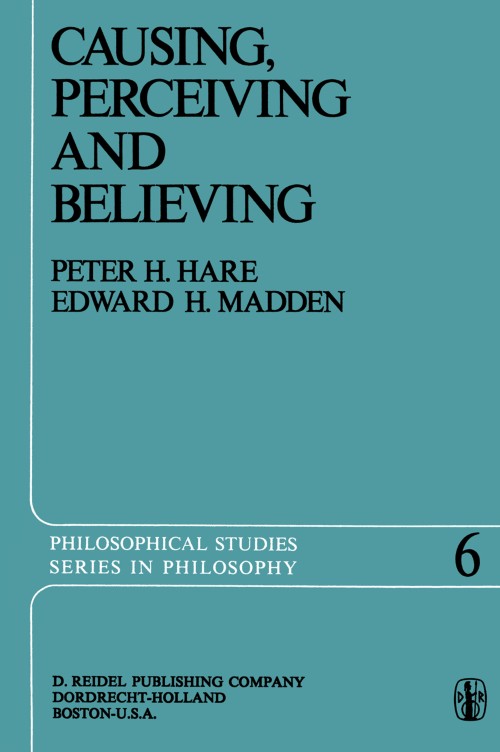
245 10|aCausing, Perceiving and Believing|h[electronic resource] :|bAn Examination of the Philosophy of C. J. Ducasse /|cedited by Peter H. Hare, Edward H. Madden.
250 |a1st ed. 1975.
264 1|aDordrecht :|bSpringer Netherlands :|bImprint: Springer,|c1975.
300 |a218 p.|bonline resource.
336 |atext|btxt|2rdacontent
337 |acomputer|bc|2rdamedia
338 |aonline resource|bcr|2rdacarrier
347 |atext file|bPDF|2rda
490 1 |aPhilosophical Studies Series,|x2542-8349 ;|v6
505 0 |aI. Introduction -- II. Causality and Necessity -- III. Human Agency -- IV. Sensing and Objective Reference -- V. Substance and the Mind-Body Relation -- VI. Propositions, Truth and Signs -- VII. Ethics and Education -- VIII. Aesthetics -- IX. Ethics of Belief -- X. Philosophy of Religion -- XI. Paranormal Phenomena -- XII. Meta-philosophy -- Bibliography of the Writings of C. J. Ducasse -- Index of Names -- Index of Subjects.
520 |aAlthough a succession of fashions swept the American philosophical scene, C. J. Ducasse was throughout his long career an effective practitioner of analytic philosophy in the classic tradition. As he explained in 1924 "[i]t is only with truths about such questions as the meaning of the term 'true', or 'real', or 'good', and the like . . . that philosophy is concerned. " Such truths are to be discovered inductively by comparing and analyzing concrete cases of the admittedly proper u/le . . . The pressing problems of philosophy are thus in my view primarily problems of def'mition, and moreover, problems of framing def'mitions which must be in formal terms, under penalty of not being otherwise understandable by or acceptable to one or another philosophical school, since the formal elements of thought and tp. ey only are common to all schools. These def'mitions, of course are not to be arbitrary; their relation to the facts of admittedly meaningful linguistic usage is the same as exists between any scientific hypothesis and the facts which it attempts to 1 construe.
532 8 |aAccessibility summary: This PDF is not accessible. It is based on scanned pages and does not support features such as screen reader compatibility or described non-text content (images, graphs etc). However, it likely supports searchable and selectable text based on OCR (Optical Character Recognition). Users with accessibility needs may not be able to use this content effectively. Please contact us at accessibilitysupport@springernature.com if you require assistance or an alternative format.
532 8 |aInaccessible, or known limited accessibility
532 8 |aNo reading system accessibility options actively disabled
532 8 |aPublisher contact for further accessibility information: accessibilitysupport@springernature.com
650 0|aPhilosophy, Modern.
650 14|aEarly Modern Philosophy.
700 1 |aHare, Peter H.|eeditor.|4edt|4http://id.loc.gov/vocabulary/relators/edt
700 1 |aMadden, Edward H.|eeditor.|4edt|4http://id.loc.gov/vocabulary/relators/edt
710 2 |aSpringerLink (Online service)
773 0 |tSpringer Nature eBook
776 08|iPrinted edition:|z9789027705631
776 08|iPrinted edition:|z9789401017879
776 08|iPrinted edition:|z9789401017886
830 0|aPhilosophical Studies Series,|x2542-8349 ;|v6
856 40|uhttps://doi.org/10.1007/978-94-010-1786-2
912 |aZDB-2-SHU
912 |aZDB-2-SXPR
912 |aZDB-2-BAE
950 |aHumanities, Social Sciences and Law (SpringerNature-11648)
950 |aPhilosophy and Religion (R0) (SpringerNature-43725)