

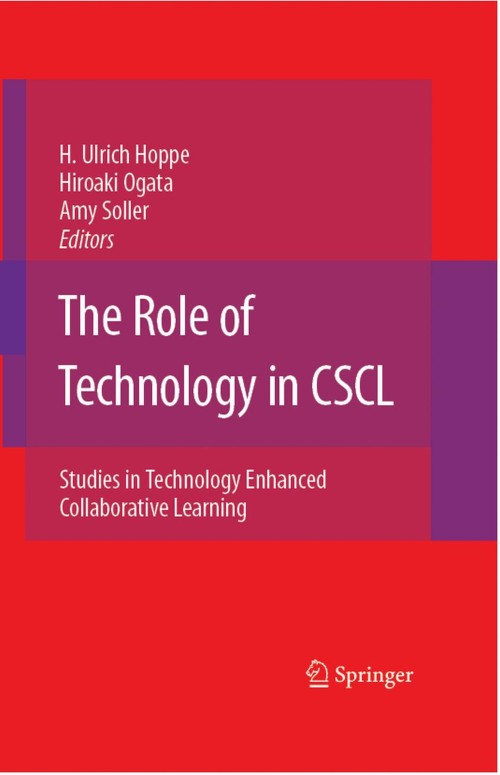
The Role of Technology in CSCL [electronic resource] : Studies in Technology Enhanced Collaborative Learning / edited by Ulrich H. Hoppe, H. Ogata, A. Soller.
Erişim Adresi
ISBN
9780387711362
Dil Kodu
İngilizce
Yer Numarası
DK/16395
Basım Bildirimi
1st ed. 2007.
Yayın Bilgisi
New York, NY : Springer US : Imprint: Springer, 2007.
Fiziksel Niteleme
XII, 196 p. online resource.
Dizi
Computer-Supported Collaborative Learning Series, 2543-0157 ; 9
İçindekiler Notu
Design, Modeling, and Analysis of Collaborative Learning -- Educational information technologies and collaborative learning -- Design, modeling, and analysis of collaborative learning -- Points of cooperation: Integrating cooperative learning into web-based courses -- A computational tool for lifelong learning: Experiencing breakdowns and understanding situations -- Modeling the process of collaborative learning -- An approach for coaching collaboration based on difference recognition and participation tracking -- Collaborative Tools in Educational Practice -- Collaborative tools in educational practice -- A Paiva, R. Prada Supporting collaborative activities in computer-integrated classrooms - the NIMIS Approach -- Designing a CSCL environment for experimental learning in a distance learning context -- Pupil communication during electronic collaborative projects:Integrating communication tools with communication scenarios -- Supporting awareness in distributed collaborative learning environments.
Özet, vb.
This book relates "new" information and communication technologies (ICT) to their specific teaching and learning functions, in particular how ICT is appropriated for and/or by educational or learning communities. We categorize consumer-oriented educational multimedia as established technologies, not of primary importance for innovative approaches to collaborative learning. Internet connections in schools and academic institutions are no longer new, though the learning culture originating from this technology may still lack a sufficiently rich definition. The technological "hot spots" of interest in this book are in turn: groupware or multi-user technologies such as group archives or synchronous co-construction environments, embedded interactive technologies in the spirit of ubiquitous computing, and modeling tools based on rich representations. Important features of these new technologies are: the move from individually oriented software tools to multi-user tools providing group awareness as well as facilities for the co-construction of knowledge; a definition of software use beyond a single piece of software towards multiple applications or tools which are not only technically interoperable but also task and role compliant in a social situation (social interoperability); high interactivity and creative potential with high productive activity and initiative on the part of the user (as opposed to the receptive scheme of usage of many educational multimedia applications); new kinds of peripherals in the spirit "of ubiquitous computing and augmented reality", which allow for redefining the borderline between physical action on the one hand and virtual or symbolic on the other.
Konu
Educational technology.
Learning, Psychology of.
Education __ Data processing.
User interfaces (Computer systems).
Human-computer interaction.
Digital Education and Educational Technology.
Instructional Psychology.
Computers and Education.
User Interfaces and Human Computer Interaction.
Learning, Psychology of.
Education __ Data processing.
User interfaces (Computer systems).
Human-computer interaction.
Digital Education and Educational Technology.
Instructional Psychology.
Computers and Education.
User Interfaces and Human Computer Interaction.
Diğer Yazarlar
Kurum Adı
Eseri Alıntıla
Referansları kullanmadan önce gözden geçirmeniz ve varsa gerekli düzeltmeleri yapmanız önerilir.
Dijital Kaynak
MARC Görünümü
LEADER 04978nam a22005775i 4500
001 815159
003 TR_AnAIT
005 20260130212008
007 cr nn 008mamaa
008 100301s2007 xxu| s |||| 0|eng d
020 |a9780387711362|9978-0-387-71136-2
024 7 |a10.1007/978-0-387-71136-2|2doi
041 |aeng
049 |aTürk Tarih Kurumu Kütüphanesi
050 4|aLB1028.3
072 7|aJNV|2bicssc
072 7|aEDU000000|2bisacsh
072 7|aJNV|2thema
082 04|a371.33|223
090 |aDK/16395
245 14|aThe Role of Technology in CSCL|h[electronic resource] :|bStudies in Technology Enhanced Collaborative Learning /|cedited by Ulrich H. Hoppe, H. Ogata, A. Soller.
250 |a1st ed. 2007.
264 1|aNew York, NY :|bSpringer US :|bImprint: Springer,|c2007.
300 |aXII, 196 p.|bonline resource.
336 |atext|btxt|2rdacontent
337 |acomputer|bc|2rdamedia
338 |aonline resource|bcr|2rdacarrier
347 |atext file|bPDF|2rda
490 1 |aComputer-Supported Collaborative Learning Series,|x2543-0157 ;|v9
505 0 |aDesign, Modeling, and Analysis of Collaborative Learning -- Educational information technologies and collaborative learning -- Design, modeling, and analysis of collaborative learning -- Points of cooperation: Integrating cooperative learning into web-based courses -- A computational tool for lifelong learning: Experiencing breakdowns and understanding situations -- Modeling the process of collaborative learning -- An approach for coaching collaboration based on difference recognition and participation tracking -- Collaborative Tools in Educational Practice -- Collaborative tools in educational practice -- A Paiva, R. Prada Supporting collaborative activities in computer-integrated classrooms - the NIMIS Approach -- Designing a CSCL environment for experimental learning in a distance learning context -- Pupil communication during electronic collaborative projects:Integrating communication tools with communication scenarios -- Supporting awareness in distributed collaborative learning environments.
520 |aThis book relates "new" information and communication technologies (ICT) to their specific teaching and learning functions, in particular how ICT is appropriated for and/or by educational or learning communities. We categorize consumer-oriented educational multimedia as established technologies, not of primary importance for innovative approaches to collaborative learning. Internet connections in schools and academic institutions are no longer new, though the learning culture originating from this technology may still lack a sufficiently rich definition. The technological "hot spots" of interest in this book are in turn: groupware or multi-user technologies such as group archives or synchronous co-construction environments, embedded interactive technologies in the spirit of ubiquitous computing, and modeling tools based on rich representations. Important features of these new technologies are: the move from individually oriented software tools to multi-user tools providing group awareness as well as facilities for the co-construction of knowledge; a definition of software use beyond a single piece of software towards multiple applications or tools which are not only technically interoperable but also task and role compliant in a social situation (social interoperability); high interactivity and creative potential with high productive activity and initiative on the part of the user (as opposed to the receptive scheme of usage of many educational multimedia applications); new kinds of peripherals in the spirit "of ubiquitous computing and augmented reality", which allow for redefining the borderline between physical action on the one hand and virtual or symbolic on the other.
650 0|aEducational technology.
650 0|aLearning, Psychology of.
650 0|aEducation|xData processing.
650 0|aUser interfaces (Computer systems).
650 0|aHuman-computer interaction.
650 14|aDigital Education and Educational Technology.
650 24|aInstructional Psychology.
650 24|aComputers and Education.
650 24|aUser Interfaces and Human Computer Interaction.
700 1 |aHoppe, Ulrich H.|eeditor.|4edt|4http://id.loc.gov/vocabulary/relators/edt
700 1 |aOgata, H.|eeditor.|4edt|4http://id.loc.gov/vocabulary/relators/edt
700 1 |aSoller, A.|eeditor.|4edt|4http://id.loc.gov/vocabulary/relators/edt
710 2 |aSpringerLink (Online service)
773 0 |tSpringer Nature eBook
776 08|iPrinted edition:|z9780387711355
776 08|iPrinted edition:|z9780387518282
776 08|iPrinted edition:|z9781441943842
830 0|aComputer-Supported Collaborative Learning Series,|x2543-0157 ;|v9
856 40|uhttps://doi.org/10.1007/978-0-387-71136-2
912 |aZDB-2-SHU
912 |aZDB-2-SXED
950 |aHumanities, Social Sciences and Law (SpringerNature-11648)
950 |aEducation (R0) (SpringerNature-43721)
001 815159
003 TR_AnAIT
005 20260130212008
007 cr nn 008mamaa
008 100301s2007 xxu| s |||| 0|eng d
020 |a9780387711362|9978-0-387-71136-2
024 7 |a10.1007/978-0-387-71136-2|2doi
041 |aeng
049 |aTürk Tarih Kurumu Kütüphanesi
050 4|aLB1028.3
072 7|aJNV|2bicssc
072 7|aEDU000000|2bisacsh
072 7|aJNV|2thema
082 04|a371.33|223
090 |aDK/16395
245 14|aThe Role of Technology in CSCL|h[electronic resource] :|bStudies in Technology Enhanced Collaborative Learning /|cedited by Ulrich H. Hoppe, H. Ogata, A. Soller.
250 |a1st ed. 2007.
264 1|aNew York, NY :|bSpringer US :|bImprint: Springer,|c2007.
300 |aXII, 196 p.|bonline resource.
336 |atext|btxt|2rdacontent
337 |acomputer|bc|2rdamedia
338 |aonline resource|bcr|2rdacarrier
347 |atext file|bPDF|2rda
490 1 |aComputer-Supported Collaborative Learning Series,|x2543-0157 ;|v9
505 0 |aDesign, Modeling, and Analysis of Collaborative Learning -- Educational information technologies and collaborative learning -- Design, modeling, and analysis of collaborative learning -- Points of cooperation: Integrating cooperative learning into web-based courses -- A computational tool for lifelong learning: Experiencing breakdowns and understanding situations -- Modeling the process of collaborative learning -- An approach for coaching collaboration based on difference recognition and participation tracking -- Collaborative Tools in Educational Practice -- Collaborative tools in educational practice -- A Paiva, R. Prada Supporting collaborative activities in computer-integrated classrooms - the NIMIS Approach -- Designing a CSCL environment for experimental learning in a distance learning context -- Pupil communication during electronic collaborative projects:Integrating communication tools with communication scenarios -- Supporting awareness in distributed collaborative learning environments.
520 |aThis book relates "new" information and communication technologies (ICT) to their specific teaching and learning functions, in particular how ICT is appropriated for and/or by educational or learning communities. We categorize consumer-oriented educational multimedia as established technologies, not of primary importance for innovative approaches to collaborative learning. Internet connections in schools and academic institutions are no longer new, though the learning culture originating from this technology may still lack a sufficiently rich definition. The technological "hot spots" of interest in this book are in turn: groupware or multi-user technologies such as group archives or synchronous co-construction environments, embedded interactive technologies in the spirit of ubiquitous computing, and modeling tools based on rich representations. Important features of these new technologies are: the move from individually oriented software tools to multi-user tools providing group awareness as well as facilities for the co-construction of knowledge; a definition of software use beyond a single piece of software towards multiple applications or tools which are not only technically interoperable but also task and role compliant in a social situation (social interoperability); high interactivity and creative potential with high productive activity and initiative on the part of the user (as opposed to the receptive scheme of usage of many educational multimedia applications); new kinds of peripherals in the spirit "of ubiquitous computing and augmented reality", which allow for redefining the borderline between physical action on the one hand and virtual or symbolic on the other.
650 0|aEducational technology.
650 0|aLearning, Psychology of.
650 0|aEducation|xData processing.
650 0|aUser interfaces (Computer systems).
650 0|aHuman-computer interaction.
650 14|aDigital Education and Educational Technology.
650 24|aInstructional Psychology.
650 24|aComputers and Education.
650 24|aUser Interfaces and Human Computer Interaction.
700 1 |aHoppe, Ulrich H.|eeditor.|4edt|4http://id.loc.gov/vocabulary/relators/edt
700 1 |aOgata, H.|eeditor.|4edt|4http://id.loc.gov/vocabulary/relators/edt
700 1 |aSoller, A.|eeditor.|4edt|4http://id.loc.gov/vocabulary/relators/edt
710 2 |aSpringerLink (Online service)
773 0 |tSpringer Nature eBook
776 08|iPrinted edition:|z9780387711355
776 08|iPrinted edition:|z9780387518282
776 08|iPrinted edition:|z9781441943842
830 0|aComputer-Supported Collaborative Learning Series,|x2543-0157 ;|v9
856 40|uhttps://doi.org/10.1007/978-0-387-71136-2
912 |aZDB-2-SHU
912 |aZDB-2-SXED
950 |aHumanities, Social Sciences and Law (SpringerNature-11648)
950 |aEducation (R0) (SpringerNature-43721)
Materyaller
Depodan talep edilen materyal sadece kütüphane içerisinde kullanılmaktadır.
Materyal dışarıya ödünç verilmemektedir.
Materyal dışarıya ödünç verilmemektedir.
