LEADER 03519nam a22005535i 4500
001 815162
003 TR_AnAIT
005 20260130212001
007 cr nn 008mamaa
008 100301s2006 ne | s |||| 0|eng d
020 |a9781402050121|9978-1-4020-5012-1
024 7 |a10.1007/978-1-4020-5012-7|2doi
041 |aeng
049 |aTürk Tarih Kurumu Kütüphanesi
050 4|aBC1-199
072 7|aHPL|2bicssc
072 7|aPHI011000|2bisacsh
072 7|aQDTL|2thema
082 04|a160|223
090 |aDK/16398
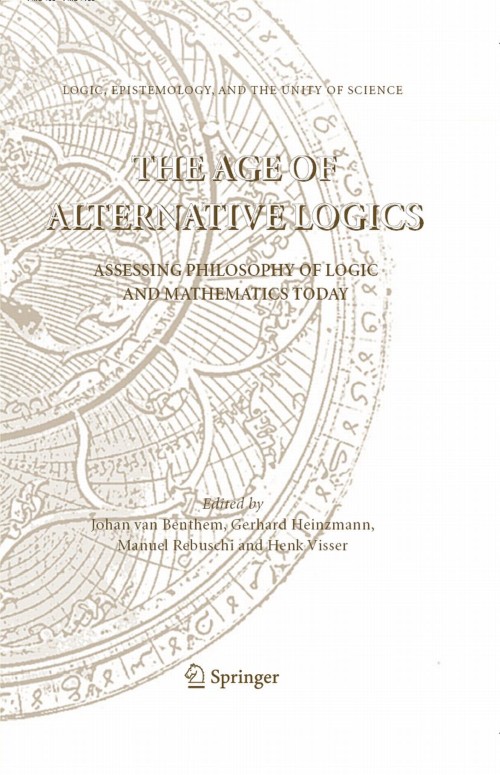
245 14|aThe Age of Alternative Logics|h[electronic resource] :|bAssessing Philosophy of Logic and Mathematics Today /|cedited by Johan van Benthem, Gerhard Heinzmann, Manuel Rebuschi, Henk Visser.
250 |a1st ed. 2006.
264 1|aDordrecht :|bSpringer Netherlands :|bImprint: Springer,|c2006.
300 |aX, 348 p.|bonline resource.
336 |atext|btxt|2rdacontent
337 |acomputer|bc|2rdamedia
338 |aonline resource|bcr|2rdacarrier
347 |atext file|bPDF|2rda
490 1 |aLogic, Epistemology, and the Unity of Science,|x2214-9783 ;|v3
505 0 |aFrom the contents Acknowledgments -- Part I Proof, Knowledge and Computation -- Part II Truth Values Beyond Bivalence -- Part III Category-Theoretic Structures -- Part IV Independence, Evaluation Games and Imperfect Information -- Part V Dialogue and Pragmatics -- Part VI Appendices. Index.
520 |aIn the last century developments in mathematics, philosophy, physics, computer science, economics and linguistics have proven important for the development of logic. There has been an influx of new ideas, concerns, and logical systems reflecting a great variety of reasoning tasks in the sciences. This volume reflects the multi-dimensional nature of the interplay between logic and science. It presents contributions from the world's leading scholars under the following headings: - Proof, Knowledge and Computation - Truth Values beyond Bivalence - Category-Theoretic Structures - Independence, Evaluation Games, and Imperfect Information - Dialogue and Pragmatics The contents exemplify the liveliness of modern perspectives on the philosophy of logic and mathematics and demonstrate the growth of the discipline. It describes new trends, possible developments for research and new issues not normally raised in the standard agenda of the philosophy of logic and mathematics. It transforms rigid classical partitions into a more open field for improvisation.
650 0|aLogic.
650 0|aMathematical logic.
650 0|aPhilosophy.
650 14|aLogic.
650 24|aMathematical Logic and Foundations.
650 24|aPhilosophy.
700 1 |avan Benthem, Johan.|eeditor.|4edt|4http://id.loc.gov/vocabulary/relators/edt
700 1 |aHeinzmann, Gerhard.|eeditor.|4edt|4http://id.loc.gov/vocabulary/relators/edt
700 1 |aRebuschi, Manuel.|eeditor.|4edt|4http://id.loc.gov/vocabulary/relators/edt
700 1 |aVisser, Henk.|eeditor.|4edt|4http://id.loc.gov/vocabulary/relators/edt
710 2 |aSpringerLink (Online service)
773 0 |tSpringer Nature eBook
776 08|iPrinted edition:|z9781402050114
776 08|iPrinted edition:|z9789048109524
776 08|iPrinted edition:|z9789048124855
830 0|aLogic, Epistemology, and the Unity of Science,|x2214-9783 ;|v3
856 40|uhttps://doi.org/10.1007/978-1-4020-5012-7
912 |aZDB-2-SHU
912 |aZDB-2-SXPR
950 |aHumanities, Social Sciences and Law (SpringerNature-11648)
950 |aPhilosophy and Religion (R0) (SpringerNature-43725)