

Interactions [electronic resource] : Mathematics, Physics and Philosophy, 1860-1930 / edited by Vincent F. Hendricks, Klaus F. Jørgensen, Jesper Lützen, Stig A. Pedersen.
Erişim Adresi
ISBN
9781402051951
Dil Kodu
İngilizce
Yer Numarası
DK/16399
Basım Bildirimi
1st ed. 2006.
Yayın Bilgisi
Dordrecht : Springer Netherlands : Imprint: Springer, 2006.
Fiziksel Niteleme
XIV, 338 p. online resource.
Dizi
Boston Studies in the Philosophy and History of Science, 2214-7942 ; 251
İçindekiler Notu
Kant, Helmholtz and the Determinacy of Physical Notes -- A Mechanical Image: Heinrich Hertz's Principles of Mechanics -- From Classical to Relativistic Mechanics: Electromagnetic Models of the Electron -- Enriques: Popularising Science and the Problems of Geometry -- Hilbert's Axiomatic Approach to the Foundations of Science—A Failed Research Program? -- The Space between Helmholtz and Einstein: Moritz Schlick on Spatial Intuition and the Foundations of Geometry -- Mathematical Structure, “World Structure,” and the Philosophical Turning-Point in Modern Physics -- Einstein's Allies and Enemies: Debating Relativity in Germany, 1916–1920 -- The Changing Concept of Matter in H.Weyl's Thought, 1918–1930 -- Why Does the Standard Measure Work in Statistical Mechanics?.
Özet, vb.
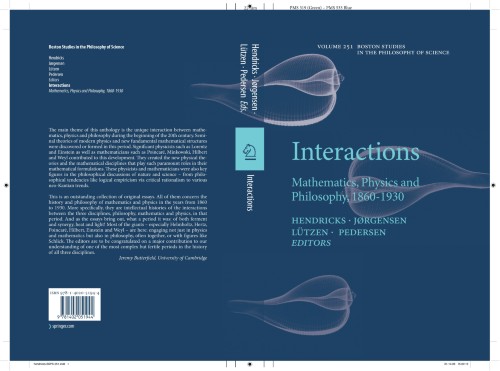
This is an outstanding collection of original essays. All of them concern the history and philosophy of mathematics and physics in the years from 1870 to 1930. More specifically, they are intellectual histories of the interactions between the three disciplines, philosophy, mathematics and physics, in that period. And as the essays bring out, what a period it was: of both ferment and synergy, heat and light! Most of the giants - especially Helmholtz, Hertz, Poincare, Hilbert, Einstein and Weyl - are here: engaging not just in physics and mathematics but also in philosophy, often together, or with figures like Schlick. The editors are to be congratulated on a major contribution to our understanding of one of the most complex but fertile periods in the history of all three disciplines. - Jeremy Butterfield, University of Cambridge This stimulating volume covers a wide range of topics which are of direct interest to anyone who thinks about the curious relation between mathematics and the natural world. Philosophers often pose interesting questions about the "dispensability" of mathematics to science. But they too often overlook the wealth of philosophical perplexities that can arise in detailed examples and case studies, both contemporary and historical. This volume refocuses our attention by addressing a number of topics connected to applied mathematics, any one of which is worthy of every philosopher’s attention. - James Robert Brown, University of Toronto What to make of neo-Kantianism in its hey-day, from 1840-1940? It was the most prolific of times and the most seminal, it was the most muddled and confused, it is philosophy working at its hardest with science and most damagingly against science. It is examined here episodically, as it engaged individual scientists: Helmholtz, , Hertz, Poincare, Minkowski, Hilbert,Eddington and Weyl. If Einstein is not in their number, he had to contend with their influence, and anyway he transformed their agenda. The essays on these figures are glinting in their focus and scholarship. Whatever one thinks of neo-Kantianism, this book is history and philosophy of science at its best: mathematically and physically informed, historically engaged, and philosophically driven. - Simon Saunders, University of Oxford Ten first-rate philosopher-historians probe insightfully into key conceptual questions of pre-quantum mathematical physics, from Helmholtz and Boltzmann, through Hertz and Lorentz, to Einstein, Weyl and Eddington, with an interesting aside on the rarely studied philosophy of Federigo Enriques. A rich and effective display of what the critical history of science can do for our understanding of scientific thought and its achievements. Roberto Torretti, University of Puerto Rico.
Konu
Philosophy.
Mathematics.
History.
Science __ History.
Science __ Philosophy.
Physics __ Philosophy.
Philosophy __ History.
Philosophy.
History of Mathematical Sciences.
History of Science.
Philosophy of Science.
Philosophical Foundations of Physics and Astronomy.
History of Philosophy.
Mathematics.
History.
Science __ History.
Science __ Philosophy.
Physics __ Philosophy.
Philosophy __ History.
Philosophy.
History of Mathematical Sciences.
History of Science.
Philosophy of Science.
Philosophical Foundations of Physics and Astronomy.
History of Philosophy.
Kurum Adı
Eseri Alıntıla
Referansları kullanmadan önce gözden geçirmeniz ve varsa gerekli düzeltmeleri yapmanız önerilir.
Dijital Kaynak
MARC Görünümü
LEADER 06028nam a22006375i 4500
001 815163
003 TR_AnAIT
005 20260130212000
007 cr nn 008mamaa
008 100301s2006 ne | s |||| 0|eng d
020 |a9781402051951|9978-1-4020-5195-1
024 7 |a10.1007/978-1-4020-5195-1|2doi
041 |aeng
049 |aTürk Tarih Kurumu Kütüphanesi
050 4|aB1-5802
072 7|aHP|2bicssc
072 7|aPHI000000|2bisacsh
072 7|aQD|2thema
082 04|a100|223
090 |aDK/16399
245 10|aInteractions|h[electronic resource] :|bMathematics, Physics and Philosophy, 1860-1930 /|cedited by Vincent F. Hendricks, Klaus F. Jørgensen, Jesper Lützen, Stig A. Pedersen.
250 |a1st ed. 2006.
264 1|aDordrecht :|bSpringer Netherlands :|bImprint: Springer,|c2006.
300 |aXIV, 338 p.|bonline resource.
336 |atext|btxt|2rdacontent
337 |acomputer|bc|2rdamedia
338 |aonline resource|bcr|2rdacarrier
347 |atext file|bPDF|2rda
490 1 |aBoston Studies in the Philosophy and History of Science,|x2214-7942 ;|v251
505 0 |aKant, Helmholtz and the Determinacy of Physical Notes -- A Mechanical Image: Heinrich Hertz's Principles of Mechanics -- From Classical to Relativistic Mechanics: Electromagnetic Models of the Electron -- Enriques: Popularising Science and the Problems of Geometry -- Hilbert's Axiomatic Approach to the Foundations of Science—A Failed Research Program? -- The Space between Helmholtz and Einstein: Moritz Schlick on Spatial Intuition and the Foundations of Geometry -- Mathematical Structure, “World Structure,” and the Philosophical Turning-Point in Modern Physics -- Einstein's Allies and Enemies: Debating Relativity in Germany, 1916–1920 -- The Changing Concept of Matter in H.Weyl's Thought, 1918–1930 -- Why Does the Standard Measure Work in Statistical Mechanics?.
520 |aThis is an outstanding collection of original essays. All of them concern the history and philosophy of mathematics and physics in the years from 1870 to 1930. More specifically, they are intellectual histories of the interactions between the three disciplines, philosophy, mathematics and physics, in that period. And as the essays bring out, what a period it was: of both ferment and synergy, heat and light! Most of the giants - especially Helmholtz, Hertz, Poincare, Hilbert, Einstein and Weyl - are here: engaging not just in physics and mathematics but also in philosophy, often together, or with figures like Schlick. The editors are to be congratulated on a major contribution to our understanding of one of the most complex but fertile periods in the history of all three disciplines. - Jeremy Butterfield, University of Cambridge This stimulating volume covers a wide range of topics which are of direct interest to anyone who thinks about the curious relation between mathematics and the natural world. Philosophers often pose interesting questions about the "dispensability" of mathematics to science. But they too often overlook the wealth of philosophical perplexities that can arise in detailed examples and case studies, both contemporary and historical. This volume refocuses our attention by addressing a number of topics connected to applied mathematics, any one of which is worthy of every philosopher’s attention. - James Robert Brown, University of Toronto What to make of neo-Kantianism in its hey-day, from 1840-1940? It was the most prolific of times and the most seminal, it was the most muddled and confused, it is philosophy working at its hardest with science and most damagingly against science. It is examined here episodically, as it engaged individual scientists: Helmholtz, , Hertz, Poincare, Minkowski, Hilbert,Eddington and Weyl. If Einstein is not in their number, he had to contend with their influence, and anyway he transformed their agenda. The essays on these figures are glinting in their focus and scholarship. Whatever one thinks of neo-Kantianism, this book is history and philosophy of science at its best: mathematically and physically informed, historically engaged, and philosophically driven. - Simon Saunders, University of Oxford Ten first-rate philosopher-historians probe insightfully into key conceptual questions of pre-quantum mathematical physics, from Helmholtz and Boltzmann, through Hertz and Lorentz, to Einstein, Weyl and Eddington, with an interesting aside on the rarely studied philosophy of Federigo Enriques. A rich and effective display of what the critical history of science can do for our understanding of scientific thought and its achievements. Roberto Torretti, University of Puerto Rico.
650 0|aPhilosophy.
650 0|aMathematics.
650 0|aHistory.
650 0|aScience|xHistory.
650 0|aScience|xPhilosophy.
650 0|aPhysics|xPhilosophy.
650 0|aPhilosophy|xHistory.
650 14|aPhilosophy.
650 24|aHistory of Mathematical Sciences.
650 24|aHistory of Science.
650 24|aPhilosophy of Science.
650 24|aPhilosophical Foundations of Physics and Astronomy.
650 24|aHistory of Philosophy.
700 1 |aHendricks, Vincent F.|eeditor.|4edt|4http://id.loc.gov/vocabulary/relators/edt
700 1 |aJørgensen, Klaus F.|eeditor.|4edt|4http://id.loc.gov/vocabulary/relators/edt
700 1 |aLützen, Jesper.|eeditor.|4edt|4http://id.loc.gov/vocabulary/relators/edt
700 1 |aPedersen, Stig A.|eeditor.|4edt|4http://id.loc.gov/vocabulary/relators/edt
710 2 |aSpringerLink (Online service)
773 0 |tSpringer Nature eBook
776 08|iPrinted edition:|z9781402051944
776 08|iPrinted edition:|z9789048110247
776 08|iPrinted edition:|z9789048173068
830 0|aBoston Studies in the Philosophy and History of Science,|x2214-7942 ;|v251
856 40|uhttps://doi.org/10.1007/978-1-4020-5195-1
912 |aZDB-2-SHU
912 |aZDB-2-SXPR
950 |aHumanities, Social Sciences and Law (SpringerNature-11648)
950 |aPhilosophy and Religion (R0) (SpringerNature-43725)
001 815163
003 TR_AnAIT
005 20260130212000
007 cr nn 008mamaa
008 100301s2006 ne | s |||| 0|eng d
020 |a9781402051951|9978-1-4020-5195-1
024 7 |a10.1007/978-1-4020-5195-1|2doi
041 |aeng
049 |aTürk Tarih Kurumu Kütüphanesi
050 4|aB1-5802
072 7|aHP|2bicssc
072 7|aPHI000000|2bisacsh
072 7|aQD|2thema
082 04|a100|223
090 |aDK/16399
245 10|aInteractions|h[electronic resource] :|bMathematics, Physics and Philosophy, 1860-1930 /|cedited by Vincent F. Hendricks, Klaus F. Jørgensen, Jesper Lützen, Stig A. Pedersen.
250 |a1st ed. 2006.
264 1|aDordrecht :|bSpringer Netherlands :|bImprint: Springer,|c2006.
300 |aXIV, 338 p.|bonline resource.
336 |atext|btxt|2rdacontent
337 |acomputer|bc|2rdamedia
338 |aonline resource|bcr|2rdacarrier
347 |atext file|bPDF|2rda
490 1 |aBoston Studies in the Philosophy and History of Science,|x2214-7942 ;|v251
505 0 |aKant, Helmholtz and the Determinacy of Physical Notes -- A Mechanical Image: Heinrich Hertz's Principles of Mechanics -- From Classical to Relativistic Mechanics: Electromagnetic Models of the Electron -- Enriques: Popularising Science and the Problems of Geometry -- Hilbert's Axiomatic Approach to the Foundations of Science—A Failed Research Program? -- The Space between Helmholtz and Einstein: Moritz Schlick on Spatial Intuition and the Foundations of Geometry -- Mathematical Structure, “World Structure,” and the Philosophical Turning-Point in Modern Physics -- Einstein's Allies and Enemies: Debating Relativity in Germany, 1916–1920 -- The Changing Concept of Matter in H.Weyl's Thought, 1918–1930 -- Why Does the Standard Measure Work in Statistical Mechanics?.
520 |aThis is an outstanding collection of original essays. All of them concern the history and philosophy of mathematics and physics in the years from 1870 to 1930. More specifically, they are intellectual histories of the interactions between the three disciplines, philosophy, mathematics and physics, in that period. And as the essays bring out, what a period it was: of both ferment and synergy, heat and light! Most of the giants - especially Helmholtz, Hertz, Poincare, Hilbert, Einstein and Weyl - are here: engaging not just in physics and mathematics but also in philosophy, often together, or with figures like Schlick. The editors are to be congratulated on a major contribution to our understanding of one of the most complex but fertile periods in the history of all three disciplines. - Jeremy Butterfield, University of Cambridge This stimulating volume covers a wide range of topics which are of direct interest to anyone who thinks about the curious relation between mathematics and the natural world. Philosophers often pose interesting questions about the "dispensability" of mathematics to science. But they too often overlook the wealth of philosophical perplexities that can arise in detailed examples and case studies, both contemporary and historical. This volume refocuses our attention by addressing a number of topics connected to applied mathematics, any one of which is worthy of every philosopher’s attention. - James Robert Brown, University of Toronto What to make of neo-Kantianism in its hey-day, from 1840-1940? It was the most prolific of times and the most seminal, it was the most muddled and confused, it is philosophy working at its hardest with science and most damagingly against science. It is examined here episodically, as it engaged individual scientists: Helmholtz, , Hertz, Poincare, Minkowski, Hilbert,Eddington and Weyl. If Einstein is not in their number, he had to contend with their influence, and anyway he transformed their agenda. The essays on these figures are glinting in their focus and scholarship. Whatever one thinks of neo-Kantianism, this book is history and philosophy of science at its best: mathematically and physically informed, historically engaged, and philosophically driven. - Simon Saunders, University of Oxford Ten first-rate philosopher-historians probe insightfully into key conceptual questions of pre-quantum mathematical physics, from Helmholtz and Boltzmann, through Hertz and Lorentz, to Einstein, Weyl and Eddington, with an interesting aside on the rarely studied philosophy of Federigo Enriques. A rich and effective display of what the critical history of science can do for our understanding of scientific thought and its achievements. Roberto Torretti, University of Puerto Rico.
650 0|aPhilosophy.
650 0|aMathematics.
650 0|aHistory.
650 0|aScience|xHistory.
650 0|aScience|xPhilosophy.
650 0|aPhysics|xPhilosophy.
650 0|aPhilosophy|xHistory.
650 14|aPhilosophy.
650 24|aHistory of Mathematical Sciences.
650 24|aHistory of Science.
650 24|aPhilosophy of Science.
650 24|aPhilosophical Foundations of Physics and Astronomy.
650 24|aHistory of Philosophy.
700 1 |aHendricks, Vincent F.|eeditor.|4edt|4http://id.loc.gov/vocabulary/relators/edt
700 1 |aJørgensen, Klaus F.|eeditor.|4edt|4http://id.loc.gov/vocabulary/relators/edt
700 1 |aLützen, Jesper.|eeditor.|4edt|4http://id.loc.gov/vocabulary/relators/edt
700 1 |aPedersen, Stig A.|eeditor.|4edt|4http://id.loc.gov/vocabulary/relators/edt
710 2 |aSpringerLink (Online service)
773 0 |tSpringer Nature eBook
776 08|iPrinted edition:|z9781402051944
776 08|iPrinted edition:|z9789048110247
776 08|iPrinted edition:|z9789048173068
830 0|aBoston Studies in the Philosophy and History of Science,|x2214-7942 ;|v251
856 40|uhttps://doi.org/10.1007/978-1-4020-5195-1
912 |aZDB-2-SHU
912 |aZDB-2-SXPR
950 |aHumanities, Social Sciences and Law (SpringerNature-11648)
950 |aPhilosophy and Religion (R0) (SpringerNature-43725)
Materyaller
Depodan talep edilen materyal sadece kütüphane içerisinde kullanılmaktadır.
Materyal dışarıya ödünç verilmemektedir.
Materyal dışarıya ödünç verilmemektedir.
