LEADER 03321nam a22005535i 4500
001 815164
003 TR_AnAIT
005 20260130211959
007 cr nn 008mamaa
008 100301s2007 ne | s |||| 0|eng d
020 |a9781402052651|9978-1-4020-5265-1
024 7 |a10.1007/978-1-4020-5265-1|2doi
041 |aeng
049 |aTürk Tarih Kurumu Kütüphanesi
050 4|aBH1-301
072 7|aHPN|2bicssc
072 7|aPHI001000|2bisacsh
072 7|aQDTN|2thema
082 04|a111.85|223
090 |aDK/16400
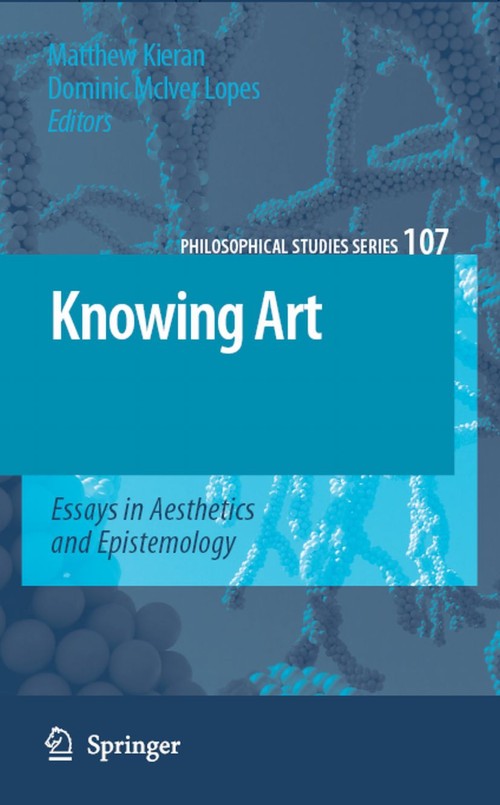
245 10|aKnowing Art|h[electronic resource] :|bEssays in Aesthetics and Epistemology /|cedited by Matthew Kieran, Dominic McIver Lopes.
250 |a1st ed. 2007.
264 1|aDordrecht :|bSpringer Netherlands :|bImprint: Springer,|c2007.
300 |aXXIV, 167 p.|bonline resource.
336 |atext|btxt|2rdacontent
337 |acomputer|bc|2rdamedia
338 |aonline resource|bcr|2rdacarrier
347 |atext file|bPDF|2rda
490 1 |aPhilosophical Studies Series,|x2542-8349 ;|v107
505 0 |aKnowing Through Art -- Knowing Content in the Visual Arts -- Pictures, Knowledge, and Power: The Case of T. J. Clark -- Narrating the Truth (More or Less) -- Fiction and Psychological Insight -- Art and Modal Knowledge -- Charley’s World: Narratives of Aesthetic Experience -- Knowing About Art -- Really Bad Taste -- Solving the Puzzle of Aesthetic Testimony -- Critical Compatibilism -- Critical Reasoning and Critical Perception.
520 |aArtworks potentially convey two kinds of knowledge. They obviously afford knowledge of art itself, and they also afford general empirical knowledge, especially knowledge of human psychology and value. Knowing Art collects ten original essays written by leading philosophers who distill and build upon recent work at the intersection of aesthetics and epistemology. Specific topics addressed include the objectivity of critical knowledge, the quality of critical testimony, the roles of principles and perception in critical reasoning, phenomenal knowledge of what a work of art is like, the acquisition of factual information and psychological understanding from fictions, and the limits of images as sources of historical evidence. In addressing these topics, the volume also explores the challenges that art poses for theories of knowledge as well as the challenges that artistic knowledge poses to traditional views about art.
650 0|aAesthetics.
650 0|aKnowledge, Theory of.
650 0|aEthics.
650 0|aArts.
650 14|aAesthetics.
650 24|aEpistemology.
650 24|aMoral Philosophy and Applied Ethics.
650 24|aArts.
700 1 |aKieran, Matthew.|eeditor.|4edt|4http://id.loc.gov/vocabulary/relators/edt
700 1 |aMcIver Lopes, Dominic.|eeditor.|4edt|4http://id.loc.gov/vocabulary/relators/edt
710 2 |aSpringerLink (Online service)
773 0 |tSpringer Nature eBook
776 08|iPrinted edition:|z9781402052644
776 08|iPrinted edition:|z9781402067853
776 08|iPrinted edition:|z9789048110490
830 0|aPhilosophical Studies Series,|x2542-8349 ;|v107
856 40|uhttps://doi.org/10.1007/978-1-4020-5265-1
912 |aZDB-2-SHU
912 |aZDB-2-SXPR
950 |aHumanities, Social Sciences and Law (SpringerNature-11648)
950 |aPhilosophy and Religion (R0) (SpringerNature-43725)