

Constructivity and Computability in Historical and Philosophical Perspective [electronic resource] / edited by Jacques Dubucs, Michel Bourdeau.
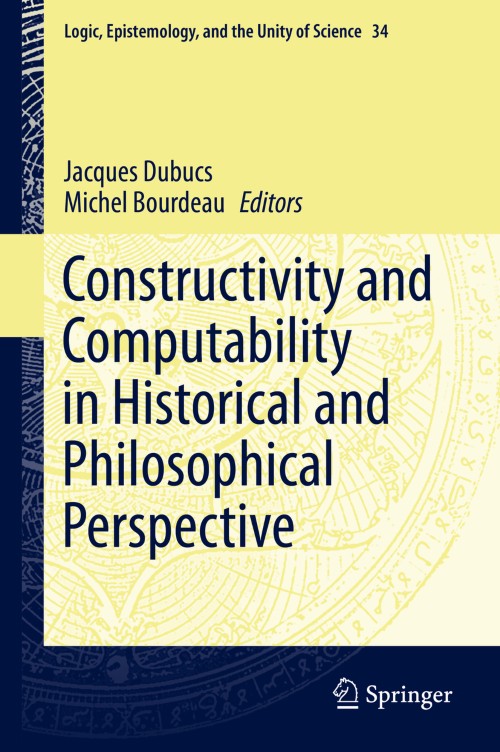
Erişim Adresi
ISBN
9789401792172
Dil Kodu
İngilizce
Yer Numarası
DK/16421
Basım Bildirimi
1st ed. 2014.
Yayın Bilgisi
Dordrecht : Springer Netherlands : Imprint: Springer, 2014.
Fiziksel Niteleme
XI, 214 p. 1 illus. online resource.
Dizi
Logic, Epistemology, and the Unity of Science, 2214-9783 ; 34
İçindekiler Notu
Preface; Jacques Dubucs and Michel Bourdeau -- Chapter 1. Constructive Recursive Functions, Church’s Thesis, and Brouwer’s Theory of the Creating Subject: Afterthoughts on a Parisian Joint Session; Göran Sundholm -- Chapter 2. The developments of the concept of machine computability from 1936 to the 1960s; Jean Mosconi -- Chapter 3. Kolmogorov Complexity in perspective, Part I: Information Theory and Randomness; Marie Ferbus-Zanda and Serge Grigorieff -- Chapter 4. Kolmogorov Complexity in perspective, Part II: Classification, Information Processing and Duality; Marie Ferbus-Zanda -- Chapter 5. Proof-theoretic semantics and feasibility; Jean Fichot -- Chapter 6. Recursive functions and constructive mathematics; Thierry Coquand -- Chapter 7. Gödel and intuitionism; Mark van Atten.
Özet, vb.
Ranging from Alan Turing’s seminal 1936 paper to the latest work on Kolmogorov complexity and linear logic, this comprehensive new work clarifies the relationship between computability on the one hand and constructivity on the other. The authors argue that even though constructivists have largely shed Brouwer’s solipsistic attitude to logic, there remain points of disagreement to this day. Focusing on the growing pains computability experienced as it was forced to address the demands of rapidly expanding applications, the content maps the developments following Turing’s ground-breaking linkage of computation and the machine, the resulting birth of complexity theory, the innovations of Kolmogorov complexity, and resolving the dissonances between proof theoretical semantics and canonical proof feasibility. Finally, it explores one of the most fundamental questions concerning the interface between constructivity and computability: whether the theory of recursive functions is needed for a rigorous development of constructive mathematics. This volume contributes to the unity of science by overcoming disunities rather than offering an overarching framework. It posits that computability’s adoption of a classical, ontological point of view kept these imperatives separated. In studying the relationship between the two, it is a vital step forward in overcoming the disagreements and misunderstandings which stand in the way of a unifying view of logic.
Konu
Logic.
Computer science.
Mathematical logic.
Logic.
Theory of Computation.
Mathematical Logic and Foundations.
Computer science.
Mathematical logic.
Logic.
Theory of Computation.
Mathematical Logic and Foundations.
Diğer Yazarlar
Kurum Adı
Eseri Alıntıla
Referansları kullanmadan önce gözden geçirmeniz ve varsa gerekli düzeltmeleri yapmanız önerilir.
Dijital Kaynak
MARC Görünümü
LEADER 04238nam a22005295i 4500
001 815185
003 TR_AnAIT
005 20260130211832
007 cr nn 008mamaa
008 140827s2014 ne | s |||| 0|eng d
020 |a9789401792172|9978-94-017-9217-2
024 7 |a10.1007/978-94-017-9217-2|2doi
041 |aeng
049 |aTürk Tarih Kurumu Kütüphanesi
050 4|aBC1-199
072 7|aHPL|2bicssc
072 7|aPHI011000|2bisacsh
072 7|aQDTL|2thema
082 04|a160|223
090 |aDK/16421
245 10|aConstructivity and Computability in Historical and Philosophical Perspective|h[electronic resource] /|cedited by Jacques Dubucs, Michel Bourdeau.
250 |a1st ed. 2014.
264 1|aDordrecht :|bSpringer Netherlands :|bImprint: Springer,|c2014.
300 |aXI, 214 p. 1 illus.|bonline resource.
336 |atext|btxt|2rdacontent
337 |acomputer|bc|2rdamedia
338 |aonline resource|bcr|2rdacarrier
347 |atext file|bPDF|2rda
490 1 |aLogic, Epistemology, and the Unity of Science,|x2214-9783 ;|v34
505 0 |aPreface; Jacques Dubucs and Michel Bourdeau -- Chapter 1. Constructive Recursive Functions, Church’s Thesis, and Brouwer’s Theory of the Creating Subject: Afterthoughts on a Parisian Joint Session; Göran Sundholm -- Chapter 2. The developments of the concept of machine computability from 1936 to the 1960s; Jean Mosconi -- Chapter 3. Kolmogorov Complexity in perspective, Part I: Information Theory and Randomness; Marie Ferbus-Zanda and Serge Grigorieff -- Chapter 4. Kolmogorov Complexity in perspective, Part II: Classification, Information Processing and Duality; Marie Ferbus-Zanda -- Chapter 5. Proof-theoretic semantics and feasibility; Jean Fichot -- Chapter 6. Recursive functions and constructive mathematics; Thierry Coquand -- Chapter 7. Gödel and intuitionism; Mark van Atten.
520 |aRanging from Alan Turing’s seminal 1936 paper to the latest work on Kolmogorov complexity and linear logic, this comprehensive new work clarifies the relationship between computability on the one hand and constructivity on the other. The authors argue that even though constructivists have largely shed Brouwer’s solipsistic attitude to logic, there remain points of disagreement to this day. Focusing on the growing pains computability experienced as it was forced to address the demands of rapidly expanding applications, the content maps the developments following Turing’s ground-breaking linkage of computation and the machine, the resulting birth of complexity theory, the innovations of Kolmogorov complexity, and resolving the dissonances between proof theoretical semantics and canonical proof feasibility. Finally, it explores one of the most fundamental questions concerning the interface between constructivity and computability: whether the theory of recursive functions is needed for a rigorous development of constructive mathematics. This volume contributes to the unity of science by overcoming disunities rather than offering an overarching framework. It posits that computability’s adoption of a classical, ontological point of view kept these imperatives separated. In studying the relationship between the two, it is a vital step forward in overcoming the disagreements and misunderstandings which stand in the way of a unifying view of logic.
650 0|aLogic.
650 0|aComputer science.
650 0|aMathematical logic.
650 14|aLogic.
650 24|aTheory of Computation.
650 24|aMathematical Logic and Foundations.
700 1 |aDubucs, Jacques.|eeditor.|4edt|4http://id.loc.gov/vocabulary/relators/edt
700 1 |aBourdeau, Michel.|eeditor.|4edt|4http://id.loc.gov/vocabulary/relators/edt
710 2 |aSpringerLink (Online service)
773 0 |tSpringer Nature eBook
776 08|iPrinted edition:|z9789401792165
776 08|iPrinted edition:|z9789401792189
776 08|iPrinted edition:|z9789402407075
830 0|aLogic, Epistemology, and the Unity of Science,|x2214-9783 ;|v34
856 40|uhttps://doi.org/10.1007/978-94-017-9217-2
912 |aZDB-2-SHU
912 |aZDB-2-SXPR
950 |aHumanities, Social Sciences and Law (SpringerNature-11648)
950 |aPhilosophy and Religion (R0) (SpringerNature-43725)
001 815185
003 TR_AnAIT
005 20260130211832
007 cr nn 008mamaa
008 140827s2014 ne | s |||| 0|eng d
020 |a9789401792172|9978-94-017-9217-2
024 7 |a10.1007/978-94-017-9217-2|2doi
041 |aeng
049 |aTürk Tarih Kurumu Kütüphanesi
050 4|aBC1-199
072 7|aHPL|2bicssc
072 7|aPHI011000|2bisacsh
072 7|aQDTL|2thema
082 04|a160|223
090 |aDK/16421
245 10|aConstructivity and Computability in Historical and Philosophical Perspective|h[electronic resource] /|cedited by Jacques Dubucs, Michel Bourdeau.
250 |a1st ed. 2014.
264 1|aDordrecht :|bSpringer Netherlands :|bImprint: Springer,|c2014.
300 |aXI, 214 p. 1 illus.|bonline resource.
336 |atext|btxt|2rdacontent
337 |acomputer|bc|2rdamedia
338 |aonline resource|bcr|2rdacarrier
347 |atext file|bPDF|2rda
490 1 |aLogic, Epistemology, and the Unity of Science,|x2214-9783 ;|v34
505 0 |aPreface; Jacques Dubucs and Michel Bourdeau -- Chapter 1. Constructive Recursive Functions, Church’s Thesis, and Brouwer’s Theory of the Creating Subject: Afterthoughts on a Parisian Joint Session; Göran Sundholm -- Chapter 2. The developments of the concept of machine computability from 1936 to the 1960s; Jean Mosconi -- Chapter 3. Kolmogorov Complexity in perspective, Part I: Information Theory and Randomness; Marie Ferbus-Zanda and Serge Grigorieff -- Chapter 4. Kolmogorov Complexity in perspective, Part II: Classification, Information Processing and Duality; Marie Ferbus-Zanda -- Chapter 5. Proof-theoretic semantics and feasibility; Jean Fichot -- Chapter 6. Recursive functions and constructive mathematics; Thierry Coquand -- Chapter 7. Gödel and intuitionism; Mark van Atten.
520 |aRanging from Alan Turing’s seminal 1936 paper to the latest work on Kolmogorov complexity and linear logic, this comprehensive new work clarifies the relationship between computability on the one hand and constructivity on the other. The authors argue that even though constructivists have largely shed Brouwer’s solipsistic attitude to logic, there remain points of disagreement to this day. Focusing on the growing pains computability experienced as it was forced to address the demands of rapidly expanding applications, the content maps the developments following Turing’s ground-breaking linkage of computation and the machine, the resulting birth of complexity theory, the innovations of Kolmogorov complexity, and resolving the dissonances between proof theoretical semantics and canonical proof feasibility. Finally, it explores one of the most fundamental questions concerning the interface between constructivity and computability: whether the theory of recursive functions is needed for a rigorous development of constructive mathematics. This volume contributes to the unity of science by overcoming disunities rather than offering an overarching framework. It posits that computability’s adoption of a classical, ontological point of view kept these imperatives separated. In studying the relationship between the two, it is a vital step forward in overcoming the disagreements and misunderstandings which stand in the way of a unifying view of logic.
650 0|aLogic.
650 0|aComputer science.
650 0|aMathematical logic.
650 14|aLogic.
650 24|aTheory of Computation.
650 24|aMathematical Logic and Foundations.
700 1 |aDubucs, Jacques.|eeditor.|4edt|4http://id.loc.gov/vocabulary/relators/edt
700 1 |aBourdeau, Michel.|eeditor.|4edt|4http://id.loc.gov/vocabulary/relators/edt
710 2 |aSpringerLink (Online service)
773 0 |tSpringer Nature eBook
776 08|iPrinted edition:|z9789401792165
776 08|iPrinted edition:|z9789401792189
776 08|iPrinted edition:|z9789402407075
830 0|aLogic, Epistemology, and the Unity of Science,|x2214-9783 ;|v34
856 40|uhttps://doi.org/10.1007/978-94-017-9217-2
912 |aZDB-2-SHU
912 |aZDB-2-SXPR
950 |aHumanities, Social Sciences and Law (SpringerNature-11648)
950 |aPhilosophy and Religion (R0) (SpringerNature-43725)
Materyaller
Depodan talep edilen materyal sadece kütüphane içerisinde kullanılmaktadır.
Materyal dışarıya ödünç verilmemektedir.
Materyal dışarıya ödünç verilmemektedir.
