LEADER 03244nam a22005775i 4500
001 815186
003 TR_AnAIT
005 20260130211831
007 cr nn 008mamaa
008 130125s2003 ne | s |||| 0|eng d
020 |a9789401707978|9978-94-017-0797-8
024 7 |a10.1007/978-94-017-0797-8|2doi
041 |aeng
049 |aTürk Tarih Kurumu Kütüphanesi
050 4|aBJ1-1725
072 7|aHPQ|2bicssc
072 7|aPHI005000|2bisacsh
072 7|aQDTQ|2thema
082 04|a170|223
090 |aDK/16422
100 1 |aDubbink, W.|eauthor.|4aut|4http://id.loc.gov/vocabulary/relators/aut
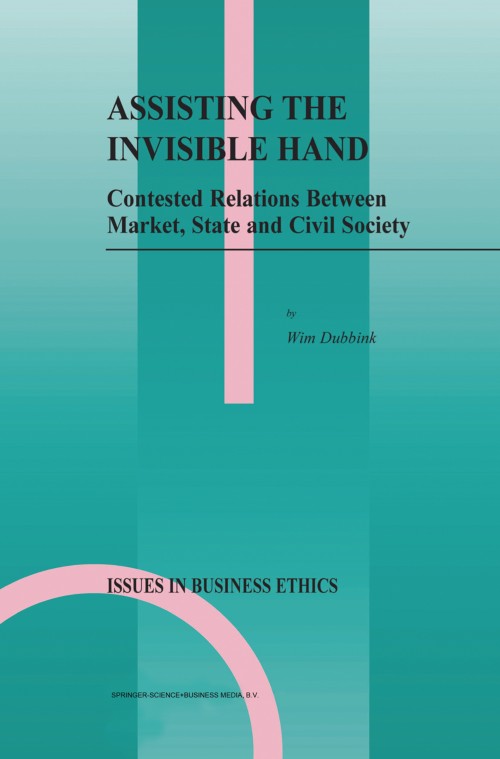
245 10|aAssisting the Invisible Hand|h[electronic resource] :|bContested Relations Between Market, State and Civil Society /|cby W. Dubbink.
250 |a1st ed. 2003.
264 1|aDordrecht :|bSpringer Netherlands :|bImprint: Springer,|c2003.
300 |aXV, 229 p.|bonline resource.
336 |atext|btxt|2rdacontent
337 |acomputer|bc|2rdamedia
338 |aonline resource|bcr|2rdacarrier
347 |atext file|bPDF|2rda
490 1 |aIssues in Business Ethics,|x2215-1680 ;|v18
505 0 |a1 Introduction -- 2 Economic Theory: The Market as Problem and Solution -- 3 Administrative Theory: From Overload to Taking Responsibility -- 4 Political Philosophy: Salvation by Civil Society? -- 5 State, Market and Civil Society in a New Configuration.
520 |aModern liberal democracies are troubled by public problems in which the free market is no innocent bystander. It is therefore generally acknowledged that the market must be controlled. Assisting the Invisible Hand is an investigation into contemporary thinking on controlling the market, especially with regard to the problem of dealing with environmental issues. The implicit modes of thinking in economics, political philosophy and administrative theory are uncovered and criticized. The book contributes to contemporary insight by arguing that the issue of market control must be addressed in terms of the relations between state, market and civil society. Furthermore, since controlling the market is so closely related to the ideals of liberal democracy, this book stresses the normative dimensions of the market control issue. The position adopted by the book is that the market cannot be controlled by the state alone. This responsibility should be shared between state, market and civil society.
650 0|aEthics.
650 0|aPhilosophy.
650 0|aEnvironmental management.
650 0|aEnvironmental economics.
650 0|aManagement.
650 14|aMoral Philosophy and Applied Ethics.
650 24|aPhilosophy.
650 24|aEnvironmental Management.
650 24|aEnvironmental Economics.
650 24|aManagement.
710 2 |aSpringerLink (Online service)
773 0 |tSpringer Nature eBook
776 08|iPrinted edition:|z9781402014444
776 08|iPrinted edition:|z9789048163533
776 08|iPrinted edition:|z9789401707985
830 0|aIssues in Business Ethics,|x2215-1680 ;|v18
856 40|uhttps://doi.org/10.1007/978-94-017-0797-8
912 |aZDB-2-SHU
912 |aZDB-2-SXPR
912 |aZDB-2-BAE
950 |aHumanities, Social Sciences and Law (SpringerNature-11648)
950 |aPhilosophy and Religion (R0) (SpringerNature-43725)