

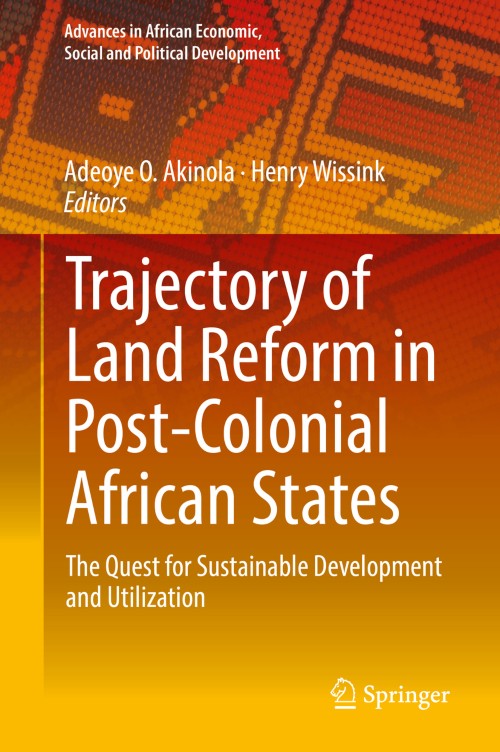
Trajectory of Land Reform in Post-Colonial African States [electronic resource] : The Quest for Sustainable Development and Utilization / edited by Adeoye O. Akinola, Henry Wissink.
Erişim Adresi
ISBN
9783319787015
Dil Kodu
İngilizce
Yer Numarası
DK/16453
Basım Bildirimi
1st ed. 2019.
Yayın Bilgisi
Cham : Springer International Publishing : Imprint: Springer, 2019.
Fiziksel Niteleme
XVI, 178 p. 2 illus., 1 illus. in color. online resource.
Dizi
Advances in African Economic, Social and Political Development, 2198-7270
İçindekiler Notu
Chapter 1: Introduction: The Political Economy of Land in Africa -- Chapter 2: At A Crossroads: Land Reform and Democratic Contestation in Zimbabwe -- Chapter 3: Food and National Security: A Study of the Interconnections -- Chapter 4: Transforming the Bodi from Pastoralists to Outgrowers: Land and State Capitalism in South Omo and Southwest Ethiopia -- Chapter 5: South African Land Claim Processing: A Case of Street-Level Bureaucracy in the KwaZulu-Natal Regional Land Claims Commission -- Chapter 6: Land Policies in Africa: A Case Study of Nigeria and Zambia -- Chapter 7: Land Governance in the Context of Legal Pluralism: Comparative Cases of Kenya, Ghana and South Africa -- Chapter 8: Rethinking Women Land Rights: Nigeria and South Africa in Comparison -- Chapter 9: The Chasm Between Sexes in Accessing Land and its Produce: The Case of Rural Women in Mwenezi District, Masvingo Province, Zimbabwe -- Chapter 10: Land Conflicts in Southern Ghana: A Reflection of Multiple Ownership ofLand and Usufruct Rights to Land Use -- Chapter 11: Land Tenure and Family Conflict in Rwanda: Case of Musanze District -- Chapter 12: Land Reform in Africa: Towards Resource Utilization and Sustainability. .
Özet, vb.
This book is an examination of post-colonial land reforms across various African states. One of the decisive contradictions of colonialism in Africa was the distortion of use, access to and ownership of land. Land related issues and the need for land reform have consistently occupied a unique position in public discourse in Africa. The post-colonial African states have had to embark on concerted efforts at redressing historical grounded land policies and addressing the growing needs of land by the poor. However, agitations for land continue, while evidence of policy gaps abound. In many cases, policy change in terms of land use, distribution and ownership has reinforced inequalities and affected power and social relations in respective post-colonial African countries. Land has assumed major causes of structural violence and impediments to human and rural development in Africa; hence the need for holistic assessment of land reforms in post-colonial African states. The central objective of the text is to identify post-independence and current trends in land reform and to address the grievances in relation to land use, ownership and distribution. The book suggests practicable policy options towards addressing the land hunger and conflict, which could derail the ‘moderate’ socio-economic achievements and political stability recorded by post-colonial African nation-states. The book draws its strength and uniqueness from its adoption of country-specific case studies, which places the book in context, and utilizes field studies methodology which generate new knowledge on the continental land question. Taking a holistic approach to understanding Africa’s land question, this book will be attractive to academicians and students interested in policy and development, African politics, post-colonial development and policy, and conflict studies as well as policy-makers working in relevant areas.
Konu
Africa __ Politics and government.
Economic development.
Political planning.
African Politics.
Development Studies.
Public Policy.
Economic development.
Political planning.
African Politics.
Development Studies.
Public Policy.
Diğer Yazarlar
Kurum Adı
Eseri Alıntıla
Referansları kullanmadan önce gözden geçirmeniz ve varsa gerekli düzeltmeleri yapmanız önerilir.
Dijital Kaynak
MARC Görünümü
LEADER 05266nam a22005415i 4500
001 815226
003 TR_AnAIT
005 20260130211711
007 cr nn 008mamaa
008 180613s2019 sz | s |||| 0|eng d
020 |a9783319787015|9978-3-319-78701-5
024 7 |a10.1007/978-3-319-78701-5|2doi
041 |aeng
049 |aTürk Tarih Kurumu Kütüphanesi
050 4|aJQ1870-3981
072 7|aJP|2bicssc
072 7|a1H|2bicssc
072 7|aPOL053000|2bisacsh
072 7|aJP|x1H|2thema
082 04|a320.96|223
090 |aDK/16453
245 10|aTrajectory of Land Reform in Post-Colonial African States|h[electronic resource] :|bThe Quest for Sustainable Development and Utilization /|cedited by Adeoye O. Akinola, Henry Wissink.
250 |a1st ed. 2019.
264 1|aCham :|bSpringer International Publishing :|bImprint: Springer,|c2019.
300 |aXVI, 178 p. 2 illus., 1 illus. in color.|bonline resource.
336 |atext|btxt|2rdacontent
337 |acomputer|bc|2rdamedia
338 |aonline resource|bcr|2rdacarrier
347 |atext file|bPDF|2rda
490 1 |aAdvances in African Economic, Social and Political Development,|x2198-7270
505 0 |aChapter 1: Introduction: The Political Economy of Land in Africa -- Chapter 2: At A Crossroads: Land Reform and Democratic Contestation in Zimbabwe -- Chapter 3: Food and National Security: A Study of the Interconnections -- Chapter 4: Transforming the Bodi from Pastoralists to Outgrowers: Land and State Capitalism in South Omo and Southwest Ethiopia -- Chapter 5: South African Land Claim Processing: A Case of Street-Level Bureaucracy in the KwaZulu-Natal Regional Land Claims Commission -- Chapter 6: Land Policies in Africa: A Case Study of Nigeria and Zambia -- Chapter 7: Land Governance in the Context of Legal Pluralism: Comparative Cases of Kenya, Ghana and South Africa -- Chapter 8: Rethinking Women Land Rights: Nigeria and South Africa in Comparison -- Chapter 9: The Chasm Between Sexes in Accessing Land and its Produce: The Case of Rural Women in Mwenezi District, Masvingo Province, Zimbabwe -- Chapter 10: Land Conflicts in Southern Ghana: A Reflection of Multiple Ownership ofLand and Usufruct Rights to Land Use -- Chapter 11: Land Tenure and Family Conflict in Rwanda: Case of Musanze District -- Chapter 12: Land Reform in Africa: Towards Resource Utilization and Sustainability. .
520 |aThis book is an examination of post-colonial land reforms across various African states. One of the decisive contradictions of colonialism in Africa was the distortion of use, access to and ownership of land. Land related issues and the need for land reform have consistently occupied a unique position in public discourse in Africa. The post-colonial African states have had to embark on concerted efforts at redressing historical grounded land policies and addressing the growing needs of land by the poor. However, agitations for land continue, while evidence of policy gaps abound. In many cases, policy change in terms of land use, distribution and ownership has reinforced inequalities and affected power and social relations in respective post-colonial African countries. Land has assumed major causes of structural violence and impediments to human and rural development in Africa; hence the need for holistic assessment of land reforms in post-colonial African states. The central objective of the text is to identify post-independence and current trends in land reform and to address the grievances in relation to land use, ownership and distribution. The book suggests practicable policy options towards addressing the land hunger and conflict, which could derail the ‘moderate’ socio-economic achievements and political stability recorded by post-colonial African nation-states. The book draws its strength and uniqueness from its adoption of country-specific case studies, which places the book in context, and utilizes field studies methodology which generate new knowledge on the continental land question. Taking a holistic approach to understanding Africa’s land question, this book will be attractive to academicians and students interested in policy and development, African politics, post-colonial development and policy, and conflict studies as well as policy-makers working in relevant areas.
650 0|aAfrica|xPolitics and government.
650 0|aEconomic development.
650 0|aPolitical planning.
650 14|aAfrican Politics.
650 24|aDevelopment Studies.
650 24|aPublic Policy.
700 1 |aAkinola, Adeoye O.|eeditor.|4edt|4http://id.loc.gov/vocabulary/relators/edt
700 1 |aWissink, Henry.|eeditor.|4edt|4http://id.loc.gov/vocabulary/relators/edt
710 2 |aSpringerLink (Online service)
773 0 |tSpringer Nature eBook
776 08|iPrinted edition:|z9783319787008
776 08|iPrinted edition:|z9783319787022
776 08|iPrinted edition:|z9783030087678
830 0|aAdvances in African Economic, Social and Political Development,|x2198-7270
856 40|uhttps://doi.org/10.1007/978-3-319-78701-5
912 |aZDB-2-POS
912 |aZDB-2-SXPI
950 |aPolitical Science and International Studies (SpringerNature-41174)
950 |aPolitical Science and International Studies (R0) (SpringerNature-43724)
001 815226
003 TR_AnAIT
005 20260130211711
007 cr nn 008mamaa
008 180613s2019 sz | s |||| 0|eng d
020 |a9783319787015|9978-3-319-78701-5
024 7 |a10.1007/978-3-319-78701-5|2doi
041 |aeng
049 |aTürk Tarih Kurumu Kütüphanesi
050 4|aJQ1870-3981
072 7|aJP|2bicssc
072 7|a1H|2bicssc
072 7|aPOL053000|2bisacsh
072 7|aJP|x1H|2thema
082 04|a320.96|223
090 |aDK/16453
245 10|aTrajectory of Land Reform in Post-Colonial African States|h[electronic resource] :|bThe Quest for Sustainable Development and Utilization /|cedited by Adeoye O. Akinola, Henry Wissink.
250 |a1st ed. 2019.
264 1|aCham :|bSpringer International Publishing :|bImprint: Springer,|c2019.
300 |aXVI, 178 p. 2 illus., 1 illus. in color.|bonline resource.
336 |atext|btxt|2rdacontent
337 |acomputer|bc|2rdamedia
338 |aonline resource|bcr|2rdacarrier
347 |atext file|bPDF|2rda
490 1 |aAdvances in African Economic, Social and Political Development,|x2198-7270
505 0 |aChapter 1: Introduction: The Political Economy of Land in Africa -- Chapter 2: At A Crossroads: Land Reform and Democratic Contestation in Zimbabwe -- Chapter 3: Food and National Security: A Study of the Interconnections -- Chapter 4: Transforming the Bodi from Pastoralists to Outgrowers: Land and State Capitalism in South Omo and Southwest Ethiopia -- Chapter 5: South African Land Claim Processing: A Case of Street-Level Bureaucracy in the KwaZulu-Natal Regional Land Claims Commission -- Chapter 6: Land Policies in Africa: A Case Study of Nigeria and Zambia -- Chapter 7: Land Governance in the Context of Legal Pluralism: Comparative Cases of Kenya, Ghana and South Africa -- Chapter 8: Rethinking Women Land Rights: Nigeria and South Africa in Comparison -- Chapter 9: The Chasm Between Sexes in Accessing Land and its Produce: The Case of Rural Women in Mwenezi District, Masvingo Province, Zimbabwe -- Chapter 10: Land Conflicts in Southern Ghana: A Reflection of Multiple Ownership ofLand and Usufruct Rights to Land Use -- Chapter 11: Land Tenure and Family Conflict in Rwanda: Case of Musanze District -- Chapter 12: Land Reform in Africa: Towards Resource Utilization and Sustainability. .
520 |aThis book is an examination of post-colonial land reforms across various African states. One of the decisive contradictions of colonialism in Africa was the distortion of use, access to and ownership of land. Land related issues and the need for land reform have consistently occupied a unique position in public discourse in Africa. The post-colonial African states have had to embark on concerted efforts at redressing historical grounded land policies and addressing the growing needs of land by the poor. However, agitations for land continue, while evidence of policy gaps abound. In many cases, policy change in terms of land use, distribution and ownership has reinforced inequalities and affected power and social relations in respective post-colonial African countries. Land has assumed major causes of structural violence and impediments to human and rural development in Africa; hence the need for holistic assessment of land reforms in post-colonial African states. The central objective of the text is to identify post-independence and current trends in land reform and to address the grievances in relation to land use, ownership and distribution. The book suggests practicable policy options towards addressing the land hunger and conflict, which could derail the ‘moderate’ socio-economic achievements and political stability recorded by post-colonial African nation-states. The book draws its strength and uniqueness from its adoption of country-specific case studies, which places the book in context, and utilizes field studies methodology which generate new knowledge on the continental land question. Taking a holistic approach to understanding Africa’s land question, this book will be attractive to academicians and students interested in policy and development, African politics, post-colonial development and policy, and conflict studies as well as policy-makers working in relevant areas.
650 0|aAfrica|xPolitics and government.
650 0|aEconomic development.
650 0|aPolitical planning.
650 14|aAfrican Politics.
650 24|aDevelopment Studies.
650 24|aPublic Policy.
700 1 |aAkinola, Adeoye O.|eeditor.|4edt|4http://id.loc.gov/vocabulary/relators/edt
700 1 |aWissink, Henry.|eeditor.|4edt|4http://id.loc.gov/vocabulary/relators/edt
710 2 |aSpringerLink (Online service)
773 0 |tSpringer Nature eBook
776 08|iPrinted edition:|z9783319787008
776 08|iPrinted edition:|z9783319787022
776 08|iPrinted edition:|z9783030087678
830 0|aAdvances in African Economic, Social and Political Development,|x2198-7270
856 40|uhttps://doi.org/10.1007/978-3-319-78701-5
912 |aZDB-2-POS
912 |aZDB-2-SXPI
950 |aPolitical Science and International Studies (SpringerNature-41174)
950 |aPolitical Science and International Studies (R0) (SpringerNature-43724)
Materyaller
Depodan talep edilen materyal sadece kütüphane içerisinde kullanılmaktadır.
Materyal dışarıya ödünç verilmemektedir.
Materyal dışarıya ödünç verilmemektedir.
