

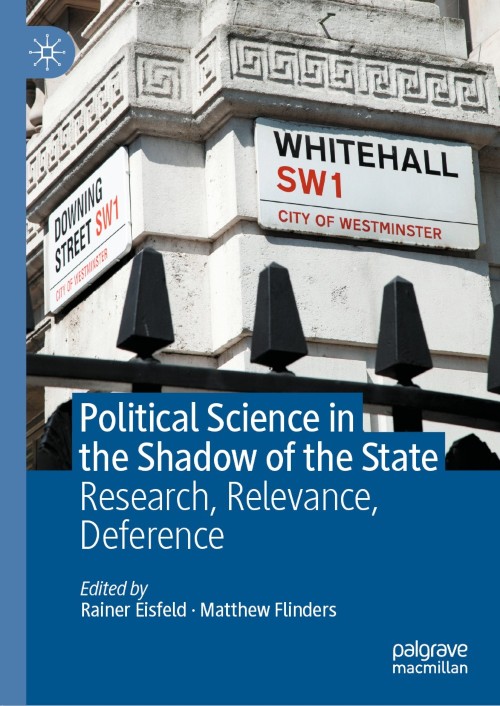
Political Science in the Shadow of the State [electronic resource] : Research, Relevance, Deference / edited by Rainer Eisfeld, Matthew Flinders.
Erişim Adresi
ISBN
9783030759186
Dil Kodu
İngilizce
Yer Numarası
DK/16501
Basım Bildirimi
1st ed. 2021.
Yayın Bilgisi
Cham : Springer International Publishing : Imprint: Palgrave Macmillan, 2021.
Fiziksel Niteleme
XXI, 344 p. 9 illus., 6 illus. in color. online resource.
İçindekiler Notu
Chapter 1: Understanding Scholarly Shifts – A Matter of Relevance -- PART I – FOUNDATIONS AND CONCEPTS -- Chapter 2: Incentives for Impact: Relevance Regimes Through a Cross-National Perspective -- Chapter 3: Towards a Tyranny of State-Directed Relevance? Co-option, Control and Research Funding -- PART II – COUNTRY CASE STUDIES -- Chapter 4: Research in a Racially Structured State: The Role of the U. S. National Science Foundation -- Chapter 5: Australia’s Politics of Research Funding: Depoliticisation and the Crisis of the Regulatory State -- Chapter 6: The Unplanned and Underfunded Co-Option of Political Science in France -- Chapter 7: Political and Social Forces Shaping Political Science Research and Knowledge Transfer in the Netherlands -- Chapter 8: When Illiberalism Meets Neoliberalism: The State and the Social Sciences in Present Hungary -- Chapter 9: Undermining the Role of Political Science: State-Directed Research Funding in the Visegrad States -- Chapter 10: Political Science or Science in the Service of Politics: Internal and External Co-option in Belarus -- Chapter 11: Social Sciences as an Instrument of National Development? The Case of Qatar -- PART III – ANALYSIS AND IMPLICATIONS -- Chapter 12: From Deference and the Politicization of Research Funding to a New Politics of Political Science.
Özet, vb.
‘This compelling volume literally spans the globe, from North America to Europe and on to the Middle East, as it apprehends how agenda-setting and research support by public authorities can redirect and limit the contours and content of political science. Sharply argued, the essays raise many points of concern’. —Ira I. Katznelson, Ruggles Professor of Political Science and History, Columbia University, USA ‘Superbly evocative…A distinguished dissection of a prevalent pattern in contemporary state-scholar relationships, revealed as disquieting in terms of its costs to intellectual freedom and social capital. Also a compassionate appeal in favor of expanding political scientists’ topic-driven international cooperation’. —Irmina Matonyte, former President, Lithuanian Political Science Association, Military Academy of Lithuania (Vilnius) ‘Political science should be relevant, but this book makes a convincingargument that the state should not be left to define what is relevant. A discipline focused on power and how to control it would do well to reflect and act on the warnings embodied in this work’. —Gerry Stoker, Professor of Governance, University of Southampton, UK What is the link between scholarship and democracy? What role do academics play in sustaining democratic values? Why should concerns about the ‘hollowing-out’ of democracy include a focus on the changing governance of higher education? Offering the first comparative analysis of how both democratic and autocratic politicians are seeking to control the research funding landscape, this book reveals a very worrying shift in the relationships between the state and universities: With higher education politically redefined as a mere tool of economic strategy, the space for academic autonomy, intellectual independence and critical thinking is being closed down. This book will be of interest to anyone concerned about democratic governance and the future of higher education. Rainer Eisfeld is Professor Emeritus of Political Science at Osnabrück University, Germany, and also taught at UCLA as a Visiting Professor. Matthew Flinders is Founding Director of the Sir Bernard Crick Centre and Professor of Politics at the University of Sheffield, UK.
Konu
Europe __ Politics and government.
Political science.
Education, Higher.
Education and state.
European Politics.
Governance and Government.
Higher Education.
Educational Policy and Politics.
Political science.
Education, Higher.
Education and state.
European Politics.
Governance and Government.
Higher Education.
Educational Policy and Politics.
Kurum Adı
Eseri Alıntıla
Referansları kullanmadan önce gözden geçirmeniz ve varsa gerekli düzeltmeleri yapmanız önerilir.
Dijital Kaynak
MARC Görünümü
LEADER 05688nam a22005415i 4500
001 815274
003 TR_AnAIT
005 20260130211356
007 cr nn 008mamaa
008 210711s2021 sz | s |||| 0|eng d
020 |a9783030759186|9978-3-030-75918-6
024 7 |a10.1007/978-3-030-75918-6|2doi
041 |aeng
049 |aTürk Tarih Kurumu Kütüphanesi
050 4|aJN1-9692.2
072 7|aJP|2bicssc
072 7|a1D|2bicssc
072 7|aPOL058000|2bisacsh
072 7|aJP|x1D|2thema
082 04|a320.94|223
090 |aDK/16501
245 10|aPolitical Science in the Shadow of the State|h[electronic resource] :|bResearch, Relevance, Deference /|cedited by Rainer Eisfeld, Matthew Flinders.
250 |a1st ed. 2021.
264 1|aCham :|bSpringer International Publishing :|bImprint: Palgrave Macmillan,|c2021.
300 |aXXI, 344 p. 9 illus., 6 illus. in color.|bonline resource.
336 |atext|btxt|2rdacontent
337 |acomputer|bc|2rdamedia
338 |aonline resource|bcr|2rdacarrier
347 |atext file|bPDF|2rda
505 0 |aChapter 1: Understanding Scholarly Shifts – A Matter of Relevance -- PART I – FOUNDATIONS AND CONCEPTS -- Chapter 2: Incentives for Impact: Relevance Regimes Through a Cross-National Perspective -- Chapter 3: Towards a Tyranny of State-Directed Relevance? Co-option, Control and Research Funding -- PART II – COUNTRY CASE STUDIES -- Chapter 4: Research in a Racially Structured State: The Role of the U. S. National Science Foundation -- Chapter 5: Australia’s Politics of Research Funding: Depoliticisation and the Crisis of the Regulatory State -- Chapter 6: The Unplanned and Underfunded Co-Option of Political Science in France -- Chapter 7: Political and Social Forces Shaping Political Science Research and Knowledge Transfer in the Netherlands -- Chapter 8: When Illiberalism Meets Neoliberalism: The State and the Social Sciences in Present Hungary -- Chapter 9: Undermining the Role of Political Science: State-Directed Research Funding in the Visegrad States -- Chapter 10: Political Science or Science in the Service of Politics: Internal and External Co-option in Belarus -- Chapter 11: Social Sciences as an Instrument of National Development? The Case of Qatar -- PART III – ANALYSIS AND IMPLICATIONS -- Chapter 12: From Deference and the Politicization of Research Funding to a New Politics of Political Science.
520 |a‘This compelling volume literally spans the globe, from North America to Europe and on to the Middle East, as it apprehends how agenda-setting and research support by public authorities can redirect and limit the contours and content of political science. Sharply argued, the essays raise many points of concern’. —Ira I. Katznelson, Ruggles Professor of Political Science and History, Columbia University, USA ‘Superbly evocative…A distinguished dissection of a prevalent pattern in contemporary state-scholar relationships, revealed as disquieting in terms of its costs to intellectual freedom and social capital. Also a compassionate appeal in favor of expanding political scientists’ topic-driven international cooperation’. —Irmina Matonyte, former President, Lithuanian Political Science Association, Military Academy of Lithuania (Vilnius) ‘Political science should be relevant, but this book makes a convincingargument that the state should not be left to define what is relevant. A discipline focused on power and how to control it would do well to reflect and act on the warnings embodied in this work’. —Gerry Stoker, Professor of Governance, University of Southampton, UK What is the link between scholarship and democracy? What role do academics play in sustaining democratic values? Why should concerns about the ‘hollowing-out’ of democracy include a focus on the changing governance of higher education? Offering the first comparative analysis of how both democratic and autocratic politicians are seeking to control the research funding landscape, this book reveals a very worrying shift in the relationships between the state and universities: With higher education politically redefined as a mere tool of economic strategy, the space for academic autonomy, intellectual independence and critical thinking is being closed down. This book will be of interest to anyone concerned about democratic governance and the future of higher education. Rainer Eisfeld is Professor Emeritus of Political Science at Osnabrück University, Germany, and also taught at UCLA as a Visiting Professor. Matthew Flinders is Founding Director of the Sir Bernard Crick Centre and Professor of Politics at the University of Sheffield, UK.
650 0|aEurope|xPolitics and government.
650 0|aPolitical science.
650 0|aEducation, Higher.
650 0|aEducation and state.
650 14|aEuropean Politics.
650 24|aGovernance and Government.
650 24|aHigher Education.
650 24|aEducational Policy and Politics.
700 1 |aEisfeld, Rainer.|eeditor.|4edt|4http://id.loc.gov/vocabulary/relators/edt
700 1 |aFlinders, Matthew.|eeditor.|0(orcid)0000-0003-3585-9010|1https://orcid.org/0000-0003-3585-9010|4edt|4http://id.loc.gov/vocabulary/relators/edt
710 2 |aSpringerLink (Online service)
773 0 |tSpringer Nature eBook
776 08|iPrinted edition:|z9783030759179
776 08|iPrinted edition:|z9783030759193
776 08|iPrinted edition:|z9783030759209
856 40|uhttps://doi.org/10.1007/978-3-030-75918-6
912 |aZDB-2-POS
912 |aZDB-2-SXPI
950 |aPolitical Science and International Studies (SpringerNature-41174)
950 |aPolitical Science and International Studies (R0) (SpringerNature-43724)
001 815274
003 TR_AnAIT
005 20260130211356
007 cr nn 008mamaa
008 210711s2021 sz | s |||| 0|eng d
020 |a9783030759186|9978-3-030-75918-6
024 7 |a10.1007/978-3-030-75918-6|2doi
041 |aeng
049 |aTürk Tarih Kurumu Kütüphanesi
050 4|aJN1-9692.2
072 7|aJP|2bicssc
072 7|a1D|2bicssc
072 7|aPOL058000|2bisacsh
072 7|aJP|x1D|2thema
082 04|a320.94|223
090 |aDK/16501
245 10|aPolitical Science in the Shadow of the State|h[electronic resource] :|bResearch, Relevance, Deference /|cedited by Rainer Eisfeld, Matthew Flinders.
250 |a1st ed. 2021.
264 1|aCham :|bSpringer International Publishing :|bImprint: Palgrave Macmillan,|c2021.
300 |aXXI, 344 p. 9 illus., 6 illus. in color.|bonline resource.
336 |atext|btxt|2rdacontent
337 |acomputer|bc|2rdamedia
338 |aonline resource|bcr|2rdacarrier
347 |atext file|bPDF|2rda
505 0 |aChapter 1: Understanding Scholarly Shifts – A Matter of Relevance -- PART I – FOUNDATIONS AND CONCEPTS -- Chapter 2: Incentives for Impact: Relevance Regimes Through a Cross-National Perspective -- Chapter 3: Towards a Tyranny of State-Directed Relevance? Co-option, Control and Research Funding -- PART II – COUNTRY CASE STUDIES -- Chapter 4: Research in a Racially Structured State: The Role of the U. S. National Science Foundation -- Chapter 5: Australia’s Politics of Research Funding: Depoliticisation and the Crisis of the Regulatory State -- Chapter 6: The Unplanned and Underfunded Co-Option of Political Science in France -- Chapter 7: Political and Social Forces Shaping Political Science Research and Knowledge Transfer in the Netherlands -- Chapter 8: When Illiberalism Meets Neoliberalism: The State and the Social Sciences in Present Hungary -- Chapter 9: Undermining the Role of Political Science: State-Directed Research Funding in the Visegrad States -- Chapter 10: Political Science or Science in the Service of Politics: Internal and External Co-option in Belarus -- Chapter 11: Social Sciences as an Instrument of National Development? The Case of Qatar -- PART III – ANALYSIS AND IMPLICATIONS -- Chapter 12: From Deference and the Politicization of Research Funding to a New Politics of Political Science.
520 |a‘This compelling volume literally spans the globe, from North America to Europe and on to the Middle East, as it apprehends how agenda-setting and research support by public authorities can redirect and limit the contours and content of political science. Sharply argued, the essays raise many points of concern’. —Ira I. Katznelson, Ruggles Professor of Political Science and History, Columbia University, USA ‘Superbly evocative…A distinguished dissection of a prevalent pattern in contemporary state-scholar relationships, revealed as disquieting in terms of its costs to intellectual freedom and social capital. Also a compassionate appeal in favor of expanding political scientists’ topic-driven international cooperation’. —Irmina Matonyte, former President, Lithuanian Political Science Association, Military Academy of Lithuania (Vilnius) ‘Political science should be relevant, but this book makes a convincingargument that the state should not be left to define what is relevant. A discipline focused on power and how to control it would do well to reflect and act on the warnings embodied in this work’. —Gerry Stoker, Professor of Governance, University of Southampton, UK What is the link between scholarship and democracy? What role do academics play in sustaining democratic values? Why should concerns about the ‘hollowing-out’ of democracy include a focus on the changing governance of higher education? Offering the first comparative analysis of how both democratic and autocratic politicians are seeking to control the research funding landscape, this book reveals a very worrying shift in the relationships between the state and universities: With higher education politically redefined as a mere tool of economic strategy, the space for academic autonomy, intellectual independence and critical thinking is being closed down. This book will be of interest to anyone concerned about democratic governance and the future of higher education. Rainer Eisfeld is Professor Emeritus of Political Science at Osnabrück University, Germany, and also taught at UCLA as a Visiting Professor. Matthew Flinders is Founding Director of the Sir Bernard Crick Centre and Professor of Politics at the University of Sheffield, UK.
650 0|aEurope|xPolitics and government.
650 0|aPolitical science.
650 0|aEducation, Higher.
650 0|aEducation and state.
650 14|aEuropean Politics.
650 24|aGovernance and Government.
650 24|aHigher Education.
650 24|aEducational Policy and Politics.
700 1 |aEisfeld, Rainer.|eeditor.|4edt|4http://id.loc.gov/vocabulary/relators/edt
700 1 |aFlinders, Matthew.|eeditor.|0(orcid)0000-0003-3585-9010|1https://orcid.org/0000-0003-3585-9010|4edt|4http://id.loc.gov/vocabulary/relators/edt
710 2 |aSpringerLink (Online service)
773 0 |tSpringer Nature eBook
776 08|iPrinted edition:|z9783030759179
776 08|iPrinted edition:|z9783030759193
776 08|iPrinted edition:|z9783030759209
856 40|uhttps://doi.org/10.1007/978-3-030-75918-6
912 |aZDB-2-POS
912 |aZDB-2-SXPI
950 |aPolitical Science and International Studies (SpringerNature-41174)
950 |aPolitical Science and International Studies (R0) (SpringerNature-43724)
Materyaller
Depodan talep edilen materyal sadece kütüphane içerisinde kullanılmaktadır.
Materyal dışarıya ödünç verilmemektedir.
Materyal dışarıya ödünç verilmemektedir.
