LEADER 04286nam a22005775i 4500
001 815522
003 TR_AnAIT
005 20260130210150
007 cr nn 008mamaa
008 170201s2017 xxk| s |||| 0|eng d
020 |a9781137270269|9978-1-137-27026-9
024 7 |a10.1057/978-1-137-27026-9|2doi
041 |aeng
049 |aTürk Tarih Kurumu Kütüphanesi
050 4|aJN1-9692.2
072 7|aJP|2bicssc
072 7|a1D|2bicssc
072 7|aPOL058000|2bisacsh
072 7|aJP|x1D|2thema
082 04|a320.94|223
090 |aDK/16742
100 1 |aBardakci, Mehmet.|eauthor.|4aut|4http://id.loc.gov/vocabulary/relators/aut
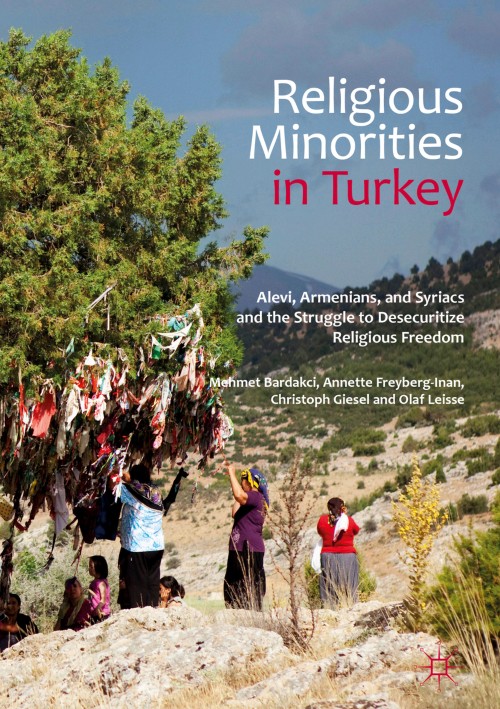
245 10|aReligious Minorities in Turkey|h[electronic resource] :|bAlevi, Armenians, and Syriacs and the Struggle to Desecuritize Religious Freedom /|cby Mehmet Bardakci, Annette Freyberg-Inan, Christoph Giesel, Olaf Leisse.
250 |a1st ed. 2017.
264 1|aLondon :|bPalgrave Macmillan UK :|bImprint: Palgrave Macmillan,|c2017.
300 |aXVI, 275 p. 35 illus.|bonline resource.
336 |atext|btxt|2rdacontent
337 |acomputer|bc|2rdamedia
338 |aonline resource|bcr|2rdacarrier
347 |atext file|bPDF|2rda
505 0 |aPreface and Acknowledgements -- 1. Introduction -- 2. European Integration and Minority Rights -- 3. Securitization and De-securitization -- 4. The Alevi -- 5. The Armenians -- 6. The Syriacs -- 7. Minority Groups in Comparison -- Conclusions -- Appendix: Survey and Interview questions and Lists of Interviews with Minority Organizations and Experts -- Bibliography -- Index. .
520 |aThis book considers the key issue of Turkey’s treatment of minorities in relation to its complex paths of both European integration and domestic and international reorientation. The expectations of Turkey’s EU and other international counterparts, as well as important domestic demands, have pushed Turkey to broaden the rights of religious and other minorities. More recently a turn towards autocratic government is rolling back some earlier achievements. This book shows how broader processes affect the lives of three important religious groups in Turkey: the Alevi as a large Muslim community and the non-Muslim communities of Armenians and Assyrians. Drawing on a wealth of original data and extensive fieldwork, the authors compare and explain improvements, set-backs, and lingering concerns for Turkey’s religious minorities and identify important challenges for Turkey’s future democratic development and European path. The book will appeal to students and scholars in the fields of minority politics, contemporary Turkish politics, and religion and politics.
532 8 |aAccessibility summary: This PDF was produced prior to the implementation of current accessibility best practices. It supports searchable and selectable text. It may or may not include elements such as described non-text content (images, graphs etc), reflowable text or screen reader compatibility. Users with accessibility needs may experience limitations. Please contact us at accessibilitysupport@springernature.com if you require assistance or an alternative format.
532 8 |aNo reading system accessibility options actively disabled
532 8 |aPublisher contact for further accessibility information: accessibilitysupport@springernature.com
650 0|aEurope|xPolitics and government.
650 0|aWorld politics.
650 0|aReligion and sociology.
650 14|aEuropean Politics.
650 24|aPolitical History.
650 24|aSociology of Religion.
700 1 |aFreyberg-Inan, Annette.|eauthor.|4aut|4http://id.loc.gov/vocabulary/relators/aut
700 1 |aGiesel, Christoph.|eauthor.|4aut|4http://id.loc.gov/vocabulary/relators/aut
700 1 |aLeisse, Olaf.|eauthor.|4aut|4http://id.loc.gov/vocabulary/relators/aut
710 2 |aSpringerLink (Online service)
773 0 |tSpringer Nature eBook
776 08|iPrinted edition:|z9781137270252
776 08|iPrinted edition:|z9781349669974
776 08|iPrinted edition:|z9781349669967
856 40|uhttps://doi.org/10.1057/978-1-137-27026-9
912 |aZDB-2-POS
912 |aZDB-2-SXPI
950 |aPolitical Science and International Studies (SpringerNature-41174)
950 |aPolitical Science and International Studies (R0) (SpringerNature-43724)