

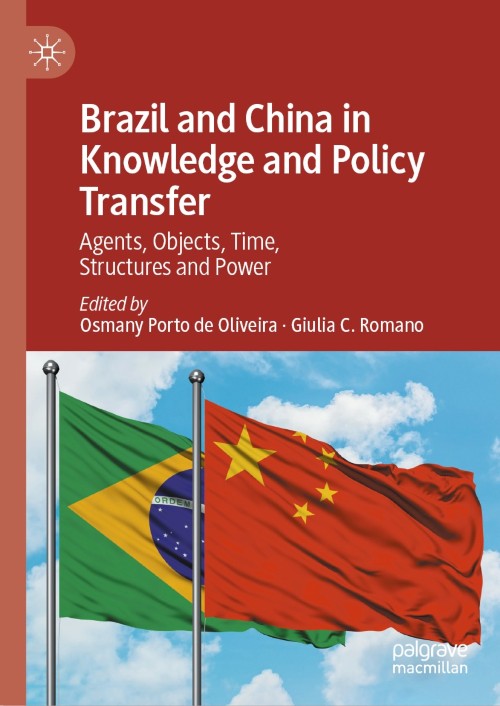
Brazil and China in Knowledge and Policy Transfer [electronic resource] : Agents, Objects, Time, Structures and Power / edited by Osmany Porto de Oliveira, Giulia C. Romano.
Erişim Adresi
ISBN
9783031091162
Dil Kodu
İngilizce
Yer Numarası
DK/16827
Basım Bildirimi
1st ed. 2022.
Yayın Bilgisi
Cham : Springer International Publishing : Imprint: Palgrave Macmillan, 2022.
Fiziksel Niteleme
XV, 344 p. 1 illus. online resource.
İçindekiler Notu
Chapter 1. Knowledge and Policy Transfers from Brazil and China: Research Questions for a Promising Agenda (Osmany Porto de Oliveira and Giulia C. Romano) -- Chapter 2. Policy diffusion and transfer as foreign policy instruments: a classification with evidence from Brazil and China (Carlos Aurélio Pimenta de Faria, Giulia C. Romano, Markus Taube) -- Chapter 3. The rise and fall of Brazil as a “policy exporter”: from Lula da Silva to Jair Bolsonaro (Laura Trajber Waisbich, Juliana Ramos Luiz and Carlos Aurélio Pimenta de Faria) -- Chapter 4. China’s global role: knowledge and policy diffusion (Jing Gu and Neil Renwick) -- Chapter 5. Policy circulation and South-South Cooperation in Brazil-Africa relations: rise, fall and change (Laura Trajber Waisbich) -- Chapter 6. China’s policy export to Africa – From the development-security nexus to knowledge-transfer (Georg Lammich) -- Chapter 7. Social Policy Diplomacy: The Diffusion of Brazilian Instruments in the Fight Against Hunger (Osmany Portode Oliveira) -- Chapter 8. From Hard to Soft Power: Chinese Policy Diffusion in Pakistan in the Age of CPEC (Asma Faiz) -- Chapter 9. Knowledge and policy transfers along the BRI: the case of Duisburg (Giulia C. Romano and Markus Taube) -- Chapter 10. The diffusion of Brazilian public policies within international venues: the cases of Health and Rural Development (Juliana Ramos Luiz and Maria Berta Ecija).
Özet, vb.
This is an exemplary comparative volume on two of the 21st century’s most important countries: Brazil and China. Chapter authors meticulously overturn the ill-informed Western narrative that policy transfer, by design, originates in the West. Kim Moloney, Assistant Professor of Public Policy, Hamad Bin Khalifa University, Qatar This exciting new book brings together an impressive array of internationally recognised scholars to address the growing influence of Brazil and China in the international arena... Anyone interested in policy transfer, lesson drawing and how these processes are operating outside of the global north should read this text. David P. Dolowitz, Professor of Politics, University of Liverpool, UK This book examines knowledge and policy transfer from the perspectives of Brazil and China. It assesses how these two nations have emerged as providers of ideas and models that contribute to the global offer of public policies. With a variety of case studies in areas such as health, food security and infrastructure, the volume offers new insights into the distinct levels through which knowledge and policy transfers take place, including the local, regional, national and supranational. It develops a multidimensional framework of analysis that considers the agents, objects, and mechanisms for knowledge and policy transfer, as well as the structures and timings within which they operate. Unlike previous studies on policy transfer – which largely focus on North-North and North-South learning processes – this book offers an innovative approach to this area of study. By reflecting on the experiences of these two rising powers, it provides fresh insights on the future of knowledge and policy transfer as global power dynamics shift. This interdisciplinary study will appeal to students and scholars of policy transfer, development studies, international relations and publicpolicy. Osmany Porto de Oliveira is Assistant Professor in the International Relations Department at the Federal University of São Paulo, Brazil. Giulia C. Romano is Postdoctoral Researcher at the Institute of East-Asian Studies, University of Duisburg-Essen, Germany.
Konu
Political planning.
Comparative government.
Public Policy.
Comparative Public Policy.
Policy Formulation.
Comparative government.
Public Policy.
Comparative Public Policy.
Policy Formulation.
Diğer Yazarlar
Kurum Adı
Eseri Alıntıla
Referansları kullanmadan önce gözden geçirmeniz ve varsa gerekli düzeltmeleri yapmanız önerilir.
Dijital Kaynak
MARC Görünümü
LEADER 06610nam a22006015i 4500
001 815608
003 TR_AnAIT
005 20260130205752
007 cr nn 008mamaa
008 221001s2022 sz | s |||| 0|eng d
020 |a9783031091162|9978-3-031-09116-2
024 7 |a10.1007/978-3-031-09116-2|2doi
041 |aeng
049 |aTürk Tarih Kurumu Kütüphanesi
050 4|aJF1525.P6
072 7|aJPP|2bicssc
072 7|aPOL028000|2bisacsh
072 7|aJPP|2thema
082 04|a320.6|223
090 |aDK/16827
245 10|aBrazil and China in Knowledge and Policy Transfer|h[electronic resource] :|bAgents, Objects, Time, Structures and Power /|cedited by Osmany Porto de Oliveira, Giulia C. Romano.
250 |a1st ed. 2022.
264 1|aCham :|bSpringer International Publishing :|bImprint: Palgrave Macmillan,|c2022.
300 |aXV, 344 p. 1 illus.|bonline resource.
336 |atext|btxt|2rdacontent
337 |acomputer|bc|2rdamedia
338 |aonline resource|bcr|2rdacarrier
341 0 |bTable of contents navigation|2onix
341 0 |bSingle logical reading order|2onix
341 0 |bUse of color is not sole means of conveying information|2onix
341 0 |bUse of high contrast between text and background color|2onix
341 0 |bNext / Previous structural navigation|2onix
341 0 |bAll non-decorative content supports reading without sight|2onix
347 |atext file|bPDF|2rda
505 0 |aChapter 1. Knowledge and Policy Transfers from Brazil and China: Research Questions for a Promising Agenda (Osmany Porto de Oliveira and Giulia C. Romano) -- Chapter 2. Policy diffusion and transfer as foreign policy instruments: a classification with evidence from Brazil and China (Carlos Aurélio Pimenta de Faria, Giulia C. Romano, Markus Taube) -- Chapter 3. The rise and fall of Brazil as a “policy exporter”: from Lula da Silva to Jair Bolsonaro (Laura Trajber Waisbich, Juliana Ramos Luiz and Carlos Aurélio Pimenta de Faria) -- Chapter 4. China’s global role: knowledge and policy diffusion (Jing Gu and Neil Renwick) -- Chapter 5. Policy circulation and South-South Cooperation in Brazil-Africa relations: rise, fall and change (Laura Trajber Waisbich) -- Chapter 6. China’s policy export to Africa – From the development-security nexus to knowledge-transfer (Georg Lammich) -- Chapter 7. Social Policy Diplomacy: The Diffusion of Brazilian Instruments in the Fight Against Hunger (Osmany Portode Oliveira) -- Chapter 8. From Hard to Soft Power: Chinese Policy Diffusion in Pakistan in the Age of CPEC (Asma Faiz) -- Chapter 9. Knowledge and policy transfers along the BRI: the case of Duisburg (Giulia C. Romano and Markus Taube) -- Chapter 10. The diffusion of Brazilian public policies within international venues: the cases of Health and Rural Development (Juliana Ramos Luiz and Maria Berta Ecija).
520 |aThis is an exemplary comparative volume on two of the 21st century’s most important countries: Brazil and China. Chapter authors meticulously overturn the ill-informed Western narrative that policy transfer, by design, originates in the West. Kim Moloney, Assistant Professor of Public Policy, Hamad Bin Khalifa University, Qatar This exciting new book brings together an impressive array of internationally recognised scholars to address the growing influence of Brazil and China in the international arena... Anyone interested in policy transfer, lesson drawing and how these processes are operating outside of the global north should read this text. David P. Dolowitz, Professor of Politics, University of Liverpool, UK This book examines knowledge and policy transfer from the perspectives of Brazil and China. It assesses how these two nations have emerged as providers of ideas and models that contribute to the global offer of public policies. With a variety of case studies in areas such as health, food security and infrastructure, the volume offers new insights into the distinct levels through which knowledge and policy transfers take place, including the local, regional, national and supranational. It develops a multidimensional framework of analysis that considers the agents, objects, and mechanisms for knowledge and policy transfer, as well as the structures and timings within which they operate. Unlike previous studies on policy transfer – which largely focus on North-North and North-South learning processes – this book offers an innovative approach to this area of study. By reflecting on the experiences of these two rising powers, it provides fresh insights on the future of knowledge and policy transfer as global power dynamics shift. This interdisciplinary study will appeal to students and scholars of policy transfer, development studies, international relations and publicpolicy. Osmany Porto de Oliveira is Assistant Professor in the International Relations Department at the Federal University of São Paulo, Brazil. Giulia C. Romano is Postdoctoral Researcher at the Institute of East-Asian Studies, University of Duisburg-Essen, Germany.
532 8 |aAccessibility summary: This PDF does not fully comply with PDF/UA standards, but does feature limited screen reader support, bookmarks for easy navigation and searchable, selectable text. Users of assistive technologies may experience difficulty navigating or interpreting content in this document. We recognize the importance of accessibility, and we welcome queries about accessibility for any of our products. If you have a question or an access need, please get in touch with us at accessibilitysupport@springernature.com.
532 8 |aNo reading system accessibility options actively disabled
532 8 |aPublisher contact for further accessibility information: accessibilitysupport@springernature.com
650 0|aPolitical planning.
650 0|aComparative government.
650 14|aPublic Policy.
650 24|aComparative Public Policy.
650 24|aPolicy Formulation.
700 1 |aPorto de Oliveira, Osmany.|eeditor.|4edt|4http://id.loc.gov/vocabulary/relators/edt
700 1 |aRomano, Giulia C.|eeditor.|4edt|4http://id.loc.gov/vocabulary/relators/edt
710 2 |aSpringerLink (Online service)
773 0 |tSpringer Nature eBook
776 08|iPrinted edition:|z9783031091155
776 08|iPrinted edition:|z9783031091179
776 08|iPrinted edition:|z9783031091186
856 40|uhttps://doi.org/10.1007/978-3-031-09116-2
912 |aZDB-2-POS
912 |aZDB-2-SXPI
950 |aPolitical Science and International Studies (SpringerNature-41174)
950 |aPolitical Science and International Studies (R0) (SpringerNature-43724)
001 815608
003 TR_AnAIT
005 20260130205752
007 cr nn 008mamaa
008 221001s2022 sz | s |||| 0|eng d
020 |a9783031091162|9978-3-031-09116-2
024 7 |a10.1007/978-3-031-09116-2|2doi
041 |aeng
049 |aTürk Tarih Kurumu Kütüphanesi
050 4|aJF1525.P6
072 7|aJPP|2bicssc
072 7|aPOL028000|2bisacsh
072 7|aJPP|2thema
082 04|a320.6|223
090 |aDK/16827
245 10|aBrazil and China in Knowledge and Policy Transfer|h[electronic resource] :|bAgents, Objects, Time, Structures and Power /|cedited by Osmany Porto de Oliveira, Giulia C. Romano.
250 |a1st ed. 2022.
264 1|aCham :|bSpringer International Publishing :|bImprint: Palgrave Macmillan,|c2022.
300 |aXV, 344 p. 1 illus.|bonline resource.
336 |atext|btxt|2rdacontent
337 |acomputer|bc|2rdamedia
338 |aonline resource|bcr|2rdacarrier
341 0 |bTable of contents navigation|2onix
341 0 |bSingle logical reading order|2onix
341 0 |bUse of color is not sole means of conveying information|2onix
341 0 |bUse of high contrast between text and background color|2onix
341 0 |bNext / Previous structural navigation|2onix
341 0 |bAll non-decorative content supports reading without sight|2onix
347 |atext file|bPDF|2rda
505 0 |aChapter 1. Knowledge and Policy Transfers from Brazil and China: Research Questions for a Promising Agenda (Osmany Porto de Oliveira and Giulia C. Romano) -- Chapter 2. Policy diffusion and transfer as foreign policy instruments: a classification with evidence from Brazil and China (Carlos Aurélio Pimenta de Faria, Giulia C. Romano, Markus Taube) -- Chapter 3. The rise and fall of Brazil as a “policy exporter”: from Lula da Silva to Jair Bolsonaro (Laura Trajber Waisbich, Juliana Ramos Luiz and Carlos Aurélio Pimenta de Faria) -- Chapter 4. China’s global role: knowledge and policy diffusion (Jing Gu and Neil Renwick) -- Chapter 5. Policy circulation and South-South Cooperation in Brazil-Africa relations: rise, fall and change (Laura Trajber Waisbich) -- Chapter 6. China’s policy export to Africa – From the development-security nexus to knowledge-transfer (Georg Lammich) -- Chapter 7. Social Policy Diplomacy: The Diffusion of Brazilian Instruments in the Fight Against Hunger (Osmany Portode Oliveira) -- Chapter 8. From Hard to Soft Power: Chinese Policy Diffusion in Pakistan in the Age of CPEC (Asma Faiz) -- Chapter 9. Knowledge and policy transfers along the BRI: the case of Duisburg (Giulia C. Romano and Markus Taube) -- Chapter 10. The diffusion of Brazilian public policies within international venues: the cases of Health and Rural Development (Juliana Ramos Luiz and Maria Berta Ecija).
520 |aThis is an exemplary comparative volume on two of the 21st century’s most important countries: Brazil and China. Chapter authors meticulously overturn the ill-informed Western narrative that policy transfer, by design, originates in the West. Kim Moloney, Assistant Professor of Public Policy, Hamad Bin Khalifa University, Qatar This exciting new book brings together an impressive array of internationally recognised scholars to address the growing influence of Brazil and China in the international arena... Anyone interested in policy transfer, lesson drawing and how these processes are operating outside of the global north should read this text. David P. Dolowitz, Professor of Politics, University of Liverpool, UK This book examines knowledge and policy transfer from the perspectives of Brazil and China. It assesses how these two nations have emerged as providers of ideas and models that contribute to the global offer of public policies. With a variety of case studies in areas such as health, food security and infrastructure, the volume offers new insights into the distinct levels through which knowledge and policy transfers take place, including the local, regional, national and supranational. It develops a multidimensional framework of analysis that considers the agents, objects, and mechanisms for knowledge and policy transfer, as well as the structures and timings within which they operate. Unlike previous studies on policy transfer – which largely focus on North-North and North-South learning processes – this book offers an innovative approach to this area of study. By reflecting on the experiences of these two rising powers, it provides fresh insights on the future of knowledge and policy transfer as global power dynamics shift. This interdisciplinary study will appeal to students and scholars of policy transfer, development studies, international relations and publicpolicy. Osmany Porto de Oliveira is Assistant Professor in the International Relations Department at the Federal University of São Paulo, Brazil. Giulia C. Romano is Postdoctoral Researcher at the Institute of East-Asian Studies, University of Duisburg-Essen, Germany.
532 8 |aAccessibility summary: This PDF does not fully comply with PDF/UA standards, but does feature limited screen reader support, bookmarks for easy navigation and searchable, selectable text. Users of assistive technologies may experience difficulty navigating or interpreting content in this document. We recognize the importance of accessibility, and we welcome queries about accessibility for any of our products. If you have a question or an access need, please get in touch with us at accessibilitysupport@springernature.com.
532 8 |aNo reading system accessibility options actively disabled
532 8 |aPublisher contact for further accessibility information: accessibilitysupport@springernature.com
650 0|aPolitical planning.
650 0|aComparative government.
650 14|aPublic Policy.
650 24|aComparative Public Policy.
650 24|aPolicy Formulation.
700 1 |aPorto de Oliveira, Osmany.|eeditor.|4edt|4http://id.loc.gov/vocabulary/relators/edt
700 1 |aRomano, Giulia C.|eeditor.|4edt|4http://id.loc.gov/vocabulary/relators/edt
710 2 |aSpringerLink (Online service)
773 0 |tSpringer Nature eBook
776 08|iPrinted edition:|z9783031091155
776 08|iPrinted edition:|z9783031091179
776 08|iPrinted edition:|z9783031091186
856 40|uhttps://doi.org/10.1007/978-3-031-09116-2
912 |aZDB-2-POS
912 |aZDB-2-SXPI
950 |aPolitical Science and International Studies (SpringerNature-41174)
950 |aPolitical Science and International Studies (R0) (SpringerNature-43724)
Materyaller
Depodan talep edilen materyal sadece kütüphane içerisinde kullanılmaktadır.
Materyal dışarıya ödünç verilmemektedir.
Materyal dışarıya ödünç verilmemektedir.
