

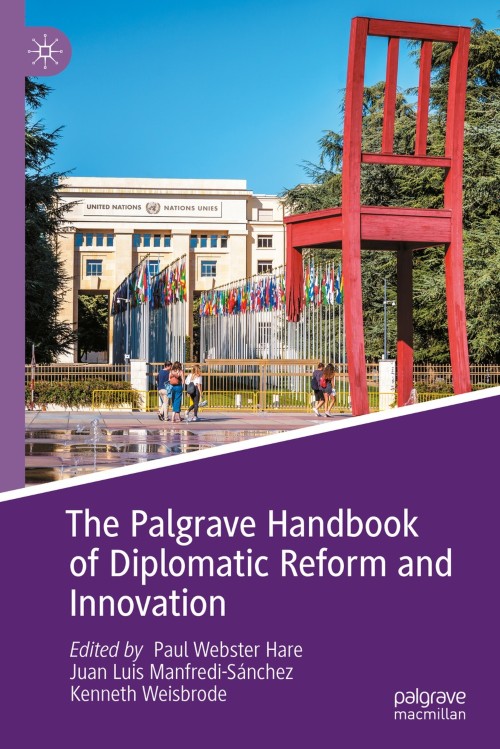
The Palgrave Handbook of Diplomatic Reform and Innovation [electronic resource] / edited by Paul Webster Hare, Juan Luis Manfredi-Sánchez, Kenneth Weisbrode.
Erişim Adresi
ISBN
9783031109713
Dil Kodu
İngilizce
Yer Numarası
DK/16832
Basım Bildirimi
1st ed. 2023.
Yayın Bilgisi
Cham : Springer International Publishing : Imprint: Palgrave Macmillan, 2023.
Fiziksel Niteleme
XXIII, 752 p. 25 illus. online resource.
Dizi
Studies in Diplomacy and International Relations, 2731-393X
İçindekiler Notu
Part I. Introduction -- 1. Diplomacy the Neglected Global Issue. Why Diplomacy Needs to Catch Up with the World (Paul Webster Hare) -- Part II. State of Diplomacy -- 2. The Closing of the Diplomatic Mind (Kenneth Weisbrode) -- 3. A Diplomatic Taxonomy for the New World Disorder (Chas W. Freeman Jr.) -- 4. Knowledge Diplomacy – A Conceptual Analysis (Jane Knight) -- 5. Why Reforms Are Needed for Bilateral Diplomacy? A Global South Perspective (Kishan S. Rana) -- 6. The 21st Century Toolbox for a Modern Diplomat (Seppe Verheyen) -- Part III. Politicization of Diplomacy -- 7. Diplomats and Politicization (Pauline Kerr) -- 8. Digital Diplomacy and International Society in the Age of Populism (Onur Erpul) -- 9. Declining Ministry of Foreign Affairs: Evidence from China (Qingmin Zhang and Lize Yang) -- 10. South Africa and its Foreign Alignment and Practice: From Hope to Dashed Expectations (Tony Leon) -- Part IV. Reforming Institutions -- 11. From Great Expectations to Dwindling Status: Brazilian Diplomacy’s Response to Post-Cold War Upheavals (Antônio Carlos Lessa and Rogério de Souza Farias) -- 12. Crisis Prevention and Stabilization Made in Germany: Meeting the Demands of Modern Diplomacy? (Sarah Bressan) -- 13. Integrated Statecraft and Australia’s Diplomacy (Tom Barber and Melissa Conley Tyler) -- 14. What Motivates South Korea’s Diplomatic Reform and Innovation? (HwaJung Kim) -- 15. The Transformations of French Diplomacy (Maxime Lefebvre) -- Part V. Digital Revolution and Diplomatic Reform -- 16. Digital Diplomacy in the Time of the Coronavirus Pandemic: Lessons and Recommendations (Corneliu Bjola and Michaela Coplen) -- 17. Exploring the Usefulness of Artificial Intelligence for Diplomatic Negotiations: Two Case Studies (Volker Stanzel) -- 18. Beyond Meeting and Tweeting: The Next Challenges for Innovation in Diplomacy (Tom Fletcher) -- 19. Disinformation and Diplomacy (Juan Luis Manfredi-Sánchez and Zhao Alexandre Huang) -- 20. Digitalizing South American MFAs: Reform and Resistance (Jorge Heine and Daniel Aguirre) -- Part VI. Multilateral Diplomacy and Innovation -- 21. Toward a More Credible Multilateralism at the United Nations. A Few Practical Steps (Bénédicte Frankinet) -- 22. A New Logic of Multilateralism on Demand (Akiko Fukushima) -- 23. About Spheres of Influence (Chas W. Freeman Jr.) -- 24. Regional Diplomacy and its Variations: Change and Innovation (Rajiv Bhatia and Kishan S. Rana) -- 25. African Union Reform (Emmanuel Balogun and Anna Mwaba) -- 26. Why Collective Diplomacy Needs to Embrace Innovation (Martin Wählisch) -- 27. Innovating International Cooperation for Development: a New Model for Partnerships between Developed and Middle Income Countries (José Antonio Zabalgoitia and Antonio Tenorio) -- 28. The UAE’s Innovative Diplomacy: How the Abraham Accords Changed (or Did Not Change) Emirati Foreign Policy (William Guéraiche) -- 29. Small States: From Intuitive To Smart Diplomacy (Vesko Garčević) -- 30. Urban Diplomacy: How Cities Will Leverage Multilateralism (Juan Luis Manfredi-Sánchez) -- Part VII. Diplomatic Agenda -- 31. Reforming Global Health Diplomacy in the Wake of COVID-19 (Mark C. Storella) -- 32. The Reform of Humanitarian Diplomacy (Gregory Simons and Anna A. Velikaya) -- 33. Geoeconomic Diplomacy: Reforming the Instrumentalization of Economic Interdependencies and Power (Kim B. Olsen) -- 34. Science Diplomacy with Diplomatic Relations to Facilitate Common-Interest Building (Paul Arthur Berkman) -- 35. Multi-stakeholderism and the 2030 Agenda: Does the Promise Hold? (Karin Bäckstrand and Felicitas Fritzsche) -- 36. The Reform of Climate Diplomacy (Andrew Gilder and Olivia Trumble) -- Part VIII. Conclusions -- 37. Conclusions (Paul Webster Hare).
Özet, vb.
In this handbook, a group of 40 scholars and practitioners from some 30 countries takes a critical look at the contemporary practice of diplomacy. Many assume diplomacy evolves naturally, and that state- and non-state actors are powerless to make significant changes. But Diplomacy’s methods, its key institutions and conventions were agreed more than six decades ago. None take account of the opportunities and vulnerabilities presented by the Internet. Diplomacy is now a neglected global issue. The COVID pandemic and the invasion of Ukraine have highlighted some of the problems of diplomatic dysfunction. Beyond identifying current problems diplomacy is facing, the book also seeks to identify some practical options for reform and innovation. How might a process of reform be agreed and implemented? What role might the United Nations, regional organizations and Big Tech play? How can new norms of diplomatic behavior and methods be established in a multipolar, digital world where diplomacy is seen as less and less effective? Paul Webster Hare is Senior Lecturer in International Relations at the Frederick S. Pardee School of Global Studies, Boston University, USA. He was a diplomat for 30 years and British ambassador to Cuba from 2001 to 2004. Juan Luis Manfredi-Sánchez is Prince of Asturias Distinguished Visiting Professor at the School of Foreign Service, Georgetown University, USA, and Professor at the University of Castilla-La Mancha, Spain. Kenneth Weisbrode is Assistant Professor of History at Bilkent University, Turkey.
Konu
Diplomacy.
International relations.
Communication in politics.
Diplomacy.
International Relations.
Political Communication.
International relations.
Communication in politics.
Diplomacy.
International Relations.
Political Communication.
Diğer Yazarlar
Kurum Adı
Eseri Alıntıla
Referansları kullanmadan önce gözden geçirmeniz ve varsa gerekli düzeltmeleri yapmanız önerilir.
Dijital Kaynak
MARC Görünümü
LEADER 08774nam a22006615i 4500
001 815613
003 TR_AnAIT
005 20260130205742
007 cr nn 008mamaa
008 230204s2023 sz | s |||| 0|eng d
020 |a9783031109713|9978-3-031-10971-3
024 7 |a10.1007/978-3-031-10971-3|2doi
041 |aeng
049 |aTürk Tarih Kurumu Kütüphanesi
050 4|aJZ1305-2060
072 7|aJPSD|2bicssc
072 7|aPOL011010|2bisacsh
072 7|aJPSD|2thema
082 04|a327.2|223
090 |aDK/16832
245 14|aThe Palgrave Handbook of Diplomatic Reform and Innovation|h[electronic resource] /|cedited by Paul Webster Hare, Juan Luis Manfredi-Sánchez, Kenneth Weisbrode.
250 |a1st ed. 2023.
264 1|aCham :|bSpringer International Publishing :|bImprint: Palgrave Macmillan,|c2023.
300 |aXXIII, 752 p. 25 illus.|bonline resource.
336 |atext|btxt|2rdacontent
337 |acomputer|bc|2rdamedia
338 |aonline resource|bcr|2rdacarrier
341 0 |bTable of contents navigation|2onix
341 0 |bSingle logical reading order|2onix
341 0 |bShort alternative textual descriptions|2onix
341 0 |bUse of color is not sole means of conveying information|2onix
341 0 |bUse of high contrast between text and background color|2onix
341 0 |bNext / Previous structural navigation|2onix
341 0 |bAll non-decorative content supports reading without sight|2onix
347 |atext file|bPDF|2rda
490 1 |aStudies in Diplomacy and International Relations,|x2731-393X
505 0 |aPart I. Introduction -- 1. Diplomacy the Neglected Global Issue. Why Diplomacy Needs to Catch Up with the World (Paul Webster Hare) -- Part II. State of Diplomacy -- 2. The Closing of the Diplomatic Mind (Kenneth Weisbrode) -- 3. A Diplomatic Taxonomy for the New World Disorder (Chas W. Freeman Jr.) -- 4. Knowledge Diplomacy – A Conceptual Analysis (Jane Knight) -- 5. Why Reforms Are Needed for Bilateral Diplomacy? A Global South Perspective (Kishan S. Rana) -- 6. The 21st Century Toolbox for a Modern Diplomat (Seppe Verheyen) -- Part III. Politicization of Diplomacy -- 7. Diplomats and Politicization (Pauline Kerr) -- 8. Digital Diplomacy and International Society in the Age of Populism (Onur Erpul) -- 9. Declining Ministry of Foreign Affairs: Evidence from China (Qingmin Zhang and Lize Yang) -- 10. South Africa and its Foreign Alignment and Practice: From Hope to Dashed Expectations (Tony Leon) -- Part IV. Reforming Institutions -- 11. From Great Expectations to Dwindling Status: Brazilian Diplomacy’s Response to Post-Cold War Upheavals (Antônio Carlos Lessa and Rogério de Souza Farias) -- 12. Crisis Prevention and Stabilization Made in Germany: Meeting the Demands of Modern Diplomacy? (Sarah Bressan) -- 13. Integrated Statecraft and Australia’s Diplomacy (Tom Barber and Melissa Conley Tyler) -- 14. What Motivates South Korea’s Diplomatic Reform and Innovation? (HwaJung Kim) -- 15. The Transformations of French Diplomacy (Maxime Lefebvre) -- Part V. Digital Revolution and Diplomatic Reform -- 16. Digital Diplomacy in the Time of the Coronavirus Pandemic: Lessons and Recommendations (Corneliu Bjola and Michaela Coplen) -- 17. Exploring the Usefulness of Artificial Intelligence for Diplomatic Negotiations: Two Case Studies (Volker Stanzel) -- 18. Beyond Meeting and Tweeting: The Next Challenges for Innovation in Diplomacy (Tom Fletcher) -- 19. Disinformation and Diplomacy (Juan Luis Manfredi-Sánchez and Zhao Alexandre Huang) -- 20. Digitalizing South American MFAs: Reform and Resistance (Jorge Heine and Daniel Aguirre) -- Part VI. Multilateral Diplomacy and Innovation -- 21. Toward a More Credible Multilateralism at the United Nations. A Few Practical Steps (Bénédicte Frankinet) -- 22. A New Logic of Multilateralism on Demand (Akiko Fukushima) -- 23. About Spheres of Influence (Chas W. Freeman Jr.) -- 24. Regional Diplomacy and its Variations: Change and Innovation (Rajiv Bhatia and Kishan S. Rana) -- 25. African Union Reform (Emmanuel Balogun and Anna Mwaba) -- 26. Why Collective Diplomacy Needs to Embrace Innovation (Martin Wählisch) -- 27. Innovating International Cooperation for Development: a New Model for Partnerships between Developed and Middle Income Countries (José Antonio Zabalgoitia and Antonio Tenorio) -- 28. The UAE’s Innovative Diplomacy: How the Abraham Accords Changed (or Did Not Change) Emirati Foreign Policy (William Guéraiche) -- 29. Small States: From Intuitive To Smart Diplomacy (Vesko Garčević) -- 30. Urban Diplomacy: How Cities Will Leverage Multilateralism (Juan Luis Manfredi-Sánchez) -- Part VII. Diplomatic Agenda -- 31. Reforming Global Health Diplomacy in the Wake of COVID-19 (Mark C. Storella) -- 32. The Reform of Humanitarian Diplomacy (Gregory Simons and Anna A. Velikaya) -- 33. Geoeconomic Diplomacy: Reforming the Instrumentalization of Economic Interdependencies and Power (Kim B. Olsen) -- 34. Science Diplomacy with Diplomatic Relations to Facilitate Common-Interest Building (Paul Arthur Berkman) -- 35. Multi-stakeholderism and the 2030 Agenda: Does the Promise Hold? (Karin Bäckstrand and Felicitas Fritzsche) -- 36. The Reform of Climate Diplomacy (Andrew Gilder and Olivia Trumble) -- Part VIII. Conclusions -- 37. Conclusions (Paul Webster Hare).
520 |aIn this handbook, a group of 40 scholars and practitioners from some 30 countries takes a critical look at the contemporary practice of diplomacy. Many assume diplomacy evolves naturally, and that state- and non-state actors are powerless to make significant changes. But Diplomacy’s methods, its key institutions and conventions were agreed more than six decades ago. None take account of the opportunities and vulnerabilities presented by the Internet. Diplomacy is now a neglected global issue. The COVID pandemic and the invasion of Ukraine have highlighted some of the problems of diplomatic dysfunction. Beyond identifying current problems diplomacy is facing, the book also seeks to identify some practical options for reform and innovation. How might a process of reform be agreed and implemented? What role might the United Nations, regional organizations and Big Tech play? How can new norms of diplomatic behavior and methods be established in a multipolar, digital world where diplomacy is seen as less and less effective? Paul Webster Hare is Senior Lecturer in International Relations at the Frederick S. Pardee School of Global Studies, Boston University, USA. He was a diplomat for 30 years and British ambassador to Cuba from 2001 to 2004. Juan Luis Manfredi-Sánchez is Prince of Asturias Distinguished Visiting Professor at the School of Foreign Service, Georgetown University, USA, and Professor at the University of Castilla-La Mancha, Spain. Kenneth Weisbrode is Assistant Professor of History at Bilkent University, Turkey.
532 8 |aAccessibility summary: This PDF does not fully comply with PDF/UA standards, but does feature limited screen reader support, described non-text content (images, graphs), bookmarks for easy navigation and searchable, selectable text. Users of assistive technologies may experience difficulty navigating or interpreting content in this document. We recognize the importance of accessibility, and we welcome queries about accessibility for any of our products. If you have a question or an access need, please get in touch with us at accessibilitysupport@springernature.com.
532 8 |aNo reading system accessibility options actively disabled
532 8 |aPublisher contact for further accessibility information: accessibilitysupport@springernature.com
650 0|aDiplomacy.
650 0|aInternational relations.
650 0|aCommunication in politics.
650 14|aDiplomacy.
650 24|aInternational Relations.
650 24|aPolitical Communication.
700 1 |aHare, Paul Webster.|eeditor.|4edt|4http://id.loc.gov/vocabulary/relators/edt
700 1 |aManfredi-Sánchez, Juan Luis.|eeditor.|0(orcid)0000-0001-9129-2907|1https://orcid.org/0000-0001-9129-2907|4edt|4http://id.loc.gov/vocabulary/relators/edt
700 1 |aWeisbrode, Kenneth.|eeditor.|4edt|4http://id.loc.gov/vocabulary/relators/edt
710 2 |aSpringerLink (Online service)
773 0 |tSpringer Nature eBook
776 08|iPrinted edition:|z9783031109706
776 08|iPrinted edition:|z9783031109720
776 08|iPrinted edition:|z9783031109737
830 0|aStudies in Diplomacy and International Relations,|x2731-393X
856 40|uhttps://doi.org/10.1007/978-3-031-10971-3
912 |aZDB-2-POS
912 |aZDB-2-SXPI
950 |aPolitical Science and International Studies (SpringerNature-41174)
950 |aPolitical Science and International Studies (R0) (SpringerNature-43724)
001 815613
003 TR_AnAIT
005 20260130205742
007 cr nn 008mamaa
008 230204s2023 sz | s |||| 0|eng d
020 |a9783031109713|9978-3-031-10971-3
024 7 |a10.1007/978-3-031-10971-3|2doi
041 |aeng
049 |aTürk Tarih Kurumu Kütüphanesi
050 4|aJZ1305-2060
072 7|aJPSD|2bicssc
072 7|aPOL011010|2bisacsh
072 7|aJPSD|2thema
082 04|a327.2|223
090 |aDK/16832
245 14|aThe Palgrave Handbook of Diplomatic Reform and Innovation|h[electronic resource] /|cedited by Paul Webster Hare, Juan Luis Manfredi-Sánchez, Kenneth Weisbrode.
250 |a1st ed. 2023.
264 1|aCham :|bSpringer International Publishing :|bImprint: Palgrave Macmillan,|c2023.
300 |aXXIII, 752 p. 25 illus.|bonline resource.
336 |atext|btxt|2rdacontent
337 |acomputer|bc|2rdamedia
338 |aonline resource|bcr|2rdacarrier
341 0 |bTable of contents navigation|2onix
341 0 |bSingle logical reading order|2onix
341 0 |bShort alternative textual descriptions|2onix
341 0 |bUse of color is not sole means of conveying information|2onix
341 0 |bUse of high contrast between text and background color|2onix
341 0 |bNext / Previous structural navigation|2onix
341 0 |bAll non-decorative content supports reading without sight|2onix
347 |atext file|bPDF|2rda
490 1 |aStudies in Diplomacy and International Relations,|x2731-393X
505 0 |aPart I. Introduction -- 1. Diplomacy the Neglected Global Issue. Why Diplomacy Needs to Catch Up with the World (Paul Webster Hare) -- Part II. State of Diplomacy -- 2. The Closing of the Diplomatic Mind (Kenneth Weisbrode) -- 3. A Diplomatic Taxonomy for the New World Disorder (Chas W. Freeman Jr.) -- 4. Knowledge Diplomacy – A Conceptual Analysis (Jane Knight) -- 5. Why Reforms Are Needed for Bilateral Diplomacy? A Global South Perspective (Kishan S. Rana) -- 6. The 21st Century Toolbox for a Modern Diplomat (Seppe Verheyen) -- Part III. Politicization of Diplomacy -- 7. Diplomats and Politicization (Pauline Kerr) -- 8. Digital Diplomacy and International Society in the Age of Populism (Onur Erpul) -- 9. Declining Ministry of Foreign Affairs: Evidence from China (Qingmin Zhang and Lize Yang) -- 10. South Africa and its Foreign Alignment and Practice: From Hope to Dashed Expectations (Tony Leon) -- Part IV. Reforming Institutions -- 11. From Great Expectations to Dwindling Status: Brazilian Diplomacy’s Response to Post-Cold War Upheavals (Antônio Carlos Lessa and Rogério de Souza Farias) -- 12. Crisis Prevention and Stabilization Made in Germany: Meeting the Demands of Modern Diplomacy? (Sarah Bressan) -- 13. Integrated Statecraft and Australia’s Diplomacy (Tom Barber and Melissa Conley Tyler) -- 14. What Motivates South Korea’s Diplomatic Reform and Innovation? (HwaJung Kim) -- 15. The Transformations of French Diplomacy (Maxime Lefebvre) -- Part V. Digital Revolution and Diplomatic Reform -- 16. Digital Diplomacy in the Time of the Coronavirus Pandemic: Lessons and Recommendations (Corneliu Bjola and Michaela Coplen) -- 17. Exploring the Usefulness of Artificial Intelligence for Diplomatic Negotiations: Two Case Studies (Volker Stanzel) -- 18. Beyond Meeting and Tweeting: The Next Challenges for Innovation in Diplomacy (Tom Fletcher) -- 19. Disinformation and Diplomacy (Juan Luis Manfredi-Sánchez and Zhao Alexandre Huang) -- 20. Digitalizing South American MFAs: Reform and Resistance (Jorge Heine and Daniel Aguirre) -- Part VI. Multilateral Diplomacy and Innovation -- 21. Toward a More Credible Multilateralism at the United Nations. A Few Practical Steps (Bénédicte Frankinet) -- 22. A New Logic of Multilateralism on Demand (Akiko Fukushima) -- 23. About Spheres of Influence (Chas W. Freeman Jr.) -- 24. Regional Diplomacy and its Variations: Change and Innovation (Rajiv Bhatia and Kishan S. Rana) -- 25. African Union Reform (Emmanuel Balogun and Anna Mwaba) -- 26. Why Collective Diplomacy Needs to Embrace Innovation (Martin Wählisch) -- 27. Innovating International Cooperation for Development: a New Model for Partnerships between Developed and Middle Income Countries (José Antonio Zabalgoitia and Antonio Tenorio) -- 28. The UAE’s Innovative Diplomacy: How the Abraham Accords Changed (or Did Not Change) Emirati Foreign Policy (William Guéraiche) -- 29. Small States: From Intuitive To Smart Diplomacy (Vesko Garčević) -- 30. Urban Diplomacy: How Cities Will Leverage Multilateralism (Juan Luis Manfredi-Sánchez) -- Part VII. Diplomatic Agenda -- 31. Reforming Global Health Diplomacy in the Wake of COVID-19 (Mark C. Storella) -- 32. The Reform of Humanitarian Diplomacy (Gregory Simons and Anna A. Velikaya) -- 33. Geoeconomic Diplomacy: Reforming the Instrumentalization of Economic Interdependencies and Power (Kim B. Olsen) -- 34. Science Diplomacy with Diplomatic Relations to Facilitate Common-Interest Building (Paul Arthur Berkman) -- 35. Multi-stakeholderism and the 2030 Agenda: Does the Promise Hold? (Karin Bäckstrand and Felicitas Fritzsche) -- 36. The Reform of Climate Diplomacy (Andrew Gilder and Olivia Trumble) -- Part VIII. Conclusions -- 37. Conclusions (Paul Webster Hare).
520 |aIn this handbook, a group of 40 scholars and practitioners from some 30 countries takes a critical look at the contemporary practice of diplomacy. Many assume diplomacy evolves naturally, and that state- and non-state actors are powerless to make significant changes. But Diplomacy’s methods, its key institutions and conventions were agreed more than six decades ago. None take account of the opportunities and vulnerabilities presented by the Internet. Diplomacy is now a neglected global issue. The COVID pandemic and the invasion of Ukraine have highlighted some of the problems of diplomatic dysfunction. Beyond identifying current problems diplomacy is facing, the book also seeks to identify some practical options for reform and innovation. How might a process of reform be agreed and implemented? What role might the United Nations, regional organizations and Big Tech play? How can new norms of diplomatic behavior and methods be established in a multipolar, digital world where diplomacy is seen as less and less effective? Paul Webster Hare is Senior Lecturer in International Relations at the Frederick S. Pardee School of Global Studies, Boston University, USA. He was a diplomat for 30 years and British ambassador to Cuba from 2001 to 2004. Juan Luis Manfredi-Sánchez is Prince of Asturias Distinguished Visiting Professor at the School of Foreign Service, Georgetown University, USA, and Professor at the University of Castilla-La Mancha, Spain. Kenneth Weisbrode is Assistant Professor of History at Bilkent University, Turkey.
532 8 |aAccessibility summary: This PDF does not fully comply with PDF/UA standards, but does feature limited screen reader support, described non-text content (images, graphs), bookmarks for easy navigation and searchable, selectable text. Users of assistive technologies may experience difficulty navigating or interpreting content in this document. We recognize the importance of accessibility, and we welcome queries about accessibility for any of our products. If you have a question or an access need, please get in touch with us at accessibilitysupport@springernature.com.
532 8 |aNo reading system accessibility options actively disabled
532 8 |aPublisher contact for further accessibility information: accessibilitysupport@springernature.com
650 0|aDiplomacy.
650 0|aInternational relations.
650 0|aCommunication in politics.
650 14|aDiplomacy.
650 24|aInternational Relations.
650 24|aPolitical Communication.
700 1 |aHare, Paul Webster.|eeditor.|4edt|4http://id.loc.gov/vocabulary/relators/edt
700 1 |aManfredi-Sánchez, Juan Luis.|eeditor.|0(orcid)0000-0001-9129-2907|1https://orcid.org/0000-0001-9129-2907|4edt|4http://id.loc.gov/vocabulary/relators/edt
700 1 |aWeisbrode, Kenneth.|eeditor.|4edt|4http://id.loc.gov/vocabulary/relators/edt
710 2 |aSpringerLink (Online service)
773 0 |tSpringer Nature eBook
776 08|iPrinted edition:|z9783031109706
776 08|iPrinted edition:|z9783031109720
776 08|iPrinted edition:|z9783031109737
830 0|aStudies in Diplomacy and International Relations,|x2731-393X
856 40|uhttps://doi.org/10.1007/978-3-031-10971-3
912 |aZDB-2-POS
912 |aZDB-2-SXPI
950 |aPolitical Science and International Studies (SpringerNature-41174)
950 |aPolitical Science and International Studies (R0) (SpringerNature-43724)
Materyaller
Depodan talep edilen materyal sadece kütüphane içerisinde kullanılmaktadır.
Materyal dışarıya ödünç verilmemektedir.
Materyal dışarıya ödünç verilmemektedir.
