

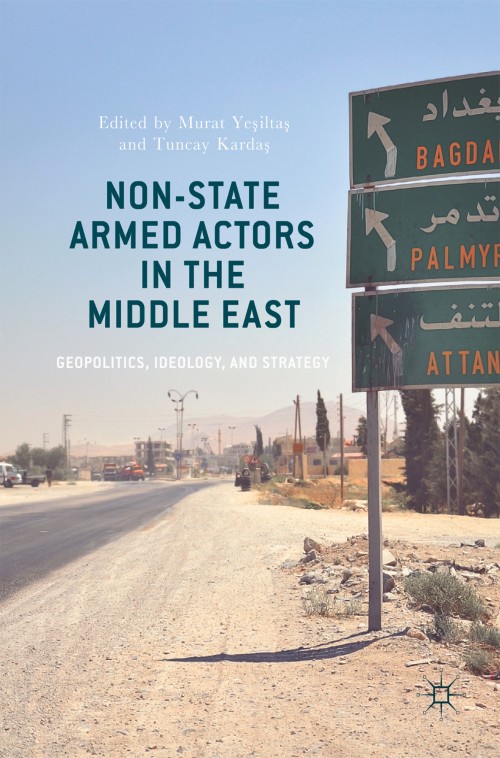
Non-State Armed Actors in the Middle East [electronic resource] : Geopolitics, Ideology, and Strategy / edited by Murat Yeşiltaş, Tuncay Kardaş.
Erişim Adresi
ISBN
9783319552873
Dil Kodu
İngilizce
Yer Numarası
DK/16847
Basım Bildirimi
1st ed. 2018.
Yayın Bilgisi
Cham : Springer International Publishing : Imprint: Palgrave Macmillan, 2018.
Fiziksel Niteleme
XV, 278 p. 2 illus. in color. online resource.
İçindekiler Notu
1. Introduction: The Phenomenon of Non-State Armed Actors and Patterns of Violent Geopolitics in the Middle East -- 2. The Transformation of the Regional Order and Non-state Armed Actors: Pathways to the Empowerment -- 3. Understanding “Foreign Policy” of the PYD/YPG as a Non-State Actor in Syria and Beyond -- 4. The Kurdish Fight Against ISIS: Realizing the Virtual Kurdistan through Factionalized Politics in a Fragmented Homeland -- 5. Global Politics of Image and the Making of a Legitimate Non-State Armed Actor: Syrian Kurds and ‘the Secular West’ in Kobane -- 6. From Al-Qaeda to Post Qaeda: The Evolution of ISIS -- 7. The New Middle East, ISIS and the 6th Revolt against the West -- 8. A New Controversial Actor in Post-ISIS Iraq: Al-Hashd Al-Shaabi (The Popular Mobilization Forces) -- 9. Operationalizing the Vision of Building a New Caliphate: From Al-Qaeda to the Islamic State (IS) -- 10. The Making of Foreign Fighters in the Middle East: Identity, Social Media and VirtualRadicalization -- 11. What the ISIS Crisis Means for the Future of the Middle East -- 12. Conclusion: The State of the Non-State Armed Actors in the Middle East.
Özet, vb.
This volume investigates the nature and changing roles of the non-state armed groups in the Middle East with a special focus on Kurdish, Shia and Islamic State groups. To understand the nature of transformation in the Middle Eastern geopolitical space, it provides new empirical and analytical insights into the impact of three prominent actors, namely ISIS, YPG and Shia Militias. With its distinctive detailed and multi-faceted analyses, it offers new findings on the changing contours of sovereignty, geopolitics and ideology, particularly after the Arab Uprisings. Overall this volume contributes to the study of violent geopolitics, critical security studies and international relations particularly by exploring the ideologies and strategies of the new non-state armed actors.
Konu
Terrorism.
Political violence.
Middle East __ Politics and government.
Politics and war.
Peace.
Human rights.
International organization.
Terrorism and Political Violence.
Middle Eastern Politics.
Military and Defence Studies.
Peace and Conflict Studies.
Human Rights.
International Organization.
Political violence.
Middle East __ Politics and government.
Politics and war.
Peace.
Human rights.
International organization.
Terrorism and Political Violence.
Middle Eastern Politics.
Military and Defence Studies.
Peace and Conflict Studies.
Human Rights.
International Organization.
Diğer Yazarlar
Kurum Adı
