LEADER 04169nam a22005535i 4500
001 815638
003 TR_AnAIT
005 20260130205614
007 cr nn 008mamaa
008 180825s2019 sz | s |||| 0|eng d
020 |a9783319714530|9978-3-319-71453-0
024 7 |a10.1007/978-3-319-71453-0|2doi
041 |aeng
049 |aTürk Tarih Kurumu Kütüphanesi
050 4|aJZ1252
072 7|aJPS|2bicssc
072 7|aKCP|2bicssc
072 7|aPOL011020|2bisacsh
072 7|aJPS|2thema
072 7|aKCP|2thema
082 04|a327.111|223
090 |aDK/16857
100 1 |aLee, Seungjoo.|eauthor.|4aut|4http://id.loc.gov/vocabulary/relators/aut
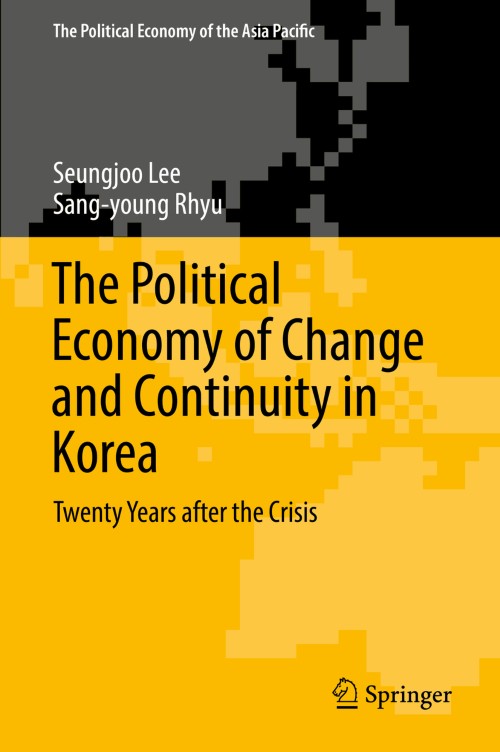
245 14|aThe Political Economy of Change and Continuity in Korea|h[electronic resource] :|bTwenty Years after the Crisis /|cby Seungjoo Lee, Sang-young Rhyu.
250 |a1st ed. 2019.
264 1|aCham :|bSpringer International Publishing :|bImprint: Springer,|c2019.
300 |aIX, 136 p. 4 illus.|bonline resource.
336 |atext|btxt|2rdacontent
337 |acomputer|bc|2rdamedia
338 |aonline resource|bcr|2rdacarrier
347 |atext file|bPDF|2rda
490 1 |aThe Political Economy of the Asia Pacific,|x1866-6515
505 0 |aCh. 1 Introduction -- Part I Governance Reform -- Ch. 2 Chaebol Reform And The Dynamics Of Institutional Change -- Ch. 3 The Corporate Governance Reform Of Newly Privatized Firms -- Ch. 4 The Paradox Of Legalization And Informal Networks -- Part II The Political Economy Of Industrial Restructuring -- Ch. 5 Globalization And The Transformation Of Production Networks In The Auto Industry: The Case Of Hyundai Motors -- Ch. 6 The Political Economy Of Cooperation And Competition In The It Industry: The Dynamics Of Self-Reinforcing Mechanism -- Ch. 7 The Restructuring Of The Aerospace Industry: The Interplay Between The Government And Private Corporation -- Part III Foreign Economic Policy -- Ch. 8 The Evolution Of FTA Policy In Korea: Toward A Hubbing Strategy.
520 |aThis book analyzes the transformation of Korean political economy since the 1990s. In the wake of the Asian financial crisis of 1997, the political economy of South Korea has evolved around two diametrically opposed features: convergence into the Anglo-American model and the state-led strategic restructuring of industries. To unravel the peculiar nature of the political economy in Korea, the authors first identify major factors that contributed to the dual dynamics of change and continuity in Korea: external pressures, ideological shift in political leadership, and the pivotal role of the Korean government. Next, they examine the way in which these factors interacted with each other to reshape the evolutionary path of the Korean political economy. Using several case studies, the authors take us through the stages of this transformation, from the reform of the chaebols to the industrial restructuring of the auto, IT, and aerospace industries to the rise of South Korea’s Free Trade Agreements (FTA) initiative. In explaining the role that the dual dynamics of change and continuity play in modern Korean political economy, this book makes an important contribution to the existing literature and will be of interest to scholars and policy-makers concerned with development in Korea and the Asia-Pacific.
650 0|aInternational economic relations.
650 0|aEconomic policy.
650 0|aDevelopment economics.
650 14|aInternational Political Economy’.
650 24|aEconomic Policy.
650 24|aDevelopment Economics.
700 1 |aRhyu, Sang-young.|eauthor.|4aut|4http://id.loc.gov/vocabulary/relators/aut
710 2 |aSpringerLink (Online service)
773 0 |tSpringer Nature eBook
776 08|iPrinted edition:|z9783319714516
776 08|iPrinted edition:|z9783319714523
776 08|iPrinted edition:|z9783030100582
830 0|aThe Political Economy of the Asia Pacific,|x1866-6515
856 40|uhttps://doi.org/10.1007/978-3-319-71453-0
912 |aZDB-2-POS
912 |aZDB-2-SXPI
950 |aPolitical Science and International Studies (SpringerNature-41174)
950 |aPolitical Science and International Studies (R0) (SpringerNature-43724)