

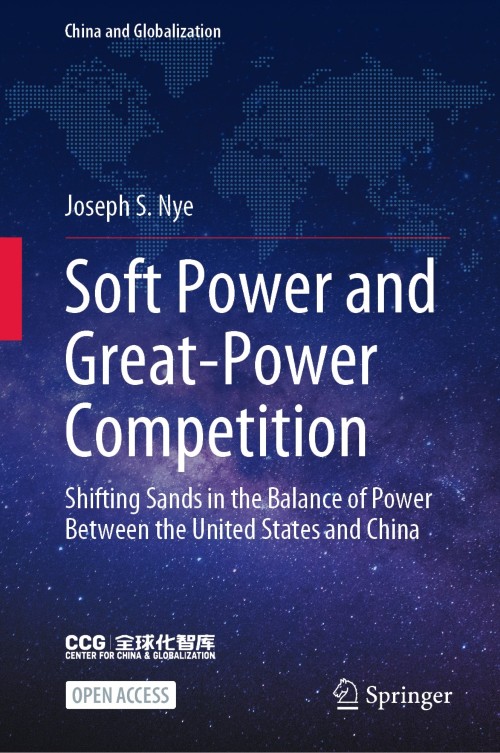
Soft Power and Great-Power Competition [electronic resource] : Shifting Sands in the Balance of Power Between the United States and China / by Joseph S. Nye.
Erişim Adresi
ISBN
9789819907144
Dil Kodu
İngilizce
Yer Numarası
DK/16932
Yazar
Basım Bildirimi
1st ed. 2023.
Yayın Bilgisi
Singapore : Springer Nature Singapore : Imprint: Springer, 2023.
Fiziksel Niteleme
IX, 208 p. 2 illus., 1 illus. in color. online resource.
Dizi
China and Globalization, 2730-9991
İçindekiler Notu
Soft Power -- The Great Power Shift -- The Limits of Soft Power -- State Smart Power Strategies -- Understanding 21st Century Power Shifts -- Soft power: the Origins and Political Progress of a Concept -- What Is a Moral Foreign Policy? -- Soft Power and American Foreign Policy -- Get Smart: Combining Hard and Soft Power -- Obama the Pragmatist -- American Soft Power in the Age of Trump -- Trump’s Effect on US Foreign Policy -- Can Joe Biden’s America Be Trusted? -- After the Liberal International Order -- As China Rises, Must Others Bow? -- The Rise of China’s Soft Power -- Hard Decisions on Soft Power: Opportunities and Difficulties for Chinese Soft Power -- Xi Jinping’s Marco Polo Strategy -- China’s Soft and Sharp Power -- Perspectives for a China Strategy -- The ‘Nye Report’: Six Years Later -- The Dollar and the Dragon -- Is China Overtaking America? -- The Financial Crisis and US-China Misperceptions -- Work With China, Don’t Contain It -- The Future of U.S -- China Relations -- The Kindleberger Trap.-The Cooperative Rivalry of US-China Relations -- The Future of U.S.-China Relations After Buenos Aires -- For the US and China, Interdependence is a Double-Edged Sword -- Cold War with China is Avoidable -- The Logic of US-China Competition.
Özet, vb.
This open access book consists of essays selected from Joseph S. Nye, Jr.’s last three decades of writing and illustrate a variety of perspectives on the nature of power, the role of the United States in the world and US-China relations. Through this collection, it is hoped that readers will gain a better understanding of today’s global environment and find that while great power competition may be inevitable in a world as centers of power shift, cooperating to address transnational challenges can be a positive sum game. The contents of this book are divided into four main parts. Part One discusses the origins and political progress of the concept of “Soft Power”. Part Two explores soft power in the American experience, its sources and interaction with US foreign policy, as well as its ebb and flow in the age of Obama, Trump and Biden. Part Three examines the rise of and the opportunities and difficulties for Chinese soft power, focusing on China’s investment in soft power andhow this demonstrates its commitment to a peaceful rise. However, it also addresses the question of how can China get “smart” on how it uses soft power. Part Four provides a bird’s-eye view of power shifts in the 21st century and the interactions between the US as an established power and China as a rising power, while also reassuring readers that Thucydidean fears are unnecessary and a Cold War is avoidable. Both countries have to realize that some forms of power must be exercised with others, not over others, the development of soft power need not be a zero-sum game. Ultimately, the US-China relationship is a “cooperative rivalry” where a successful strategy of “smart competition” is necessary and cooperation on transnational challenges like climate change, pandemics, cyberterrorism and nuclear proliferation, will serve to benefit not only China and the US, but the world as a whole.
Konu
International relations.
International economic relations.
Globalization.
International Relations.
International Political Economy’.
Globalization.
Foreign Policy.
International economic relations.
Globalization.
International Relations.
International Political Economy’.
Globalization.
Foreign Policy.
Kurum Adı
Eseri Alıntıla
Referansları kullanmadan önce gözden geçirmeniz ve varsa gerekli düzeltmeleri yapmanız önerilir.
Dijital Kaynak
MARC Görünümü
LEADER 06440nam a22006735i 4500
001 815713
003 TR_AnAIT
005 20260130205234
007 cr nn 008mamaa
008 230426s2023 si | s |||| 0|eng d
020 |a9789819907144|9978-981-99-0714-4
024 7 |a10.1007/978-981-99-0714-4|2doi
041 |aeng
049 |aTürk Tarih Kurumu Kütüphanesi
050 4|aJZ2-6530
072 7|aJPS|2bicssc
072 7|aPOL011000|2bisacsh
072 7|aJPS|2thema
082 04|a327|223
090 |aDK/16932
100 1 |aNye, Joseph S.|eauthor.|4aut|4http://id.loc.gov/vocabulary/relators/aut
245 10|aSoft Power and Great-Power Competition|h[electronic resource] :|bShifting Sands in the Balance of Power Between the United States and China /|cby Joseph S. Nye.
250 |a1st ed. 2023.
264 1|aSingapore :|bSpringer Nature Singapore :|bImprint: Springer,|c2023.
300 |aIX, 208 p. 2 illus., 1 illus. in color.|bonline resource.
336 |atext|btxt|2rdacontent
337 |acomputer|bc|2rdamedia
338 |aonline resource|bcr|2rdacarrier
341 0 |bTable of contents navigation|2onix
341 0 |bSingle logical reading order|2onix
341 0 |bShort alternative textual descriptions|2onix
341 0 |bUse of color is not sole means of conveying information|2onix
341 0 |bUse of high contrast between text and background color|2onix
341 0 |bNext / Previous structural navigation|2onix
341 0 |bAll non-decorative content supports reading without sight|2onix
347 |atext file|bPDF|2rda
490 1 |aChina and Globalization,|x2730-9991
505 0 |aSoft Power -- The Great Power Shift -- The Limits of Soft Power -- State Smart Power Strategies -- Understanding 21st Century Power Shifts -- Soft power: the Origins and Political Progress of a Concept -- What Is a Moral Foreign Policy? -- Soft Power and American Foreign Policy -- Get Smart: Combining Hard and Soft Power -- Obama the Pragmatist -- American Soft Power in the Age of Trump -- Trump’s Effect on US Foreign Policy -- Can Joe Biden’s America Be Trusted? -- After the Liberal International Order -- As China Rises, Must Others Bow? -- The Rise of China’s Soft Power -- Hard Decisions on Soft Power: Opportunities and Difficulties for Chinese Soft Power -- Xi Jinping’s Marco Polo Strategy -- China’s Soft and Sharp Power -- Perspectives for a China Strategy -- The ‘Nye Report’: Six Years Later -- The Dollar and the Dragon -- Is China Overtaking America? -- The Financial Crisis and US-China Misperceptions -- Work With China, Don’t Contain It -- The Future of U.S -- China Relations -- The Kindleberger Trap.-The Cooperative Rivalry of US-China Relations -- The Future of U.S.-China Relations After Buenos Aires -- For the US and China, Interdependence is a Double-Edged Sword -- Cold War with China is Avoidable -- The Logic of US-China Competition.
506 0 |aOpen Access
520 |aThis open access book consists of essays selected from Joseph S. Nye, Jr.’s last three decades of writing and illustrate a variety of perspectives on the nature of power, the role of the United States in the world and US-China relations. Through this collection, it is hoped that readers will gain a better understanding of today’s global environment and find that while great power competition may be inevitable in a world as centers of power shift, cooperating to address transnational challenges can be a positive sum game. The contents of this book are divided into four main parts. Part One discusses the origins and political progress of the concept of “Soft Power”. Part Two explores soft power in the American experience, its sources and interaction with US foreign policy, as well as its ebb and flow in the age of Obama, Trump and Biden. Part Three examines the rise of and the opportunities and difficulties for Chinese soft power, focusing on China’s investment in soft power andhow this demonstrates its commitment to a peaceful rise. However, it also addresses the question of how can China get “smart” on how it uses soft power. Part Four provides a bird’s-eye view of power shifts in the 21st century and the interactions between the US as an established power and China as a rising power, while also reassuring readers that Thucydidean fears are unnecessary and a Cold War is avoidable. Both countries have to realize that some forms of power must be exercised with others, not over others, the development of soft power need not be a zero-sum game. Ultimately, the US-China relationship is a “cooperative rivalry” where a successful strategy of “smart competition” is necessary and cooperation on transnational challenges like climate change, pandemics, cyberterrorism and nuclear proliferation, will serve to benefit not only China and the US, but the world as a whole.
532 8 |aAccessibility summary: This PDF does not fully comply with PDF/UA standards, but does feature limited screen reader support, described non-text content (images, graphs), bookmarks for easy navigation and searchable, selectable text. Users of assistive technologies may experience difficulty navigating or interpreting content in this document. We recognize the importance of accessibility, and we welcome queries about accessibility for any of our products. If you have a question or an access need, please get in touch with us at accessibilitysupport@springernature.com.
532 8 |aNo reading system accessibility options actively disabled
532 8 |aPublisher contact for further accessibility information: accessibilitysupport@springernature.com
650 0|aInternational relations.
650 0|aInternational economic relations.
650 0|aGlobalization.
650 14|aInternational Relations.
650 24|aInternational Political Economy’.
650 24|aGlobalization.
650 24|aForeign Policy.
710 2 |aSpringerLink (Online service)
773 0 |tSpringer Nature eBook
776 08|iPrinted edition:|z9789819907137
776 08|iPrinted edition:|z9789819907151
776 08|iPrinted edition:|z9789819907168
830 0|aChina and Globalization,|x2730-9991
856 40|uhttps://doi.org/10.1007/978-981-99-0714-4
912 |aZDB-2-POS
912 |aZDB-2-SXPI
912 |aZDB-2-SOB
950 |aPolitical Science and International Studies (SpringerNature-41174)
950 |aPolitical Science and International Studies (R0) (SpringerNature-43724)
001 815713
003 TR_AnAIT
005 20260130205234
007 cr nn 008mamaa
008 230426s2023 si | s |||| 0|eng d
020 |a9789819907144|9978-981-99-0714-4
024 7 |a10.1007/978-981-99-0714-4|2doi
041 |aeng
049 |aTürk Tarih Kurumu Kütüphanesi
050 4|aJZ2-6530
072 7|aJPS|2bicssc
072 7|aPOL011000|2bisacsh
072 7|aJPS|2thema
082 04|a327|223
090 |aDK/16932
100 1 |aNye, Joseph S.|eauthor.|4aut|4http://id.loc.gov/vocabulary/relators/aut
245 10|aSoft Power and Great-Power Competition|h[electronic resource] :|bShifting Sands in the Balance of Power Between the United States and China /|cby Joseph S. Nye.
250 |a1st ed. 2023.
264 1|aSingapore :|bSpringer Nature Singapore :|bImprint: Springer,|c2023.
300 |aIX, 208 p. 2 illus., 1 illus. in color.|bonline resource.
336 |atext|btxt|2rdacontent
337 |acomputer|bc|2rdamedia
338 |aonline resource|bcr|2rdacarrier
341 0 |bTable of contents navigation|2onix
341 0 |bSingle logical reading order|2onix
341 0 |bShort alternative textual descriptions|2onix
341 0 |bUse of color is not sole means of conveying information|2onix
341 0 |bUse of high contrast between text and background color|2onix
341 0 |bNext / Previous structural navigation|2onix
341 0 |bAll non-decorative content supports reading without sight|2onix
347 |atext file|bPDF|2rda
490 1 |aChina and Globalization,|x2730-9991
505 0 |aSoft Power -- The Great Power Shift -- The Limits of Soft Power -- State Smart Power Strategies -- Understanding 21st Century Power Shifts -- Soft power: the Origins and Political Progress of a Concept -- What Is a Moral Foreign Policy? -- Soft Power and American Foreign Policy -- Get Smart: Combining Hard and Soft Power -- Obama the Pragmatist -- American Soft Power in the Age of Trump -- Trump’s Effect on US Foreign Policy -- Can Joe Biden’s America Be Trusted? -- After the Liberal International Order -- As China Rises, Must Others Bow? -- The Rise of China’s Soft Power -- Hard Decisions on Soft Power: Opportunities and Difficulties for Chinese Soft Power -- Xi Jinping’s Marco Polo Strategy -- China’s Soft and Sharp Power -- Perspectives for a China Strategy -- The ‘Nye Report’: Six Years Later -- The Dollar and the Dragon -- Is China Overtaking America? -- The Financial Crisis and US-China Misperceptions -- Work With China, Don’t Contain It -- The Future of U.S -- China Relations -- The Kindleberger Trap.-The Cooperative Rivalry of US-China Relations -- The Future of U.S.-China Relations After Buenos Aires -- For the US and China, Interdependence is a Double-Edged Sword -- Cold War with China is Avoidable -- The Logic of US-China Competition.
506 0 |aOpen Access
520 |aThis open access book consists of essays selected from Joseph S. Nye, Jr.’s last three decades of writing and illustrate a variety of perspectives on the nature of power, the role of the United States in the world and US-China relations. Through this collection, it is hoped that readers will gain a better understanding of today’s global environment and find that while great power competition may be inevitable in a world as centers of power shift, cooperating to address transnational challenges can be a positive sum game. The contents of this book are divided into four main parts. Part One discusses the origins and political progress of the concept of “Soft Power”. Part Two explores soft power in the American experience, its sources and interaction with US foreign policy, as well as its ebb and flow in the age of Obama, Trump and Biden. Part Three examines the rise of and the opportunities and difficulties for Chinese soft power, focusing on China’s investment in soft power andhow this demonstrates its commitment to a peaceful rise. However, it also addresses the question of how can China get “smart” on how it uses soft power. Part Four provides a bird’s-eye view of power shifts in the 21st century and the interactions between the US as an established power and China as a rising power, while also reassuring readers that Thucydidean fears are unnecessary and a Cold War is avoidable. Both countries have to realize that some forms of power must be exercised with others, not over others, the development of soft power need not be a zero-sum game. Ultimately, the US-China relationship is a “cooperative rivalry” where a successful strategy of “smart competition” is necessary and cooperation on transnational challenges like climate change, pandemics, cyberterrorism and nuclear proliferation, will serve to benefit not only China and the US, but the world as a whole.
532 8 |aAccessibility summary: This PDF does not fully comply with PDF/UA standards, but does feature limited screen reader support, described non-text content (images, graphs), bookmarks for easy navigation and searchable, selectable text. Users of assistive technologies may experience difficulty navigating or interpreting content in this document. We recognize the importance of accessibility, and we welcome queries about accessibility for any of our products. If you have a question or an access need, please get in touch with us at accessibilitysupport@springernature.com.
532 8 |aNo reading system accessibility options actively disabled
532 8 |aPublisher contact for further accessibility information: accessibilitysupport@springernature.com
650 0|aInternational relations.
650 0|aInternational economic relations.
650 0|aGlobalization.
650 14|aInternational Relations.
650 24|aInternational Political Economy’.
650 24|aGlobalization.
650 24|aForeign Policy.
710 2 |aSpringerLink (Online service)
773 0 |tSpringer Nature eBook
776 08|iPrinted edition:|z9789819907137
776 08|iPrinted edition:|z9789819907151
776 08|iPrinted edition:|z9789819907168
830 0|aChina and Globalization,|x2730-9991
856 40|uhttps://doi.org/10.1007/978-981-99-0714-4
912 |aZDB-2-POS
912 |aZDB-2-SXPI
912 |aZDB-2-SOB
950 |aPolitical Science and International Studies (SpringerNature-41174)
950 |aPolitical Science and International Studies (R0) (SpringerNature-43724)
Materyaller
Depodan talep edilen materyal sadece kütüphane içerisinde kullanılmaktadır.
Materyal dışarıya ödünç verilmemektedir.
Materyal dışarıya ödünç verilmemektedir.
