

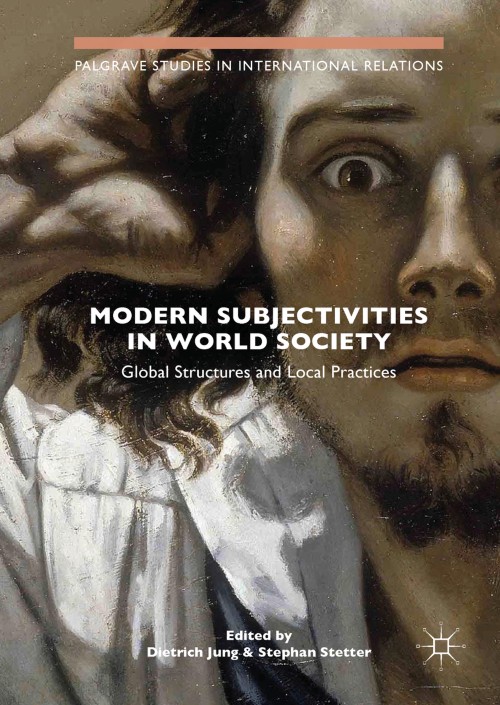
Modern Subjectivities in World Society [electronic resource] : Global Structures and Local Practices / edited by Dietrich Jung, Stephan Stetter.
Erişim Adresi
ISBN
9783319907345
Dil Kodu
İngilizce
Yer Numarası
DK/16974
Basım Bildirimi
1st ed. 2019.
Yayın Bilgisi
Cham : Springer International Publishing : Imprint: Palgrave Macmillan, 2019.
Fiziksel Niteleme
XIV, 235 p. online resource.
Dizi
Palgrave Studies in International Relations, 2946-2681
İçindekiler Notu
1. Chapter 1 Why Study Modern Subjectivities in World Society? An Introduction by Dietrich Jung and Stephan Stetter -- 2. Modern Subjectivities and World Political Order: Differentiation, Inclusion/Exclusion, and the Evolution of the International by Stephan Stetter -- 3. Modern Subjectivity and the Emergence of Global Modernity: Syntax and Semantics of Modern Times by Dietrich Jung -- 4. Globalization and Nationalist Subjectivities by Siniša Malešević -- 5. Colonial Globality, Postcolonial Subjectivities in the Middle East by Pinar Bilgin -- 6. The Everyday Production of Modern Subjectivity in World Society: Global Structures Meet Local Practices in Palestine by Jan Busse -- 7. Defiant Subjects: Religion in World Polity Theory and Public Discourse by Paul Bramadat -- 8. Modern Subjectivities and Religions in a Post-Westphalian World Society: Reconstructing the Universal through Lived Particularities by Peter Beyer -- 9. Modern Subjectivities, Religious Belief, and Irony in Everyday Life by George M. Thomas -- 10. In-between Machines: The Global, Local, and Automobile Subjectivity Formation by Martin Ledstrup -- 11. Incorporating Nonhuman Subjectivity into World Society. The Case for Extending Personhood to Plants by Thomas J. Puleo.
Özet, vb.
This book brings together theories of world society with poststructuralist and postcolonial work on modern subjectivity to understand the universalising and particularising processes of globalisation. It addresses a theoretical void in global studies by attending to the co-constituted process through which modern subjectivities and global processes emerge and interact. The editors outline a key problem in global studies, which is a lack of engagement between the local/particular/individual and the ‘universalising’ processes in which they are situated. The volume deals with this concern with contributions from historical sociologists, poststructuralist and postcolonial scholars and by focusing in the Middle East, religion in global modernity and non-human subjectivities. Dietrich Jung is Professor and Head of the Center for Contemporary Middle East Studies, University of Southern Denmark, Denmark. Stephan Stetter is Professor of World Politics and Conflict Studies at the Bundeswehr University Munich, Germany/EU and co-editor of the Zeitschrift für Internationale Beziehungen. .
Konu
International relations.
Globalization.
Middle East __ Politics and government.
Religion and politics.
Political science.
International Relations Theory.
Globalization.
Middle Eastern Politics.
Politics and Religion.
Political Theory.
Globalization.
Middle East __ Politics and government.
Religion and politics.
Political science.
International Relations Theory.
Globalization.
Middle Eastern Politics.
Politics and Religion.
Political Theory.
Diğer Yazarlar
Kurum Adı
Eseri Alıntıla
Referansları kullanmadan önce gözden geçirmeniz ve varsa gerekli düzeltmeleri yapmanız önerilir.
Dijital Kaynak
MARC Görünümü
LEADER 04536nam a22005775i 4500
001 815755
003 TR_AnAIT
005 20260130204935
007 cr nn 008mamaa
008 180720s2019 sz | s |||| 0|eng d
020 |a9783319907345|9978-3-319-90734-5
024 7 |a10.1007/978-3-319-90734-5|2doi
041 |aeng
049 |aTürk Tarih Kurumu Kütüphanesi
050 4|aJZ2-6530
072 7|aJPS|2bicssc
072 7|aPOL011000|2bisacsh
072 7|aJPS|2thema
082 04|a327.101|223
090 |aDK/16974
245 10|aModern Subjectivities in World Society|h[electronic resource] :|bGlobal Structures and Local Practices /|cedited by Dietrich Jung, Stephan Stetter.
250 |a1st ed. 2019.
264 1|aCham :|bSpringer International Publishing :|bImprint: Palgrave Macmillan,|c2019.
300 |aXIV, 235 p.|bonline resource.
336 |atext|btxt|2rdacontent
337 |acomputer|bc|2rdamedia
338 |aonline resource|bcr|2rdacarrier
347 |atext file|bPDF|2rda
490 1 |aPalgrave Studies in International Relations,|x2946-2681
505 0 |a1. Chapter 1 Why Study Modern Subjectivities in World Society? An Introduction by Dietrich Jung and Stephan Stetter -- 2. Modern Subjectivities and World Political Order: Differentiation, Inclusion/Exclusion, and the Evolution of the International by Stephan Stetter -- 3. Modern Subjectivity and the Emergence of Global Modernity: Syntax and Semantics of Modern Times by Dietrich Jung -- 4. Globalization and Nationalist Subjectivities by Siniša Malešević -- 5. Colonial Globality, Postcolonial Subjectivities in the Middle East by Pinar Bilgin -- 6. The Everyday Production of Modern Subjectivity in World Society: Global Structures Meet Local Practices in Palestine by Jan Busse -- 7. Defiant Subjects: Religion in World Polity Theory and Public Discourse by Paul Bramadat -- 8. Modern Subjectivities and Religions in a Post-Westphalian World Society: Reconstructing the Universal through Lived Particularities by Peter Beyer -- 9. Modern Subjectivities, Religious Belief, and Irony in Everyday Life by George M. Thomas -- 10. In-between Machines: The Global, Local, and Automobile Subjectivity Formation by Martin Ledstrup -- 11. Incorporating Nonhuman Subjectivity into World Society. The Case for Extending Personhood to Plants by Thomas J. Puleo.
520 |aThis book brings together theories of world society with poststructuralist and postcolonial work on modern subjectivity to understand the universalising and particularising processes of globalisation. It addresses a theoretical void in global studies by attending to the co-constituted process through which modern subjectivities and global processes emerge and interact. The editors outline a key problem in global studies, which is a lack of engagement between the local/particular/individual and the ‘universalising’ processes in which they are situated. The volume deals with this concern with contributions from historical sociologists, poststructuralist and postcolonial scholars and by focusing in the Middle East, religion in global modernity and non-human subjectivities. Dietrich Jung is Professor and Head of the Center for Contemporary Middle East Studies, University of Southern Denmark, Denmark. Stephan Stetter is Professor of World Politics and Conflict Studies at the Bundeswehr University Munich, Germany/EU and co-editor of the Zeitschrift für Internationale Beziehungen. .
650 0|aInternational relations.
650 0|aGlobalization.
650 0|aMiddle East|xPolitics and government.
650 0|aReligion and politics.
650 0|aPolitical science.
650 14|aInternational Relations Theory.
650 24|aGlobalization.
650 24|aMiddle Eastern Politics.
650 24|aPolitics and Religion.
650 24|aPolitical Theory.
700 1 |aJung, Dietrich.|eeditor.|4edt|4http://id.loc.gov/vocabulary/relators/edt
700 1 |aStetter, Stephan.|eeditor.|4edt|4http://id.loc.gov/vocabulary/relators/edt
710 2 |aSpringerLink (Online service)
773 0 |tSpringer Nature eBook
776 08|iPrinted edition:|z9783319907338
776 08|iPrinted edition:|z9783319907352
776 08|iPrinted edition:|z9783030080860
830 0|aPalgrave Studies in International Relations,|x2946-2681
856 40|uhttps://doi.org/10.1007/978-3-319-90734-5
912 |aZDB-2-POS
912 |aZDB-2-SXPI
950 |aPolitical Science and International Studies (SpringerNature-41174)
950 |aPolitical Science and International Studies (R0) (SpringerNature-43724)
001 815755
003 TR_AnAIT
005 20260130204935
007 cr nn 008mamaa
008 180720s2019 sz | s |||| 0|eng d
020 |a9783319907345|9978-3-319-90734-5
024 7 |a10.1007/978-3-319-90734-5|2doi
041 |aeng
049 |aTürk Tarih Kurumu Kütüphanesi
050 4|aJZ2-6530
072 7|aJPS|2bicssc
072 7|aPOL011000|2bisacsh
072 7|aJPS|2thema
082 04|a327.101|223
090 |aDK/16974
245 10|aModern Subjectivities in World Society|h[electronic resource] :|bGlobal Structures and Local Practices /|cedited by Dietrich Jung, Stephan Stetter.
250 |a1st ed. 2019.
264 1|aCham :|bSpringer International Publishing :|bImprint: Palgrave Macmillan,|c2019.
300 |aXIV, 235 p.|bonline resource.
336 |atext|btxt|2rdacontent
337 |acomputer|bc|2rdamedia
338 |aonline resource|bcr|2rdacarrier
347 |atext file|bPDF|2rda
490 1 |aPalgrave Studies in International Relations,|x2946-2681
505 0 |a1. Chapter 1 Why Study Modern Subjectivities in World Society? An Introduction by Dietrich Jung and Stephan Stetter -- 2. Modern Subjectivities and World Political Order: Differentiation, Inclusion/Exclusion, and the Evolution of the International by Stephan Stetter -- 3. Modern Subjectivity and the Emergence of Global Modernity: Syntax and Semantics of Modern Times by Dietrich Jung -- 4. Globalization and Nationalist Subjectivities by Siniša Malešević -- 5. Colonial Globality, Postcolonial Subjectivities in the Middle East by Pinar Bilgin -- 6. The Everyday Production of Modern Subjectivity in World Society: Global Structures Meet Local Practices in Palestine by Jan Busse -- 7. Defiant Subjects: Religion in World Polity Theory and Public Discourse by Paul Bramadat -- 8. Modern Subjectivities and Religions in a Post-Westphalian World Society: Reconstructing the Universal through Lived Particularities by Peter Beyer -- 9. Modern Subjectivities, Religious Belief, and Irony in Everyday Life by George M. Thomas -- 10. In-between Machines: The Global, Local, and Automobile Subjectivity Formation by Martin Ledstrup -- 11. Incorporating Nonhuman Subjectivity into World Society. The Case for Extending Personhood to Plants by Thomas J. Puleo.
520 |aThis book brings together theories of world society with poststructuralist and postcolonial work on modern subjectivity to understand the universalising and particularising processes of globalisation. It addresses a theoretical void in global studies by attending to the co-constituted process through which modern subjectivities and global processes emerge and interact. The editors outline a key problem in global studies, which is a lack of engagement between the local/particular/individual and the ‘universalising’ processes in which they are situated. The volume deals with this concern with contributions from historical sociologists, poststructuralist and postcolonial scholars and by focusing in the Middle East, religion in global modernity and non-human subjectivities. Dietrich Jung is Professor and Head of the Center for Contemporary Middle East Studies, University of Southern Denmark, Denmark. Stephan Stetter is Professor of World Politics and Conflict Studies at the Bundeswehr University Munich, Germany/EU and co-editor of the Zeitschrift für Internationale Beziehungen. .
650 0|aInternational relations.
650 0|aGlobalization.
650 0|aMiddle East|xPolitics and government.
650 0|aReligion and politics.
650 0|aPolitical science.
650 14|aInternational Relations Theory.
650 24|aGlobalization.
650 24|aMiddle Eastern Politics.
650 24|aPolitics and Religion.
650 24|aPolitical Theory.
700 1 |aJung, Dietrich.|eeditor.|4edt|4http://id.loc.gov/vocabulary/relators/edt
700 1 |aStetter, Stephan.|eeditor.|4edt|4http://id.loc.gov/vocabulary/relators/edt
710 2 |aSpringerLink (Online service)
773 0 |tSpringer Nature eBook
776 08|iPrinted edition:|z9783319907338
776 08|iPrinted edition:|z9783319907352
776 08|iPrinted edition:|z9783030080860
830 0|aPalgrave Studies in International Relations,|x2946-2681
856 40|uhttps://doi.org/10.1007/978-3-319-90734-5
912 |aZDB-2-POS
912 |aZDB-2-SXPI
950 |aPolitical Science and International Studies (SpringerNature-41174)
950 |aPolitical Science and International Studies (R0) (SpringerNature-43724)
Materyaller
Depodan talep edilen materyal sadece kütüphane içerisinde kullanılmaktadır.
Materyal dışarıya ödünç verilmemektedir.
Materyal dışarıya ödünç verilmemektedir.
