

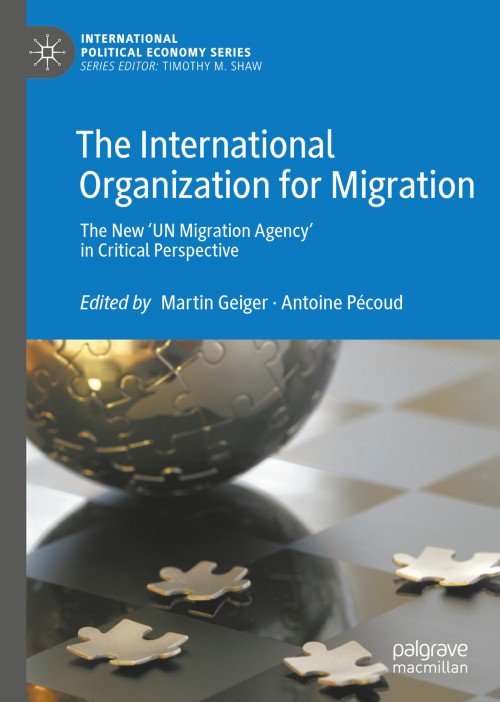
The International Organization for Migration [electronic resource] : The New ‘UN Migration Agency’ in Critical Perspective / edited by Martin Geiger, Antoine Pécoud.
Erişim Adresi
ISBN
9783030329761
Dil Kodu
İngilizce
Yer Numarası
DK/17012
Basım Bildirimi
1st ed. 2020.
Yayın Bilgisi
Cham : Springer International Publishing : Imprint: Palgrave Macmillan, 2020.
Fiziksel Niteleme
XVII, 316 p. 8 illus., 3 illus. in color. online resource.
Dizi
International Political Economy Series, 2662-2491
İçindekiler Notu
1. Introduction: The International Organization for Migration as the New ‘UN Migration Agency’ -- 2. Unfinished Business: The IOM and Migrants’ Human Rights -- 3. Gendering Migration Management -- 4. Drivers of Expenditure Allocation in IOM: Refugees, Donors, and International Bureaucracy -- 5. Between Migration and Development: The IOM’s Development Fund -- 6. Measuring ‘Well-Governed’ Migration: The IOM’s Migration Governance Indicators -- 7. The IOM in Building and Supporting Migration Management in China -- 8. Knowledge Production at the IOM: Looking for Local Knowledge in Tajikistan -- 9. The IOM’s Missing Migrants Project: The Global Authority on Border Deaths -- 10. The IOM’s Humanitarian Border Management in the West African Ebola Crisis (2014–2016) -- 11. Humanitarian Detention and Deportation: The IOM and Anti-Trafficking in Laos -- 12. The IOM’s Crisis Management andthe Expulsion of Ethiopians from Saudi Arabia -- 13. Possible Futures? The New ‘UN Migration Agency’ and the Shifting Global Order.
Özet, vb.
‘This book recasts with brio the IOM’s transformation. The result is impressive and thought-provoking.’ —Didier Bigo, Professor of Sociology, Sciences Po Paris, France ‘Rich case studies show the interplay between the IOM’s soft power and its tendency to serve the will of powerful patrons. For an inside view of a process that continues to unfold, look no further than this volume.’ —David Scott FitzGerald, Gildred Chair in U.S.-Mexican Relations and Co-Director, Center for Comparative Immigration Studies, University of California San Diego, USA ‘A much needed and timely book. This book critically investigates the new role of the IOM as the UN agency responsible for managing people flows and borders.’ —Anna Triandafyllidou, Canada Excellence Research Chair in Migration and Integration, Ryerson University Toronto, Canada ‘The most up-to-date and encompassing research on the IOM. A must-read for those who are interested in migration and mobility studies, and the increasing role of the IOM in migration politics.’ —Zhenjiang Zhang, Professor and Dean, School of International Studies and Academy of Overseas Chinese Studies, Jinan University Guangzhou, China In 2016, the International Organization for Migration (IOM) became part of the United Nations. With 173 member states and more than 400 field offices, the IOM—the new ‘UN migration agency’—plays a key role in migration governance. The contributors in this volume provide an in-depth and comprehensive insight into the IOM, its transformation, current structure and projects, as well as its capacity, self-understanding and political agenda. Martin Geiger is Associate Professor of Politics of Human Migration and Mobility at Carleton University, Canada, Senior Research Fellow at the Center for China and Globalization in Beijing, and Corresponding Member of the Institute for Migration Research and Intercultural Studies in Osnabrueck, Germany. Antoine Pécoud is Professor of Sociology at the University of Paris 13, a Research Associate at CERI/Sciences Po, and a Fellow of the Institut des Migrations, France.
Konu
International economic relations.
International organization.
Emigration and immigration.
Political science.
International relations.
International Political Economy’.
International Organization.
Human Migration.
Governance and Government.
Foreign Policy.
International organization.
Emigration and immigration.
Political science.
International relations.
International Political Economy’.
International Organization.
Human Migration.
Governance and Government.
Foreign Policy.
Diğer Yazarlar
Kurum Adı
Eseri Alıntıla
Referansları kullanmadan önce gözden geçirmeniz ve varsa gerekli düzeltmeleri yapmanız önerilir.
Dijital Kaynak
MARC Görünümü
LEADER 06772nam a22007215i 4500
001 815793
003 TR_AnAIT
005 20260130204705
007 cr nn 008mamaa
008 200218s2020 sz | s |||| 0|eng d
020 |a9783030329761|9978-3-030-32976-1
024 7 |a10.1007/978-3-030-32976-1|2doi
041 |aeng
049 |aTürk Tarih Kurumu Kütüphanesi
050 4|aJZ1252
072 7|aJPS|2bicssc
072 7|aKCP|2bicssc
072 7|aPOL011020|2bisacsh
072 7|aJPS|2thema
072 7|aKCP|2thema
082 04|a327.111|223
090 |aDK/17012
245 14|aThe International Organization for Migration|h[electronic resource] :|bThe New ‘UN Migration Agency’ in Critical Perspective /|cedited by Martin Geiger, Antoine Pécoud.
250 |a1st ed. 2020.
264 1|aCham :|bSpringer International Publishing :|bImprint: Palgrave Macmillan,|c2020.
300 |aXVII, 316 p. 8 illus., 3 illus. in color.|bonline resource.
336 |atext|btxt|2rdacontent
337 |acomputer|bc|2rdamedia
338 |aonline resource|bcr|2rdacarrier
341 0 |bTable of contents navigation|2onix
341 0 |bSingle logical reading order|2onix
341 0 |bShort alternative textual descriptions|2onix
341 0 |bUse of color is not sole means of conveying information|2onix
341 0 |bUse of high contrast between text and background color|2onix
341 0 |bNext / Previous structural navigation|2onix
341 0 |bAll non-decorative content supports reading without sight|2onix
347 |atext file|bPDF|2rda
490 1 |aInternational Political Economy Series,|x2662-2491
505 0 |a1. Introduction: The International Organization for Migration as the New ‘UN Migration Agency’ -- 2. Unfinished Business: The IOM and Migrants’ Human Rights -- 3. Gendering Migration Management -- 4. Drivers of Expenditure Allocation in IOM: Refugees, Donors, and International Bureaucracy -- 5. Between Migration and Development: The IOM’s Development Fund -- 6. Measuring ‘Well-Governed’ Migration: The IOM’s Migration Governance Indicators -- 7. The IOM in Building and Supporting Migration Management in China -- 8. Knowledge Production at the IOM: Looking for Local Knowledge in Tajikistan -- 9. The IOM’s Missing Migrants Project: The Global Authority on Border Deaths -- 10. The IOM’s Humanitarian Border Management in the West African Ebola Crisis (2014–2016) -- 11. Humanitarian Detention and Deportation: The IOM and Anti-Trafficking in Laos -- 12. The IOM’s Crisis Management andthe Expulsion of Ethiopians from Saudi Arabia -- 13. Possible Futures? The New ‘UN Migration Agency’ and the Shifting Global Order.
520 |a‘This book recasts with brio the IOM’s transformation. The result is impressive and thought-provoking.’ —Didier Bigo, Professor of Sociology, Sciences Po Paris, France ‘Rich case studies show the interplay between the IOM’s soft power and its tendency to serve the will of powerful patrons. For an inside view of a process that continues to unfold, look no further than this volume.’ —David Scott FitzGerald, Gildred Chair in U.S.-Mexican Relations and Co-Director, Center for Comparative Immigration Studies, University of California San Diego, USA ‘A much needed and timely book. This book critically investigates the new role of the IOM as the UN agency responsible for managing people flows and borders.’ —Anna Triandafyllidou, Canada Excellence Research Chair in Migration and Integration, Ryerson University Toronto, Canada ‘The most up-to-date and encompassing research on the IOM. A must-read for those who are interested in migration and mobility studies, and the increasing role of the IOM in migration politics.’ —Zhenjiang Zhang, Professor and Dean, School of International Studies and Academy of Overseas Chinese Studies, Jinan University Guangzhou, China In 2016, the International Organization for Migration (IOM) became part of the United Nations. With 173 member states and more than 400 field offices, the IOM—the new ‘UN migration agency’—plays a key role in migration governance. The contributors in this volume provide an in-depth and comprehensive insight into the IOM, its transformation, current structure and projects, as well as its capacity, self-understanding and political agenda. Martin Geiger is Associate Professor of Politics of Human Migration and Mobility at Carleton University, Canada, Senior Research Fellow at the Center for China and Globalization in Beijing, and Corresponding Member of the Institute for Migration Research and Intercultural Studies in Osnabrueck, Germany. Antoine Pécoud is Professor of Sociology at the University of Paris 13, a Research Associate at CERI/Sciences Po, and a Fellow of the Institut des Migrations, France.
532 8 |aAccessibility summary: This PDF does not fully comply with PDF/UA standards, but does feature limited screen reader support, described non-text content (images, graphs), bookmarks for easy navigation and searchable, selectable text. Users of assistive technologies may experience difficulty navigating or interpreting content in this document. We recognize the importance of accessibility, and we welcome queries about accessibility for any of our products. If you have a question or an access need, please get in touch with us at accessibilitysupport@springernature.com.
532 8 |aNo reading system accessibility options actively disabled
532 8 |aPublisher contact for further accessibility information: accessibilitysupport@springernature.com
650 0|aInternational economic relations.
650 0|aInternational organization.
650 0|aEmigration and immigration.
650 0|aPolitical science.
650 0|aInternational relations.
650 14|aInternational Political Economy’.
650 24|aInternational Organization.
650 24|aHuman Migration.
650 24|aGovernance and Government.
650 24|aForeign Policy.
700 1 |aGeiger, Martin.|eeditor.|4edt|4http://id.loc.gov/vocabulary/relators/edt
700 1 |aPécoud, Antoine.|eeditor.|0(orcid)0000-0002-3159-8338|1https://orcid.org/0000-0002-3159-8338|4edt|4http://id.loc.gov/vocabulary/relators/edt
710 2 |aSpringerLink (Online service)
773 0 |tSpringer Nature eBook
776 08|iPrinted edition:|z9783030329754
776 08|iPrinted edition:|z9783030329778
776 08|iPrinted edition:|z9783030329785
830 0|aInternational Political Economy Series,|x2662-2491
856 40|uhttps://doi.org/10.1007/978-3-030-32976-1
912 |aZDB-2-POS
912 |aZDB-2-SXPI
950 |aPolitical Science and International Studies (SpringerNature-41174)
950 |aPolitical Science and International Studies (R0) (SpringerNature-43724)
001 815793
003 TR_AnAIT
005 20260130204705
007 cr nn 008mamaa
008 200218s2020 sz | s |||| 0|eng d
020 |a9783030329761|9978-3-030-32976-1
024 7 |a10.1007/978-3-030-32976-1|2doi
041 |aeng
049 |aTürk Tarih Kurumu Kütüphanesi
050 4|aJZ1252
072 7|aJPS|2bicssc
072 7|aKCP|2bicssc
072 7|aPOL011020|2bisacsh
072 7|aJPS|2thema
072 7|aKCP|2thema
082 04|a327.111|223
090 |aDK/17012
245 14|aThe International Organization for Migration|h[electronic resource] :|bThe New ‘UN Migration Agency’ in Critical Perspective /|cedited by Martin Geiger, Antoine Pécoud.
250 |a1st ed. 2020.
264 1|aCham :|bSpringer International Publishing :|bImprint: Palgrave Macmillan,|c2020.
300 |aXVII, 316 p. 8 illus., 3 illus. in color.|bonline resource.
336 |atext|btxt|2rdacontent
337 |acomputer|bc|2rdamedia
338 |aonline resource|bcr|2rdacarrier
341 0 |bTable of contents navigation|2onix
341 0 |bSingle logical reading order|2onix
341 0 |bShort alternative textual descriptions|2onix
341 0 |bUse of color is not sole means of conveying information|2onix
341 0 |bUse of high contrast between text and background color|2onix
341 0 |bNext / Previous structural navigation|2onix
341 0 |bAll non-decorative content supports reading without sight|2onix
347 |atext file|bPDF|2rda
490 1 |aInternational Political Economy Series,|x2662-2491
505 0 |a1. Introduction: The International Organization for Migration as the New ‘UN Migration Agency’ -- 2. Unfinished Business: The IOM and Migrants’ Human Rights -- 3. Gendering Migration Management -- 4. Drivers of Expenditure Allocation in IOM: Refugees, Donors, and International Bureaucracy -- 5. Between Migration and Development: The IOM’s Development Fund -- 6. Measuring ‘Well-Governed’ Migration: The IOM’s Migration Governance Indicators -- 7. The IOM in Building and Supporting Migration Management in China -- 8. Knowledge Production at the IOM: Looking for Local Knowledge in Tajikistan -- 9. The IOM’s Missing Migrants Project: The Global Authority on Border Deaths -- 10. The IOM’s Humanitarian Border Management in the West African Ebola Crisis (2014–2016) -- 11. Humanitarian Detention and Deportation: The IOM and Anti-Trafficking in Laos -- 12. The IOM’s Crisis Management andthe Expulsion of Ethiopians from Saudi Arabia -- 13. Possible Futures? The New ‘UN Migration Agency’ and the Shifting Global Order.
520 |a‘This book recasts with brio the IOM’s transformation. The result is impressive and thought-provoking.’ —Didier Bigo, Professor of Sociology, Sciences Po Paris, France ‘Rich case studies show the interplay between the IOM’s soft power and its tendency to serve the will of powerful patrons. For an inside view of a process that continues to unfold, look no further than this volume.’ —David Scott FitzGerald, Gildred Chair in U.S.-Mexican Relations and Co-Director, Center for Comparative Immigration Studies, University of California San Diego, USA ‘A much needed and timely book. This book critically investigates the new role of the IOM as the UN agency responsible for managing people flows and borders.’ —Anna Triandafyllidou, Canada Excellence Research Chair in Migration and Integration, Ryerson University Toronto, Canada ‘The most up-to-date and encompassing research on the IOM. A must-read for those who are interested in migration and mobility studies, and the increasing role of the IOM in migration politics.’ —Zhenjiang Zhang, Professor and Dean, School of International Studies and Academy of Overseas Chinese Studies, Jinan University Guangzhou, China In 2016, the International Organization for Migration (IOM) became part of the United Nations. With 173 member states and more than 400 field offices, the IOM—the new ‘UN migration agency’—plays a key role in migration governance. The contributors in this volume provide an in-depth and comprehensive insight into the IOM, its transformation, current structure and projects, as well as its capacity, self-understanding and political agenda. Martin Geiger is Associate Professor of Politics of Human Migration and Mobility at Carleton University, Canada, Senior Research Fellow at the Center for China and Globalization in Beijing, and Corresponding Member of the Institute for Migration Research and Intercultural Studies in Osnabrueck, Germany. Antoine Pécoud is Professor of Sociology at the University of Paris 13, a Research Associate at CERI/Sciences Po, and a Fellow of the Institut des Migrations, France.
532 8 |aAccessibility summary: This PDF does not fully comply with PDF/UA standards, but does feature limited screen reader support, described non-text content (images, graphs), bookmarks for easy navigation and searchable, selectable text. Users of assistive technologies may experience difficulty navigating or interpreting content in this document. We recognize the importance of accessibility, and we welcome queries about accessibility for any of our products. If you have a question or an access need, please get in touch with us at accessibilitysupport@springernature.com.
532 8 |aNo reading system accessibility options actively disabled
532 8 |aPublisher contact for further accessibility information: accessibilitysupport@springernature.com
650 0|aInternational economic relations.
650 0|aInternational organization.
650 0|aEmigration and immigration.
650 0|aPolitical science.
650 0|aInternational relations.
650 14|aInternational Political Economy’.
650 24|aInternational Organization.
650 24|aHuman Migration.
650 24|aGovernance and Government.
650 24|aForeign Policy.
700 1 |aGeiger, Martin.|eeditor.|4edt|4http://id.loc.gov/vocabulary/relators/edt
700 1 |aPécoud, Antoine.|eeditor.|0(orcid)0000-0002-3159-8338|1https://orcid.org/0000-0002-3159-8338|4edt|4http://id.loc.gov/vocabulary/relators/edt
710 2 |aSpringerLink (Online service)
773 0 |tSpringer Nature eBook
776 08|iPrinted edition:|z9783030329754
776 08|iPrinted edition:|z9783030329778
776 08|iPrinted edition:|z9783030329785
830 0|aInternational Political Economy Series,|x2662-2491
856 40|uhttps://doi.org/10.1007/978-3-030-32976-1
912 |aZDB-2-POS
912 |aZDB-2-SXPI
950 |aPolitical Science and International Studies (SpringerNature-41174)
950 |aPolitical Science and International Studies (R0) (SpringerNature-43724)
Materyaller
Depodan talep edilen materyal sadece kütüphane içerisinde kullanılmaktadır.
Materyal dışarıya ödünç verilmemektedir.
Materyal dışarıya ödünç verilmemektedir.
