

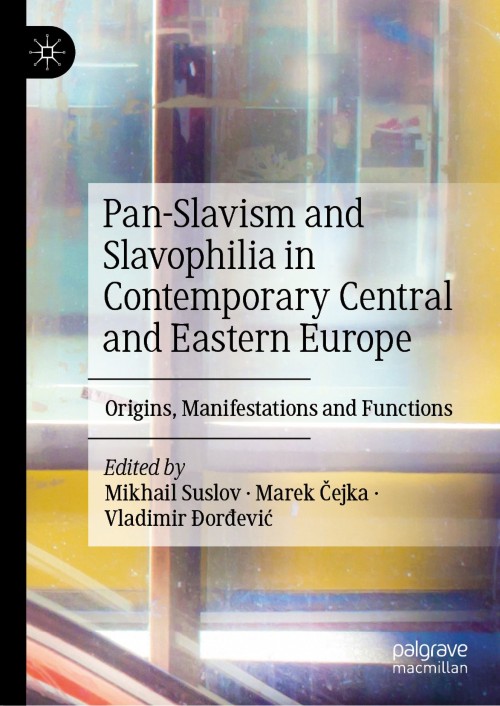
Pan-Slavism and Slavophilia in Contemporary Central and Eastern Europe [electronic resource] : Origins, Manifestations and Functions / edited by Mikhail Suslov, Marek Čejka, Vladimir Ðorđević.
Erişim Adresi
ISBN
9783031178757
Dil Kodu
İngilizce
Yer Numarası
DK/17041
Basım Bildirimi
1st ed. 2023.
Yayın Bilgisi
Cham : Springer International Publishing : Imprint: Palgrave Macmillan, 2023.
Fiziksel Niteleme
XXVII, 428 p. 19 illus., 17 illus. in color. online resource.
İçindekiler Notu
Chapter 1. Introduction - Examining Pan-Slavism: Conceptual Approach, Methodological Framework, and State of the Art -- Chaper 2. Structure of the Volume -- Section I: Pan-Slavism as History -- Chapter 3. Russian Pan-Slavism: A Historical Perspective -- Chaper 4. A Short History of Pan-Slavism and its Impact on Central Europe in the Nineteenth and Twentieth Centuries -- Chapter 5. Pan-Slavism in the Balkans: A Historical View -- Section II: Pan-Slavism as a (Political) Tool -- Chapter 6. New Wine in an Old Wineskin: Slavophilia and Geopolitical Populism in Putin’s Russia -- Chapter 7. Ideational Travels of Slavophilia in Belarus: From Tsars to Lukashenka -- Chapter 8. On Pan-Slavism, Brotherhood, and Mythology: The Imagery of Contemporary Geopolitical Discourse in Serbia -- Chapter 9. Intermarium or Hyperborea? Pan-Slavism in Poland after 1989 -- Section III: On Pan-Slavism, Identity, and Other Issues -- Chapter 10. A Distant Acquaintance: Reflecting on Croatia’s Relationship with Pan-Slavism -- Chapter 11. On Pan-Slavism(s) and Macedonian National Identity -- Chapter 12. Invented ‘Europeanness’ versus Residual Slavophilism: Ukraine as an Ideological Battlefield -- Section IV: On Pan-Slavism, East vs. West Divide, and Orthodoxy -- Chapter 13. Bulgaria’s Backlash against the Istanbul Convention: Slavophilia as the Historical Frame of Pseudo-Religious Illiberalism -- Chapter 14. Montenegrin Squaring of the Circle: Between Russophilia, Pan-Orthodoxia, and Competing Nationalism -- Chapter 15. Pan-Slavism and Slavophilia in the Czech Republic within the Context of Hybrid Threats -- Chapter 16. Slovakia: Emergence of an Old-New Pseudo-Pan-Slavism in the Context of the Conflict between Russia and Ukraine after 2014 -- Section V: An Ethnographic Look on Pan-Slavism -- Chapter 17. Manifestations of Pan-Slavic Sentiments among South Slavic Diaspora Communities in the United States of America -- Chapter 18. Interethnic Ritual Kinship as Pan-Slavism in Bosnia and Herzegovina. Afterword.
Özet, vb.
This collection is an important contribution in both the historical and contemporary analysis of Pan-Slavism. It places this concept in context of Yugoslavism, as well as Russian appeals to Slavic and Orthodox solidarity and competing European identity. This book will become a standard study on the topic through its comprehensive and systematic approach, covering most Slavic countries and not treating Pan-Slavism as just a type of failed meta nationalism, but as an important idea informing the Slavic world today. - Florian Bieber, Professor of Southeast European History and Politics, University of Graz, Austria The heyday of Pan-Slavism may be long gone, but the idea of the brotherhood of Slavs continues to inspire a range of cultural, civilisational and geopolitical imaginations in Europe. This book is a veritable treasure trove for anyone interested in the curious evolution of thisunderstudied phenomenon and its contemporary ramifications. - Filip Ejdus, Associate Professor, Faculty of Political Science, University of Belgrade, Serbia This book explores origins, manifestations, and functions of Pan-Slavism in contemporary Central and Eastern Europe, arguing that despite the extinction of Pan-Slavism as an articulated Romantic-era geopolitical ideology, a number of related discourses, metaphors, and emotions have spilled over into the mainstream debates and popular imagination. Using the term Slavophilia to capture the range of representations, the volume analyses how geopolitical discourses shape the identity and policies of a community, providing a comparative analysis that covers a range of Slavic countries in order to understand how Pan-Slavism works and resonates across geographic and political contexts. Mikhail Suslov is Assistant Professor in the Department of Cross-Cultural and Regional Studies at the University of Copenhagen, Denmark. Marek Čejka is Associate Professor in the Department of Territorial Studies at Mendel University in Brno, Czech Republic. Đorđević Vladimir is Assistant Professor in the Department of Territorial Studies at Mendel University in Brno, Czech Republic. .
Konu
Europe __ Politics and government.
Russia __ History.
Europe, Eastern __ History.
Soviet Union __ History.
European Politics.
Russian, Soviet, and East European History.
Russia __ History.
Europe, Eastern __ History.
Soviet Union __ History.
European Politics.
Russian, Soviet, and East European History.
Diğer Yazarlar
Kurum Adı
Eseri Alıntıla
Referansları kullanmadan önce gözden geçirmeniz ve varsa gerekli düzeltmeleri yapmanız önerilir.
Dijital Kaynak
MARC Görünümü
LEADER 07497nam a22006495i 4500
001 815822
003 TR_AnAIT
005 20260130204615
007 cr nn 008mamaa
008 230213s2023 sz | s |||| 0|eng d
020 |a9783031178757|9978-3-031-17875-7
024 7 |a10.1007/978-3-031-17875-7|2doi
041 |aeng
049 |aTürk Tarih Kurumu Kütüphanesi
050 4|aJN1-9692.2
072 7|aJP|2bicssc
072 7|a1D|2bicssc
072 7|aPOL058000|2bisacsh
072 7|aJP|x1D|2thema
082 04|a320.94|223
090 |aDK/17041
245 10|aPan-Slavism and Slavophilia in Contemporary Central and Eastern Europe|h[electronic resource] :|bOrigins, Manifestations and Functions /|cedited by Mikhail Suslov, Marek Čejka, Vladimir Ðorđević.
250 |a1st ed. 2023.
264 1|aCham :|bSpringer International Publishing :|bImprint: Palgrave Macmillan,|c2023.
300 |aXXVII, 428 p. 19 illus., 17 illus. in color.|bonline resource.
336 |atext|btxt|2rdacontent
337 |acomputer|bc|2rdamedia
338 |aonline resource|bcr|2rdacarrier
341 0 |bTable of contents navigation|2onix
341 0 |bSingle logical reading order|2onix
341 0 |bShort alternative textual descriptions|2onix
341 0 |bUse of color is not sole means of conveying information|2onix
341 0 |bUse of high contrast between text and background color|2onix
341 0 |bNext / Previous structural navigation|2onix
341 0 |bAll non-decorative content supports reading without sight|2onix
347 |atext file|bPDF|2rda
505 0 |aChapter 1. Introduction - Examining Pan-Slavism: Conceptual Approach, Methodological Framework, and State of the Art -- Chaper 2. Structure of the Volume -- Section I: Pan-Slavism as History -- Chapter 3. Russian Pan-Slavism: A Historical Perspective -- Chaper 4. A Short History of Pan-Slavism and its Impact on Central Europe in the Nineteenth and Twentieth Centuries -- Chapter 5. Pan-Slavism in the Balkans: A Historical View -- Section II: Pan-Slavism as a (Political) Tool -- Chapter 6. New Wine in an Old Wineskin: Slavophilia and Geopolitical Populism in Putin’s Russia -- Chapter 7. Ideational Travels of Slavophilia in Belarus: From Tsars to Lukashenka -- Chapter 8. On Pan-Slavism, Brotherhood, and Mythology: The Imagery of Contemporary Geopolitical Discourse in Serbia -- Chapter 9. Intermarium or Hyperborea? Pan-Slavism in Poland after 1989 -- Section III: On Pan-Slavism, Identity, and Other Issues -- Chapter 10. A Distant Acquaintance: Reflecting on Croatia’s Relationship with Pan-Slavism -- Chapter 11. On Pan-Slavism(s) and Macedonian National Identity -- Chapter 12. Invented ‘Europeanness’ versus Residual Slavophilism: Ukraine as an Ideological Battlefield -- Section IV: On Pan-Slavism, East vs. West Divide, and Orthodoxy -- Chapter 13. Bulgaria’s Backlash against the Istanbul Convention: Slavophilia as the Historical Frame of Pseudo-Religious Illiberalism -- Chapter 14. Montenegrin Squaring of the Circle: Between Russophilia, Pan-Orthodoxia, and Competing Nationalism -- Chapter 15. Pan-Slavism and Slavophilia in the Czech Republic within the Context of Hybrid Threats -- Chapter 16. Slovakia: Emergence of an Old-New Pseudo-Pan-Slavism in the Context of the Conflict between Russia and Ukraine after 2014 -- Section V: An Ethnographic Look on Pan-Slavism -- Chapter 17. Manifestations of Pan-Slavic Sentiments among South Slavic Diaspora Communities in the United States of America -- Chapter 18. Interethnic Ritual Kinship as Pan-Slavism in Bosnia and Herzegovina. Afterword.
520 |aThis collection is an important contribution in both the historical and contemporary analysis of Pan-Slavism. It places this concept in context of Yugoslavism, as well as Russian appeals to Slavic and Orthodox solidarity and competing European identity. This book will become a standard study on the topic through its comprehensive and systematic approach, covering most Slavic countries and not treating Pan-Slavism as just a type of failed meta nationalism, but as an important idea informing the Slavic world today. - Florian Bieber, Professor of Southeast European History and Politics, University of Graz, Austria The heyday of Pan-Slavism may be long gone, but the idea of the brotherhood of Slavs continues to inspire a range of cultural, civilisational and geopolitical imaginations in Europe. This book is a veritable treasure trove for anyone interested in the curious evolution of thisunderstudied phenomenon and its contemporary ramifications. - Filip Ejdus, Associate Professor, Faculty of Political Science, University of Belgrade, Serbia This book explores origins, manifestations, and functions of Pan-Slavism in contemporary Central and Eastern Europe, arguing that despite the extinction of Pan-Slavism as an articulated Romantic-era geopolitical ideology, a number of related discourses, metaphors, and emotions have spilled over into the mainstream debates and popular imagination. Using the term Slavophilia to capture the range of representations, the volume analyses how geopolitical discourses shape the identity and policies of a community, providing a comparative analysis that covers a range of Slavic countries in order to understand how Pan-Slavism works and resonates across geographic and political contexts. Mikhail Suslov is Assistant Professor in the Department of Cross-Cultural and Regional Studies at the University of Copenhagen, Denmark. Marek Čejka is Associate Professor in the Department of Territorial Studies at Mendel University in Brno, Czech Republic. Đorđević Vladimir is Assistant Professor in the Department of Territorial Studies at Mendel University in Brno, Czech Republic. .
532 8 |aAccessibility summary: This PDF does not fully comply with PDF/UA standards, but does feature limited screen reader support, described non-text content (images, graphs), bookmarks for easy navigation and searchable, selectable text. Users of assistive technologies may experience difficulty navigating or interpreting content in this document. We recognize the importance of accessibility, and we welcome queries about accessibility for any of our products. If you have a question or an access need, please get in touch with us at accessibilitysupport@springernature.com.
532 8 |aNo reading system accessibility options actively disabled
532 8 |aPublisher contact for further accessibility information: accessibilitysupport@springernature.com
650 0|aEurope|xPolitics and government.
650 0|aRussia|xHistory.
650 0|aEurope, Eastern|xHistory.
650 0|aSoviet Union|xHistory.
650 14|aEuropean Politics.
650 24|aRussian, Soviet, and East European History.
700 1 |aSuslov, Mikhail.|eeditor.|4edt|4http://id.loc.gov/vocabulary/relators/edt
700 1 |aČejka, Marek.|eeditor.|4edt|4http://id.loc.gov/vocabulary/relators/edt
700 1 |aÐorđević, Vladimir.|eeditor.|4edt|4http://id.loc.gov/vocabulary/relators/edt
710 2 |aSpringerLink (Online service)
773 0 |tSpringer Nature eBook
776 08|iPrinted edition:|z9783031178740
776 08|iPrinted edition:|z9783031178764
776 08|iPrinted edition:|z9783031178771
856 40|uhttps://doi.org/10.1007/978-3-031-17875-7
912 |aZDB-2-POS
912 |aZDB-2-SXPI
950 |aPolitical Science and International Studies (SpringerNature-41174)
950 |aPolitical Science and International Studies (R0) (SpringerNature-43724)
001 815822
003 TR_AnAIT
005 20260130204615
007 cr nn 008mamaa
008 230213s2023 sz | s |||| 0|eng d
020 |a9783031178757|9978-3-031-17875-7
024 7 |a10.1007/978-3-031-17875-7|2doi
041 |aeng
049 |aTürk Tarih Kurumu Kütüphanesi
050 4|aJN1-9692.2
072 7|aJP|2bicssc
072 7|a1D|2bicssc
072 7|aPOL058000|2bisacsh
072 7|aJP|x1D|2thema
082 04|a320.94|223
090 |aDK/17041
245 10|aPan-Slavism and Slavophilia in Contemporary Central and Eastern Europe|h[electronic resource] :|bOrigins, Manifestations and Functions /|cedited by Mikhail Suslov, Marek Čejka, Vladimir Ðorđević.
250 |a1st ed. 2023.
264 1|aCham :|bSpringer International Publishing :|bImprint: Palgrave Macmillan,|c2023.
300 |aXXVII, 428 p. 19 illus., 17 illus. in color.|bonline resource.
336 |atext|btxt|2rdacontent
337 |acomputer|bc|2rdamedia
338 |aonline resource|bcr|2rdacarrier
341 0 |bTable of contents navigation|2onix
341 0 |bSingle logical reading order|2onix
341 0 |bShort alternative textual descriptions|2onix
341 0 |bUse of color is not sole means of conveying information|2onix
341 0 |bUse of high contrast between text and background color|2onix
341 0 |bNext / Previous structural navigation|2onix
341 0 |bAll non-decorative content supports reading without sight|2onix
347 |atext file|bPDF|2rda
505 0 |aChapter 1. Introduction - Examining Pan-Slavism: Conceptual Approach, Methodological Framework, and State of the Art -- Chaper 2. Structure of the Volume -- Section I: Pan-Slavism as History -- Chapter 3. Russian Pan-Slavism: A Historical Perspective -- Chaper 4. A Short History of Pan-Slavism and its Impact on Central Europe in the Nineteenth and Twentieth Centuries -- Chapter 5. Pan-Slavism in the Balkans: A Historical View -- Section II: Pan-Slavism as a (Political) Tool -- Chapter 6. New Wine in an Old Wineskin: Slavophilia and Geopolitical Populism in Putin’s Russia -- Chapter 7. Ideational Travels of Slavophilia in Belarus: From Tsars to Lukashenka -- Chapter 8. On Pan-Slavism, Brotherhood, and Mythology: The Imagery of Contemporary Geopolitical Discourse in Serbia -- Chapter 9. Intermarium or Hyperborea? Pan-Slavism in Poland after 1989 -- Section III: On Pan-Slavism, Identity, and Other Issues -- Chapter 10. A Distant Acquaintance: Reflecting on Croatia’s Relationship with Pan-Slavism -- Chapter 11. On Pan-Slavism(s) and Macedonian National Identity -- Chapter 12. Invented ‘Europeanness’ versus Residual Slavophilism: Ukraine as an Ideological Battlefield -- Section IV: On Pan-Slavism, East vs. West Divide, and Orthodoxy -- Chapter 13. Bulgaria’s Backlash against the Istanbul Convention: Slavophilia as the Historical Frame of Pseudo-Religious Illiberalism -- Chapter 14. Montenegrin Squaring of the Circle: Between Russophilia, Pan-Orthodoxia, and Competing Nationalism -- Chapter 15. Pan-Slavism and Slavophilia in the Czech Republic within the Context of Hybrid Threats -- Chapter 16. Slovakia: Emergence of an Old-New Pseudo-Pan-Slavism in the Context of the Conflict between Russia and Ukraine after 2014 -- Section V: An Ethnographic Look on Pan-Slavism -- Chapter 17. Manifestations of Pan-Slavic Sentiments among South Slavic Diaspora Communities in the United States of America -- Chapter 18. Interethnic Ritual Kinship as Pan-Slavism in Bosnia and Herzegovina. Afterword.
520 |aThis collection is an important contribution in both the historical and contemporary analysis of Pan-Slavism. It places this concept in context of Yugoslavism, as well as Russian appeals to Slavic and Orthodox solidarity and competing European identity. This book will become a standard study on the topic through its comprehensive and systematic approach, covering most Slavic countries and not treating Pan-Slavism as just a type of failed meta nationalism, but as an important idea informing the Slavic world today. - Florian Bieber, Professor of Southeast European History and Politics, University of Graz, Austria The heyday of Pan-Slavism may be long gone, but the idea of the brotherhood of Slavs continues to inspire a range of cultural, civilisational and geopolitical imaginations in Europe. This book is a veritable treasure trove for anyone interested in the curious evolution of thisunderstudied phenomenon and its contemporary ramifications. - Filip Ejdus, Associate Professor, Faculty of Political Science, University of Belgrade, Serbia This book explores origins, manifestations, and functions of Pan-Slavism in contemporary Central and Eastern Europe, arguing that despite the extinction of Pan-Slavism as an articulated Romantic-era geopolitical ideology, a number of related discourses, metaphors, and emotions have spilled over into the mainstream debates and popular imagination. Using the term Slavophilia to capture the range of representations, the volume analyses how geopolitical discourses shape the identity and policies of a community, providing a comparative analysis that covers a range of Slavic countries in order to understand how Pan-Slavism works and resonates across geographic and political contexts. Mikhail Suslov is Assistant Professor in the Department of Cross-Cultural and Regional Studies at the University of Copenhagen, Denmark. Marek Čejka is Associate Professor in the Department of Territorial Studies at Mendel University in Brno, Czech Republic. Đorđević Vladimir is Assistant Professor in the Department of Territorial Studies at Mendel University in Brno, Czech Republic. .
532 8 |aAccessibility summary: This PDF does not fully comply with PDF/UA standards, but does feature limited screen reader support, described non-text content (images, graphs), bookmarks for easy navigation and searchable, selectable text. Users of assistive technologies may experience difficulty navigating or interpreting content in this document. We recognize the importance of accessibility, and we welcome queries about accessibility for any of our products. If you have a question or an access need, please get in touch with us at accessibilitysupport@springernature.com.
532 8 |aNo reading system accessibility options actively disabled
532 8 |aPublisher contact for further accessibility information: accessibilitysupport@springernature.com
650 0|aEurope|xPolitics and government.
650 0|aRussia|xHistory.
650 0|aEurope, Eastern|xHistory.
650 0|aSoviet Union|xHistory.
650 14|aEuropean Politics.
650 24|aRussian, Soviet, and East European History.
700 1 |aSuslov, Mikhail.|eeditor.|4edt|4http://id.loc.gov/vocabulary/relators/edt
700 1 |aČejka, Marek.|eeditor.|4edt|4http://id.loc.gov/vocabulary/relators/edt
700 1 |aÐorđević, Vladimir.|eeditor.|4edt|4http://id.loc.gov/vocabulary/relators/edt
710 2 |aSpringerLink (Online service)
773 0 |tSpringer Nature eBook
776 08|iPrinted edition:|z9783031178740
776 08|iPrinted edition:|z9783031178764
776 08|iPrinted edition:|z9783031178771
856 40|uhttps://doi.org/10.1007/978-3-031-17875-7
912 |aZDB-2-POS
912 |aZDB-2-SXPI
950 |aPolitical Science and International Studies (SpringerNature-41174)
950 |aPolitical Science and International Studies (R0) (SpringerNature-43724)
Materyaller
Depodan talep edilen materyal sadece kütüphane içerisinde kullanılmaktadır.
Materyal dışarıya ödünç verilmemektedir.
Materyal dışarıya ödünç verilmemektedir.
