

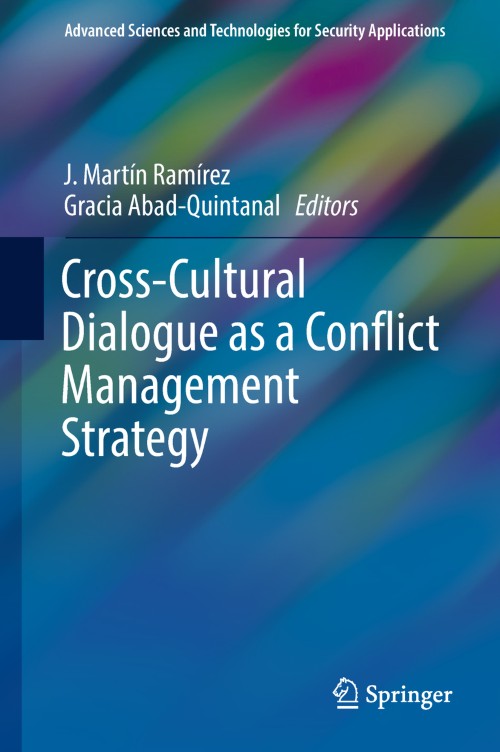
Cross-Cultural Dialogue as a Conflict Management Strategy [electronic resource] / edited by J. Martín Ramírez, Gracia Abad-Quintanal.
Erişim Adresi
ISBN
9783319772318
Dil Kodu
İngilizce
Yer Numarası
DK/17089
Basım Bildirimi
1st ed. 2018.
Yayın Bilgisi
Cham : Springer International Publishing : Imprint: Springer, 2018.
Fiziksel Niteleme
XIV, 154 p. 10 illus., 7 illus. in color. online resource.
Dizi
Advanced Sciences and Technologies for Security Applications, 2363-9466
İçindekiler Notu
First Section: World order and conflict -- The world order and the new geopolitical trends; Major General (r) -- The destiny of nuclear weapons after the ban treaty -- Second Section: Culture, violence and conflict -- Security culture and morale: Determinants of effective operation of uniformed services -- Individual terrorism as a response to the distorted phenomenon of cultural identity -- Languaje diversity as a source of conflict in Hungary. Possible implications of migrations -- Third Section: Cultural differences and conflict management -- The Search for Unity Beneath our Cultural Differences -- What can psychology offer in cross-cultural dialogue: a psychological approach to intercultural competence -- Sensemaking and unknowables in Risk Management -- Aesthetics of Peace: The Role of Art in Conflict Transformation -- Fourth Section: The legal and justice systems and the cross-cultural conflict -- Dangerous offenders with personality disorders: a comparative study of the situation in diverse legal cultures, with special attention to the Spanish Legal System -- Terrorism and violence in Spanish Prisons: a Brief Glimpse into prison environment. Personal Experience and reflections -- Epilogue.
Özet, vb.
This book contributes to the current knowledge and research on conflict and cross-cultural dialogue, emphasizing how respect, tolerance and dialogue may be quite effective tools for bridging the diverse cultures and, consequently, for solving many of the conflicts of today’s world, characterized by a dynamic interchange of populations with very diverse cultural and ethnic backgrounds. For this purpose, we rely on reputed scholars from ten different countries, and from different cultures and fields of expertise, which allows for diverse contributions from a valuable interdisciplinary perspective. The first section of the book deals with the correlation between cultural differences and conflict, while also showing how such conflicts can be prevented and, should they arise, managed and solved. The second section addresses a different, more specific issue: how cultural expression means and tools for cultural communication may lead to conflict whereas theymay help to avoid it as well. Finally, the third section analyzes how legal and justice systems deal with cross-cultural conflicts as well as with situations which may lead to cross-cultural conflicts, thus assessing to which extent such systems contribute to avoid and/or solve such kind of conflicts.
Konu
Peace.
Security, International.
Ethnopsychology.
Culture.
Security systems.
Peace and Conflict Studies.
International Security Studies.
Cross-Cultural Psychology.
Sociology of Culture.
Security Science and Technology.
Security, International.
Ethnopsychology.
Culture.
Security systems.
Peace and Conflict Studies.
International Security Studies.
Cross-Cultural Psychology.
Sociology of Culture.
Security Science and Technology.
Diğer Yazarlar
Kurum Adı
Eseri Alıntıla
Referansları kullanmadan önce gözden geçirmeniz ve varsa gerekli düzeltmeleri yapmanız önerilir.
Dijital Kaynak
MARC Görünümü
LEADER 04711nam a22005775i 4500
001 815870
003 TR_AnAIT
005 20260130204506
007 cr nn 008mamaa
008 180411s2018 sz | s |||| 0|eng d
020 |a9783319772318|9978-3-319-77231-8
024 7 |a10.1007/978-3-319-77231-8|2doi
041 |aeng
049 |aTürk Tarih Kurumu Kütüphanesi
050 4|aJZ5509.2-6300
072 7|aGTJ|2bicssc
072 7|aPOL034000|2bisacsh
072 7|aGTU|2thema
082 04|a327.1|223
090 |aDK/17089
245 10|aCross-Cultural Dialogue as a Conflict Management Strategy|h[electronic resource] /|cedited by J. Martín Ramírez, Gracia Abad-Quintanal.
250 |a1st ed. 2018.
264 1|aCham :|bSpringer International Publishing :|bImprint: Springer,|c2018.
300 |aXIV, 154 p. 10 illus., 7 illus. in color.|bonline resource.
336 |atext|btxt|2rdacontent
337 |acomputer|bc|2rdamedia
338 |aonline resource|bcr|2rdacarrier
347 |atext file|bPDF|2rda
490 1 |aAdvanced Sciences and Technologies for Security Applications,|x2363-9466
505 0 |aFirst Section: World order and conflict -- The world order and the new geopolitical trends; Major General (r) -- The destiny of nuclear weapons after the ban treaty -- Second Section: Culture, violence and conflict -- Security culture and morale: Determinants of effective operation of uniformed services -- Individual terrorism as a response to the distorted phenomenon of cultural identity -- Languaje diversity as a source of conflict in Hungary. Possible implications of migrations -- Third Section: Cultural differences and conflict management -- The Search for Unity Beneath our Cultural Differences -- What can psychology offer in cross-cultural dialogue: a psychological approach to intercultural competence -- Sensemaking and unknowables in Risk Management -- Aesthetics of Peace: The Role of Art in Conflict Transformation -- Fourth Section: The legal and justice systems and the cross-cultural conflict -- Dangerous offenders with personality disorders: a comparative study of the situation in diverse legal cultures, with special attention to the Spanish Legal System -- Terrorism and violence in Spanish Prisons: a Brief Glimpse into prison environment. Personal Experience and reflections -- Epilogue.
520 |aThis book contributes to the current knowledge and research on conflict and cross-cultural dialogue, emphasizing how respect, tolerance and dialogue may be quite effective tools for bridging the diverse cultures and, consequently, for solving many of the conflicts of today’s world, characterized by a dynamic interchange of populations with very diverse cultural and ethnic backgrounds. For this purpose, we rely on reputed scholars from ten different countries, and from different cultures and fields of expertise, which allows for diverse contributions from a valuable interdisciplinary perspective. The first section of the book deals with the correlation between cultural differences and conflict, while also showing how such conflicts can be prevented and, should they arise, managed and solved. The second section addresses a different, more specific issue: how cultural expression means and tools for cultural communication may lead to conflict whereas theymay help to avoid it as well. Finally, the third section analyzes how legal and justice systems deal with cross-cultural conflicts as well as with situations which may lead to cross-cultural conflicts, thus assessing to which extent such systems contribute to avoid and/or solve such kind of conflicts.
650 0|aPeace.
650 0|aSecurity, International.
650 0|aEthnopsychology.
650 0|aCulture.
650 0|aSecurity systems.
650 14|aPeace and Conflict Studies.
650 24|aInternational Security Studies.
650 24|aCross-Cultural Psychology.
650 24|aSociology of Culture.
650 24|aSecurity Science and Technology.
700 1 |aRamírez, J. Martín.|eeditor.|4edt|4http://id.loc.gov/vocabulary/relators/edt
700 1 |aAbad-Quintanal, Gracia.|eeditor.|4edt|4http://id.loc.gov/vocabulary/relators/edt
710 2 |aSpringerLink (Online service)
773 0 |tSpringer Nature eBook
776 08|iPrinted edition:|z9783319772301
776 08|iPrinted edition:|z9783319772325
776 08|iPrinted edition:|z9783030084059
830 0|aAdvanced Sciences and Technologies for Security Applications,|x2363-9466
856 40|uhttps://doi.org/10.1007/978-3-319-77231-8
912 |aZDB-2-POS
912 |aZDB-2-SXPI
950 |aPolitical Science and International Studies (SpringerNature-41174)
950 |aPolitical Science and International Studies (R0) (SpringerNature-43724)
001 815870
003 TR_AnAIT
005 20260130204506
007 cr nn 008mamaa
008 180411s2018 sz | s |||| 0|eng d
020 |a9783319772318|9978-3-319-77231-8
024 7 |a10.1007/978-3-319-77231-8|2doi
041 |aeng
049 |aTürk Tarih Kurumu Kütüphanesi
050 4|aJZ5509.2-6300
072 7|aGTJ|2bicssc
072 7|aPOL034000|2bisacsh
072 7|aGTU|2thema
082 04|a327.1|223
090 |aDK/17089
245 10|aCross-Cultural Dialogue as a Conflict Management Strategy|h[electronic resource] /|cedited by J. Martín Ramírez, Gracia Abad-Quintanal.
250 |a1st ed. 2018.
264 1|aCham :|bSpringer International Publishing :|bImprint: Springer,|c2018.
300 |aXIV, 154 p. 10 illus., 7 illus. in color.|bonline resource.
336 |atext|btxt|2rdacontent
337 |acomputer|bc|2rdamedia
338 |aonline resource|bcr|2rdacarrier
347 |atext file|bPDF|2rda
490 1 |aAdvanced Sciences and Technologies for Security Applications,|x2363-9466
505 0 |aFirst Section: World order and conflict -- The world order and the new geopolitical trends; Major General (r) -- The destiny of nuclear weapons after the ban treaty -- Second Section: Culture, violence and conflict -- Security culture and morale: Determinants of effective operation of uniformed services -- Individual terrorism as a response to the distorted phenomenon of cultural identity -- Languaje diversity as a source of conflict in Hungary. Possible implications of migrations -- Third Section: Cultural differences and conflict management -- The Search for Unity Beneath our Cultural Differences -- What can psychology offer in cross-cultural dialogue: a psychological approach to intercultural competence -- Sensemaking and unknowables in Risk Management -- Aesthetics of Peace: The Role of Art in Conflict Transformation -- Fourth Section: The legal and justice systems and the cross-cultural conflict -- Dangerous offenders with personality disorders: a comparative study of the situation in diverse legal cultures, with special attention to the Spanish Legal System -- Terrorism and violence in Spanish Prisons: a Brief Glimpse into prison environment. Personal Experience and reflections -- Epilogue.
520 |aThis book contributes to the current knowledge and research on conflict and cross-cultural dialogue, emphasizing how respect, tolerance and dialogue may be quite effective tools for bridging the diverse cultures and, consequently, for solving many of the conflicts of today’s world, characterized by a dynamic interchange of populations with very diverse cultural and ethnic backgrounds. For this purpose, we rely on reputed scholars from ten different countries, and from different cultures and fields of expertise, which allows for diverse contributions from a valuable interdisciplinary perspective. The first section of the book deals with the correlation between cultural differences and conflict, while also showing how such conflicts can be prevented and, should they arise, managed and solved. The second section addresses a different, more specific issue: how cultural expression means and tools for cultural communication may lead to conflict whereas theymay help to avoid it as well. Finally, the third section analyzes how legal and justice systems deal with cross-cultural conflicts as well as with situations which may lead to cross-cultural conflicts, thus assessing to which extent such systems contribute to avoid and/or solve such kind of conflicts.
650 0|aPeace.
650 0|aSecurity, International.
650 0|aEthnopsychology.
650 0|aCulture.
650 0|aSecurity systems.
650 14|aPeace and Conflict Studies.
650 24|aInternational Security Studies.
650 24|aCross-Cultural Psychology.
650 24|aSociology of Culture.
650 24|aSecurity Science and Technology.
700 1 |aRamírez, J. Martín.|eeditor.|4edt|4http://id.loc.gov/vocabulary/relators/edt
700 1 |aAbad-Quintanal, Gracia.|eeditor.|4edt|4http://id.loc.gov/vocabulary/relators/edt
710 2 |aSpringerLink (Online service)
773 0 |tSpringer Nature eBook
776 08|iPrinted edition:|z9783319772301
776 08|iPrinted edition:|z9783319772325
776 08|iPrinted edition:|z9783030084059
830 0|aAdvanced Sciences and Technologies for Security Applications,|x2363-9466
856 40|uhttps://doi.org/10.1007/978-3-319-77231-8
912 |aZDB-2-POS
912 |aZDB-2-SXPI
950 |aPolitical Science and International Studies (SpringerNature-41174)
950 |aPolitical Science and International Studies (R0) (SpringerNature-43724)
Materyaller
Depodan talep edilen materyal sadece kütüphane içerisinde kullanılmaktadır.
Materyal dışarıya ödünç verilmemektedir.
Materyal dışarıya ödünç verilmemektedir.
