

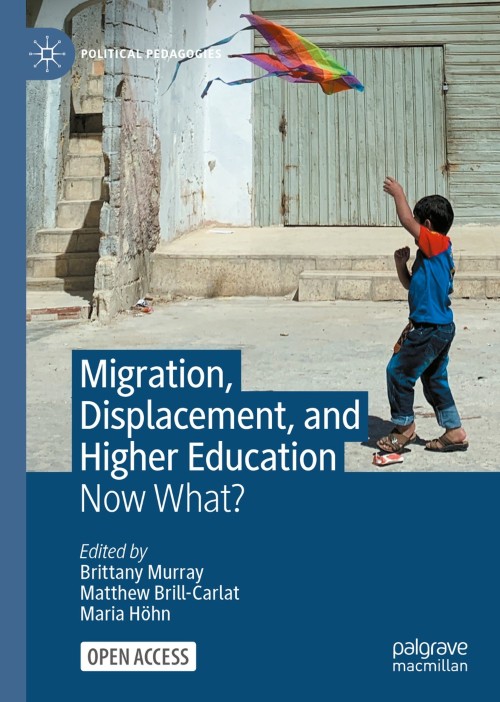
Migration, Displacement, and Higher Education [electronic resource] : Now What? / edited by Brittany Murray, Matthew Brill-Carlat, Maria Höhn.
Erişim Adresi
ISBN
9783031123504
Dil Kodu
İngilizce
Yer Numarası
DK/17137
Basım Bildirimi
1st ed. 2023.
Yayın Bilgisi
Cham : Springer International Publishing : Imprint: Palgrave Macmillan, 2023.
Fiziksel Niteleme
XXVIII, 299 p. 18 illus. online resource.
Dizi
Political Pedagogies, 2662-7817
İçindekiler Notu
1. If Not Now, When? -- 2. A Developing Community of Collaboration in Indiana -- 3. Learning Together: Exploring Visual and Textual Narration with Students Affected by Forced Migration -- 4. Global Cultural Exchange, Women's Leadership, and Advocacy: Connecting the Hudson Valley and the Gaza Strip through WhatsApp -- 5. Refugees and Forced Migration: An Engaged Humanities Course in French and Francophone Studies -- 6. Education Can't Wait for LGBTQ Refugees? Exploring Inclusion and Access to Higher Education in Kakuma Refugee Camp -- 7. Migration, Death, and Disappearance: Education and Engagement in Tuscon, Arizona -- 8. Teaching Undergraduate Forced Migration Studies through a Community-based Law and Policy Clinic during COVID: What are the crises and opportunities? -- 9. Court Interpretation, or Ganas Goes Legit -- 10. Searching for Safety and Researching for Justice: Documenting Migrant Experiences in the Paso del Norte Border Region -- 11. What Can Architectural Education Do? Froma Design-Oriented Approach toward a Research-Oriented Approach and Politically Informed Spatial Practice in the Refugee Context -- 12. The Archaeology of Forced Migration in Greece: A Layered Pedagogy -- 13. Teaching Forced Displacement with Geospatial Technology in Refugee Camps: Lessons from Rwanda and Jordon -- 14. On the Pedagogical Value of Not Going There: Mobility, Fossil Fuel Consumption, and the Production of Refugees -- 15. Teaching Tragedy: Toward a Pedagogy of Accountability - The Every Campus A Refuge Model -- 16. The Power of Participatory and Immersive Filmmaking -- 17. Finding Place: Strengthening Pedagogical Practices on Forced Migration through Interpersonal Understanding in Higher Education -- 18. Climate Change, Human Displacement, and STEM Education: Toward a More Transdisciplinary and Inclusive Culture of Science -- 19. Reading Eveline in Jakarta: Community Learning with Hazara Refugees -- 20. Place-Conscious Education: Teaching Displacement Using Oral Histories in Virtual Reality -- 21. Learning at the Borders: How an Experimental Learning Course in Bern, Switzerland Transformed Undergraduate Learning about Memory, Mental Health and Displacement -- 22. Rebuilding After War and Genocide: Learning with and From Refugees in the Transnational Digital Classroom -- 23. Small Things.
Özet, vb.
This open access book is a nuanced introduction to Forced Migration Studies and a toolkit for faculty and undergraduate students, with a special emphasis on community-engaged learning. Experts from the social sciences, humanities, arts, and experimental sciences offer interdisciplinary perspectives to translate critical analysis into concrete action. The collection highlights activists, artists, and educators who have initiated projects in cooperation with and for the benefit of populations affected by migration and displacement. Together, these contributions powerfully articulate the relevance of the liberal arts and social sciences in preparing students to meet increasingly interconnected global challenges such as forced migration, climate change, and Covid-19. Brittany Murray is Assistant Professor of French at the University of Tennessee, Knoxville, USA, and a former member of the Consortium on Forced Migration, Displacement, and Education’s leadership team at Vassar College. Matthew Brill-Carlat is an immigration paralegal serving unaccompanied children in New York, USA. He is former Coordinator of Research and Pedagogy and member of the leadership team of the Consortium on Forced Migration, Displacement, and Education at Vassar College. Maria Höhn is Professor Emerita of History on the Marion Musser Lloyd ‘32 Chair at Vassar College, New York, USA, where she was Director and Principal Investigator of the Andrew W. Mellon Foundation-funded Consortium on Forced Migration, Displacement, and Education.
Konu
Emigration and immigration.
Emigration and immigration __ Government policy.
Education, Higher.
Human Migration.
Migration Policy.
Higher Education.
Emigration and immigration __ Government policy.
Education, Higher.
Human Migration.
Migration Policy.
Higher Education.
Diğer Yazarlar
Kurum Adı
Eseri Alıntıla
Referansları kullanmadan önce gözden geçirmeniz ve varsa gerekli düzeltmeleri yapmanız önerilir.
Dijital Kaynak
MARC Görünümü
LEADER 07293nam a22007095i 4500
001 815919
003 TR_AnAIT
005 20260130204254
007 cr nn 008mamaa
008 230209s2023 sz | s |||| 0|eng d
020 |a9783031123504|9978-3-031-12350-4
024 7 |a10.1007/978-3-031-12350-4|2doi
041 |aeng
049 |aTürk Tarih Kurumu Kütüphanesi
050 4|aJV6001-9480
050 4|aHB1951-2577
072 7|aJFFN|2bicssc
072 7|aSOC007000|2bisacsh
072 7|aJBFH|2thema
072 7|aRGCG|2thema
082 04|a304.8|223
090 |aDK/17137
245 10|aMigration, Displacement, and Higher Education|h[electronic resource] :|bNow What? /|cedited by Brittany Murray, Matthew Brill-Carlat, Maria Höhn.
250 |a1st ed. 2023.
264 1|aCham :|bSpringer International Publishing :|bImprint: Palgrave Macmillan,|c2023.
300 |aXXVIII, 299 p. 18 illus.|bonline resource.
336 |atext|btxt|2rdacontent
337 |acomputer|bc|2rdamedia
338 |aonline resource|bcr|2rdacarrier
341 0 |bTable of contents navigation|2onix
341 0 |bSingle logical reading order|2onix
341 0 |bShort alternative textual descriptions|2onix
341 0 |bUse of color is not sole means of conveying information|2onix
341 0 |bUse of high contrast between text and background color|2onix
341 0 |bNext / Previous structural navigation|2onix
341 0 |bAll non-decorative content supports reading without sight|2onix
347 |atext file|bPDF|2rda
490 1 |aPolitical Pedagogies,|x2662-7817
505 0 |a1. If Not Now, When? -- 2. A Developing Community of Collaboration in Indiana -- 3. Learning Together: Exploring Visual and Textual Narration with Students Affected by Forced Migration -- 4. Global Cultural Exchange, Women's Leadership, and Advocacy: Connecting the Hudson Valley and the Gaza Strip through WhatsApp -- 5. Refugees and Forced Migration: An Engaged Humanities Course in French and Francophone Studies -- 6. Education Can't Wait for LGBTQ Refugees? Exploring Inclusion and Access to Higher Education in Kakuma Refugee Camp -- 7. Migration, Death, and Disappearance: Education and Engagement in Tuscon, Arizona -- 8. Teaching Undergraduate Forced Migration Studies through a Community-based Law and Policy Clinic during COVID: What are the crises and opportunities? -- 9. Court Interpretation, or Ganas Goes Legit -- 10. Searching for Safety and Researching for Justice: Documenting Migrant Experiences in the Paso del Norte Border Region -- 11. What Can Architectural Education Do? Froma Design-Oriented Approach toward a Research-Oriented Approach and Politically Informed Spatial Practice in the Refugee Context -- 12. The Archaeology of Forced Migration in Greece: A Layered Pedagogy -- 13. Teaching Forced Displacement with Geospatial Technology in Refugee Camps: Lessons from Rwanda and Jordon -- 14. On the Pedagogical Value of Not Going There: Mobility, Fossil Fuel Consumption, and the Production of Refugees -- 15. Teaching Tragedy: Toward a Pedagogy of Accountability - The Every Campus A Refuge Model -- 16. The Power of Participatory and Immersive Filmmaking -- 17. Finding Place: Strengthening Pedagogical Practices on Forced Migration through Interpersonal Understanding in Higher Education -- 18. Climate Change, Human Displacement, and STEM Education: Toward a More Transdisciplinary and Inclusive Culture of Science -- 19. Reading Eveline in Jakarta: Community Learning with Hazara Refugees -- 20. Place-Conscious Education: Teaching Displacement Using Oral Histories in Virtual Reality -- 21. Learning at the Borders: How an Experimental Learning Course in Bern, Switzerland Transformed Undergraduate Learning about Memory, Mental Health and Displacement -- 22. Rebuilding After War and Genocide: Learning with and From Refugees in the Transnational Digital Classroom -- 23. Small Things.
506 0 |aOpen Access
520 |aThis open access book is a nuanced introduction to Forced Migration Studies and a toolkit for faculty and undergraduate students, with a special emphasis on community-engaged learning. Experts from the social sciences, humanities, arts, and experimental sciences offer interdisciplinary perspectives to translate critical analysis into concrete action. The collection highlights activists, artists, and educators who have initiated projects in cooperation with and for the benefit of populations affected by migration and displacement. Together, these contributions powerfully articulate the relevance of the liberal arts and social sciences in preparing students to meet increasingly interconnected global challenges such as forced migration, climate change, and Covid-19. Brittany Murray is Assistant Professor of French at the University of Tennessee, Knoxville, USA, and a former member of the Consortium on Forced Migration, Displacement, and Education’s leadership team at Vassar College. Matthew Brill-Carlat is an immigration paralegal serving unaccompanied children in New York, USA. He is former Coordinator of Research and Pedagogy and member of the leadership team of the Consortium on Forced Migration, Displacement, and Education at Vassar College. Maria Höhn is Professor Emerita of History on the Marion Musser Lloyd ‘32 Chair at Vassar College, New York, USA, where she was Director and Principal Investigator of the Andrew W. Mellon Foundation-funded Consortium on Forced Migration, Displacement, and Education.
532 8 |aAccessibility summary: This PDF does not fully comply with PDF/UA standards, but does feature limited screen reader support, described non-text content (images, graphs), bookmarks for easy navigation and searchable, selectable text. Users of assistive technologies may experience difficulty navigating or interpreting content in this document. We recognize the importance of accessibility, and we welcome queries about accessibility for any of our products. If you have a question or an access need, please get in touch with us at accessibilitysupport@springernature.com.
532 8 |aNo reading system accessibility options actively disabled
532 8 |aPublisher contact for further accessibility information: accessibilitysupport@springernature.com
650 0|aEmigration and immigration.
650 0|aEmigration and immigration|xGovernment policy.
650 0|aEducation, Higher.
650 14|aHuman Migration.
650 24|aMigration Policy.
650 24|aHigher Education.
700 1 |aMurray, Brittany.|eeditor.|4edt|4http://id.loc.gov/vocabulary/relators/edt
700 1 |aBrill-Carlat, Matthew.|eeditor.|4edt|4http://id.loc.gov/vocabulary/relators/edt
700 1 |aHöhn, Maria.|eeditor.|4edt|4http://id.loc.gov/vocabulary/relators/edt
710 2 |aSpringerLink (Online service)
773 0 |tSpringer Nature eBook
776 08|iPrinted edition:|z9783031123498
776 08|iPrinted edition:|z9783031123511
776 08|iPrinted edition:|z9783031123528
830 0|aPolitical Pedagogies,|x2662-7817
856 40|uhttps://doi.org/10.1007/978-3-031-12350-4
912 |aZDB-2-POS
912 |aZDB-2-SXPI
912 |aZDB-2-SOB
950 |aPolitical Science and International Studies (SpringerNature-41174)
950 |aPolitical Science and International Studies (R0) (SpringerNature-43724)
001 815919
003 TR_AnAIT
005 20260130204254
007 cr nn 008mamaa
008 230209s2023 sz | s |||| 0|eng d
020 |a9783031123504|9978-3-031-12350-4
024 7 |a10.1007/978-3-031-12350-4|2doi
041 |aeng
049 |aTürk Tarih Kurumu Kütüphanesi
050 4|aJV6001-9480
050 4|aHB1951-2577
072 7|aJFFN|2bicssc
072 7|aSOC007000|2bisacsh
072 7|aJBFH|2thema
072 7|aRGCG|2thema
082 04|a304.8|223
090 |aDK/17137
245 10|aMigration, Displacement, and Higher Education|h[electronic resource] :|bNow What? /|cedited by Brittany Murray, Matthew Brill-Carlat, Maria Höhn.
250 |a1st ed. 2023.
264 1|aCham :|bSpringer International Publishing :|bImprint: Palgrave Macmillan,|c2023.
300 |aXXVIII, 299 p. 18 illus.|bonline resource.
336 |atext|btxt|2rdacontent
337 |acomputer|bc|2rdamedia
338 |aonline resource|bcr|2rdacarrier
341 0 |bTable of contents navigation|2onix
341 0 |bSingle logical reading order|2onix
341 0 |bShort alternative textual descriptions|2onix
341 0 |bUse of color is not sole means of conveying information|2onix
341 0 |bUse of high contrast between text and background color|2onix
341 0 |bNext / Previous structural navigation|2onix
341 0 |bAll non-decorative content supports reading without sight|2onix
347 |atext file|bPDF|2rda
490 1 |aPolitical Pedagogies,|x2662-7817
505 0 |a1. If Not Now, When? -- 2. A Developing Community of Collaboration in Indiana -- 3. Learning Together: Exploring Visual and Textual Narration with Students Affected by Forced Migration -- 4. Global Cultural Exchange, Women's Leadership, and Advocacy: Connecting the Hudson Valley and the Gaza Strip through WhatsApp -- 5. Refugees and Forced Migration: An Engaged Humanities Course in French and Francophone Studies -- 6. Education Can't Wait for LGBTQ Refugees? Exploring Inclusion and Access to Higher Education in Kakuma Refugee Camp -- 7. Migration, Death, and Disappearance: Education and Engagement in Tuscon, Arizona -- 8. Teaching Undergraduate Forced Migration Studies through a Community-based Law and Policy Clinic during COVID: What are the crises and opportunities? -- 9. Court Interpretation, or Ganas Goes Legit -- 10. Searching for Safety and Researching for Justice: Documenting Migrant Experiences in the Paso del Norte Border Region -- 11. What Can Architectural Education Do? Froma Design-Oriented Approach toward a Research-Oriented Approach and Politically Informed Spatial Practice in the Refugee Context -- 12. The Archaeology of Forced Migration in Greece: A Layered Pedagogy -- 13. Teaching Forced Displacement with Geospatial Technology in Refugee Camps: Lessons from Rwanda and Jordon -- 14. On the Pedagogical Value of Not Going There: Mobility, Fossil Fuel Consumption, and the Production of Refugees -- 15. Teaching Tragedy: Toward a Pedagogy of Accountability - The Every Campus A Refuge Model -- 16. The Power of Participatory and Immersive Filmmaking -- 17. Finding Place: Strengthening Pedagogical Practices on Forced Migration through Interpersonal Understanding in Higher Education -- 18. Climate Change, Human Displacement, and STEM Education: Toward a More Transdisciplinary and Inclusive Culture of Science -- 19. Reading Eveline in Jakarta: Community Learning with Hazara Refugees -- 20. Place-Conscious Education: Teaching Displacement Using Oral Histories in Virtual Reality -- 21. Learning at the Borders: How an Experimental Learning Course in Bern, Switzerland Transformed Undergraduate Learning about Memory, Mental Health and Displacement -- 22. Rebuilding After War and Genocide: Learning with and From Refugees in the Transnational Digital Classroom -- 23. Small Things.
506 0 |aOpen Access
520 |aThis open access book is a nuanced introduction to Forced Migration Studies and a toolkit for faculty and undergraduate students, with a special emphasis on community-engaged learning. Experts from the social sciences, humanities, arts, and experimental sciences offer interdisciplinary perspectives to translate critical analysis into concrete action. The collection highlights activists, artists, and educators who have initiated projects in cooperation with and for the benefit of populations affected by migration and displacement. Together, these contributions powerfully articulate the relevance of the liberal arts and social sciences in preparing students to meet increasingly interconnected global challenges such as forced migration, climate change, and Covid-19. Brittany Murray is Assistant Professor of French at the University of Tennessee, Knoxville, USA, and a former member of the Consortium on Forced Migration, Displacement, and Education’s leadership team at Vassar College. Matthew Brill-Carlat is an immigration paralegal serving unaccompanied children in New York, USA. He is former Coordinator of Research and Pedagogy and member of the leadership team of the Consortium on Forced Migration, Displacement, and Education at Vassar College. Maria Höhn is Professor Emerita of History on the Marion Musser Lloyd ‘32 Chair at Vassar College, New York, USA, where she was Director and Principal Investigator of the Andrew W. Mellon Foundation-funded Consortium on Forced Migration, Displacement, and Education.
532 8 |aAccessibility summary: This PDF does not fully comply with PDF/UA standards, but does feature limited screen reader support, described non-text content (images, graphs), bookmarks for easy navigation and searchable, selectable text. Users of assistive technologies may experience difficulty navigating or interpreting content in this document. We recognize the importance of accessibility, and we welcome queries about accessibility for any of our products. If you have a question or an access need, please get in touch with us at accessibilitysupport@springernature.com.
532 8 |aNo reading system accessibility options actively disabled
532 8 |aPublisher contact for further accessibility information: accessibilitysupport@springernature.com
650 0|aEmigration and immigration.
650 0|aEmigration and immigration|xGovernment policy.
650 0|aEducation, Higher.
650 14|aHuman Migration.
650 24|aMigration Policy.
650 24|aHigher Education.
700 1 |aMurray, Brittany.|eeditor.|4edt|4http://id.loc.gov/vocabulary/relators/edt
700 1 |aBrill-Carlat, Matthew.|eeditor.|4edt|4http://id.loc.gov/vocabulary/relators/edt
700 1 |aHöhn, Maria.|eeditor.|4edt|4http://id.loc.gov/vocabulary/relators/edt
710 2 |aSpringerLink (Online service)
773 0 |tSpringer Nature eBook
776 08|iPrinted edition:|z9783031123498
776 08|iPrinted edition:|z9783031123511
776 08|iPrinted edition:|z9783031123528
830 0|aPolitical Pedagogies,|x2662-7817
856 40|uhttps://doi.org/10.1007/978-3-031-12350-4
912 |aZDB-2-POS
912 |aZDB-2-SXPI
912 |aZDB-2-SOB
950 |aPolitical Science and International Studies (SpringerNature-41174)
950 |aPolitical Science and International Studies (R0) (SpringerNature-43724)
Materyaller
Depodan talep edilen materyal sadece kütüphane içerisinde kullanılmaktadır.
Materyal dışarıya ödünç verilmemektedir.
Materyal dışarıya ödünç verilmemektedir.
