LEADER 04202nam a22004935i 4500
001 816009
003 TR_AnAIT
005 20260130203610
007 cr nn 008mamaa
008 210824s2021 sz | s |||| 0|eng d
020 |a9783030301750|9978-3-030-30175-0
024 7 |a10.1007/978-3-030-30175-0|2doi
041 |aeng
049 |aTürk Tarih Kurumu Kütüphanesi
050 4|aJZ2-6530
072 7|aJPS|2bicssc
072 7|aPOL028000|2bisacsh
072 7|aJPS|2thema
082 04|a327.1|223
090 |aDK/17227
100 1 |aClarke, Michael.|eauthor.|4aut|4http://id.loc.gov/vocabulary/relators/aut
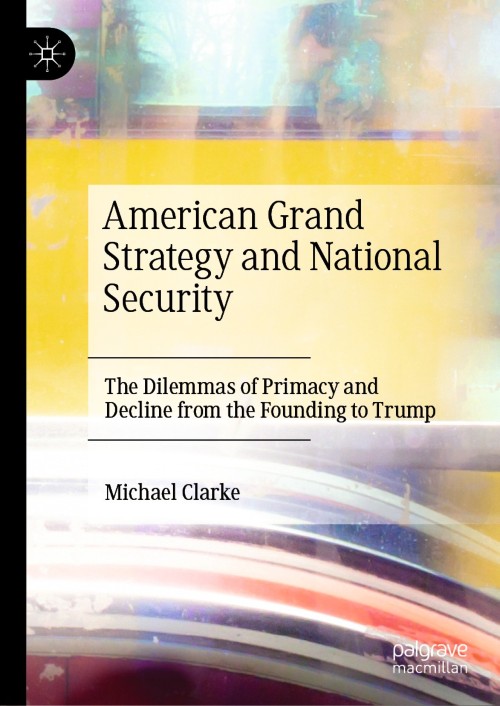
245 10|aAmerican Grand Strategy and National Security|h[electronic resource] :|bThe Dilemmas of Primacy and Decline from the Founding to Trump /|cby Michael Clarke.
250 |a1st ed. 2021.
264 1|aCham :|bSpringer International Publishing :|bImprint: Palgrave Macmillan,|c2021.
300 |aXII, 570 p. 1 illus.|bonline resource.
336 |atext|btxt|2rdacontent
337 |acomputer|bc|2rdamedia
338 |aonline resource|bcr|2rdacarrier
347 |atext file|bPDF|2rda
505 0 |a1. American Grand Strategy and National Security -- 2. Before Primacy: American Grand Strategy from the Founding to “Manifest Destiny” -- 3. Priming for Primacy: Building an” Empire of Principles” in the Progressive Era -- 4.Primacy Deferred: American Grand Strategy from Wilson to FDR -- 5. Primed for Primacy: American Grand Strategy and National Security during the Cold War -- 6. Primacy in the Service of (Inter)national Security: The Promises and Pitfalls of the Unipolar Moment -- 7. Primacy Constrained: Barack Obama and the Perils of Grand Strategic Under-reach -- 8. Power without Primacy: Donald Trump and the Future of American Grand Strategy.
520 |aThis book explains the grand strategic behavior of the United States from the Founding of the Republic to the Trump administration. To do so, it employs a neoclassical realist framework to argue that, while systemic change explains the broad evolution of US grand strategy, the precise shape and content of the grand strategies pursued has been conditioned by domestic political culture and interests. The book argues that distinct political cultures of statecraft (Hamiltonian, Jeffersonian, Jacksonian, and Wilsonian) have acted as permissive filters through which policy-makers have interpreted and responded to systemic stimuli, making some grand strategy choices more likely than others in the pursuit of national security. In particular, this book demonstrates that the American pursuit of primacy was facilitated by the predominance from the mid-19th century onward of the extroverted and vindicationist Hamiltonian and Wilsonian forms of statecraft, which reached a peak of influence at the end of the Cold War. The grand strategic overreach of the George W. Bush administration, however, stimulated the resurgence of the long dormant, introverted, and exemplarist Jeffersonian and Jacksonian forms of statecraft under the Obama and Trump administrations, respectively resulting in grand strategies of “decline management” and decline "denial." Ultimately, the return of exemplarist sentiment suggests a breakdown in elite consensus about the nature and purpose of American power in the 21st century. Dr. Michael Clarke is Senior Fellow at the Centre for Defence Research, Australian Defence College, and Visiting Fellow at the Australia-China Relations Institute, University of Technology Sydney, Australia.
650 0|aInternational relations.
650 0|aAmerica|xPolitics and government.
650 0|aSecurity, International.
650 14|aForeign Policy.
650 24|aAmerican Politics.
650 24|aInternational Security Studies.
710 2 |aSpringerLink (Online service)
773 0 |tSpringer Nature eBook
776 08|iPrinted edition:|z9783030301743
776 08|iPrinted edition:|z9783030301767
776 08|iPrinted edition:|z9783030301774
856 40|uhttps://doi.org/10.1007/978-3-030-30175-0
912 |aZDB-2-POS
912 |aZDB-2-SXPI
950 |aPolitical Science and International Studies (SpringerNature-41174)
950 |aPolitical Science and International Studies (R0) (SpringerNature-43724)