

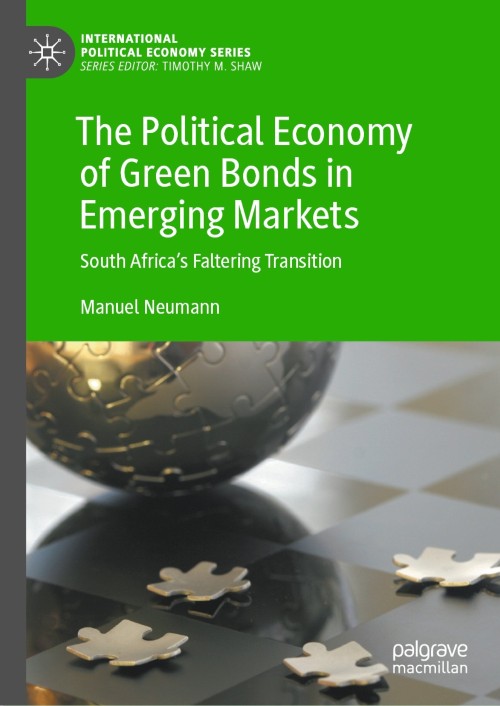
The Political Economy of Green Bonds in Emerging Markets [electronic resource] : South Africa's Faltering Transition / by Manuel Neumann.
Erişim Adresi
ISBN
9783031305023
Dil Kodu
İngilizce
Yer Numarası
DK/17239
Yazar
Basım Bildirimi
1st ed. 2023.
Yayın Bilgisi
Cham : Springer Nature Switzerland : Imprint: Palgrave Macmillan, 2023.
Fiziksel Niteleme
XVII, 281 p. 6 illus., 5 illus. in color. online resource.
Dizi
International Political Economy Series, 2662-2491
İçindekiler Notu
Ch 1: Introduction -- Ch 2: What do we already know about green bonds? A literature review -- Ch 3: Towards new approaches of understanding the greening of capital markets -- Ch 4: The political economy of greening South Africa’s capital markets -- Ch 5: A stalling green bond take-off -- Ch 6: Emerging capital market responses to climate change. Lessons beyond South Africa -- Ch 7: Conclusion.
Özet, vb.
“This book is a must read to understand the pitfalls of relying solely on financial innovation to solve the climate crisis.” (Matthew Paterson, University of Manchester) “…an emphatic call for rethinking finance to advance a just energy transition” Mzukisi Qobo, Wits University) "A truly enlightening and empirically rich account of a green bond market that wasn't...." (Daniel Mertens, University Osnabrück) “…required reading for scholars of just transitions in the Global South.” (Daniela Gabor, UWE Bristol) Funding low-carbon transitions to address climate change is one of the major challenges of our time. Green bonds have emerged as a powerful tool to enlist institutional investors’ wealth for these transitions. But despite exponential growth in many parts of the world, the green bond market in South Africa has been stalling. This book grapples with this puzzle: It debunks some of the promises underpinning green bond markets globally and traces the manifold practices undergirding its promotion. It then identifies some barriers prohibiting the expansion of green bonds in emerging markets and zooms in on the depoliticizing tendencies a transition premised on financial innovation produces. In the last part, this work discloses the idiosyncratic political economic challenges of a fossil-based economy in transition and shines a light on the competing elements of a ‘green’ and a ‘just’ transition. In so doing, this book contributes important new qualitative insights into green bond markets-in-the-making and extends political economic scholarship on finance-led transition endeavors in emerging economies. Chapters 3 and 6 is available open access under a Creative Commons Attribution 4.0 International License via link.springer.com. Manuel Neumann is a Senior Policy Officer at the German Federal Ministry for Economic Cooperation and Development. He did his PhD at Kassel University and wasa visiting scholar at Wits University in Johannesburg in 2018 and 2019. Beforehand, he worked in the development context in Geneva and Kathmandu and studied in London (M.Sc.), New Delhi, and Tübingen (B.Sc.). His research revolves around green financial innovation and the political economy of energy transitions in the global South.
Konu
International economic relations.
Finance.
International Political Economy’.
Financial Economics.
Finance.
International Political Economy’.
Financial Economics.
Kurum Adı
Eseri Alıntıla
Referansları kullanmadan önce gözden geçirmeniz ve varsa gerekli düzeltmeleri yapmanız önerilir.
Dijital Kaynak
MARC Görünümü
LEADER 05828nam a22006375i 4500
001 816021
003 TR_AnAIT
005 20260130203535
007 cr nn 008mamaa
008 230517s2023 sz | s |||| 0|eng d
020 |a9783031305023|9978-3-031-30502-3
024 7 |a10.1007/978-3-031-30502-3|2doi
041 |aeng
049 |aTürk Tarih Kurumu Kütüphanesi
050 4|aJZ1252
072 7|aJPS|2bicssc
072 7|aKCP|2bicssc
072 7|aPOL011020|2bisacsh
072 7|aJPS|2thema
072 7|aKCP|2thema
082 04|a327.111|223
090 |aDK/17239
100 1 |aNeumann, Manuel.|eauthor.|4aut|4http://id.loc.gov/vocabulary/relators/aut
245 14|aThe Political Economy of Green Bonds in Emerging Markets|h[electronic resource] :|bSouth Africa's Faltering Transition /|cby Manuel Neumann.
250 |a1st ed. 2023.
264 1|aCham :|bSpringer Nature Switzerland :|bImprint: Palgrave Macmillan,|c2023.
300 |aXVII, 281 p. 6 illus., 5 illus. in color.|bonline resource.
336 |atext|btxt|2rdacontent
337 |acomputer|bc|2rdamedia
338 |aonline resource|bcr|2rdacarrier
341 0 |bTable of contents navigation|2onix
341 0 |bSingle logical reading order|2onix
341 0 |bShort alternative textual descriptions|2onix
341 0 |bUse of color is not sole means of conveying information|2onix
341 0 |bUse of high contrast between text and background color|2onix
341 0 |bNext / Previous structural navigation|2onix
341 0 |bAll non-decorative content supports reading without sight|2onix
347 |atext file|bPDF|2rda
490 1 |aInternational Political Economy Series,|x2662-2491
505 0 |aCh 1: Introduction -- Ch 2: What do we already know about green bonds? A literature review -- Ch 3: Towards new approaches of understanding the greening of capital markets -- Ch 4: The political economy of greening South Africa’s capital markets -- Ch 5: A stalling green bond take-off -- Ch 6: Emerging capital market responses to climate change. Lessons beyond South Africa -- Ch 7: Conclusion.
520 |a“This book is a must read to understand the pitfalls of relying solely on financial innovation to solve the climate crisis.” (Matthew Paterson, University of Manchester) “…an emphatic call for rethinking finance to advance a just energy transition” Mzukisi Qobo, Wits University) "A truly enlightening and empirically rich account of a green bond market that wasn't...." (Daniel Mertens, University Osnabrück) “…required reading for scholars of just transitions in the Global South.” (Daniela Gabor, UWE Bristol) Funding low-carbon transitions to address climate change is one of the major challenges of our time. Green bonds have emerged as a powerful tool to enlist institutional investors’ wealth for these transitions. But despite exponential growth in many parts of the world, the green bond market in South Africa has been stalling. This book grapples with this puzzle: It debunks some of the promises underpinning green bond markets globally and traces the manifold practices undergirding its promotion. It then identifies some barriers prohibiting the expansion of green bonds in emerging markets and zooms in on the depoliticizing tendencies a transition premised on financial innovation produces. In the last part, this work discloses the idiosyncratic political economic challenges of a fossil-based economy in transition and shines a light on the competing elements of a ‘green’ and a ‘just’ transition. In so doing, this book contributes important new qualitative insights into green bond markets-in-the-making and extends political economic scholarship on finance-led transition endeavors in emerging economies. Chapters 3 and 6 is available open access under a Creative Commons Attribution 4.0 International License via link.springer.com. Manuel Neumann is a Senior Policy Officer at the German Federal Ministry for Economic Cooperation and Development. He did his PhD at Kassel University and wasa visiting scholar at Wits University in Johannesburg in 2018 and 2019. Beforehand, he worked in the development context in Geneva and Kathmandu and studied in London (M.Sc.), New Delhi, and Tübingen (B.Sc.). His research revolves around green financial innovation and the political economy of energy transitions in the global South.
532 8 |aAccessibility summary: This PDF does not fully comply with PDF/UA standards, but does feature limited screen reader support, described non-text content (images, graphs), bookmarks for easy navigation and searchable, selectable text. Users of assistive technologies may experience difficulty navigating or interpreting content in this document. We recognize the importance of accessibility, and we welcome queries about accessibility for any of our products. If you have a question or an access need, please get in touch with us at accessibilitysupport@springernature.com.
532 8 |aNo reading system accessibility options actively disabled
532 8 |aPublisher contact for further accessibility information: accessibilitysupport@springernature.com
650 0|aInternational economic relations.
650 0|aFinance.
650 14|aInternational Political Economy’.
650 24|aFinancial Economics.
710 2 |aSpringerLink (Online service)
773 0 |tSpringer Nature eBook
776 08|iPrinted edition:|z9783031305016
776 08|iPrinted edition:|z9783031305030
776 08|iPrinted edition:|z9783031305047
830 0|aInternational Political Economy Series,|x2662-2491
856 40|uhttps://doi.org/10.1007/978-3-031-30502-3
912 |aZDB-2-POS
912 |aZDB-2-SXPI
950 |aPolitical Science and International Studies (SpringerNature-41174)
950 |aPolitical Science and International Studies (R0) (SpringerNature-43724)
Materyaller
Depodan talep edilen materyal sadece kütüphane içerisinde kullanılmaktadır.
Materyal dışarıya ödünç verilmemektedir.
Materyal dışarıya ödünç verilmemektedir.
