

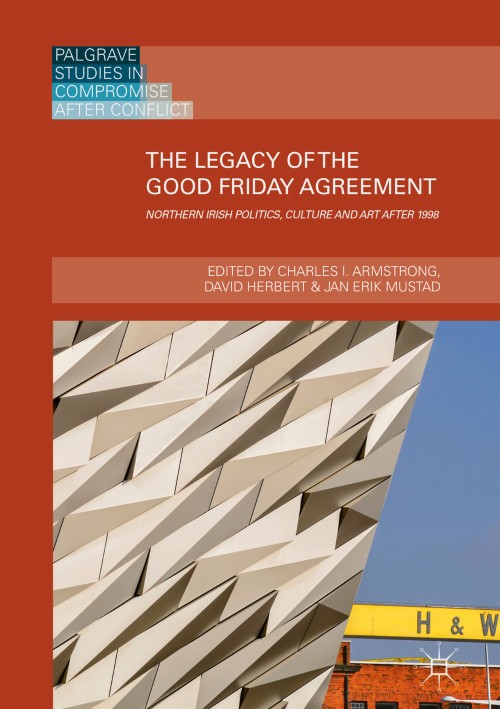
The Legacy of the Good Friday Agreement [electronic resource] : Northern Irish Politics, Culture and Art after 1998 / edited by Charles I. Armstrong, David Herbert, Jan Erik Mustad.
Erişim Adresi
ISBN
9783319912325
Dil Kodu
İngilizce
Yer Numarası
DK/17254
Basım Bildirimi
1st ed. 2019.
Yayın Bilgisi
Cham : Springer International Publishing : Imprint: Palgrave Macmillan, 2019.
Fiziksel Niteleme
XXI, 297 p. 11 illus. in color. online resource.
Dizi
Palgrave Studies in Compromise after Conflict, 2946-2800
İçindekiler Notu
1.Introduction -- 2.Eamonn O’Kane and Paul Dixon, ‘The Northern Irish Peace Process: Political Issues and Controversies’ -- Part I The Will to Change: Key Players and Events -- 3.Paul Dixon, ‘Tony Blair’s Honourable Deception: In Defence of the “Dirty” Politics of the Northern Irish Peace Process’ -- 4.Charles I. Armstrong, ‘”George Mitchell’s Peace”: The Good Friday Agreement in Colum McCann’s Novel TransAtlantic’ -- 5.Jan Erik Mustad, ‘From Protest to Power: The Rise of the DUP’ -- Part II Winners, Losers and Beyond the Zero Sum Game? -- 6.Stefanie Lehner, ‘Troubling Victims: Representing a New Politics of Victimhood in Northern Ireland on Stage and Screen’ -- 7.Neil Jarman, ‘A Bitter Peace: Flag Protests, the Politics of No and Culture Wars’ -- 8.Gladys Ganiel, ‘A Gender Balanced Approach to Transforming Cultures of Militarism in Northern Ireland’ -- 9.Sissel Rosland, ‘Making Hope and History Rhyme? Dealing with Division and the Past in Northern Ireland after the Good Friday Agreement’ -- Part III The Efficacy and Narratives of Culture -- 10.Seán Crosson, ‘The Shore (2011): Examining the Reconciliation Narrative in Post-Troubles Cinema’ -- 11.Margaret Mills Harper, ‘Elementals in Language: Seamus Heaney after the Good Friday Agreement’ -- 12.Anne Karhio, ‘Finished and Under Construction: Visual Representation and Spatial Relations in Post-Ceasefire Northern Irish Poetry’ -- 13.Ruben Moi, ‘Post-Good Friday Positions and Parallaxes in Sinéad Morrissey’s Poetry’ -- PART IV. THE FUTURE OF PEACE -- 14.David Herbert, ‘Legacies of 1998: What Kind of Social Peace Has Developed in Northern Ireland? Social Attitudes, Inequality and Territoriality’ -- 15.John Brewer, ‘The Sociology of the Northern Irish Peace Process’.
Özet, vb.
This book provides a multidisciplinary collection of essays that seek to explore the deeply problematic legacy of post-Agreement Northern Ireland. Thus, the authors of this book look at a number of issues that continue to stymie the development of a robust and sustainable peacebuilding project, including segregation, contested parades and flags, ethnic party mobilization, and memorialization. Towards addressing these contemporary issues, authors are drawn from a range of disciplines, including politics, history, literature, drama, cultural studies, sociology, and social psychology. Charles I. Armstrong is a Professor of British literature at the University of Agder, Norway. David Herbert is Professor of Sociology at Kingston University, UK, and Professor of Religious Studies at the University of Agder, Norway. Jan Erik Mustad is Associate Professor in British Studies in the Department of Foreign Languages at theUniversity of Agder, Norway.
Konu
Peace.
Terrorism.
Political violence.
Europe __ Politics and government.
World politics.
Peace and Conflict Studies.
Terrorism and Political Violence.
European Politics.
Political History.
Terrorism.
Political violence.
Europe __ Politics and government.
World politics.
Peace and Conflict Studies.
Terrorism and Political Violence.
European Politics.
Political History.
Diğer Yazarlar
Kurum Adı
Eseri Alıntıla
Referansları kullanmadan önce gözden geçirmeniz ve varsa gerekli düzeltmeleri yapmanız önerilir.
Dijital Kaynak
MARC Görünümü
LEADER 06282nam a22006975i 4500
001 816036
003 TR_AnAIT
005 20260130203444
007 cr nn 008mamaa
008 180903s2019 sz | s |||| 0|eng d
020 |a9783319912325|9978-3-319-91232-5
024 7 |a10.1007/978-3-319-91232-5|2doi
041 |aeng
049 |aTürk Tarih Kurumu Kütüphanesi
050 4|aJZ5509.2-6300
072 7|aGTJ|2bicssc
072 7|aPOL034000|2bisacsh
072 7|aGTU|2thema
082 04|a327.1|223
090 |aDK/17254
245 14|aThe Legacy of the Good Friday Agreement|h[electronic resource] :|bNorthern Irish Politics, Culture and Art after 1998 /|cedited by Charles I. Armstrong, David Herbert, Jan Erik Mustad.
250 |a1st ed. 2019.
264 1|aCham :|bSpringer International Publishing :|bImprint: Palgrave Macmillan,|c2019.
300 |aXXI, 297 p. 11 illus. in color.|bonline resource.
336 |atext|btxt|2rdacontent
337 |acomputer|bc|2rdamedia
338 |aonline resource|bcr|2rdacarrier
341 0 |bTable of contents navigation|2onix
341 0 |bSingle logical reading order|2onix
341 0 |bShort alternative textual descriptions|2onix
341 0 |bUse of color is not sole means of conveying information|2onix
341 0 |bUse of high contrast between text and background color|2onix
341 0 |bNext / Previous structural navigation|2onix
341 0 |bAll non-decorative content supports reading without sight|2onix
347 |atext file|bPDF|2rda
490 1 |aPalgrave Studies in Compromise after Conflict,|x2946-2800
505 0 |a1.Introduction -- 2.Eamonn O’Kane and Paul Dixon, ‘The Northern Irish Peace Process: Political Issues and Controversies’ -- Part I The Will to Change: Key Players and Events -- 3.Paul Dixon, ‘Tony Blair’s Honourable Deception: In Defence of the “Dirty” Politics of the Northern Irish Peace Process’ -- 4.Charles I. Armstrong, ‘”George Mitchell’s Peace”: The Good Friday Agreement in Colum McCann’s Novel TransAtlantic’ -- 5.Jan Erik Mustad, ‘From Protest to Power: The Rise of the DUP’ -- Part II Winners, Losers and Beyond the Zero Sum Game? -- 6.Stefanie Lehner, ‘Troubling Victims: Representing a New Politics of Victimhood in Northern Ireland on Stage and Screen’ -- 7.Neil Jarman, ‘A Bitter Peace: Flag Protests, the Politics of No and Culture Wars’ -- 8.Gladys Ganiel, ‘A Gender Balanced Approach to Transforming Cultures of Militarism in Northern Ireland’ -- 9.Sissel Rosland, ‘Making Hope and History Rhyme? Dealing with Division and the Past in Northern Ireland after the Good Friday Agreement’ -- Part III The Efficacy and Narratives of Culture -- 10.Seán Crosson, ‘The Shore (2011): Examining the Reconciliation Narrative in Post-Troubles Cinema’ -- 11.Margaret Mills Harper, ‘Elementals in Language: Seamus Heaney after the Good Friday Agreement’ -- 12.Anne Karhio, ‘Finished and Under Construction: Visual Representation and Spatial Relations in Post-Ceasefire Northern Irish Poetry’ -- 13.Ruben Moi, ‘Post-Good Friday Positions and Parallaxes in Sinéad Morrissey’s Poetry’ -- PART IV. THE FUTURE OF PEACE -- 14.David Herbert, ‘Legacies of 1998: What Kind of Social Peace Has Developed in Northern Ireland? Social Attitudes, Inequality and Territoriality’ -- 15.John Brewer, ‘The Sociology of the Northern Irish Peace Process’.
520 |aThis book provides a multidisciplinary collection of essays that seek to explore the deeply problematic legacy of post-Agreement Northern Ireland. Thus, the authors of this book look at a number of issues that continue to stymie the development of a robust and sustainable peacebuilding project, including segregation, contested parades and flags, ethnic party mobilization, and memorialization. Towards addressing these contemporary issues, authors are drawn from a range of disciplines, including politics, history, literature, drama, cultural studies, sociology, and social psychology. Charles I. Armstrong is a Professor of British literature at the University of Agder, Norway. David Herbert is Professor of Sociology at Kingston University, UK, and Professor of Religious Studies at the University of Agder, Norway. Jan Erik Mustad is Associate Professor in British Studies in the Department of Foreign Languages at theUniversity of Agder, Norway.
532 8 |aAccessibility summary: This PDF does not fully comply with PDF/UA standards, but does feature limited screen reader support, described non-text content (images, graphs), bookmarks for easy navigation and searchable, selectable text. Users of assistive technologies may experience difficulty navigating or interpreting content in this document. We recognize the importance of accessibility, and we welcome queries about accessibility for any of our products. If you have a question or an access need, please get in touch with us at accessibilitysupport@springernature.com.
532 8 |aNo reading system accessibility options actively disabled
532 8 |aPublisher contact for further accessibility information: accessibilitysupport@springernature.com
650 0|aPeace.
650 0|aTerrorism.
650 0|aPolitical violence.
650 0|aEurope|xPolitics and government.
650 0|aWorld politics.
650 14|aPeace and Conflict Studies.
650 24|aTerrorism and Political Violence.
650 24|aEuropean Politics.
650 24|aPolitical History.
700 1 |aArmstrong, Charles I.|eeditor.|4edt|4http://id.loc.gov/vocabulary/relators/edt
700 1 |aHerbert, David.|eeditor.|4edt|4http://id.loc.gov/vocabulary/relators/edt
700 1 |aMustad, Jan Erik.|eeditor.|4edt|4http://id.loc.gov/vocabulary/relators/edt
710 2 |aSpringerLink (Online service)
773 0 |tSpringer Nature eBook
776 08|iPrinted edition:|z9783319912318
776 08|iPrinted edition:|z9783319912332
776 08|iPrinted edition:|z9783030082048
830 0|aPalgrave Studies in Compromise after Conflict,|x2946-2800
856 40|uhttps://doi.org/10.1007/978-3-319-91232-5
912 |aZDB-2-POS
912 |aZDB-2-SXPI
950 |aPolitical Science and International Studies (SpringerNature-41174)
950 |aPolitical Science and International Studies (R0) (SpringerNature-43724)
001 816036
003 TR_AnAIT
005 20260130203444
007 cr nn 008mamaa
008 180903s2019 sz | s |||| 0|eng d
020 |a9783319912325|9978-3-319-91232-5
024 7 |a10.1007/978-3-319-91232-5|2doi
041 |aeng
049 |aTürk Tarih Kurumu Kütüphanesi
050 4|aJZ5509.2-6300
072 7|aGTJ|2bicssc
072 7|aPOL034000|2bisacsh
072 7|aGTU|2thema
082 04|a327.1|223
090 |aDK/17254
245 14|aThe Legacy of the Good Friday Agreement|h[electronic resource] :|bNorthern Irish Politics, Culture and Art after 1998 /|cedited by Charles I. Armstrong, David Herbert, Jan Erik Mustad.
250 |a1st ed. 2019.
264 1|aCham :|bSpringer International Publishing :|bImprint: Palgrave Macmillan,|c2019.
300 |aXXI, 297 p. 11 illus. in color.|bonline resource.
336 |atext|btxt|2rdacontent
337 |acomputer|bc|2rdamedia
338 |aonline resource|bcr|2rdacarrier
341 0 |bTable of contents navigation|2onix
341 0 |bSingle logical reading order|2onix
341 0 |bShort alternative textual descriptions|2onix
341 0 |bUse of color is not sole means of conveying information|2onix
341 0 |bUse of high contrast between text and background color|2onix
341 0 |bNext / Previous structural navigation|2onix
341 0 |bAll non-decorative content supports reading without sight|2onix
347 |atext file|bPDF|2rda
490 1 |aPalgrave Studies in Compromise after Conflict,|x2946-2800
505 0 |a1.Introduction -- 2.Eamonn O’Kane and Paul Dixon, ‘The Northern Irish Peace Process: Political Issues and Controversies’ -- Part I The Will to Change: Key Players and Events -- 3.Paul Dixon, ‘Tony Blair’s Honourable Deception: In Defence of the “Dirty” Politics of the Northern Irish Peace Process’ -- 4.Charles I. Armstrong, ‘”George Mitchell’s Peace”: The Good Friday Agreement in Colum McCann’s Novel TransAtlantic’ -- 5.Jan Erik Mustad, ‘From Protest to Power: The Rise of the DUP’ -- Part II Winners, Losers and Beyond the Zero Sum Game? -- 6.Stefanie Lehner, ‘Troubling Victims: Representing a New Politics of Victimhood in Northern Ireland on Stage and Screen’ -- 7.Neil Jarman, ‘A Bitter Peace: Flag Protests, the Politics of No and Culture Wars’ -- 8.Gladys Ganiel, ‘A Gender Balanced Approach to Transforming Cultures of Militarism in Northern Ireland’ -- 9.Sissel Rosland, ‘Making Hope and History Rhyme? Dealing with Division and the Past in Northern Ireland after the Good Friday Agreement’ -- Part III The Efficacy and Narratives of Culture -- 10.Seán Crosson, ‘The Shore (2011): Examining the Reconciliation Narrative in Post-Troubles Cinema’ -- 11.Margaret Mills Harper, ‘Elementals in Language: Seamus Heaney after the Good Friday Agreement’ -- 12.Anne Karhio, ‘Finished and Under Construction: Visual Representation and Spatial Relations in Post-Ceasefire Northern Irish Poetry’ -- 13.Ruben Moi, ‘Post-Good Friday Positions and Parallaxes in Sinéad Morrissey’s Poetry’ -- PART IV. THE FUTURE OF PEACE -- 14.David Herbert, ‘Legacies of 1998: What Kind of Social Peace Has Developed in Northern Ireland? Social Attitudes, Inequality and Territoriality’ -- 15.John Brewer, ‘The Sociology of the Northern Irish Peace Process’.
520 |aThis book provides a multidisciplinary collection of essays that seek to explore the deeply problematic legacy of post-Agreement Northern Ireland. Thus, the authors of this book look at a number of issues that continue to stymie the development of a robust and sustainable peacebuilding project, including segregation, contested parades and flags, ethnic party mobilization, and memorialization. Towards addressing these contemporary issues, authors are drawn from a range of disciplines, including politics, history, literature, drama, cultural studies, sociology, and social psychology. Charles I. Armstrong is a Professor of British literature at the University of Agder, Norway. David Herbert is Professor of Sociology at Kingston University, UK, and Professor of Religious Studies at the University of Agder, Norway. Jan Erik Mustad is Associate Professor in British Studies in the Department of Foreign Languages at theUniversity of Agder, Norway.
532 8 |aAccessibility summary: This PDF does not fully comply with PDF/UA standards, but does feature limited screen reader support, described non-text content (images, graphs), bookmarks for easy navigation and searchable, selectable text. Users of assistive technologies may experience difficulty navigating or interpreting content in this document. We recognize the importance of accessibility, and we welcome queries about accessibility for any of our products. If you have a question or an access need, please get in touch with us at accessibilitysupport@springernature.com.
532 8 |aNo reading system accessibility options actively disabled
532 8 |aPublisher contact for further accessibility information: accessibilitysupport@springernature.com
650 0|aPeace.
650 0|aTerrorism.
650 0|aPolitical violence.
650 0|aEurope|xPolitics and government.
650 0|aWorld politics.
650 14|aPeace and Conflict Studies.
650 24|aTerrorism and Political Violence.
650 24|aEuropean Politics.
650 24|aPolitical History.
700 1 |aArmstrong, Charles I.|eeditor.|4edt|4http://id.loc.gov/vocabulary/relators/edt
700 1 |aHerbert, David.|eeditor.|4edt|4http://id.loc.gov/vocabulary/relators/edt
700 1 |aMustad, Jan Erik.|eeditor.|4edt|4http://id.loc.gov/vocabulary/relators/edt
710 2 |aSpringerLink (Online service)
773 0 |tSpringer Nature eBook
776 08|iPrinted edition:|z9783319912318
776 08|iPrinted edition:|z9783319912332
776 08|iPrinted edition:|z9783030082048
830 0|aPalgrave Studies in Compromise after Conflict,|x2946-2800
856 40|uhttps://doi.org/10.1007/978-3-319-91232-5
912 |aZDB-2-POS
912 |aZDB-2-SXPI
950 |aPolitical Science and International Studies (SpringerNature-41174)
950 |aPolitical Science and International Studies (R0) (SpringerNature-43724)
Materyaller
Depodan talep edilen materyal sadece kütüphane içerisinde kullanılmaktadır.
Materyal dışarıya ödünç verilmemektedir.
Materyal dışarıya ödünç verilmemektedir.
