LEADER 04274nam a22005535i 4500
001 816055
003 TR_AnAIT
005 20260130203312
007 cr nn 008mamaa
008 190525s2019 sz | s |||| 0|eng d
020 |a9783319995526|9978-3-319-99552-6
024 7 |a10.1007/978-3-319-99552-6|2doi
041 |aeng
049 |aTürk Tarih Kurumu Kütüphanesi
050 4|aJK1-9993
050 4|aJL1-3899
072 7|aJP|2bicssc
072 7|a1K|2bicssc
072 7|aPOL040000|2bisacsh
072 7|aJP|x1K|2thema
082 04|a320.9|223
090 |aDK/17273
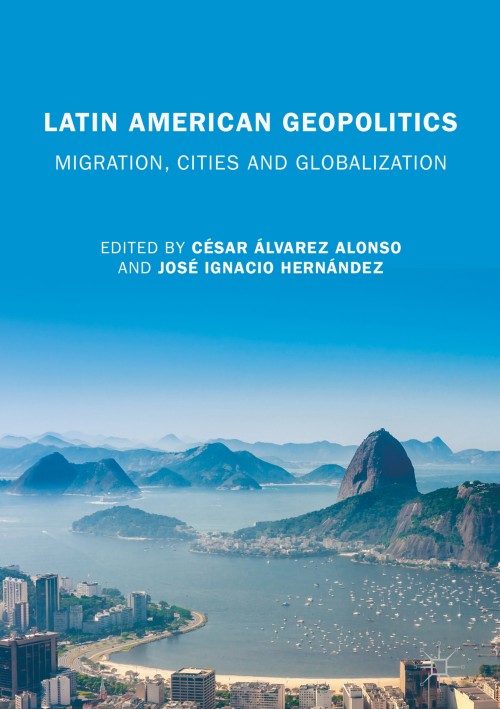
245 10|aLatin American Geopolitics|h[electronic resource] :|bMigration, Cities and Globalization /|cedited by César Álvarez Alonso, José Ignacio Hernández.
250 |a1st ed. 2019.
264 1|aCham :|bSpringer International Publishing :|bImprint: Palgrave Macmillan,|c2019.
300 |aXIX, 267 p. 24 illus.|bonline resource.
336 |atext|btxt|2rdacontent
337 |acomputer|bc|2rdamedia
338 |aonline resource|bcr|2rdacarrier
347 |atext file|bPDF|2rda
505 0 |a1. Introduction -- 2. Mercosur and the Pacific Alliance Convergence in Building a Labor Level Playing Field Across Latin America -- 3. The Movement of People in the Pacific Alliance in Chile -- 4. Preserving Domestic Autonomy: Weak Migration Laws and the Mercosur Strategy of Limited Integration -- 5. Building Territories in Urban Settings: Family Networks of Indigenous Peoples in Argentina’s Hinterland -- 6. Theoretical and Methodological Contributions to Social Mobilization in the Context of Globalization. A Case Study of Mexico 2010-2015 -- 7. The Use of Technologies to Control Irregular Immigrants in Tapachula, Chiapas -- 8. Migrant Agricultural Laborers in Mexico: Transforming the Marginal Consciousness through Education -- 9. Correlation Between Violence and Forced Migration in Mexico -- 10. A Critical Approach in Forestry Cities in the Chilean Case -- 11. Conclusion.
520 |aThis edited volume analyzes globalization, migration, cities and development in Latin American geopolitics. The globalization in Latin America lays out various interrelated social, economic and political networks which challenge local-regional political systems, urban-rural territorial management, transnational mobility, social mobilization patterns, migrants, gender rights, illegal border crossing, urban and transnational violence and crime. Also, globalization and migration are changing Latin America’s own vision as a collective community. The contributors argue that the economic regionalization-globalization promotes changes in the social and economic geography which refer to social phenomena, the dynamic of social classes and their spatial implications, all of which may impact economic growth on the region. Finally, a multidisciplinary perspective is used to highlight the complexity of migration, cities and globalization in Latin America. The project will appeal to a wider audience including political scientists, scholars, researchers, students and non-academics interested in Latin American geopolitics. César Álvarez Alonso is Visiting Researcher at the Institute for Global Law and Policy at Harvard Law School, USA. José Ignacio Hernández is Visiting Researcher at the Center for International Development at Harvard Kennedy School, USA.
650 0|aAmerica|xPolitics and government.
650 0|aPolitical science.
650 0|aComparative government.
650 0|aGlobalization.
650 14|aAmerican Politics.
650 24|aPolitical Science.
650 24|aGovernance and Government.
650 24|aComparative Politics.
650 24|aGlobalization.
700 1 |aAlonso, César Álvarez.|eeditor.|4edt|4http://id.loc.gov/vocabulary/relators/edt
700 1 |aHernández, José Ignacio.|eeditor.|4edt|4http://id.loc.gov/vocabulary/relators/edt
710 2 |aSpringerLink (Online service)
773 0 |tSpringer Nature eBook
776 08|iPrinted edition:|z9783319995519
776 08|iPrinted edition:|z9783319995533
856 40|uhttps://doi.org/10.1007/978-3-319-99552-6
912 |aZDB-2-POS
912 |aZDB-2-SXPI
950 |aPolitical Science and International Studies (SpringerNature-41174)
950 |aPolitical Science and International Studies (R0) (SpringerNature-43724)