

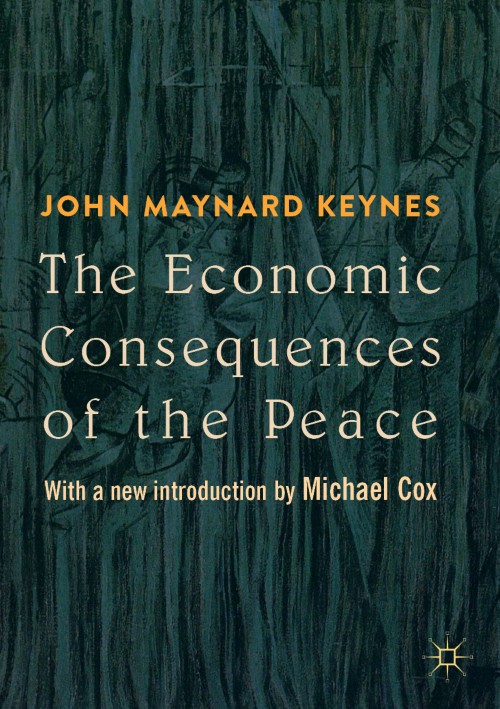
The Economic Consequences of the Peace [electronic resource] : With a new introduction by Michael Cox / by John Maynard Keynes ; edited by Michael Cox.
Erişim Adresi
ISBN
9783030047597
Dil Kodu
İngilizce
Yer Numarası
DK/17290
Yazar
Basım Bildirimi
1st ed. 2019.
Yayın Bilgisi
Cham : Springer International Publishing : Imprint: Palgrave Macmillan, 2019.
Fiziksel Niteleme
XIII, 216 p. online resource.
İçindekiler Notu
1. Introduction by Michael Cox -- 2. Original Preface from John Maynard Keynes -- 3. Chapter I: Introductory -- 4. Chapter II: Europe Before the War -- 5. Chapter III: The Conference -- 6. Chapter IV: The Treaty -- 7. Chapter V: Reparation -- 8. Chapter VI: Europe After the Treaty -- 9. Chapter VII: Remedies.
Özet, vb.
First published in December 1919, this global bestseller attacking those who had made the peace in Paris after the First World War, sparked immediate controversy. It also made John Maynard Keynes famous overnight and soon came to define how people around the world viewed the Versailles Peace Treaty. In Germany the book, which argued against reparations, was greeted with enthusiasm; in France with dismay; and in the US as ammunition that could be (and was) used against Woodrow Wilson in his ultimately unsuccessful bid to sell the League of Nations to an increasingly sceptical American public. Meanwhile in his own country the book provoked outrage amongst establishment critics – Keynes was even refused membership of the prestigious British Academy – while admirers from Winston Churchill to the founders of the LSE, Sidney and Beatrice Webb, went on to praise Keynes for his wisdom and humanity. Keynes may have written what he thought was a reasoned critique of the economics of the peace settlement. In effect, he had penned a political bombshell whose key arguments are still being debated today. The Economic Consequences of the Peace is now reissued by Keynes’ publisher of choice with a new introduction from Michael Cox, one of the major figures in the field of International Relations today. Scholarly yet engaged and readable, Cox’s introduction to the work – written a century after the book first hit the headlines – critically appraises Keynes' polemic contextualising and bringing to life the text for a new generation of scholars and students of IR, IPE, Politics and History. The original text and this authoritative introduction provide essential reading for anyone who wishes to understand the tragedy that was the twentieth century; why making peace with former enemies can be just as hard as winning a war against them; and how and why ideas really do matter. John Maynard Keynes (1883-1946) has justifiably been called the most influential economist of the twentieth century. His behind the scenes account of what went on Paris in 1919 also marked him out as one of the greatest masters of the polemical form in the English language. A renaissance man who was just as much at home in the world of art and ballet as he was discussing probability theory and the history of economic thought, Keynes left an indelible mark on the world through his work as an economist, journalist, sponsor of the arts, and policy-maker in two wars. Michael Cox is Director of LSE IDEAS and Professor Emeritus of International Relations at the London School of Economics. Over a long and distinguished career he has published work on the former USSR, the Cold War, US foreign policy and more recently on the reshaping of world order in the 21st century. His work on E.H.Carr and Carr's The Twenty Years' Crisis has only confirmed his reputation as a scholar of international standing. He is currently working on a history of the London School of Economics entitled: The School: The LSE and the Shaping of the Modern World. .
Konu
Economics __ History.
International relations.
History, Modern.
Peace.
World politics.
International economic relations.
History of Economic Thought and Methodology.
International Relations Theory.
Modern History.
Peace and Conflict Studies.
Political History.
International Political Economy’.
International relations.
History, Modern.
Peace.
World politics.
International economic relations.
History of Economic Thought and Methodology.
International Relations Theory.
Modern History.
Peace and Conflict Studies.
Political History.
International Political Economy’.
Diğer Yazarlar
Kurum Adı
Eseri Alıntıla
Referansları kullanmadan önce gözden geçirmeniz ve varsa gerekli düzeltmeleri yapmanız önerilir.
Dijital Kaynak
MARC Görünümü
LEADER 05449nam a22005655i 4500
001 816072
003 TR_AnAIT
005 20260130203146
007 cr nn 008mamaa
008 191021s2019 sz | s |||| 0|eng d
020 |a9783030047597|9978-3-030-04759-7
024 7 |a10.1007/978-3-030-04759-7|2doi
041 |aeng
049 |aTürk Tarih Kurumu Kütüphanesi
050 4|aHB75-130
072 7|aKCA|2bicssc
072 7|aBUS069030|2bisacsh
072 7|aKCA|2thema
082 04|a330.1509|223
090 |aDK/17290
100 1 |aKeynes, John Maynard.|eauthor.|4aut|4http://id.loc.gov/vocabulary/relators/aut
245 14|aThe Economic Consequences of the Peace|h[electronic resource] :|bWith a new introduction by Michael Cox /|cby John Maynard Keynes ; edited by Michael Cox.
250 |a1st ed. 2019.
264 1|aCham :|bSpringer International Publishing :|bImprint: Palgrave Macmillan,|c2019.
300 |aXIII, 216 p.|bonline resource.
336 |atext|btxt|2rdacontent
337 |acomputer|bc|2rdamedia
338 |aonline resource|bcr|2rdacarrier
347 |atext file|bPDF|2rda
505 0 |a1. Introduction by Michael Cox -- 2. Original Preface from John Maynard Keynes -- 3. Chapter I: Introductory -- 4. Chapter II: Europe Before the War -- 5. Chapter III: The Conference -- 6. Chapter IV: The Treaty -- 7. Chapter V: Reparation -- 8. Chapter VI: Europe After the Treaty -- 9. Chapter VII: Remedies.
520 |aFirst published in December 1919, this global bestseller attacking those who had made the peace in Paris after the First World War, sparked immediate controversy. It also made John Maynard Keynes famous overnight and soon came to define how people around the world viewed the Versailles Peace Treaty. In Germany the book, which argued against reparations, was greeted with enthusiasm; in France with dismay; and in the US as ammunition that could be (and was) used against Woodrow Wilson in his ultimately unsuccessful bid to sell the League of Nations to an increasingly sceptical American public. Meanwhile in his own country the book provoked outrage amongst establishment critics – Keynes was even refused membership of the prestigious British Academy – while admirers from Winston Churchill to the founders of the LSE, Sidney and Beatrice Webb, went on to praise Keynes for his wisdom and humanity. Keynes may have written what he thought was a reasoned critique of the economics of the peace settlement. In effect, he had penned a political bombshell whose key arguments are still being debated today. The Economic Consequences of the Peace is now reissued by Keynes’ publisher of choice with a new introduction from Michael Cox, one of the major figures in the field of International Relations today. Scholarly yet engaged and readable, Cox’s introduction to the work – written a century after the book first hit the headlines – critically appraises Keynes' polemic contextualising and bringing to life the text for a new generation of scholars and students of IR, IPE, Politics and History. The original text and this authoritative introduction provide essential reading for anyone who wishes to understand the tragedy that was the twentieth century; why making peace with former enemies can be just as hard as winning a war against them; and how and why ideas really do matter. John Maynard Keynes (1883-1946) has justifiably been called the most influential economist of the twentieth century. His behind the scenes account of what went on Paris in 1919 also marked him out as one of the greatest masters of the polemical form in the English language. A renaissance man who was just as much at home in the world of art and ballet as he was discussing probability theory and the history of economic thought, Keynes left an indelible mark on the world through his work as an economist, journalist, sponsor of the arts, and policy-maker in two wars. Michael Cox is Director of LSE IDEAS and Professor Emeritus of International Relations at the London School of Economics. Over a long and distinguished career he has published work on the former USSR, the Cold War, US foreign policy and more recently on the reshaping of world order in the 21st century. His work on E.H.Carr and Carr's The Twenty Years' Crisis has only confirmed his reputation as a scholar of international standing. He is currently working on a history of the London School of Economics entitled: The School: The LSE and the Shaping of the Modern World. .
650 0|aEconomics|xHistory.
650 0|aInternational relations.
650 0|aHistory, Modern.
650 0|aPeace.
650 0|aWorld politics.
650 0|aInternational economic relations.
650 14|aHistory of Economic Thought and Methodology.
650 24|aInternational Relations Theory.
650 24|aModern History.
650 24|aPeace and Conflict Studies.
650 24|aPolitical History.
650 24|aInternational Political Economy’.
700 1 |aCox, Michael.|eeditor.|4edt|4http://id.loc.gov/vocabulary/relators/edt
710 2 |aSpringerLink (Online service)
773 0 |tSpringer Nature eBook
776 08|iPrinted edition:|z9783030047580
776 08|iPrinted edition:|z9783030047603
856 40|uhttps://doi.org/10.1007/978-3-030-04759-7
912 |aZDB-2-POS
912 |aZDB-2-SXPI
950 |aPolitical Science and International Studies (SpringerNature-41174)
950 |aPolitical Science and International Studies (R0) (SpringerNature-43724)
001 816072
003 TR_AnAIT
005 20260130203146
007 cr nn 008mamaa
008 191021s2019 sz | s |||| 0|eng d
020 |a9783030047597|9978-3-030-04759-7
024 7 |a10.1007/978-3-030-04759-7|2doi
041 |aeng
049 |aTürk Tarih Kurumu Kütüphanesi
050 4|aHB75-130
072 7|aKCA|2bicssc
072 7|aBUS069030|2bisacsh
072 7|aKCA|2thema
082 04|a330.1509|223
090 |aDK/17290
100 1 |aKeynes, John Maynard.|eauthor.|4aut|4http://id.loc.gov/vocabulary/relators/aut
245 14|aThe Economic Consequences of the Peace|h[electronic resource] :|bWith a new introduction by Michael Cox /|cby John Maynard Keynes ; edited by Michael Cox.
250 |a1st ed. 2019.
264 1|aCham :|bSpringer International Publishing :|bImprint: Palgrave Macmillan,|c2019.
300 |aXIII, 216 p.|bonline resource.
336 |atext|btxt|2rdacontent
337 |acomputer|bc|2rdamedia
338 |aonline resource|bcr|2rdacarrier
347 |atext file|bPDF|2rda
505 0 |a1. Introduction by Michael Cox -- 2. Original Preface from John Maynard Keynes -- 3. Chapter I: Introductory -- 4. Chapter II: Europe Before the War -- 5. Chapter III: The Conference -- 6. Chapter IV: The Treaty -- 7. Chapter V: Reparation -- 8. Chapter VI: Europe After the Treaty -- 9. Chapter VII: Remedies.
520 |aFirst published in December 1919, this global bestseller attacking those who had made the peace in Paris after the First World War, sparked immediate controversy. It also made John Maynard Keynes famous overnight and soon came to define how people around the world viewed the Versailles Peace Treaty. In Germany the book, which argued against reparations, was greeted with enthusiasm; in France with dismay; and in the US as ammunition that could be (and was) used against Woodrow Wilson in his ultimately unsuccessful bid to sell the League of Nations to an increasingly sceptical American public. Meanwhile in his own country the book provoked outrage amongst establishment critics – Keynes was even refused membership of the prestigious British Academy – while admirers from Winston Churchill to the founders of the LSE, Sidney and Beatrice Webb, went on to praise Keynes for his wisdom and humanity. Keynes may have written what he thought was a reasoned critique of the economics of the peace settlement. In effect, he had penned a political bombshell whose key arguments are still being debated today. The Economic Consequences of the Peace is now reissued by Keynes’ publisher of choice with a new introduction from Michael Cox, one of the major figures in the field of International Relations today. Scholarly yet engaged and readable, Cox’s introduction to the work – written a century after the book first hit the headlines – critically appraises Keynes' polemic contextualising and bringing to life the text for a new generation of scholars and students of IR, IPE, Politics and History. The original text and this authoritative introduction provide essential reading for anyone who wishes to understand the tragedy that was the twentieth century; why making peace with former enemies can be just as hard as winning a war against them; and how and why ideas really do matter. John Maynard Keynes (1883-1946) has justifiably been called the most influential economist of the twentieth century. His behind the scenes account of what went on Paris in 1919 also marked him out as one of the greatest masters of the polemical form in the English language. A renaissance man who was just as much at home in the world of art and ballet as he was discussing probability theory and the history of economic thought, Keynes left an indelible mark on the world through his work as an economist, journalist, sponsor of the arts, and policy-maker in two wars. Michael Cox is Director of LSE IDEAS and Professor Emeritus of International Relations at the London School of Economics. Over a long and distinguished career he has published work on the former USSR, the Cold War, US foreign policy and more recently on the reshaping of world order in the 21st century. His work on E.H.Carr and Carr's The Twenty Years' Crisis has only confirmed his reputation as a scholar of international standing. He is currently working on a history of the London School of Economics entitled: The School: The LSE and the Shaping of the Modern World. .
650 0|aEconomics|xHistory.
650 0|aInternational relations.
650 0|aHistory, Modern.
650 0|aPeace.
650 0|aWorld politics.
650 0|aInternational economic relations.
650 14|aHistory of Economic Thought and Methodology.
650 24|aInternational Relations Theory.
650 24|aModern History.
650 24|aPeace and Conflict Studies.
650 24|aPolitical History.
650 24|aInternational Political Economy’.
700 1 |aCox, Michael.|eeditor.|4edt|4http://id.loc.gov/vocabulary/relators/edt
710 2 |aSpringerLink (Online service)
773 0 |tSpringer Nature eBook
776 08|iPrinted edition:|z9783030047580
776 08|iPrinted edition:|z9783030047603
856 40|uhttps://doi.org/10.1007/978-3-030-04759-7
912 |aZDB-2-POS
912 |aZDB-2-SXPI
950 |aPolitical Science and International Studies (SpringerNature-41174)
950 |aPolitical Science and International Studies (R0) (SpringerNature-43724)
Materyaller
Depodan talep edilen materyal sadece kütüphane içerisinde kullanılmaktadır.
Materyal dışarıya ödünç verilmemektedir.
Materyal dışarıya ödünç verilmemektedir.
